

Forced chemistry can weaken the connection an audition is meant to reveal. Knowing how to cast for chemistry between actors means watching how they listen, respond, and make room for each other, rather than simply judging whether they seem instantly close. Pair performers in a scene and notice whether their choices create a believable dynamic without either actor taking over.
It’s easy to mistake big gestures or obvious attraction for a strong connection. But chemistry can also emerge through timing, attentive reactions, shared humor, tension, or quiet trust. The goal isn’t to make actors manufacture a bond. It’s to create a clear, supportive setting where the characters’ relationship can take shape.
This guide explains how to explore that connection through clear communication about emotional beats and physical actions, improvisation, and rehearsal. You’ll learn what to look for in a pairing, how to invite authentic choices, and how to avoid demanding a spark or letting one actor overpower a scene partner.
Key Takeaways
- Discuss the scene’s emotional beats and physical choices so both actors understand the relationship they’re exploring.
- Use improvisation to reveal character dynamics, shared goals, and unexpected moments of connection.
- Rehearse different approaches together, paying attention to how spacing, timing, and listening shape the scene.
- Let chemistry develop through mutual response rather than forced intensity, and leave room for each actor’s choices.
Communicating about emotional beats and physical actions
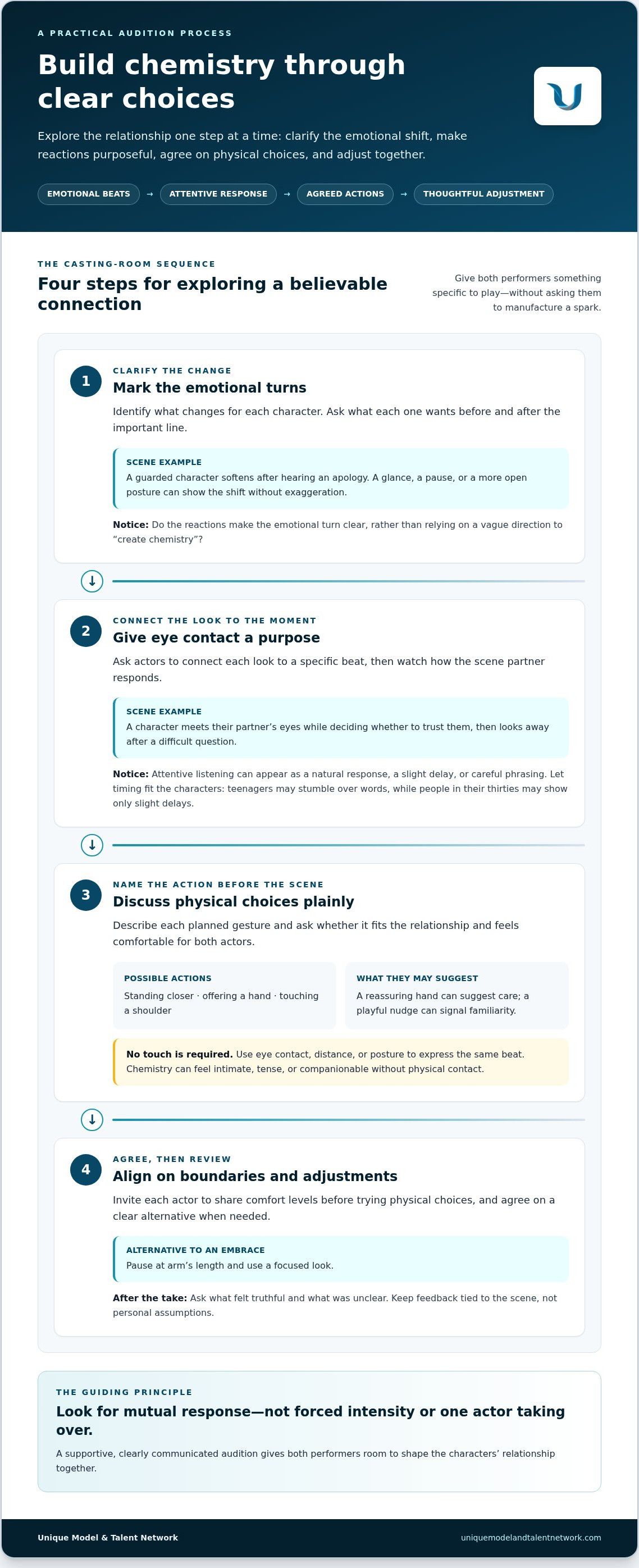
- Mark the emotional turns. Before the audition, identify what changes for each character during the scene. For example, a guarded character might soften after hearing an apology. Ask both actors what their characters want before and after that line. Then watch whether their reactions make the shift clear without exaggerating it. A glance, a pause, or a more open posture can communicate the change. Clear beats give actors something specific to play, rather than a vague instruction to “create chemistry.”
- Give eye contact a purpose. Ask actors to connect each look to a moment in the scene. A character might meet their partner’s eyes while deciding whether to trust them, then look away after a difficult question. Notice whether the partner responds naturally. Attentiveness can also show in a slight delay before answering or careful phrasing. The timing should suit the characters: teenagers may stumble over words, while people in their thirties may show only slight delays.
- Discuss physical actions plainly. Name each planned gesture before the scene, such as standing closer, offering a hand, or touching a shoulder. Ask both actors how the action fits the relationship and whether they feel comfortable performing it. A reassuring hand on the shoulder can suggest care; a playful nudge can signal familiarity. If either actor prefers no touch, use eye contact, distance, or posture to express the same beat. Chemistry can feel intimate, tense, or companionable without physical contact.
- Align on boundaries and adjustments. Invite each actor to share their comfort levels before trying physical choices, then agree on a clear alternative. For example, replace an embrace with a pause at arm’s length and a focused look. After the take, ask what felt truthful and what was unclear. Keep feedback tied to the scene, not personal assumptions. This open exchange builds a shared understanding of the characters and prevents the casting exercise from pressuring anyone into unwanted contact.
Improvisation to explore character dynamics
Casting directors assess chemistry by pairing actors and observing how they listen, respond, and shape a relationship together. Improvised exchanges and scene variations can reveal character dynamics that scripted dialogue alone may not show.
-
Create Shared Character Histories
Give the actors a shared event to improvise, such as getting lost on the way to an important meeting. Ask them to decide what each character remembers, while leaving details open for discovery. Watch whether they build on each other’s ideas instead of competing to control the story. A common history should create playable familiarity, not require matching personalities or identical reactions.
- Set a shared goal, then give the characters different approaches. For example, both want to persuade a neighbor to attend a community event, but one uses humor while the other stays practical. Let the actors improvise the conversation, then notice whether their contrasting choices still connect. Mike Mills invited actors to find overlap between themselves and their characters. This can encourage specific, personal choices without asking performers to imitate each other.
-
Assess Chemistry Through Audition Exercises
Pair actors for a short improvisation, then introduce a new circumstance, such as hiding a surprise from a friend. Notice who accepts a partner’s offer, adapts when plans shift, and makes the relationship legible through behavior. Paul Feig’s casting process brings actors together in different combinations. Testing varied pairings can reveal which performers create an engaging connection, whether romantic, tense, or companionable.
- Change one condition at a time. Ask the pair to replay the same exchange with their characters standing farther apart, pursuing a different tactic, or protecting a secret. Check whether their connection still reads when the initial idea changes. Don’t judge chemistry by volume or instant intimacy alone. Strong improvisation shows in specific responses, shared focus, and a willingness to let a scene partner’s choices affect the scene.
Paul Feig uses rehearsals and improv sessions to explore personalities and relationships, then draws on what the team learns to rewrite the script. Trust helps actors feel safe and supported as they explore organic moments beyond scripted scenes.
Rehearsing and experimenting together
Actors can prepare by identifying each character’s objective and trying different ways to pursue it. For friends or family, test shared ease, familiar habits, and how each actor handles disagreement.
- Set one clear scene objective. Give each actor a specific goal, such as persuading a sibling to stay for dinner. Ask them to play the objective, not a predetermined level of affection. Watch whether their tactics create a recognizable relationship. Friends may tease or interrupt; family members may know how to challenge each other without explaining every detail.
- Rehearse alternate choices. Have the pair repeat a scene with one change, such as a quieter approach or a different response to an interruption. Keep the circumstances consistent so you can compare their choices. Do they adapt to each other, or fall back on fixed line readings? Rehearsing outside class or on set gives scene partners room to explore approaches beyond the first take.
- Leave space for discovery. When the format allows, try a scene without written dialogue, then note which exchanges feel specific to the characters. Drake Doremus developed outline-based scenes without written dialogue, allowing dialogue to emerge during rehearsal. This freedom can help actors find rhythms and reactions that a tightly fixed reading might miss.
- Use rehearsal to refine the material. Track moments that reveal a clearer relationship, then consider whether the scene needs adjustment. During rehearsal for Beginners, Mike Mills added a page of dialogue after Christopher Plummer suggested his character needed to tell his son something. Treat discoveries as useful evidence, not a reason to rewrite every audition scene.
- Observe the pair’s comfort and responsiveness. Notice whether actors can shift their energy while staying engaged with each other. Director Nick Hamm noted that a hot water bottle helped Martin McCann relax and play a scene differently. For friends or relatives, look for easy familiarity and credible friction, rather than assuming closeness means constant warmth.
Avoiding forced chemistry and overpowering a co-star
Strong chemistry is reciprocal, not a contest for attention. Assess how each actor affects the other, while keeping the role requirements central.
-
Schedule Chemistry Reads in Casting
Bring shortlisted actors together after individual auditions show they can handle the material and before making final casting decisions. This lets you compare pairings without treating chemistry as a substitute for role fit. Try different combinations and give each pair the same scene objective. Don’t let an early impression decide the outcome before you’ve seen actors respond to partners.
-
Distinguish Chemistry from Individual Performances
Look for choices shaped by a scene partner, not just polished delivery. For example, one actor may pause after a surprising confession, prompting the other to soften their next line. Then switch partners or repeat the scene under changed circumstances. If a performance stays equally compelling but barely responds to different partners, you may be seeing individual skill more than a shared dynamic.
-
Cast Romantic Chemistry Without Stereotypes
Start with the characters’ wants and relationship, not assumptions about appearance or familiar romance tropes. Ask actors to play a scene where one wants closeness while the other hesitates. Look for believable attention, tension, and mutual response, rather than demanding flirtation or instant intimacy. Romantic connection can register through restrained timing or a meaningful glance when those choices serve the characters.
- Weigh the whole role. Chemistry matters alongside the actor’s fit for the character, command of the material, and ability to collaborate. A strong pairing shouldn’t excuse a mismatch with the role’s demands. Compare the scene against the project’s needs, then note each actor’s distinct contribution. To sharpen your casting judgment, explore industry expert Q&A sessions for professional perspectives on evaluating talent.
Actors can strengthen on-screen chemistry by noticing their co-star’s energy and responding naturally to their choices. Staying present lets a performer make room for a partner’s timing and reactions instead of relying only on a planned display of connection.
Actors should avoid forcing chemistry, which can make a performance feel contrived. Focus on genuine responses to the scene and partner. If a moment feels pushed, return to the characters’ intentions and let the interaction develop without demanding a particular effect.
Unique Model & Talent Network: The Network Membership
Unique Model & Talent Network helps actors develop the skills that support confident, responsive audition work. For guidance beyond practicing scenes alone, The Network Membership connects you with industry experts and a professional community.
Live Industry Workshops and Industry Expert Q&A Sessions help you build industry knowledge and strengthen your approach. Portfolio & Reel Reviews offer a chance to refine how your work comes across on camera, while Monthly Skill-Building Challenges provide structured opportunities to keep practicing. These resources support your growth as an actor; they don’t replace thoughtful casting decisions or the shared work of a chemistry read.
If continued development would help with your next audition, explore The Network Membership at Unique Model & Talent Network.
Carry a More Curious Eye Into Your Next Audition
Deciding how to cast for chemistry between actors is also a chance to define the creative environment you want to build. A strong casting room makes space for attentive choices, professional boundaries, and different interpretations of the same role. Carry that standard into every audition, whether you’re evaluating a pairing or preparing to work with a scene partner.
Your next step could be sharpening your craft and industry perspective. The Network Membership, Live Industry Workshops, and Portfolio & Reel Reviews offer ways to stay engaged with professional development as you pursue new opportunities. Choose the support that fits your current goals, then bring what you learn into your next audition room.
Connect with Unique Model & Talent Network to explore your next step. Keep developing your craft, stay open to collaboration, and let each performance show what you can bring to the work.
Frequently Asked Questions
What does chemistry between actors mean in casting?
Chemistry is the believable effect actors create together, making their characters’ relationship engaging on screen. It can read as affection, rivalry, trust, or shared history, depending on the story. For example, two characters hiding a mistake might exchange a quick look that suggests they understand each other without explaining the secret. Casting teams assess whether that connection supports the relationship the script requires.
What are common mistakes when casting for on-screen chemistry?
A common mistake is choosing a pairing because both actors deliver impressive auditions alone, without testing how they perform together. Another is treating chemistry as romantic attraction, even when the story calls for friendship, family tension, or professional trust. Avoid rewarding the loudest performance, too: a scene can lose balance if one actor’s energy leaves no room for the other character to register.


