

Spending $300 an hour on a legendary mentor won't matter if your craft never leaves the rehearsal room and reaches a casting director's screen. You've likely felt the weight of the city's high stakes while trying to decide if a Meisner intensive or an Adler workshop is the right investment for your specific goals. It's exhausting to worry about "pay-to-play" schemes when you just want to find legitimate acting coaches in new york who can actually help you grow. We understand that in 2026, talent is just the baseline; strategy is what secures the contract.
This guide will show you how to vet mentors, align their techniques with your budget, and bridge the gap between "good acting" and "booked work." You'll learn to identify the red flags of predatory studios and discover how to turn private sessions into career acceleration. We'll break down current NYC rates, analyze the city's top training philosophies, and explain how to pair your training with a managed networking layer to ensure your skills actually reach the people who hire.
Key Takeaways
- Success in the 2026 market requires more than raw talent; you must develop a market-specific craft that meets the technical demands of New York’s film and TV hubs.
- Differentiate between foundational technique and specialized on-camera training to ensure you select acting coaches in new york who align with your immediate professional goals.
- Protect your career and budget by implementing a vetting process that includes defining specific outcomes and auditing classes before financial commitment.
- Avoid the "classroom trap" by learning to translate studio feedback into tangible assets like updated casting profiles and refined audition reels.
- Enhance your training with a strategic networking layer to access live workshops and industry experts who can turn your improved skills into professional bookings.
The 2026 Landscape: Why NYC Acting Coaches are Essential for Success
New York's identity as an actor's city has undergone a seismic shift. While Broadway remains a vital heart, the city has solidified its status as a global powerhouse for high-end film and episodic television production. In 2026, the demand for technical precision is higher than ever. Raw talent might get you into the room, but a market-specific craft keeps you there. This is why finding the right acting coaches in new york is no longer a luxury; it's a strategic necessity for anyone serious about a professional career.
The modern audition process is dominated by the self-tape. This shift has changed the coach's role from a traditional teacher to an essential creative partner. A great mentor ensures your performance translates through the lens, helping you master the minute adjustments that make a performance feel "lived-in" rather than "staged." They act as your first line of defense against stagnant habits, providing a bridge to the industry elite by sharpening the specific tools casting directors currently prioritize.
Manhattan vs. Brooklyn: Where the Industry Trains
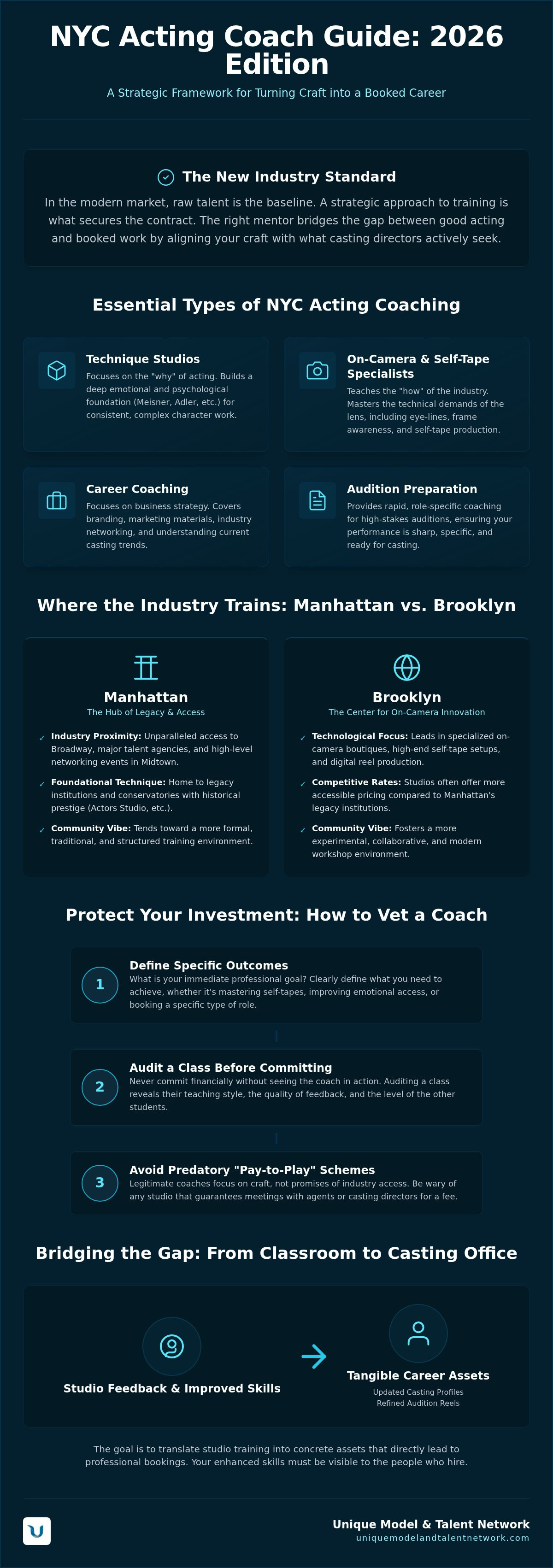
The geography of training has expanded. Manhattan remains the home of legacy institutions like the Actors Studio, centered in Midtown and the West Village. These areas provide unparalleled proximity to the Broadway theater district and major talent agencies. If you're looking for foundational technique and historical prestige, Manhattan's studios are the standard.
Brooklyn has emerged as the hub for specialized on-camera boutiques. These studios often offer more competitive rates and focus heavily on the technical nuances of film. When choosing between boroughs, consider these factors:
- Industry Proximity: Manhattan studios offer easier access to midtown networking events and legacy agencies.
- Technological Focus: Brooklyn boutiques often lead in high-end self-tape setups and digital reel production.
- Community Vibe: Manhattan tends toward the formal and traditional, while Brooklyn offers a more experimental, collaborative environment.
The Competitive Edge of Professional Mentorship
Transitioning from a hobbyist mindset to a professional career track requires a mentor who understands current casting trends. It isn't enough to "be the best actor" in a vacuum. You need a coach who knows what networks like HBO or Hulu look for in 2026. This professional perspective helps you avoid the "soul-searching" traps that lack business context. Peer networking within these elite circles is equally vital. The connections you make in a high-level class often lead to your first professional referrals, creating a community of accountability that general social media simply cannot replicate.
Essential Types of Acting Coaching in NYC
Finding the right acting coaches in new york requires a clear-eyed assessment of your current career gaps. Not every mentor serves the same purpose. You might need a deep emotional reset, or you might simply need to learn where to look during a tight close-up. In the 2026 market, professional actors often maintain a rotation of specialized mentors to cover different aspects of their development:
- Technique: Long-term emotional and psychological growth.
- On-Camera: Technical mastery of the frame and self-tape equipment.
- Career: Branding, marketing, and industry networking.
- Audition Prep: Rapid turnaround for specific, high-stakes roles.
Technique Studios: Building Your Foundation
Foundational studios focus on the "why" of your acting. Programs specializing in Meisner, Strasberg, or Adler provide the emotional and psychological tools required for complex character work. Committing to a multi-year conservatory is a significant decision. It's often the right choice if you find your performances lack depth or consistency. While legacy methods remain a staple, modern 2026 curricula now emphasize speed. You must be able to access deep emotional truths without the luxury of long rehearsal periods typical of theater. Understanding how to vet and select the right coach for your foundation is critical to avoid wasting years on a style that doesn't resonate with your personal process.
On-Camera and Self-Tape Specialists
The technical demands of the lens are distinct from the stage. On-camera specialists focus on the "how" of the industry. They teach you to master eye-lines, frame awareness, and the subtle shifts in energy required for a self-tape. By 2026, these coaches have become digital-first experts. They don't just watch your performance; they analyze your technical setup. Many top acting coaches in new york now integrate reel-building into their classes, ensuring you leave with professional footage that showcases your marketability. If you're hitting a wall with your audition-to-booking ratio, the issue is often technical rather than artistic.
Beyond these pillars, you should consider career coaching and audition prep. Career coaches tackle the business side, focusing on branding and agent relationships. Audition prep is a short-term, high-intensity service for specific roles. If you've mastered the craft but struggle with the strategy, joining a professional Network Membership can provide the community and strategy needed to turn your training into professional bookings.
How to Vet and Select the Right Coach for Your Career Stage
Choosing from the sea of acting coaches in new york requires more than reading a bio or following a recommendation from a friend. You need a systematic approach to ensure your investment yields professional results. In a market this competitive, your choice of mentor shouldn't just improve your craft; it should refine your career strategy. Follow this five-step process to find a coach who meets the high standards of the 2026 industry.
- Step 1: Define your immediate goal. Are you looking to fix a technical flaw, prepare for a specific audition, or secure new representation? A coach who specializes in Meisner technique might not be the best choice for a last-minute network procedural audition.
- Step 2: Audit the class. If a studio doesn't allow audits, request a consultation. Observe the coach’s communication style. They should provide actionable, specific adjustments rather than vague, emotional critiques.
- Step 3: Research industry active-status. Verify if the coach is currently working or has recent credits. The industry has changed rapidly; a mentor who hasn't been on a professional set in five years may not understand the nuances of current casting expectations.
- Step 4: Analyze alumni success. Don't be dazzled by one celebrity name-drop. Look for a consistent track record of students booking guest star, recurring, and series regular roles in the last 18 months.
- Step 5: Evaluate the community. The students in the room are your future collaborators. A high-level studio acts as a professional network, not just a rehearsal space.
Avoiding the "Pay-to-Play" and Scouting Scams
Protective mentorship is essential because the NYC market is rife with "pay-to-play" schemes. Be wary of coaches who guarantee agency representation or claim their class is a "direct pipeline" to specific casting directors. Legitimate workshops focus on education and skill-building. If a session feels more like a paid audition than a learning environment, it likely violates industry standards. You can always verify a coach’s credentials or a studio’s reputation through SAG-AFTRA resources or professional industry databases.
Modern Vetting: Reels, Digitals, and Social Presence
In 2026, a coach must be able to critique your digital presence. Does the mentor understand the acting portfolio requirements of the current market? High-level coaching is ineffective if your digital materials are holding you back. A coach should be able to tell you if your reel is hitting the right beats for your "type" or if your headshots are outdated. This is why a professional portfolio review for actors is often a prerequisite for joining elite, booking-focused classes. If a coach ignores your digital assets, they aren't preparing you for the reality of modern casting.
Bridging the Gap: From the Classroom to the Casting Office
Many actors fall into the "Classroom Trap." They spend years working with acting coaches in new york, refining every emotional beat, yet their audition calendar remains empty. This disconnect occurs when training is treated as a safe haven rather than a launchpad. In the 2026 market, professional growth requires you to treat your studio time as a business development lab. Your coach's feedback isn't just for your craft; it’s data you can use to optimize your casting profiles and marketing materials.
If your coach consistently notes your strength in high-stakes procedural drama, but your headshots lean toward "quirky best friend," you’re sending mixed signals to the industry. Use these sessions to clarify your "type" and ensure your digital presence reflects your actual performance capability. Transitioning from "student" to "colleague" in the eyes of NYC industry pros happens the moment you start applying classroom adjustments to your professional persona.
Translating Craft into Auditions
A coach is your most valuable asset when preparing for film industry auditions. They help you break down a script not just for artistic truth, but for the technical requirements of the lens. This involves turning specific technical feedback into actionable resume updates. For example, if a coach helps you master a specific dialect or a technical skill like stage combat, that should be reflected in your special skills section immediately. To maintain this momentum between in-person sessions, many actors now utilize acting workshops online. These digital spaces allow you to stay sharp and accessible, ensuring your skills don't get rusty between major NYC bookings.
Networking: The Missing Ingredient
The final step in bridging the gap is acting industry networking. Training gives you the skill, but networking provides the opportunity. In a city as massive as New York, public social media platforms are often too noisy and unorganized to be effective. You need access to "vetted" talent circles where high standards are the norm and professional integrity is expected.
Peer-to-peer referrals are the lifeblood of the Off-Broadway and Indie film scenes. When you surround yourself with serious professionals, you gain access to the hidden job market that isn't posted on public casting sites. If you’re ready to stop just practicing and start booking, consider joining our Network Membership to connect with casting directors who are actively hiring in the current NYC market.
Beyond the Studio: Building Your Career with Unique Model & Talent Network
Securing the most elite acting coaches in new york is only the first half of a successful career strategy. While your coach refines your emotional depth and technical precision, you still need a dedicated platform to showcase those skills to the right people. Unique Model & Talent Network acts as the essential networking and educational layer that traditional studios often lack. We don't just help you refine your craft; we provide the professional environment where your training meets professional opportunity. We act as your career strategy partner, ensuring the work you do in the rehearsal room actually reaches the industry elite.
Our private community on Mighty Networks offers a moderated, professional space away from the chaotic "pay-to-play" noise of general social media. Here, you can access Portfolio & Reel Reviews that ensure your digital presence is industry-ready before you ever step into a high-stakes casting office. This real-time feedback loop bridges the gap between classroom exercises and professional standards. By emphasizing the legitimacy of opportunities and high standards of our members, we move you away from the superficiality of public platforms and toward a sense of career security.
The Network Advantage: Access and Accountability
Maintaining momentum is the hardest part of the NYC hustle. To keep your craft sharp between intensive sessions with acting coaches in new york, we provide Monthly Skill-Building Challenges and Industry Expert Q&A Sessions. These aren't generic lectures; they're high-value interactions with professionals who understand the 2026 market. You'll gain access to Live Industry Workshops with casting directors who actually hire, allowing you to build a global network from your home base in the New York market. This level of accountability ensures you're always moving toward your next booking rather than just waiting for the phone to ring.
Your Next Steps in the NYC Market
Integrating The Network Membership into your weekly professional routine changes your trajectory. Instead of spending hours scrolling through unverified casting calls or unorganized groups, you'll focus on targeted growth and vetted connections. You'll move from the perpetual cycle of searching for coaches to the active phase of booking paid work. If you're serious about your craft and ready to be treated like the professional you are, it's time to step into a gated community that values integrity and results. Join the Unique Model & Talent Network and take control of your acting career today.
Mastering the New York Market: Your Path to Professional Bookings
Choosing the right acting coaches in new york is a foundational step, but your professional growth shouldn't stop at the studio door. You've learned how to vet for industry relevance and how to avoid the classroom trap by translating feedback into actionable digital assets. In the 2026 landscape, the most successful actors are those who pair their technical training with a disciplined career strategy. You need a community that values your craft as much as your commercial viability.
By securing direct access to casting directors and receiving professional portfolio and reel reviews, you move beyond the uncertainty of public platforms. Our private, curated industry community provides the clarity and advocacy required to navigate a competitive field with confidence. It's time to stop practicing in a vacuum and start positioning yourself for the roles you deserve. Elevate your career with The Network Membership and turn your hard-earned skills into tangible success. Your next professional booking is waiting for the version of you that is fully prepared and properly connected.
Frequently Asked Questions
How much do acting coaches in New York typically charge in 2026?
Private acting coaches in new york typically charge between $100 and $150 per hour for instructors with professional film and TV credits. Entry-level or less experienced coaches might start around $50 per hour, while high-profile mentors can exceed $300. Group classes offer a more accessible entry point, averaging $25 to $40 per hour. When budgeting, factor in the frequency of sessions and whether the studio requires a multi-week commitment or allows for individual session booking.
Do I need a coach if I already have an acting degree?
Yes, a professional coach is essential for maintaining your competitive edge regardless of your educational background. While an acting degree provides a vital artistic foundation, a coach focuses on the immediate technical and business demands of the 2026 market. Mentors help you adapt your academic training to the fast-paced world of self-tapes and specific casting trends. Think of your degree as your education and your coach as your career-long professional development partner.
What is the difference between an acting teacher and an acting coach?
An acting teacher typically focuses on long-term foundational growth and the mastery of specific techniques like Meisner or Adler. In contrast, an acting coach is results-oriented and often hired for short-term goals, such as preparing for a specific audition or refining a character for a booked role. While teachers build your artistic muscles over years, coaches help you apply those skills to win professional contracts and navigate the technical nuances of the lens.
How can I tell if an NYC acting coach is a scam?
Legitimate acting coaches in new york never guarantee agency representation or promise that their class will lead directly to a job. Be wary of high-pressure sales tactics or scouting events that require large upfront fees for exposure. A professional studio will prioritize your skill development over vague promises of fame. Always verify a coach’s current industry credits and check for a consistent track record of alumni success in professional film, television, or stage productions.
Should I focus on theatre or film/TV coaching in New York?
Your focus should align with your immediate career goals, but the 2026 NYC market heavily prioritizes film and television production. While theatre coaching builds excellent stamina and vocal presence, on-camera coaching is critical for mastering the technical requirements of modern auditions. Many successful actors maintain a balance by training in foundational technique while working with a specialist to ensure their performance translates effectively through a camera lens for self-tapes and digital reels.
How often should I see an acting coach to see real results?
Consistency is the key to seeing tangible results in your craft and booking ratio. Most professional actors work with a coach at least once a week during foundational training or when actively auditioning. If you're preparing for a specific high-stakes role, you might increase frequency to multiple sessions in a single week. The goal is to maintain a rehearsal-ready state so you don't have to warm up when a major opportunity arrives.
Can I find quality acting coaching in New York on a budget?
You can find high-quality training without overextending your finances by prioritizing group classes over private sessions. Group lessons in New York average $25 to $40 per hour and provide the added benefit of peer networking. Additionally, many reputable studios now offer online workshops that reduce overhead costs while maintaining high standards. Supplementing these classes with a professional networking community can provide the career strategy and expert access you need without constant private session fees.
What should I bring to my first session with a New York acting coach?
Arrive prepared with two contrasting, memorized monologues or scenes that fit your current casting type. You should also bring a professional headshot and a current resume for the coach to review. Beyond physical materials, have a clear, specific goal for the session. Whether you want to fix a technical habit or prepare for a specific network procedural, being organized allows your coach to provide the most impactful and professional feedback from the very start.


