
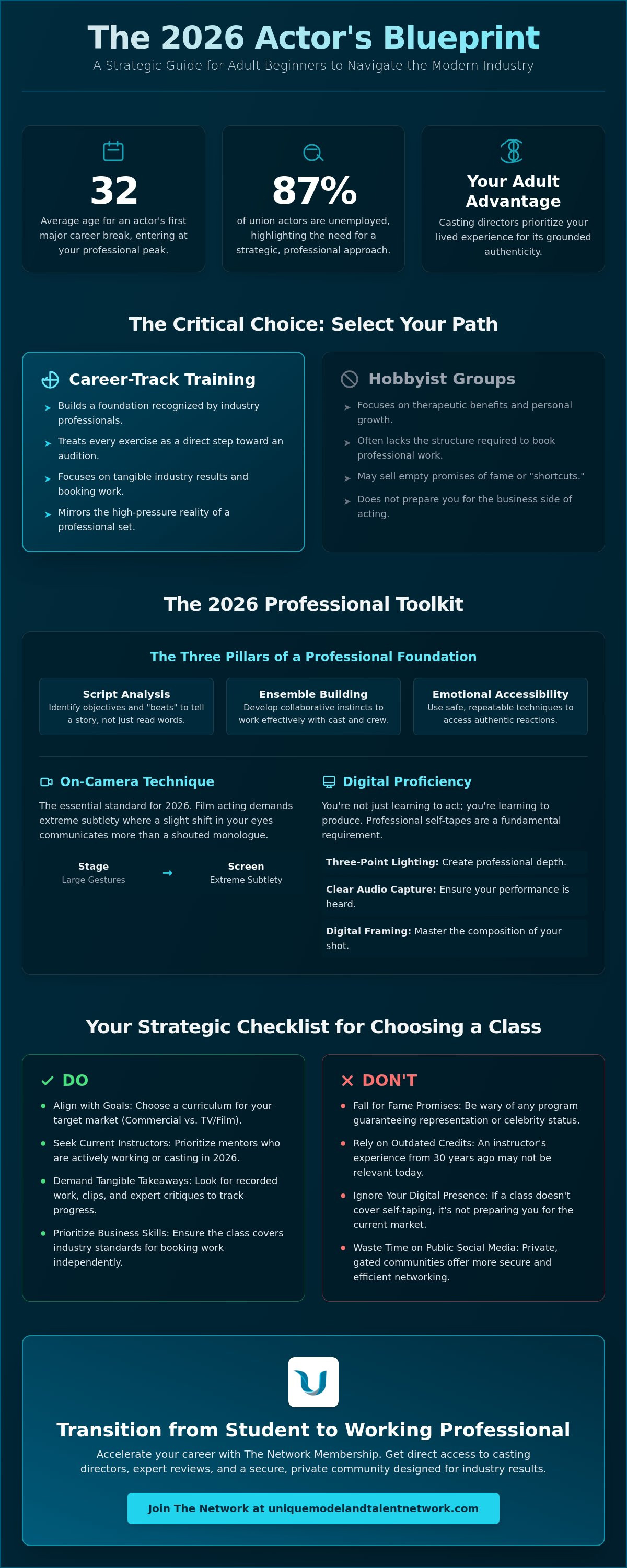
Did you know that as of June 2026, the average age for an actor to land their first major career break is 32? If you feel like you are starting late or fear looking foolish in front of younger peers, you are actually entering the industry during your peak professional years. Many newcomers feel paralyzed by the technical jargon of "method" versus "technique" or worry about wasting resources on hobbyist workshops that never lead to a real set. It is a valid concern in a field where 87 percent of union actors are unemployed at any given time.
This guide will show you how to identify high-quality acting classes for adults beginners that prioritize professional standards over empty promises. You will learn how to choose a foundation that builds genuine confidence and bridges the gap between learning the craft and booking your first paid role. We will provide a clear roadmap for mastering 2026 requirements like self-taping and digital adaptability, giving you a distinct advantage before you even step into the audition room. It is time to move past the uncertainty and start building a career based on tangible industry results.
Key Takeaways
- Distinguish between hobbyist groups and career-track training to ensure your initial investment builds a foundation recognized by industry professionals.
- Identify how to select acting classes for adults beginners that align with your specific market goals, whether you are targeting commercial work or TV and film.
- Understand the essential business standards required to start booking professional work independently, proving that you do not need an agent to launch your career.
- Discover why private, gated communities provide a more secure and efficient path to networking than the unorganized distractions of public social media.
- Learn how direct access to casting directors and expert reviews through The Network Membership can accelerate your transition from student to working professional.
What are Acting Classes for Adult Beginners in 2026?
Acting classes for adults beginners are no longer just about memorizing lines or conquering stage fright. In 2026, these classes serve as a rigorous, foundational entry point into a multi-billion dollar industry. If you are serious about a career, you must understand that professional training is a form of business development. You can explore the broader history of What is Acting? to see how the craft has evolved, but your immediate focus should be on practical application. These classes provide the technical vocabulary and emotional tools required to meet the high standards of modern production sets.
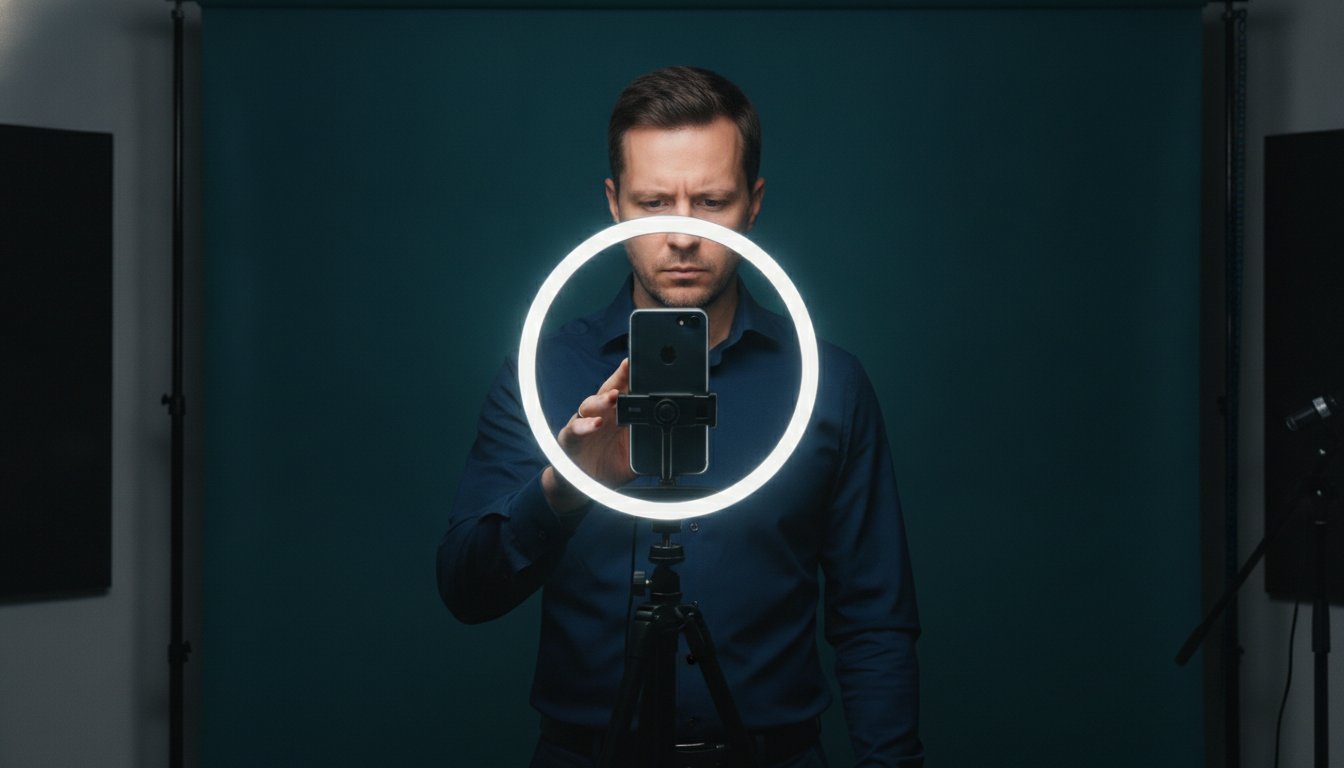
Modern acting classes for adults beginners must also integrate digital proficiency. By 2026, the ability to create professional-quality self-tapes has become a fundamental requirement for every actor. You aren't just learning to act; you're learning to produce. This means mastering technical skills like three-point lighting, clear audio capture, and digital framing alongside your emotional work. If a class doesn't address your digital presence, it isn't preparing you for the current market.
Adults possess a distinct advantage in this field: lived experience. You don't have to "imagine" professional conflict, deep joy, or complex grief because you've likely felt them. This emotional maturity allows you to bypass the superficiality often found in younger performers. Casting directors in 2026 heavily prioritize this grounded authenticity and naturalism over theatrical flair.
Core Elements of a Professional Foundation
Professional training focuses on three non-negotiable pillars. Script analysis teaches you to identify the objectives and "beats" within a professional screenplay, ensuring you tell a story rather than just reading words. Ensemble building develops the collaborative instincts needed to work effectively with directors and crew members. Finally, emotional accessibility provides safe, repeatable techniques for accessing authentic reactions without compromising your personal well-being. These skills form the bedrock of a sustainable career.
The Shift from Stage to Screen
While theater remains a powerful training ground, most career-track beginners now prioritize on-camera technique. Theatrical projection requires large gestures to reach the back of the house; however, film acting demands extreme subtlety. A slight shift in your eyes can communicate more to a camera than a shouted monologue. On-camera technique is the specific practice of adjusting your performance to suit the lens, making it the essential standard for 2026 commercial and television work.
Choosing the Right Beginner Curriculum for Your Goals
Selecting acting classes for adults beginners is a strategic decision that should align with your specific professional objectives. If you want to book commercial work, a class focused on Shakespearean verse won't provide the return on investment you need. If your goal is TV and film, look for a curriculum that emphasizes naturalism and technical lens awareness. Review the career outlook for actors to understand which sectors are growing. Always prioritize instructors who are currently working or casting. An instructor with credits from thirty years ago might not understand the nuances of a 2026 self-tape or the speed of a modern digital set. You deserve a mentor who understands the current demands of the market.
Be wary of any program that promises fame or guaranteed representation as an immediate outcome. Professional training is about skill acquisition; if they are selling you a shortcut to celebrity, they are likely a predatory hobbyist group. Instead, look for classes that provide tangible takeaways. These include recorded clips of your work or written critiques from industry experts that you can use to track your development. A professional class should end with you possessing a clearer understanding of your type and a set of performance notes that guide your career acceleration.
Technique vs. Scene Study
Beginners often face a choice between foundation techniques and scene study. Frameworks like Meisner focus on instinct and "living truthfully under imaginary circumstances." Stanislavski emphasizes the "magic if" and internal motivation, while Adler highlights the power of imagination and sociological context. While these theories provide a vocabulary, scene study is where you apply them to a real script. It is the laboratory where abstract concepts become professional habits. Finding a balance between the two is essential for a well-rounded start.
The Importance of Live Feedback
You cannot learn to act in a vacuum. Pre-recorded courses offer information, but they fail to provide the real-time adjustments that a beginner needs to avoid developing bad habits. This is why acting workshops online have become so popular; they offer global access to top-tier coaches while maintaining the interactive element of a physical studio. Observing group critiques also sharpens your critical eye, helping you recognize professional standards in others so you can replicate them in your own work. If you are ready to put these principles into practice, engaging with Live Industry Workshops can provide the professional scrutiny required to grow.
The Business of Acting: What Most Classes Forget
Talent is the price of admission, but it is not the ticket to a sustainable career. Many hobbyist acting classes for adults beginners focus exclusively on the "feeling" of a scene while ignoring the logistical realities of the industry. In a field where 87 percent of union actors are unemployed at any given time, your business acumen is what separates you from the crowd. If you treat your craft as a hobby, the industry will treat you as a hobbyist. To secure professional work, you must view your talent as the product and your marketing materials as the sales pitch.
The most common misconception for new actors is that they must wait for an agent to grant them permission to work. This is false. In 2026, you do not need an agent to start booking professional roles. Directors and producers frequently use casting websites to find fresh faces for commercials, independent films, and branded content. For these low-budget independent projects, new actors can expect to earn between $100 and $500 per day. By learning to navigate these platforms yourself, you gain immediate agency over your career acceleration rather than waiting for a phone call that may never come.
Headshots, Resumes, and Reels
Your "Professional Package" is your digital calling card. A high-quality headshot is your most critical business investment; it must look like you on your best day, not a stylized version of someone else. When formatting a resume with zero credits, focus on your specific training and "special skills" like dialects or athletic abilities. If you lack professional footage, use high-quality clips from your acting classes for adults beginners to create a "starter reel." This shows casting directors your range and technical proficiency before you've even stepped onto a professional set.
Navigating Casting Platforms
Modern recruitment happens in digital spaces. Setting up profiles on major industry databases is only the first step; you must also understand how to optimize those profiles to appear in searches. This involves building an acting portfolio that highlights your specific "type" and professional readiness. Be disciplined when browsing public casting calls. If a listing asks for sensitive personal information or upfront "fees" for an audition, it is likely a scam. Stick to verified platforms that maintain high professional standards to protect your time and resources.
Networking for Beginners: Beyond the Classroom
Your development in acting classes for adults beginners provides the necessary foundation, but your professional network determines how often that foundation is actually put to work. While many newcomers flock to public social media platforms, these spaces are often unorganized and filled with distractions that hinder professional growth. A private, gated community offers a concentrated focus that public platforms simply cannot match. Within a professional network, you aren't just another profile in a sea of noise; you are a vetted member of a community that values high standards and career security. This exclusivity elevates your perceived status in the eyes of decision-makers who prefer to source talent from reliable, professional environments.
Effective networking is about building professional bonds rather than seeking immediate favors. If you approach an industry professional with the sole goal of being "discovered," you will likely be ignored. If you approach them as a prepared collaborator who understands the business, you earn their respect. Industry access is defined by your ability to be seen by decision-makers, and this access is earned through consistent, professional engagement over time. Peer-to-peer networking is equally vital; your classmates are your future colleagues who will share audition leads and set experiences that you won't find on any public job board.
Q&A Sessions with Industry Experts
Direct interaction with casting directors and agents is a rare opportunity that requires meticulous preparation. When you participate in Industry Expert Q&A Sessions, your goal is to learn the unspoken rules of the industry from those who actually do the hiring. Ask about current recruitment trends or what specifically makes a self-tape stand out in the 2026 market. This level of inquiry demonstrates that you are serious about your business, often turning a single interaction into a long-term professional connection. Hearing directly from experts provides a level of clarity that no generic textbook can offer.
Skill-Building Challenges
The gap between formal classes can often lead to "acting muscle" atrophy. Engaging in Monthly Skill-Building Challenges ensures your craft remains sharp and your portfolio stays current between bookings. These challenges provide a structured environment to test new techniques and receive feedback before you take them to a high-stakes audition. By utilizing acting industry networking tools, you can find collaborators for self-tape practice or independent projects. If you are ready to move beyond the classroom and enter a professional environment, The Network Membership provides the elite access you need to start your career with confidence.
Unique Model & Talent Network: Your Professional Community
The entertainment industry can feel like a chaotic landscape where predatory groups often prey on those just starting their journey. While acting classes for adults beginners provide you with the essential craft, our network provides the professional framework to use that craft effectively. We act as a protective authority, ensuring you have a secure space to grow without the distractions of superficial social media platforms. By joining a managed talent community, you move away from the "aspiring" label and toward the grounded reality of professional business development. It is about finding career security in an environment that values high standards and professional growth over fame or vanity.
Direct access to decision-makers is the hallmark of a serious career strategy. Through our community, you gain the advantage of being seen by casting directors and professional photographers who value the legitimacy of our members. Instead of navigating the industry in isolation, you benefit from a collective of experts who focus on tangible success. We bridge the gap from beginner student to working professional by providing the accreditation and internal industry perspectives that general public groups lack. This sense of community belonging empowers you to approach your first audition with the confidence of a seasoned insider.
The Network Membership Advantage
The Network Membership offers an organized value structure designed to accelerate your career path. Members gain access to Live Industry Workshops and Portfolio & Reel Reviews conducted by vetted experts who know exactly what the market requires in 2026. This is a private, moderated environment where the focus remains on professional growth rather than external distractions. You can participate in Monthly Skill-Building Challenges to keep your performance sharp and build a resume that reflects consistent professional activity. This disciplined approach ensures you are always ready for the next opportunity when it arises.
Your Next Steps in the Industry
Transitioning from a student mindset to a professional strategy requires a shift in focus. It is no longer just about taking classes; it is about executing a plan that puts you in front of the right people at the right time. By surrounding yourself with a community of serious creatives who value integrity and efficiency, you elevate your professional status. If you are ready to take command of your future and move beyond entry-level uncertainty, Join the Unique Model & Talent Network today and start your professional journey with a team that advocates for your success.
Launch Your Professional Acting Career with Confidence
You now possess the roadmap to transition from a curious newcomer to a strategic professional. Success in 2026 requires more than just talent; it demands a balance between the high standards of your craft and the disciplined execution of a business plan. By prioritizing career-track acting classes for adults beginners and mastering the technical requirements of the modern industry, you set yourself apart from the hobbyist crowd. You have the life experience to bring authenticity to every role, and now you have the knowledge to protect your career from common pitfalls.
The journey to your first professional booking is more efficient when you aren't navigating it alone. Our private Mighty Networks community provides a secure environment where you can focus on growth without the noise of external platforms. You will gain direct access to casting directors and sharpen your performance through monthly skill-building challenges designed for the current market. If you are ready to be seen by decision-makers who value professional integrity, it is time to take the next step.
Join the Unique Model & Talent Network and get noticed by industry pros today. Your professional journey starts now, and we are here to advocate for your success every step of the way.
Frequently Asked Questions
Is it too late to start acting as an adult beginner?
It is never too late to begin your professional journey. Data from June 2026 shows that the average age for an actor's first major break is 32, with peak earning years typically falling between ages 35 and 50. Starting later means you bring a depth of lived experience that younger performers can't replicate, which is a significant advantage when casting directors look for authentic naturalism in modern scripts.
Do I need a professional headshot before my first acting class?
You don't need a professional headshot just to start learning. While a high-quality photo is your most important business tool, it's better to wait until you understand your specific "type" and marketability before investing in an expensive session. For your initial acting classes for adults beginners, a clear, well-lit snapshot is often sufficient for instructors to track your progress and identify your visual range.
How much do acting classes for adults typically cost?
The cost for acting classes for adults beginners varies significantly based on the program's intensity and the instructor's current industry status. Introductory monthly courses are generally accessible, while multi-week conservatories or specialized intensives requiring significant studio time involve a higher investment. Always prioritize programs that offer tangible career assets, such as recorded performance clips or direct feedback from vetted industry experts, to ensure you get a professional return.
Can I learn acting online, or do I need to be in a physical studio?
You can effectively learn the craft in both environments, but they serve different professional needs. Online training is exceptionally valuable for mastering self-taping, which is a fundamental requirement for the 2026 market. It also provides global access to elite coaches you might not find locally. Physical studios remain beneficial for ensemble work, but digital proficiency is now a non-negotiable standard for booking professional work.
What is the difference between an acting class and a workshop?
A class is typically a long-term commitment focused on building a foundational technique or framework over several weeks or months. A workshop is a high-intensity, short-term session that usually targets a very specific skill, such as "On-Set Survival" or "Commercial Auditioning." Workshops often feature guest industry experts, providing a rare opportunity for direct networking and immediate feedback from those who are currently hiring talent.
How do I know if an acting class is a scam?
Legitimate programs focus on skill acquisition and professional development rather than empty promises of fame. Be wary of any class that guarantees you an agent or a specific job upon completion. You should also check if the school follows a recognized "Code of Conduct," such as the one established by the Association of Acting Coaches and Educators. If an instructor lacks recent professional credits or asks for upfront representation fees, it's a major red flag.
Should I take improv classes if I want to be a dramatic actor?
Improv is an essential tool for every dramatic actor because it sharpens your listening skills and spontaneity. Modern casting directors prioritize performances that feel conversational and unscripted. Improv training helps you stay present in a scene, allowing you to react authentically to your scene partner rather than just waiting for your turn to speak. This adaptability is crucial on professional sets where directors often ask for varied takes.
How long does it take to go from a beginner class to booking a professional job?
The timeline varies, but some dedicated students start booking low-budget independent films or commercial work within their first six months. For these entry-level projects, new actors in 2026 can expect to earn between $100 and $500 per day. Your progress depends on how quickly you build your "Professional Package," including your reel and digital portfolio, and how consistently you engage with industry networking platforms to find opportunities.


