
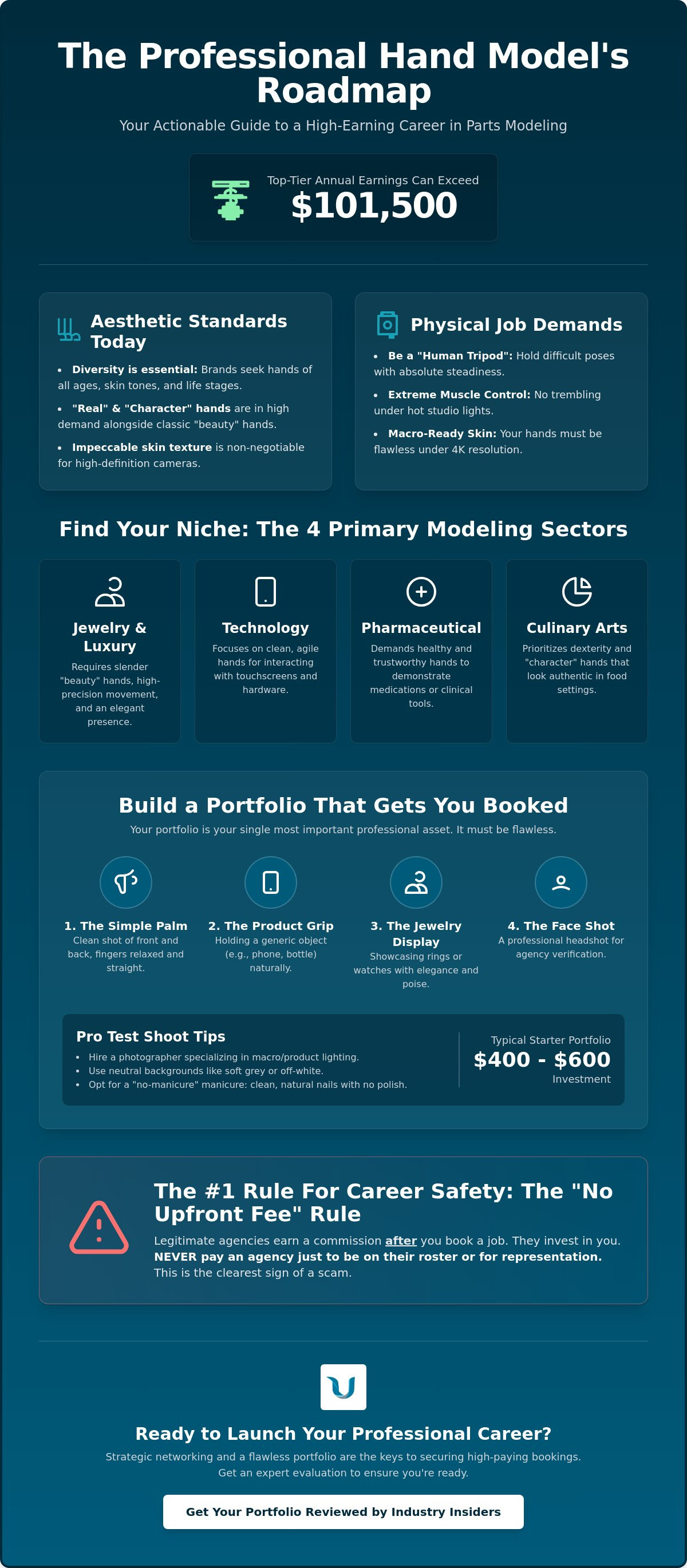
Did you know that top-tier professional hand models can earn upwards of $101,500 annually simply by mastering the art of the "human prop"? It's a highly specialized discipline where a single steady pose can define a multi-million dollar commercial campaign. If you've ever wondered how to become a hand model but felt overwhelmed by the lack of clear entry points or worried about industry scams, your hesitation is completely valid. The professional modeling world often feels like a closed door, especially when you don't have a proven roadmap to follow.
This guide demystifies the industry by providing a clear, actionable strategy rooted in technical precision and career security. We'll show you how to master the standards that casting directors demand, from building a submission-ready portfolio to understanding the latest legal protections like the New York State Fashion Workers Act. You'll learn how to transform your natural assets into a professional brand, create high-impact digital samples, and safely network with the insiders who actually book the jobs. It's time to move past the uncertainty and start building a career based on tangible standards and elite industry connections.
Key Takeaways
- Define the precise digital standards and the three fundamental shots required to master how to become a hand model in a professional capacity.
- Protect your career by learning to identify legitimate representation and applying the "No Upfront Fee" rule to every agency interaction.
- Adopt the high-standard maintenance regimens and environmental safeguards necessary to keep your primary assets in peak commercial condition.
- Discover why strategic networking and warm introductions are the most effective catalysts for securing high-paying commercial and editorial bookings.
Understanding the Professional World of Parts Modeling
Hand modeling is a high-stakes technical discipline where your hands function as the primary vessel for a brand's message. Far from being a simple matter of genetic luck, it is a specialized niche within the commercial and editorial industries that requires the precision of a silent actor. When you investigate how to become a hand model, you're essentially training to be a storyteller who conveys complex emotions, from the luxury of a diamond ring to the reliability of a new medical device, all without showing your face. For a foundational look at the history and variety of this career, Wikipedia's overview of hand modeling provides excellent context on the professional landscape.
In the current market, your work will likely fall into one of four primary sectors:
- Jewelry and Luxury: Requires high-precision movement and "beauty" hands with slender fingers.
- Technology: Focuses on clean, agile hands for interacting with touchscreens and hardware.
- Pharmaceutical: Demands hands that look healthy and trustworthy to demonstrate medication or clinical tools.
- Culinary Arts: Prioritizes dexterity and "character" hands that look at home in a kitchen or restaurant setting.
The Aesthetic Standards of 2026
The industry has moved beyond the singular "classic" standard of slender fingers and long nail beds. While those traits remain vital for high-fashion jewelry, the rise of lifestyle branding has created a massive demand for "real" and "character" hands. Diversity is now a professional requirement; brands are actively seeking hands that represent different ages, skin tones, and life stages to build authenticity. Regardless of your specific category, your skin texture must be impeccable. Production teams look for even tones and minimal scarring because today's high-definition cameras capture every pore.
The Physical Demands of the Job
Success in this field depends on your ability to function as a "human tripod." You'll often be asked to hold a product in a difficult, cramped position for several minutes while a lighting crew makes adjustments. This requires immense muscle control and stamina. Trembling is the enemy of a successful shoot; casting directors prioritize models who can maintain a steady, relaxed grip under the heat of studio lights. Macro-Readiness is defined as the ability to maintain skin perfection under 4K resolution lenses. If you're serious about learning how to become a hand model, you must treat your hands as professional equipment that requires constant maintenance and disciplined control.
Building a Professional Parts Portfolio That Gets You Noticed
Your portfolio is the single most important asset in your professional toolkit. In a digital-first industry, your initial submission must be flawless because casting directors often make decisions in seconds. If you're learning how to become a hand model, you need to move beyond casual snapshots and invest in high-quality imagery that showcases your range and technical precision.
Every professional portfolio requires three essential foundational shots. First is the "Simple Palm," showing both the back and front of the hand with relaxed, straight fingers. Next is the "Product Grip," where you demonstrate your ability to hold a generic object, such as a phone or a cosmetic bottle, without blocking the brand's visibility. Finally, the "Jewelry Display" focuses on elegance and the ability to showcase rings or watches without creating distracting shadows. Agencies also require a "Face Shot" to verify your overall appearance and professional presentation, even if your face is never seen on camera.
Professional photography for a portfolio typically costs between $75 and $250 per image, but a comprehensive starter portfolio can often be built for $400 to $600. This investment ensures that your skin texture is highlighted through macro lighting rather than obscured by poor shadows. If you want a professional eye to evaluate your current images, consider seeking Portfolio & Reel Reviews from industry experts who understand these technical nuances.
The Anatomy of a Perfect Hand Test Shoot
Selecting a photographer who specializes in macro or product lighting is non-negotiable. You need someone who understands how to manage the intense detail captured by 4K lenses. Use neutral backgrounds, such as soft greys or off-whites, to ensure your skin tone remains the focus. For these tests, stick to a "no-manicure" manicure. This means clean, natural nails with no polish, allowing agencies to see the health and shape of your natural nail beds.
Common Portfolio Mistakes to Avoid
The fastest way to receive a rejection is submitting selfies or photos with poor lighting. These lack the clarity required for professional evaluation. Avoid over-editing your images; casting directors need to see real skin texture, not artificial filters that make hands look like plastic. Additionally, watch for inconsistent nail lengths or messy cuticles. These small details signal a lack of professionalism and can immediately disqualify you from high-level bookings when you are first learning how to become a hand model.
The Business of Modeling: Navigating Agencies and Scams
The professional world of parts modeling operates on a foundation of financial legitimacy and mutual success. If you are serious about how to become a hand model, you must understand that reputable agencies like Parts Models or Body Parts function as your business partners, not your customers. They earn their revenue by securing you high-paying contracts, not by charging you for the privilege of being on their roster. With the average hand model salary in the United States reaching approximately $65,246 per year, the stakes are high enough to attract both elite professionals and predatory opportunists.
A cornerstone of industry standards is the "No Upfront Fee" rule. Reputable modeling agencies typically charge a commission of 15% to 20% of your earnings once a job is booked. In some cases, agencies may charge up to 25% for new talent, but this is always deducted from your paycheck after the client pays. Under the New York State Fashion Workers Act, which became effective on June 19, 2025, management companies in that state are legally capped at a 20% commission. If an organization asks for a "registration fee" or "onboarding cost" before you've booked work, they are likely a modeling school masquerading as an agency to sell expensive, unnecessary classes.
How to Submit to Agencies Successfully
Research the specific "Parts" or "Commercial" divisions of major modeling networks. Your cover letter should be concise and benefit-driven, positioning you as a disciplined professional who understands the technical demands of macro photography. Craft your submission to show you are ready to hit the ground running. If you don't hear back immediately, wait two to four weeks before sending a brief, professional follow-up. Avoid the informal and unorganized communication styles common on social media; instead, mirror the efficiency of a high-level corporate environment.
Identifying and Avoiding Predatory Practices
Red flags include mandatory "portfolio packages" that require you to use an agency's in-house photographer at an inflated price. While you need professional imagery to succeed, a legitimate agent will provide a list of recommended photographers rather than forcing a specific, high-cost transaction. For a deeper look at the technical standards required for professional visuals, see The Ultimate Guide to Building an Acting Portfolio That Books in 2026. Protecting your career trajectory requires a sense of advocacy and a reliance on vetted industry perspectives rather than vague online promises.
Protecting Your Assets: Professional Hand Maintenance
If you're serious about how to become a hand model, you must shift your perspective from personal grooming to professional asset management. Your hands are your primary tools. They require the same level of care and maintenance that a master craftsman gives to their finest equipment. In an industry where 4K resolution is the standard, even a minor scratch or a patch of dry skin can result in a lost booking or a costly retouching bill for the client; this is especially true for high-precision textile shoots where customers who buy machine embroidery designs expect to see the intricate patterns held by perfect, macro-ready hands. Every detail is magnified under studio lights, meaning your skin must be flawless at all times.
The "Model Life" regimen starts with extreme protection. Sun exposure is a career killer because it leads to age spots and uneven skin tone. Professional models apply high-quality SPF daily, regardless of the weather. Constant moisturization is equally vital. While a basic manicure at a salon costs between $15 and $40, many top-tier models prefer at-home maintenance to ensure total control over their "canvas." Switching to disciplined at-home nail care can reduce your annual spending by 70% to 80% while keeping your cuticles in pristine condition. Using professional-grade products, such as Nécessaire’s hand retinol or L'Occitane’s Immortelle Youth Hand Cream, ensures your skin remains "macro-ready" for the camera.
Avoiding "Hand Hazards" is a non-negotiable part of the job. You should wear gloves for almost every daily task, from washing dishes and gardening to carrying groceries. A single paper cut or a kitchen burn can sideline your career for weeks. If you want to refine your technical skills and learn more about professional standards, participating in Monthly Skill-Building Challenges is an excellent way to stay disciplined and connected with other high-level talent.
The Professional Grooming Kit
Your kit should include high-quality cuticle oil, non-greasy lotion, and glass files. Never use metal files, as they can cause micro-fractures in the nail. A critical rule for every professional: never cut your own cuticles before a booking. This often leads to redness or inflammation that the camera will amplify. Instead, use a gentle pusher and plenty of oil to keep the area tidy. Your hands are your professional tools and must be treated with the same respect as a photographer treats their lenses.
Insurance and Liability for Parts Models
Once you reach the elite tier of the industry, insuring your hands becomes a savvy business decision. This protects your income against accidents that could end your career. Additionally, you must understand "Work for Hire" contracts. These agreements dictate how a client can use your images and for how long. Always review the usage rights before signing, as this determines your long-term residual income and professional value in the marketplace. When you understand how to become a hand model at this level, you realize that your success depends as much on your business acumen as it does on your physical appearance.
Accelerating Your Career Through Professional Networking
While mastering technical poses and hand maintenance is essential, your professional network acts as the primary catalyst for consistent bookings. In the parts industry, who you know often dictates what you book. Many aspiring models rely solely on cold submissions to agencies, which frequently result in high rejection rates because they lack the endorsement of a trusted peer. If you want to understand how to become a hand model at the highest level, you must prioritize building relationships with photographers, hand stylists, and creative directors who are already active in the production environment.
Think of your social media presence as a digital business card rather than a personal hobby. High-level professionals use digital platforms to scout for talent who can function as reliable collaborators under high-resolution 4K lenses. When you position yourself as a disciplined professional who understands studio etiquette, you move from being a simple "human prop" to a valued member of the production team. This shift in perception is what separates occasional gig-seekers from established industry insiders who receive direct inquiries for high-budget campaigns.
The Power of a Managed Talent Community
Accessing a private, moderated environment provides a level of career security that public platforms cannot offer. Within a professional network, you can attend live workshops with casting directors who specialize in commercial parts and participate in monthly challenges to refine your dexterity. These interactions provide the warm introductions necessary to bypass the "slush pile" of cold emails. To understand how these connections scale professional trajectories, review The Ultimate Acting Industry Networking Platform Guide for 2026 for a strategic look at modern industry bonds.
Transitioning from Beginner to Booked Professional
Scaling your career requires you to set high professional standards early. This includes seeking peer feedback in a secure space where the focus is on growth rather than vanity. By engaging with other serious professionals, you gain internal industry perspectives that help you avoid common pitfalls and identify legitimate financial opportunities. When you are first learning how to become a hand model, the transition from hobbyist to professional happens when you stop waiting for luck and start engineering access. If you are ready to turn your natural assets into a lucrative professional career, it is time to move beyond the distractions of general social media. Take the decisive step toward career acceleration and Join the Unique Model & Talent Network today to gain the clarity and access you need to succeed in the competitive world of 2026 parts modeling.
Launching Your Career with Professional Precision
Transitioning from a curious observer to a working professional requires more than just natural aesthetics. It demands a commitment to technical precision, disciplined maintenance, and a deep understanding of industry-standard business practices. You now have the foundational knowledge of how to become a hand model, from identifying reputable agencies to protecting your primary assets against daily hazards. Success in 2026 is reserved for those who treat their craft as a business and their hands as high-value professional equipment.
The journey doesn't have to be navigated alone. By joining a focused environment, you remove the noise of social media and replace it with concentrated professional growth. You deserve a path that offers financial legitimacy and direct connections to the people who actually make the casting decisions. This isn't just about finding work; it's about building a sustainable career within a protective and ambitious community.
Join the Professional Network That Opens Doors to gain direct access to casting directors, participate in live portfolio reviews by industry experts, and belong to a private, scam-free community for serious talent. Your career acceleration starts with a single professional choice. We are ready to help you turn your potential into a documented success story.
Frequently Asked Questions
How much do hand models make per shoot in 2026?
Hand models in the United States earn an average of $31.37 per hour, though rates vary significantly based on the scale of the production. While annual salaries average around $65,246, top earners in the industry command up to $140,000 annually for high-stakes commercial campaigns. Your specific payout depends on the usage rights negotiated by your agency and whether the project is for local digital use or a global television broadcast.
Do I need to be a certain height or weight to be a hand model?
Traditional modeling height and weight requirements don't apply to the world of parts modeling. Casting directors focus exclusively on the proportions of your hands, the length of your fingers, and the health of your skin. This makes the field highly accessible to a diverse range of talent who might not fit the rigid standards of the fashion runway. Many professionals find that learning how to become a hand model is a strategic way to enter the entertainment industry based on specific physical assets.
Can I be a hand model if I have tattoos on my arms?
Tattoos on your arms or wrists can limit your eligibility for "beauty" work, but they aren't an automatic disqualifier for "lifestyle" or "character" roles. Brands often seek a specific aesthetic, and some modern campaigns embrace visible ink to appear more authentic to their target audience. If you have tattoos, you should provide clear photos of them to your agency so they can submit you for projects where body art is either welcomed or easily covered by the product being held.
What is the "Macro-Test" and how do I pass it?
The "Macro-Test" is a technical screening where your hands are filmed under extreme close-up 4K lenses to evaluate your stability and skin texture. To pass this test, you must demonstrate "Human Tripod" capabilities by holding a product perfectly still for several minutes without trembling. Practice your dexterity and muscle control at home by holding small, heavy objects in various grips to build the necessary stamina for a professional set environment.
Is it possible to be a hand model and a regular model at the same time?
It's very common for talent to maintain a presence in both traditional modeling and specialized parts divisions. Mastering how to become a hand model allows you to diversify your portfolio and secure bookings during the fashion industry's off-seasons. Many agencies actually prefer talent who can handle both, as it makes you a more versatile asset for multi-channel commercial campaigns that require both face and parts work.
How do I find a reputable parts modeling agency near me?
Focus your search on agencies in major production hubs like New York or Los Angeles that have dedicated "Parts" or "Commercial" departments. A reputable agency will never ask for money upfront; they earn their income through a 15% to 20% commission on the jobs you book. In New York, for example, legitimate management companies must register with the state and post a $50,000 surety bond, providing a layer of financial protection for the models they represent.
What should I wear to a "go-see" or casting for hand modeling?
Wear simple, form-fitting clothing in solid, neutral colors that don't distract from your skin tone. Short sleeves or sleeveless tops are essential so the casting director can see your arms and hands clearly. You should arrive with clean, natural nails and zero jewelry. The goal is to present yourself as a blank canvas that can easily be adapted to the specific needs of a jewelry, technology, or pharmaceutical client.
How do I protect my hands from aging and sun damage for modeling?
Professional protection requires a daily commitment to high-SPF sunscreen and the use of UPF-rated gloves while driving or outdoors. Sun damage is the primary cause of age spots and loss of skin elasticity, both of which can end a parts modeling career prematurely. Beyond topical protection, avoid activities that risk scarring or bruising, and always wear protective gloves when performing household tasks like cleaning or gardening to keep your "canvas" in pristine condition.


