

The most convincing commercial-audition outfit usually isn’t a costume. If you’re wondering what to wear to a commercial audition, aim to suggest the role while still looking like yourself. The balance can be tricky: should you dress casually, look polished, or echo the character’s style? Concerns about distracting colors and patterns can make choosing an outfit feel like another performance.
You don’t need a new wardrobe or a perfect character look. Start with the audition brief, then choose comfortable clothes that support its direction and keep the focus on your face and performance. Follow specific instructions. If the brief leaves room for interpretation, a simple, authentic outfit is a reliable starting point.
This checklist covers how closely to reflect the role, how to choose camera-friendly colors and styles, and what wardrobe distractions to avoid. You’ll also find a repeatable way to test clothes you already own, whether you’re auditioning in person or recording a self-tape. The aim is to arrive prepared, comfortable, and ready to be seen.
Key Takeaways
- To decide what to wear to a commercial audition, start with the brief and suggest the role without dressing in a full costume.
- Check fit, condition, and freedom of movement so your outfit feels polished and comfortable on camera.
- Choose simple details that support the commercial setting without competing with your expression.
- Record a phone test to check how your outfit looks in frame, including its color, fit, and any distracting details.
- Once you’ve tested an outfit against the brief, stick with it and focus on delivering the requested performance.
What should you wear to a commercial audition? Start with the brief
Wear polished everyday clothing that supports the commercial brief without turning you into a costume. A commercial often needs viewers to recognize a customer, setting, or familiar situation quickly. Your outfit can suggest that context, but it should still feel like something you could naturally wear. Aim for a choice specific enough to fit the role and simple enough to keep attention on your performance.
Before choosing clothes, read the casting breakdown for explicit wardrobe, color, or product-use instructions. If it asks for business casual, a particular color, or clothing suited to a stated activity, make that your priority. Wardrobe is one part of preparation, not a promise of casting or booking. Your read, presence, and ability to follow the brief remain central.
How to read wardrobe clues in a commercial breakdown
Work through the breakdown in a consistent order. Identify the product, setting, intended audience, and any direct wardrobe requirements. Then consider the role’s everyday context: someone meeting a client may dress differently from someone relaxing at home. This gives you a grounded starting point instead of defaulting to a full professional look or generic casual wear.
- Product: Note whether the scene centers on food, clothing, technology, or another item, and follow any stated use or handling directions.
- Setting: Look for clues such as a home, workplace, or public space.
- Audience: Consider who the commercial is speaking to and what kind of everyday customer the role represents.
- Requirements: Follow requested colors, wardrobe pieces, or other specific instructions as closely as your available clothing allows.
If the breakdown includes campaign references, use them to understand the overall visual tone. They’re clues, not a demand to copy an exact outfit or reproduce a previous performer’s styling. The Wikipedia article on auditions gives general background on auditions and their purpose. For wardrobe decisions, the casting breakdown is the more direct guide.
How much character should your audition outfit suggest?
Use one or two believable details to place yourself in the role’s world. A neat overshirt or simple collared top might suggest a practical, put-together character; a relaxed knit could feel more at home in a casual scene. These are cues, not rules. Choose details that suit the brief and feel natural on you, rather than assembling a look that seems borrowed or exaggerated.
Make sure you can move and deliver your lines comfortably. If a jacket pulls when you gesture, a collar needs constant adjustment, or an accessory draws your attention, the styling may interfere with the read. Skip theatrical costumes and conspicuous choices that announce the character before you do. Let your expression, voice, and performance carry the scene.
Build a camera-ready commercial audition outfit with these essentials
When deciding what to wear to a commercial audition, check the outfit as it will appear on camera, not just in a mirror. It should fit the brief, look cared for, and let you move and speak comfortably. A subtle garment in person can look busy in a close-up, while a sleeve or collar that shifts during your read can become a distraction.
Use this quick check before you commit:
- Fit: Choose clothes that sit neatly without pulling, gaping, or needing constant adjustment.
- Condition: Check for visible stains, wrinkles, lint, loose threads, or missing buttons.
- Movement: Sit, stand, turn, and gesture as the scene requires. Nothing should restrict your natural posture.
- Overall impression: Make sure the outfit feels appropriate to the role and the level of polish requested.
Small details matter. Busy prints, narrow stripes, sharp contrast, and large graphics can compete with your facial expression or create a restless effect on screen. Check visible logos and slogans against the casting instructions and product context. A brand mark may draw attention away from the project’s product or conflict with its visual direction, so don’t assume a familiar logo is harmless.
Choose colors and patterns that keep attention on your performance
No single color works for every complexion, backdrop, and lighting setup. If possible, test your outfit in the space or against a background similar to the audition’s. Notice details that catch light, such as shiny fabric or reflective jewelry, and check whether a pattern competes with your face. Solid colors or quieter textures are a practical starting point, but judge the full look on camera before deciding.
Check fit, movement, and finishing details
Wear something that supports natural gestures and relaxed delivery. Raise your arms, turn your shoulders, and sit as you might during the scene. Check that collars stay in place, sleeves don’t ride up unexpectedly, and hems remain tidy. If a garment twists, slips, or needs repeated fixing, choose another option. Comfort helps you stay focused on the read.
Finish with shoes, jewelry, and grooming that support rather than dominate the look. Keep shoes clean and consistent with the brief, especially if the shot may include your full body. Choose secure, unobtrusive accessories that won’t swing, clink, or reflect light. Keep hair neat in a way that feels like you and doesn’t obscure your face. Aim for a considered appearance, not styling that distracts from your performance.
To keep strengthening your audition preparation, live industry workshops and expert Q&A sessions offer opportunities to learn and build your skills.
Match your outfit to the commercial: compare the brief, not just the clothes
The same outfit can send different signals in different scenes. A crisp shirt might suit one workplace role but feel too formal for a relaxed home setting. To decide what to wear to a commercial audition, connect each choice to the breakdown: what is the character doing, where are they, and how polished does the scene feel? Use the setting to guide formality, color, and layers, not to build a rigid character costume.
Use this comparison as a starting point, not a set of prescribed looks. Each suggestion applies only when the breakdown supports that context.
| Commercial context | Qualities to consider | Check against the brief |
|---|---|---|
| Home or everyday scene | Comfortable, well-kept clothing that feels natural for the activity | Does the scene suggest relaxing, preparing a meal, or another specific routine? |
| Workplace | A level of polish that could read as business-casual or more relaxed | Is the role meeting a client, working independently, or taking a casual break? |
| Errands or public setting | Practical layers and an easy, familiar everyday appearance | What task is the character doing, and does the breakdown specify any wardrobe details? |
| Active lifestyle | Clothing that allows the stated movement without looking over-styled | Does the scene call for activity, or is “active” only an assumption based on the product? |
Everyday, workplace, and lifestyle commercial cues
Let the scene determine the level of formality. For a home scene, choose pieces that suit the stated routine; for a workplace, use the role and tone to decide whether business-casual or relaxed clothing fits. If the breakdown describes an active moment, prioritize practical movement. In every context, stay recognizable and comfortable. A setting is a clue, not permission to impose a stock character or assumed lifestyle.
Color and layering can shift the impression without changing who you are. A layer may add polish to a workplace look, while removing it can make the same outfit feel more relaxed. Keep those choices restrained and tied to the scene. Avoid treating a brand’s customer as a stereotype based on age, job, body type, or background. Follow the person described in the breakdown, not a generalization about who might buy the product.
When the brief gives limited wardrobe direction
If wardrobe notes are sparse, choose a clean, versatile outfit that doesn’t suggest a competing setting or character. Use the product category and scene description as quiet context clues, then keep the styling grounded. Don’t add props or highly specific pieces just to make the connection obvious. For broader preparation beyond wardrobe, the professional guide to film industry auditions offers related context for approaching the process with intention.
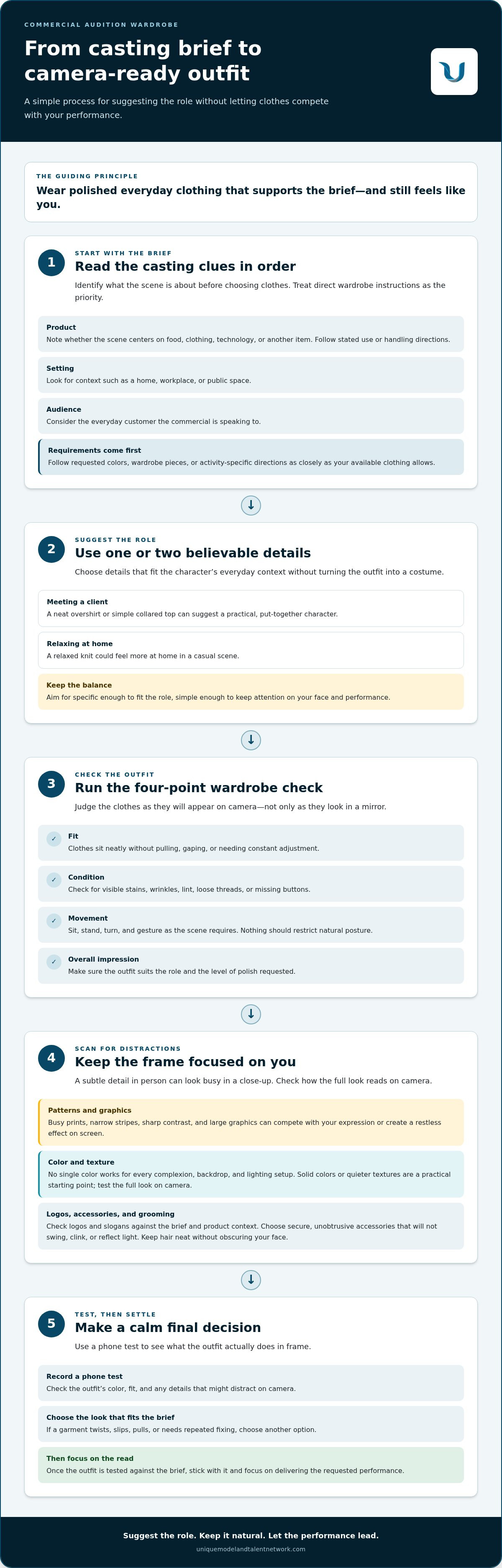
Checklist to test your commercial audition look
A quick, repeatable check can turn outfit uncertainty into a practical decision. Instead of guessing what to wear to a commercial audition, review the brief, test a complete look, and make only the adjustments called for by the camera or movement check. Use clothes you already own, and set aside a simple alternative in case your first choice doesn’t feel right once you’re wearing it.
- Review the brief. Recheck wardrobe, color, product-use, and framing instructions. Note whether the scene may show you seated, standing, or moving, so you can test the outfit in the right positions.
- Select a complete outfit. Put together the clothes, shoes, and accessories you plan to wear. Check that the combination suits the role and doesn’t introduce a conflicting logo, graphic, or character cue. Choose a practical backup from your closet.
- Record a camera test. Use your phone to record a short sample in similar lighting, if possible. Review the frame for color, fit, patterns, graphics, and details that pull attention from your face.
- Check movement and position. Repeat a few natural gestures from the scene. Sit and stand if both positions may appear in the audition. Notice whether fabric pulls, shifts, wrinkles, rustles, or slips out of place.
- Make one final adjustment. Remove or fix anything distracting, such as a loose fastening or noisy accessory. If the outfit remains uncomfortable, switch to the backup and run the same quick check.
Test the outfit on camera before audition day
Keep the phone at the expected camera height and use the likely framing, such as a close-up or a wider view. Watch the recording once for your face and delivery, then again for the clothes. Do stripes or graphics draw your eye? Does a sleeve or collar shift as you gesture? The test can reveal visual distractions, but it can’t predict a casting decision.
For a useful comparison, record your chosen outfit and backup from the same position. Look for consistency in color and fit across the frame, then choose the option that best supports the brief without demanding attention. A phone screen won’t perfectly reproduce every audition setup, so treat the recording as a practical check, not a guarantee.
Make a final comfort and continuity check
Before settling on the outfit, move through the scene at a natural pace. Sit, stand, turn, and gesture; check for pulling, slipping, distracting fabric noise, or accessories that swing into frame. Give the outfit a final look for wrinkles, lint, and loose fastenings. If you’re preparing other visual materials too, consistent, intentional presentation can also support building an acting portfolio.
Keep the backup simple and ready. It’s a calm solution if your first outfit proves uncomfortable, not a reason to keep changing your mind. For structured practice and professional feedback as you build audition readiness, explore the Network Membership.
Arrive ready: make a calm final decision and keep developing your audition skills
Your final outfit decision can be simple: follow the brief, choose the option you tested, and avoid last-minute styling changes. You don’t need a new look for every role. Appropriate clothes you already own can support the scene just as well as anything purchased specifically for an audition. The goal isn’t to look like a different person. It’s to arrive prepared and feel comfortable enough to focus on the work.
Clothing is only one part of audition preparation. Once your outfit is settled, give your attention to the requested performance: understand the sides, listen closely, and make clear choices that fit the direction. A polished wardrobe can support your presentation, but it can’t replace the read or guarantee a casting outcome.
What to do if you are second-guessing your outfit
Pause before changing anything. Return to the casting breakdown and ask whether your concern comes from an actual instruction or from anxiety, comparison, or pressure to follow a trend. Set aside choices that don’t serve the role context. Then choose the tested option that feels believable and allows comfortable movement. A casting result can’t tell you by itself whether your outfit was right or wrong; many parts of an audition contribute to a decision.
Use a short final check instead of reopening the whole wardrobe debate:
- Does it follow the brief? Keep any stated wardrobe directions at the center of your choice.
- Did you test it? Trust what you observed on camera and in movement rather than making an untested change at the last minute.
- Can you focus in it? Choose the option that lets you stand, sit, and deliver the scene without fussing with your clothes.
Once those points are in place, stop adjusting. A calm, familiar choice frees your attention for the audition itself.
Build professional confidence through informed practice
Presentation becomes easier to judge with practice. Repeating a simple outfit-checking process helps you notice what feels comfortable, what reads clearly on camera, and what supports different role contexts. Constructive feedback can add another perspective, especially as you refine your audition approach over time. Focus on learning, not on trying to control an outcome that no wardrobe can promise.
The Network Membership connects aspiring actors and models with industry experts in a private, moderated professional community. Members can take part in live workshops led by industry professionals and use expert Q&A sessions to continue developing their skills. For ongoing learning and peer support as you build your audition readiness, Explore the Unique Model & Talent Network.
Take your audition preparation one step further
Your outfit doesn’t need to carry the whole audition. Think of what to wear to a commercial audition as one practical decision to prepare in advance, then give your attention to being present, responsive, and specific in the scene. This can make the process feel less like searching for a perfect look and more like building a reliable professional routine.
As you gain experience, keep learning from people who understand the work. The Unique Model & Talent Network brings together live workshops led by industry professionals, portfolio reviews, expert Q&A sessions, and a private professional community. These resources support continued skill development and offer constructive perspectives as you refine how you present yourself.
Explore the Unique Model & Talent Network and take a thoughtful next step in your professional development. You’re building your craft one prepared choice and one focused performance at a time.
Frequently Asked Questions
Do I need to buy a new outfit for every commercial audition?
No, you can build audition looks from clothes you already own. When deciding what to wear to a commercial audition, focus on the role’s context and specific instructions, not whether the outfit is new. A clean shirt and simple layer may work for different briefs when styled appropriately. Keep a few reliable options ready, and adjust them to suit each scene rather than shopping for every role.
Can I wear glasses to a commercial audition?
Yes, wear your glasses if they’re part of how you normally present yourself, unless the breakdown gives different instructions. Before recording or arriving, check that the frames sit comfortably and don’t slip when you move. If the audition is self-taped, watch for reflections from lights or windows. Adjust the light or your position if glare obscures your eyes, so your expression remains visible.
Should I wear makeup to a commercial audition?
Makeup is optional. Choose what feels authentic to you and fits the role, rather than adding a look you wouldn’t normally wear. If you use makeup, check it in the audition lighting or on a short phone recording; a shade that looks subtle in a mirror may appear different on camera. Avoid experimenting with unfamiliar products right before the audition, especially if they make you uncomfortable or need frequent touch-ups.
Can I wear visible tattoos to a commercial audition?
Usually, you can leave tattoos visible unless the casting breakdown requests a particular appearance or gives instructions about covering them. Don’t assume a tattoo automatically conflicts with a role or brand. If you’re considering covering one, test that choice in advance and make sure it looks even on camera and stays comfortable. Follow any specific direction, and avoid last-minute coverage that might smudge or distract during the read.
What if the commercial audition instructions specify an outfit?
Follow the stated outfit direction as closely as you reasonably can. If the breakdown asks for a particular color, uniform, or clothing item, treat that as more important than your preferred styling. Read the full instruction so you understand whether it applies to the whole look or only one piece. If you don’t own the exact item, use the closest suitable option you have and keep the rest of the outfit simple.
Should I bring a second outfit to an in-person commercial audition?
Bring a second option only if it’s practical or the breakdown requests a change. A backup can help if your first outfit gets stained, becomes uncomfortable, or doesn’t work as expected, but you don’t need to pack multiple looks for every audition. Choose an alternative from your existing wardrobe that fits the same direction. Keep it ready without letting extra choices create more doubt on the day.


