

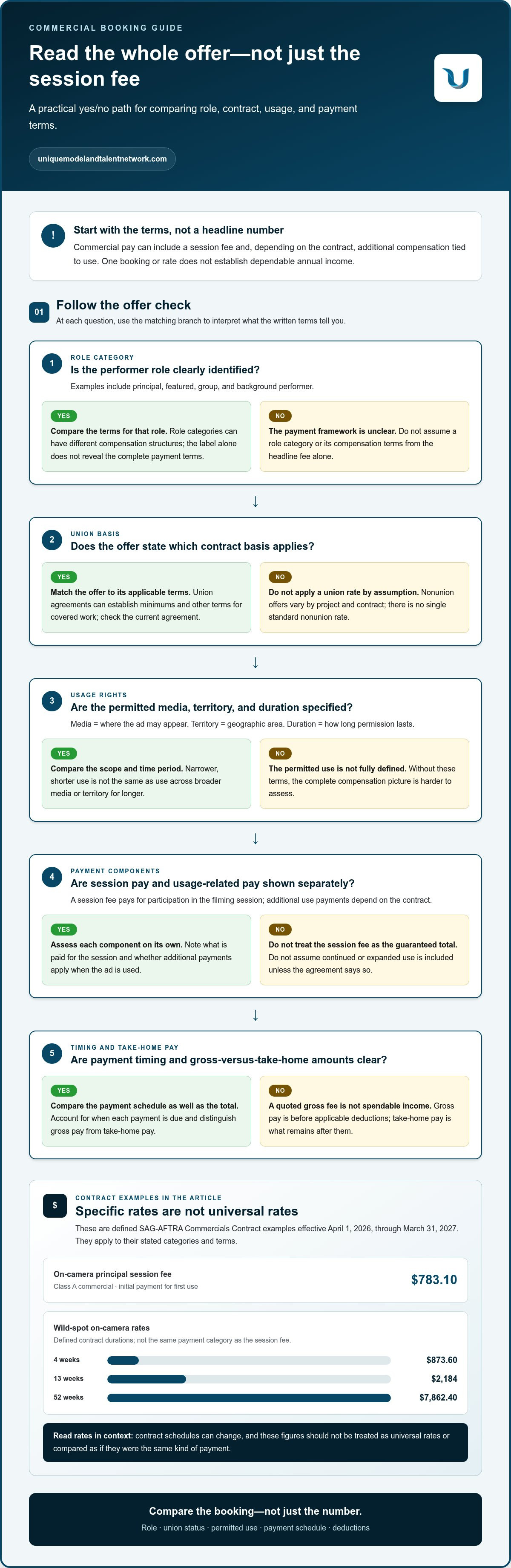
What if the fee attached to a commercial booking is only part of the pay story? If you’re asking how much do commercial actors make, the answer depends on more than a headline rate. For example, under the SAG-AFTRA contract effective April 1, 2026, to March 31, 2027, the on-camera principal session fee for a Class A commercial is $783.10. That’s the initial payment for first use; later use may bring additional payments under the contract.
Conflicting online figures can make earnings seem easier to predict than they are. A session fee isn’t the same as a usage payment, and one booking doesn’t guarantee steady work or dependable annual income. Your role, union status, the commercial’s reach, and how long the campaign runs can all shape compensation.
This guide explains the main parts of commercial pay, how union and nonunion arrangements can differ, and what to look for in usage terms and buyouts. You’ll get a practical way to assess a booking and set realistic expectations without treating one rate or successful audition as a forecast of yearly earnings.
Key Takeaways
- There’s no single dependable answer to how much do commercial actors make; compensation depends on the booking and its terms.
- Compare the role, union status, permitted ad use, contract length, and payment timing instead of relying on one headline rate.
- Use your own confirmed bookings and expenses to build a more realistic income plan.
- Develop your skills and industry knowledge while treating each booking as an opportunity, not a promise of steady work.
- Industry workshops, expert Q&A sessions, and peer connections can support career learning without guaranteeing paid bookings.
How Much Do Commercial Actors Make? Start With How the Pay Works
There’s no single dependable pay figure for every commercial actor. If you’re asking how much do commercial actors make, assess each booking on its own terms: compensation depends on the role, the contract, and the ad’s permitted use. Acting includes many kinds of work, as this overview of the acting profession illustrates, so a salary figure for actors generally may not describe commercial bookings well.
A commercial payment may include a session fee for the shoot and, depending on the contract, additional compensation when the ad is used. These are separate parts of the deal, not interchangeable labels for one guaranteed amount. For a dated example, SAG-AFTRA’s Commercials Contract rates effective April 1, 2026, through March 31, 2027, list an on-camera principal session fee of $783.10 for a Class A commercial. That is a specific union-contract rate for a defined category, not a universal rate for all actors or projects.
Why a single average can mislead
Commercial actors are generally paid for bookings rather than receiving a steady salary from each job. One actor might book a shoot and receive payment under that contract; another might have different roles or usage terms, or no bookings during the same period. An annual salary estimate can obscure those differences, especially when its source doesn’t explain how it accounts for irregular work.
Role matters, too. A principal performer, featured performer, group performer, and background actor may be compensated under different terms. Union status also affects which contract framework applies. Nonunion work doesn’t follow one universal rate, so a number from one project shouldn’t be treated as the expected pay for another. When you encounter an average, first identify what it measures: a session, a particular usage period, or earnings across a year.
What does a commercial actor’s pay figure include?
The session fee is payment for the actor’s participation in the filming session. It’s the starting point for assessing a booking, but it may not represent the full compensation if the contract provides additional payments tied to use. Usage terms describe where, for how long, or in what contexts the commercial can run. Depending on the contract, a campaign with broader or longer permitted use may have different payment terms from one with narrower use.
Read the payment schedule as carefully as the total. Note what is paid for the session, whether additional usage payments apply, and when each payment is due. Also distinguish gross pay from take-home pay: gross is the amount before applicable deductions, while take-home is what remains after them. The exact deductions depend on individual circumstances, so don’t treat a quoted gross fee as spendable income. Clear terms make it easier to compare bookings by their actual value, not just a headline number.
What Determines Commercial Actor Pay: Role, Union Status, and Usage
A commercial offer is shaped by several connected terms, not just the time spent filming. Role category helps establish the compensation framework; union status determines which contract terms may apply; and usage describes how the finished ad can reach audiences. To understand how much do commercial actors make, compare these details together rather than assuming one rate applies to every performer or campaign.
How role type and union status affect the offer
A breakdown may identify a principal performer who carries the spot, a featured performer with a distinct moment, a group performer appearing as part of an ensemble, or a background performer who helps create the scene. Those categories can have different compensation structures, and the role label alone doesn’t reveal the complete payment terms.
Union agreements can establish minimums and other terms for covered work. Nonunion offers vary by project and contract, so there isn’t one standard nonunion rate. Compare the actual role and written terms, and consult the current applicable agreement before relying on a union rate. For broader context, the Bureau of Labor Statistics’ actor salaries and job outlook information covers actors as an occupational group, not a guaranteed commercial rate.
Why usage rights can change the total
Usage has several dimensions. Media identifies where an ad may appear, such as broadcast, cable, or digital channels. Territory describes the geographic area of use, while duration sets how long the permission lasts. A digital campaign limited to one market and a short period is not the same use as a campaign permitted across broader media or territory for longer.
Read the contract for renewal, extension, or additional-use terms. Continued or expanded use may involve additional compensation if the agreement provides for it; don’t assume that compensation is included in the initial payment. A session payment and a usage-related payment cover different parts of the booking, so evaluate them separately.
For a dated illustration, SAG-AFTRA’s Commercials Contract, effective April 1, 2026, through March 31, 2027, lists wild-spot on-camera rates of $873.60 for four weeks, $2,184 for 13 weeks, and $7,862.40 for 52 weeks. These figures apply to defined union contract categories and terms. They aren’t universal rates, and shouldn’t be compared as though each were the same kind of payment. Rate schedules can change, so use the current agreement when reviewing an offer.
Before accepting or comparing offers, write down the role category, union or nonunion basis, media, territory, permitted run length, and whether extensions are addressed. This turns a headline figure into a clearer picture of what the contract covers. Building industry knowledge is part of professional development; the Network Membership community offers workshops, expert Q&A sessions, and peer connection to support learning.
How to Compare Commercial Acting Offers Without Chasing One Headline Rate
A useful comparison starts with what the contract permits, not just the largest number in a casting notice. When weighing two offers, record the same details for each: role, session payment, media, territory, usage term, and payment timing. This makes differences visible before you decide which headline total better reflects the deal.
Use this hypothetical comparison as a worksheet, not a rate card. The session payment is represented by a variable because actual compensation depends on the specific booking and agreement.
| Offer | Role | Session payment | Usage | Term | Payment timing |
|---|---|---|---|---|---|
| A | Principal | Session amount A | Broadcast in a defined territory | Shorter stated run | Session payment on the stated schedule; usage payment terms listed separately |
| B | Principal | Session amount A | Digital and broadcast use across a broader territory | Longer stated run | Payment dates and any later-use payment described in the agreement |
Even with the same session payment, Offer A and Offer B aren’t equivalent. The second hypothetical grants broader media use and a longer term. That wider permission may affect the contract’s overall compensation, but don’t assume it does. Compare what the agreement actually promises, including whether additional use triggers another payment.
A practical offer comparison checklist
Build a side-by-side record while the terms are in front of you. Capture the role category and session conditions, then note each usage dimension separately. This helps keep assumptions about an ad’s exposure from being mistaken for guaranteed earnings.
- Write down the role and what the session payment covers.
- Record permitted media, territory, and usage duration.
- Mark whether renewal, extension, or additional use has a stated payment provision.
- Separate confirmed contract terms from hoped-for reach, repeat airings, or future campaign plans.
What to verify in a booking agreement
Before comparing totals, read the compensation schedule and payment timeline. Identify which payment is tied to the session and whether usage-related compensation is included, separate, or conditional. Then review the wording for extensions and renewals. A broad phrase such as “digital use” may not tell you every platform or time limit unless the agreement defines it.
If the booking is covered by a union agreement, compare its terms with the current official SAG-AFTRA materials that apply to that category and contract period. Don’t rely on a copied rate chart without checking its date and scope. For a nonunion booking, use the written offer as the basis for comparison rather than assuming it follows a standard scale.
This method gives you a grounded answer to how much do commercial actors make for a particular booking: assess the confirmed payment and the rights granted, then keep possible future use separate unless the contract explains what happens.
Can Commercial Acting Provide Reliable Income? Plan Around Variable Bookings
One commercial booking doesn’t establish predictable annual income. A campaign may pay according to its agreed terms, but future auditions, bookings, renewals, and repeat use aren’t guaranteed. Build your plan around what you’ve actually booked and what the contract confirms, not the best-case value of a possible campaign. For a wider view of audition preparation and the booking process, explore this guide to film industry auditions.
A grounded way to estimate your own commercial income
Choose a consistent period, such as a calendar year or another span that suits your records. The aim isn’t to predict the next booking. It’s to understand what your work history shows and make a practical plan from there.
- Gather completed booking records. List each commercial booking in the period you chose, using payment statements or other records rather than memory. Note the booking date and the amount actually received.
- Separate payment types. Track session compensation apart from usage-related payments. This shows what came from the shoot and what arrived later under the contract.
- Count only confirmed compensation. Include amounts supported by a booking and its terms. Keep auditions that haven’t resulted in a booking, speculative renewals, and hoped-for repeat use out of confirmed income.
- Account for expenses. Compare recorded income with your own work-related and personal expenses to understand what remains available for your budget. Keep gross payments distinct from money you can spend.
This record gives you a more useful baseline than an online annual average. If you’ve booked inconsistently, your history may show that income varies substantially from one period to another. If you’re new to commercial work, you won’t yet have enough personal booking history to establish a reliable pattern. Start tracking now and update your records as confirmed payments arrive.
Build skills and industry knowledge between bookings
Use quieter stretches to prepare for the next opportunity, rather than assuming one is guaranteed. Regular audition practice can help you stay ready to respond to casting requests, while learning about the process can sharpen your professional judgment. The guide to professional acting workshops online offers a starting point for exploring skill-building options. Training and networking support development, but neither guarantees a role or income.
For ongoing learning and connection with industry experts and peers, explore the Network Membership. Use what you learn to make informed choices, while keeping your financial plan anchored to confirmed bookings, actual payment records, and expenses. That’s a steadier approach to uncertainty than treating any single opportunity as a forecast.
Build Commercial Acting Career Knowledge With the Right Support
Understanding commercial pay is one part of building a professional acting career. Skill development and industry knowledge can help you prepare, assess your materials, and make informed decisions. Realistic financial expectations also keep one booking from becoming an assumed income pattern. Learning supports your development, but it can’t promise a role, steady work, or a particular level of earnings.
Use expert feedback to strengthen your professional materials
Your portfolio and reel help present your work. A review can offer an informed perspective on how those materials communicate your experience and goals, giving you practical areas to consider as you refine them. Use feedback to guide preparation and growth, not as a prediction of who will cast you or whether you’ll book a role. This guide to building an acting portfolio can help you think through how to develop and maintain your materials.
Keep the process connected to your professional aims. You might use a review to identify what feels clear, where your materials could be more focused, or what skills you want to strengthen next. Those observations can guide your practice without turning career development into a promise of paid work.
Continue learning in a professional community
Commercial acting involves more than understanding a rate. Live industry workshops and expert Q&A sessions can help you build knowledge with industry professionals, while monthly skill-building challenges offer a way to keep developing between auditions and bookings. Peer connections add another perspective: actors can share questions and learn in a professional community rather than relying solely on scattered social-media advice.
Use these resources to build a stronger foundation, not to forecast your income. A workshop can support your craft; an expert conversation can clarify industry concepts; peers can offer connection as you work toward your goals. Keep financial expectations grounded in confirmed work and contract terms, while investing in learning that supports your development.
If you’re looking for an educational setting that brings together industry workshops, expert Q&A, peer connection, and portfolio and reel reviews, explore the Network Membership. Build your industry knowledge and keep developing your craft while staying realistic about the work required to grow a career.
Make Your Next Career Step Deliberate
Let “how much do commercial actors make” lead to a more useful question: what professional habits will help you make informed choices as opportunities arise? Set a goal you can act on, such as reviewing your materials, strengthening a specific on-camera skill, or learning more about commercial agreements. Then give that goal consistent attention, even between bookings.
Career growth rarely follows a straight line. You can’t control every audition outcome, but you can build your craft, seek thoughtful feedback, and develop a clearer understanding of the business side of acting. Treat each step as progress, not as a guarantee of immediate work or income.
If you’re ready to keep learning alongside emerging talent and industry professionals, explore the Network Membership and keep building your industry knowledge.
Frequently Asked Questions
Do commercial actors get paid for auditions?
Generally, auditions are part of seeking a role, not paid commercial engagements. Don’t count an audition as income unless the project terms explicitly provide payment. For example, keep travel or preparation costs in a separate expense record rather than subtracting them from money you’ve earned. If you’re selected, review the booking paperwork before filming so you understand what work is covered and how compensation will be handled.
Do commercial actors get paid if an advertisement never airs?
Payment depends on the agreement, the work completed, and any conditions stated in the contract. For instance, a production may have separate terms for completing a session and for the ad’s use. Don’t assume every payment depends on the commercial airing, or that an unaired spot is always paid the same way. Keep a copy of the booking documents and refer to their wording to understand what applies.
How long does it take commercial actors to get paid?
There’s no universal payment timeline; it can vary by production, contract, and applicable union terms. Check the agreement for due dates, required forms, and any steps you must complete after the session. Keep a simple record of the booking date, shoot date, submitted paperwork, and payments received. That timeline helps you follow up based on the actual terms instead of relying on another actor’s experience.
Can beginners make money as commercial actors?
Yes, beginners can pursue paid commercial roles, but auditions don’t guarantee a booking or income. If you’re asking how much do commercial actors make at the start, there isn’t a dependable beginner figure: role, contract, union status, and usage all matter. Focus on preparing professional materials and learning how bookings work. Track your completed jobs and payments so expectations grow from evidence, not online claims.
Is commercial acting a full-time job?
Commercial acting can be part of a full-time career for some performers, but a booking itself doesn’t establish steady employment. Work may arrive unevenly, so consider how commercial projects fit alongside your other acting work or income sources. For planning, distinguish confirmed engagements from auditions and possible future bookings. A realistic budget should account for quiet periods rather than assuming commercial work will arrive on a regular schedule.
Are commercial acting earnings taxable?
Paid acting income may have tax implications, but how it’s reported depends on your circumstances and applicable tax rules. Keep records of payment statements, contracts, and relevant project expenses so you have organized documentation. Also distinguish gross compensation from the amount you take home. For guidance on deductions, filing status, or reporting requirements, speak with a qualified tax professional who can advise you based on your situation.
Do commercial actors receive residuals when an ad runs again?
Not automatically. Whether repeat or expanded use brings additional compensation depends on the applicable agreement and the booking’s terms. Some agreements may use payment language other than “residuals,” so look for provisions covering reruns, renewals, extensions, or added media. Union and nonunion arrangements can differ. For a specific booking, use the current relevant agreement and written contract rather than assuming every repeat airing triggers the same payment.


