

What if the right model for your photoshoot isn’t the person with the biggest following, but the one who best fits the brief? If you’re unsure how to find models for a photoshoot, you’re not alone: choosing between agencies, casting platforms, social media, and personal networks can feel harder than planning the shoot itself. A portfolio can show a model’s range, but it won’t confirm availability, experience with your concept, or whether the working arrangement is a fit.
A clear process makes the search more professional and the collaboration easier to plan. This guide will help you define your casting needs, choose sourcing channels that suit your project, compare candidates against the brief, and make a clear first approach. You’ll also learn what to settle around compensation, image use, logistics, and respectful on-set communication before shoot day. We’ll cover practical sourcing steps first, then look at how professional networking and education can help you build lasting relationships with emerging talent.
Key Takeaways
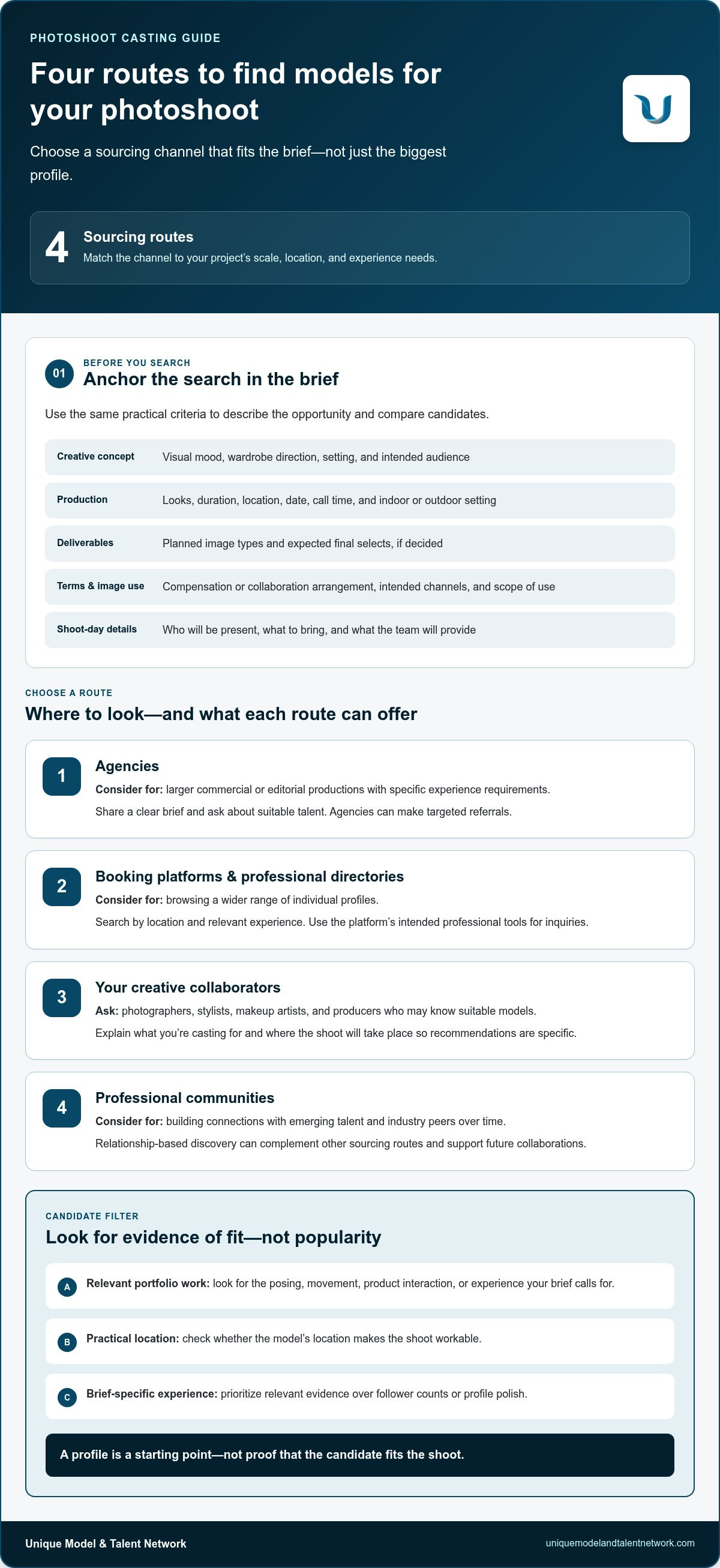
- Define the shoot concept, audience, deliverables, schedule, location, and image-use needs before you start casting.
- Learn how to find models for a photoshoot by choosing discovery channels that fit your project and the talent you’re seeking.
- Compare candidates against your brief, focusing on relevant portfolio work, communication, reliability, and availability rather than popularity alone.
- Make your first approach clear and respectful, then put the agreed terms and shoot details in writing.
- Build professional connections through industry learning and networking to support future collaborations with emerging talent.
Start with the Photoshoot Brief: Define the Model You Need
If this is your first photoshoot, you don’t need a complicated casting document. A clear, practical brief helps you search with purpose, describe the opportunity, and compare candidates consistently. Before asking how to find models for a photoshoot, decide what the images need to communicate and what the collaboration involves.
A useful brief turns the creative concept, audience, deliverables, logistics, and image-use terms into clear criteria you can share with candidates.
Turn the creative concept into practical casting criteria
Start with the story behind the images. Describe the visual mood, wardrobe direction, setting, and intended audience. A polished campaign for outdoor clothing, for example, calls for a different look and performance style than intimate studio portraits. If you’re planning fashion photography, specify whether the images should showcase garments, communicate a lifestyle, or support editorial storytelling.
- Separate essentials from preferences. List role requirements, such as comfort with movement, experience posing with a product, or the ability to portray a particular character. Keep preferences, like a specific hairstyle, flexible unless they’re central to the concept.
- Define the production. State the number of looks, approximate shoot duration, location, date, and expected call time. Say whether the shoot is indoors or outdoors, and flag practical conditions such as walking between locations.
- Name the deliverables. Explain the planned image types and, if you’ve decided, how many final selects you expect to deliver. This gives candidates a clearer sense of the scope and preparation involved.
Set expectations before inviting applications
Be direct about compensation or collaboration terms. A paid booking, test shoot, and creative collaboration are different arrangements. Describe the one you’re offering so models can decide whether the project works for them before committing.
- Explain image usage. Identify the intended channels, such as a portfolio, brand website, social media, or advertising, and clarify the expected scope and duration of use. Don’t leave commercial use or other planned uses open to interpretation.
- Set delivery expectations. Share the expected format or approximate timing for final images if known, and explain how the model will receive them. Note any planned promotional use or crediting approach.
- Cover shoot-day details. Say who will be present, including the photographer and any stylist or makeup artist. List what the model should bring, such as wardrobe options, shoes, or reference images, and what the production team will provide.
Before sharing the brief, reread it from a candidate’s perspective. Can someone understand the concept, schedule, terms, image use, and preparation needed without asking for basic details? If so, you’re ready to invite interest and assess applicants against the same criteria.
Where to Find Models for a Photoshoot: Choose the Right Channel
The best place to search depends on the brief you’ve prepared. A local portrait session may call for nearby emerging talent, while a campaign with specialized requirements may benefit from agency referrals. Rather than posting everywhere and sorting through mismatched responses, choose channels based on the project’s scale, location, and experience needs. That makes how to find models for a photoshoot a practical sourcing decision, not a popularity contest.
- Match the channel to the project. For a larger commercial or editorial production with specific experience requirements, contact agencies with a clear brief and ask about suitable talent. Agencies can make targeted referrals, while a direct booking platform or professional directory may offer a wider range of individual profiles.
- Search by relevant evidence. In talent directories and creative communities, browse by location and project-relevant experience. Look for portfolio images that show the posing, movement, or product interaction your shoot needs. Follow the platform’s norms and use its intended professional tools for inquiries.
- Ask your collaborators. Photographers, stylists, makeup artists, and producers may know models whose working style and experience suit the project. Explain what you’re casting for and where the shoot will take place so recommendations are specific.
- Build relationships beyond one post. Professional communities can help you connect with emerging talent and industry peers over time. For relationship-based discovery, explore acting industry networking platforms and consider how a moderated network can support professional connections. Unique Model & Talent Network brings emerging talent and industry professionals together, providing a setting to build relationships alongside other sourcing routes.
Use directories and creative communities with purpose
A profile is a starting point, not proof of fit. Compare its portfolio with the visual demands in your brief, check whether the person’s location makes the shoot practical, and note experience that directly relates to the work. A polished profile may not show the specific skills you need, so base your assessment on relevant evidence rather than follower counts or presentation alone.
Keep your search focused. If you need a model comfortable demonstrating a product in motion, prioritize portfolios that show movement or similar work. If the shoot is local and short, prioritize candidates whose location and availability fit the schedule. Don’t narrow the search with preferences that aren’t essential to the role.
Build a focused shortlist from referrals and networks
Track promising candidates in one simple shortlist. Record each person’s portfolio link, location, relevant fit notes, referral source, and communication status. This makes it easier to compare candidates fairly and follow up without losing details across messages. A professional community such as the Unique Model & Talent Network can also help you develop industry relationships and learn from peers alongside other sourcing routes.
Use more than one channel if your first search doesn’t produce a strong shortlist. Keep the brief and selection criteria consistent across referrals, directories, and agency inquiries. You’ll get a clearer comparison, and candidates will receive a consistent description of the opportunity.
How to Evaluate Model Candidates Without Guessing
A strong candidate isn’t necessarily the most visible one. Use the same criteria for everyone and compare what each person can bring to this specific project. That keeps your decision grounded in the brief rather than follower counts, assumptions, or a single striking image.
Judge portfolio fit against the shoot concept and deliverables, not popularity or one standout image. Give each criterion a project-specific importance level: essential, useful, or optional. This helps you distinguish a genuine mismatch from a preference that shouldn’t rule someone out.
| Criteria | Evidence to review | Project-specific importance |
|---|---|---|
| Portfolio relevance | Images showing the expressions, movement, styling, or setting the shoot calls for | Essential if the concept depends on a specific skill or visual approach |
| Range and adaptability | Examples across different poses, moods, or looks | Useful when the shoot includes several setups; optional for a focused portrait session |
| Reliability signals | Clear profile details, relevant credits, and consistent project information | Important for every project, especially one with a fixed schedule |
| Communication | Direct answers, professional tone, and attention to agreed details | Essential for coordinating expectations and logistics |
| Practical availability | Confirmed date, location fit, and ability to meet the call time | Essential if the shoot date or location can’t change |
Review portfolios for relevance to the shoot
Look for examples that demonstrate what your concept requires. A lifestyle shoot may call for relaxed expressions and natural interaction, while a movement-focused brief needs images that show the candidate working in motion. Consider consistency across the portfolio, but also look for adaptability if you’re planning multiple looks. No single frame proves how someone will perform in a new setup.
If you’re assessing how a portfolio presents someone’s range and experience, this guide to building a professional acting portfolio offers useful context. Apply the same principle to model portfolios: review the overall body of work, not just its strongest image.
Confirm fit through clear, professional communication
Once a candidate looks promising on paper, ask concise questions tied to the shoot: Have they worked with a similar concept? Are they available for the stated date and call time? Do they understand the project’s terms and planned image use? Their replies can clarify expectations, but assess the content and clarity of communication rather than making assumptions about personality.
Notice whether messages are timely, specific, and consistent with the information already shared. A candidate who flags a scheduling conflict early is giving you useful information; don’t treat a respectful decline as a reliability problem. Keep the process fair by asking each finalist comparable questions, then weigh their answers against the requirements that matter for this project. A large following, personal appearance preferences, or unrelated personal details shouldn’t substitute for relevant evidence.
Approach Models Professionally and Prepare the Collaboration
Once you’ve identified a promising candidate, the way you communicate sets the tone for the shoot. A respectful, specific invitation gives the model enough information to make an informed decision and helps both of you see whether the collaboration is a fit. Knowing how to find models for a photoshoot also means treating the first message, shared expectations, and shoot-day plan as parts of one professional process.
Clear written expectations about compensation, image usage, schedule, deliverables, and release documentation reduce avoidable misunderstandings before anyone arrives on set.
Write an outreach message models can assess
Personalize your opening with a relevant detail, such as a portfolio image that shows the kind of movement or expression your concept needs. Then summarize the essentials so the recipient doesn’t have to piece together the opportunity from scattered messages. Be direct about the expected commitment, compensation or collaboration terms, and intended image use. Invite questions, give a reasonable reply date, and make it clear that the model can decline.
Outreach template:
Hi [Name], I’m [your name], a [photographer/role]. I liked your [specific portfolio work or relevant experience] and thought it could suit a [brief concept] shoot. We’re planning [date and approximate time] at [location], with an expected commitment of [duration]. The terms are [compensation or collaboration arrangement], and the images are intended for [use and channels]. If you’re interested, I’d be happy to share more details. Please let me know by [date] if that timing works, and feel free to ask any questions.
Adapt the template to the person and project. Don’t imply a paid opportunity if the arrangement is collaborative, or leave the terms vague in the hope of discussing them later. A clear invitation helps candidates decide on their own terms.
Confirm the plan before the shoot date
After the model agrees, send one written confirmation everyone can refer to. Include the schedule, full address, arrival instructions, contact person, wardrobe guidance, and what the model should bring. Identify who will be on set and share relevant updates, such as a location change or revised call time, as soon as possible.
- Document image use. Agree on intended channels, scope, duration, and any credit expectations. Handle permission and release documents in a way that fits the project and location, and make sure the model has time to review the terms before signing.
- Clarify delivery. Confirm what images the model can expect, how they’ll receive them, and the anticipated delivery timing if agreed.
- Reconfirm the essentials. Before shoot day, make sure everyone understands the date, arrival time, location, and terms.
Professional preparation builds trust without requiring an elaborate paperwork process or a lengthy chain of messages. If you want to develop industry relationships alongside practical shoot planning, connect with industry professionals through the network, where learning and networking can support future collaborations.
Build Better Model Connections Through Industry Learning and Networking
A one-off listing can help you locate profiles for a current casting. An informal social post may bring quick responses. But neither necessarily creates the professional relationships that make future collaborations easier to plan. Ongoing networking gives photographers, models, and other creatives a chance to learn how each person works, exchange insight, and build trust over time.
Networking doesn’t replace casting for a specific shoot. Each project still needs its own brief, candidate assessment, and clear agreement. Think of networking as a longer-term foundation: it can help you become a more informed collaborator and build connections that may be relevant when a new concept takes shape. It’s one useful part of how to find models for a photoshoot, not a substitute for confirming fit and terms for a particular project.
Make networking useful beyond a single casting search
Professional relationships grow through contribution, not just requests. Share practical knowledge from your work, listen to the experiences of emerging talent, and follow through when you make a commitment. A thoughtful exchange about posing direction, set preparation, or portfolio presentation can build mutual understanding before you discuss a particular shoot.
Structured learning can strengthen those connections, too. Workshops give participants a setting to develop skills together, while portfolio reviews can help talent and creatives reflect on how work is presented. Expert Q&A sessions offer a chance to hear industry perspectives and ask focused questions. Treat these opportunities as professional development, then assess every casting on its own requirements.
- Contribute with purpose. Share relevant experience and useful feedback rather than contacting people only when you need a candidate.
- Stay connected thoughtfully. Follow up after a workshop or conversation with a specific note about what you learned or appreciated.
- Keep casting project-specific. When a shoot comes up, return to its requirements and assess interested candidates on their fit for that brief.
Explore a professional community for continued connection
A professional network is more than a page of listings. A private, moderated community can bring emerging talent and industry professionals together for ongoing learning and conversation. Unique Model & Talent Network offers members access to live industry workshops, portfolio and reel reviews, monthly skill-building challenges, and industry expert Q&A sessions. Industry professionals can join to discover vetted talent and host educational sessions.
Use these spaces to learn, exchange perspectives, and build relationships at a professional pace. Photographers can take part in a creative community while continuing to assess candidates and plan each shoot according to its brief.
Explore The Network Membership as a learning and networking option for building stronger industry connections.
Make Your Next Creative Connection Count
Your next shoot can be more than a finished set of images. Treat each collaboration as a chance to learn how you work with others, then carry those insights into the next project. A note about what made the creative process smooth, or what you’d approach differently, can help you become a more thoughtful and confident collaborator.
Keep building your industry knowledge between castings, too. The Unique Model & Talent Network is a private, moderated community connecting emerging talent with industry professionals, with live workshops, portfolio reviews, skill-building challenges, and expert Q&A sessions. Professionals can join to discover vetted talent and host educational sessions, creating opportunities for meaningful industry exchange.
If you’re ready to develop connections and keep learning alongside people in the industry, explore The Network Membership. A more intentional approach to how to find models for a photoshoot can start with one clear next step: building the professional relationships that help your creative work grow.
Frequently Asked Questions
Do I need a modeling agency to find models for a photoshoot?
No, an agency isn’t required for every photoshoot. For a small local portrait project, you might find candidates through a creative community or a trusted collaborator. A campaign requiring specialized experience or several roles may benefit from agency referrals. Start by deciding what the shoot needs, then choose a route that can reach that talent. The right sourcing method depends on the assignment, not a universal rule.
How can I find models for a photoshoot with a limited budget?
Set the project terms before reaching out, and don’t treat exposure as guaranteed compensation. Some photographers and models choose to collaborate on portfolio-building work, while other projects call for paid talent. If you’re figuring out how to find models for a photoshoot on a tight budget, be upfront about the time commitment, intended image use, and deliverables. Candidates can then decide whether the arrangement suits their own goals.
What should I include in a message to a model?
Include the key details a model needs to decide whether to respond: who you are, why you’re contacting them, the concept, date, location, expected time, terms, and intended image use. Mention a relevant portfolio detail so your message feels personal rather than mass-sent. A concise subject line can make the project easy to identify later. Invite questions, give a reasonable response date, and make declining comfortable.
How many models should I contact for a photoshoot?
There’s no fixed number that fits every shoot. The size of your shortlist depends on the role, schedule, location, and how many candidates meet the essential criteria. For a single-role shoot, focus on a manageable group of strong matches instead of sending generic messages widely. Track replies and availability, then confirm your chosen model and any backup plan early enough to coordinate the production.
Should models sign a release for a photoshoot?
Whether a release is appropriate depends on the project, intended image use, and applicable local requirements. Discuss where and how the photos may appear before the shoot, then make sure the written agreement reflects what both parties understand. For commercial use or complex rights, seek legal guidance relevant to the project’s jurisdiction rather than relying on a generic form. Keep a record of the agreed terms.
How do I make a model feel comfortable during a photoshoot?
Make the set feel predictable and respectful. Before the session, explain who will be present and how the shoot will run. Agree on boundaries, and check in if a pose, wardrobe choice, or creative direction changes. For example, pause to discuss a new setup rather than assuming consent carries over. Respect requests to stop or adjust, and plan breaks so the model can reset as needed.
Can aspiring models work with photographers before joining an agency?
Yes, aspiring models can take part in suitable projects while gaining experience and developing portfolio material. Before agreeing, both sides should be clear about the purpose, time commitment, compensation, and image use. A collaboration can help someone practice on set or explore a particular look, but it doesn’t promise agency representation or future work. Choose projects that support a defined goal and maintain professional boundaries throughout.


