
What if your high-end portfolio isn't actually the tool that lands you the job? If you've ever stood in a crowded casting office feeling like you're missing a secret piece of the puzzle, you're in the right place. Most casting directors spend less than 3 seconds looking at a talent's materials before making a mental "yes" or "no" decision. It's easy to feel overwhelmed by industry jargon or anxious about whether your current photos look professional enough. Understanding exactly what is a comp card is the first step toward moving past the noise and into the room where real, paying jobs are booked.
You deserve to feel confident every time you hand over your marketing materials. We're going to help you stop guessing and start presenting yourself as a vetted professional. This guide provides the practical guidance you need to master the model's business card so you can stand out at your next casting call. We'll break down the specific anatomy of a high-converting card, show you how to select your five strongest images, and explain the crucial differences between comp cards, digitals, and full portfolios. By the end of this article, you'll have a clear roadmap to being really seen by industry insiders without the distractions of social media.
Key Takeaways
- Understand exactly what is a comp card and why this "modeling business card" is the most critical tool for your professional marketing.
- Master the anatomy of a high-conversion card by prioritizing five high-quality images that showcase your range from commercial to high fashion.
- Learn the precise physical and digital specifications required to navigate the 2026 industry landscape without the noise of outdated standards.
- Discover how to present your materials with confidence during a Go-See so you can stop guessing and start booking real, paying jobs.
Defining the Comp Card: Your Modeling Business Card
If you're serious about booking real, paying jobs, you need to understand exactly what is a comp card. It's more than just a collection of photos; it's your professional handshake in a competitive industry. A comp card, or composite card, is a double-sided marketing tool used by models and actors to showcase their range and versatility in a single glance. While your personality gets you in the door, this card keeps you top-of-mind long after you've left the room. It serves as the primary "leave-behind" for casting directors and agents after a go-see or audition, ensuring they have a physical reminder of your talent.
The industry often uses the terms Zed card or Sed card interchangeably. These names honor industry pioneers like Peter Marlowe and Sebastian Sed, who helped formalize the standard. According to Wikipedia's article on comp cards, the format was specifically designed to streamline how agencies and clients viewed talent. It's important to distinguish these from what are digitals. While digitals are raw, unedited "polaroids" that show your natural state, your comp card features your best professional, edited work. It's the curated, high-end version of your brand designed to stop the guessing and prove your professional value.
The History of the Zed Card
The Zed card originated in London during the 1960s to standardize model submissions. Before this, talent would often bring a disorganized collection of loose prints. The format evolved from bulky A4 paper to the modern A5 card stock standard that fits perfectly into a casting director’s filing system. Even in a digital-first world, the industry relies on physical cards. They provide a tactile reference that won't get lost in a crowded email inbox or a crashed browser tab during a busy casting session.
Comp Card vs. Digital Portfolio
Think of your portfolio as the "book" or the full story of your career. Your comp card is the "elevator pitch" or the highlights reel. You need both to navigate professional casting environments without the noise of social media distractions. While a portfolio shows your depth, the comp card acts as a quick-reference guide for busy decision-makers. It allows an agent to recall your look, measurements, and range in under five seconds. This efficiency helps you stay organized and presents you as a vetted professional ready for work.
The Anatomy of a High-Conversion Comp Card
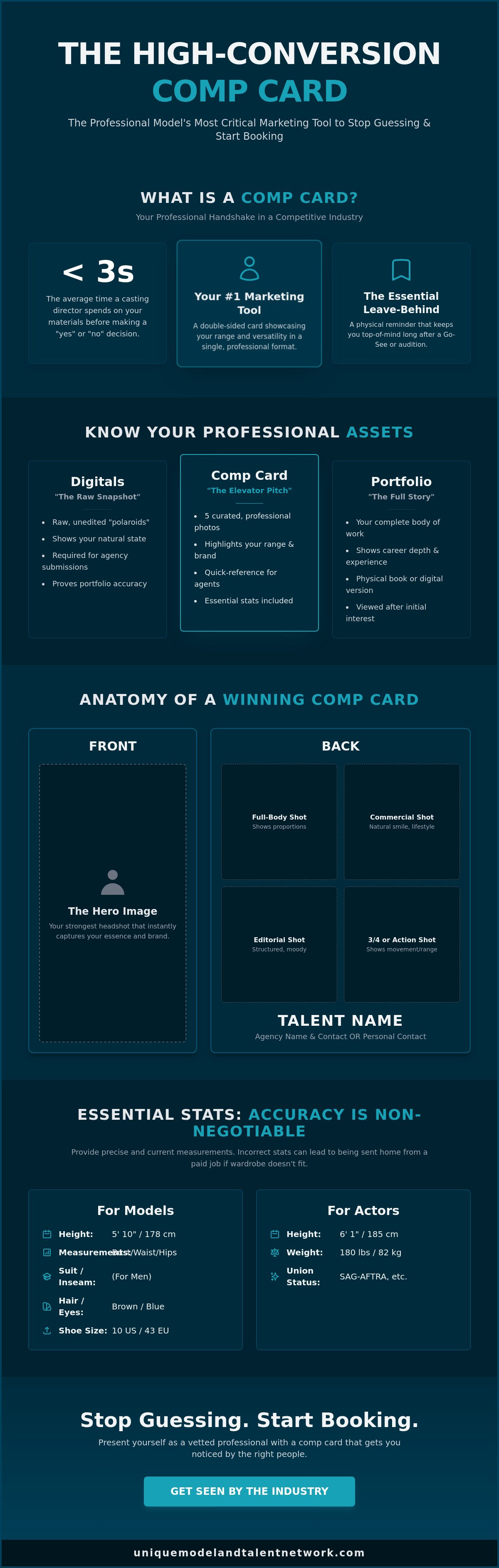
Understanding what is a comp card starts with its physical anatomy. It is not just a collection of photos; it is a high-impact marketing piece designed to sell your "brand" to a client in under three seconds. A standard, professional card follows a strict five-image layout. This format has remained the industry gold standard because it provides a comprehensive overview of a talent's range without overwhelming the viewer with unnecessary noise.
The front of the card is reserved for your "hero" image. This must be your strongest, most signature headshot that captures your essence immediately. If this image fails to grab attention, the casting director will likely never flip the card over. To see how top-tier talent selects these images, you can study industry-standard portfolios on Models.com to see the level of polish required for a professional first impression.
The back of the card features a collage of four varied looks. This is where you prove your versatility. You should include a full-body shot to show your proportions, along with a mix of commercial and editorial vibes. If you are a commercial model, include a "lifestyle" shot with a natural smile. If you lean toward high fashion, include a more structured, moody image. This variety tells a client that you can handle multiple types of "real, paying jobs" without needing a separate portfolio for each.
Essential Stats to Include
Accuracy in your measurements is the absolute rule of the industry. If you provide outdated stats and show up to a set where the wardrobe doesn't fit, you risk being sent home and "vetted" out of future opportunities with that casting office. Your stats allow clients to know if you fit the wardrobe requirements instantly.
- For Models: You must list your height, bust/waist/hips (for women), suit/inseam (for men), hair color, eye color, and shoe size.
- For Actors: Include your height, weight, and your current Union status, such as SAG-AFTRA or non-union.
Contact Information Standards
The way you present your contact details signals your level of professional experience. If you have agency representation, you should only include the agency’s logo and their specific contact details. This ensures the agency handles all negotiations and keeps your professional image streamlined.
If you are working as a freelance talent, you need to be your own gatekeeper. Include a professional email address, a working phone number, and a direct link to your acting industry networking platform profile. Many modern cards now utilize QR codes on the back. This allows a scout to scan the card with their phone and jump directly to your digital video reel or full portfolio. If you want to stop guessing about your marketing materials and start seeing results, consider joining a vetted professional network that connects you with legitimate industry insiders.
Selecting the Right Images: Quality Over Quantity
If you're building your first card, you might feel tempted to fill every inch of white space with your favorite photos. That's a mistake that costs talent real opportunities. The biggest error beginners make is using 5 "okay" photos instead of 3 "amazing" ones. A cluttered card suggests you don't know your brand. A curated card proves you're a professional ready for a high-stakes set.
Your card must tell a complete story within seconds. It's not enough to look good; you must demonstrate range. Can you handle a high fashion editorial? Do you look natural in an athletic setting? Can you play the approachable neighbor in a commercial? If every photo shows you in the same mood or outfit, you're wasting valuable real estate. Avoid "repeating" looks at all costs. Each image must reveal a different facet of your talent so a casting director can place you in multiple roles.
Professionalism is your primary currency in this industry. If you include "selfies" or filtered social media photos, your card will likely end up in the trash. Vetted agencies report that 85 percent of talent submissions are rejected immediately due to poor image quality. High-end clients want to see your skin texture, your true hair color, and your natural bone structure. Filters hide the very details that book real, paying jobs.
The "Hero" Shot
The front-page headshot, known as the "Hero" shot, is your most critical asset. It needs to be clean, well-lit, and pulsing with personality. While some models prefer a "smize" or a moody look, direct eye contact with the camera is vital. It creates an immediate connection with the viewer. The hero shot is the hook that determines if the back of the card is even looked at.
Building the "Versatility Collage"
The back of the card is where you prove your utility. You need a full-body shot to show your proportions and how you carry yourself. Without this, casting directors are left guessing about your height and build. You should also include a "lifestyle" shot. These are the images that appeal to massive commercial clients like Target or Amazon who need talent that feels relatable and warm.
If you're unsure which images truly represent your "bookable" self, you're not alone. Investing in a professional portfolio review for actors can help you identify which images are actually booking-ready. This process takes the guesswork out of your presentation. When you understand what is a comp card from a buyer's perspective, you stop choosing photos based on vanity and start choosing them based on marketability. A streamlined, professional card is your ticket out of the noise and into the casting room.
Physical vs. Digital Comp Cards: Navigating 2026
If you want to book real, paying jobs in 2026, you can't choose between a physical or a digital presence. You need both to be considered a serious professional. Understanding what is a comp card in the current market means recognizing it as a hybrid tool. It serves as your physical handshake during in-person meetings and your digital calling card in the global casting database. Without both versions, you're essentially invisible to half of the industry's decision-makers.
For your physical cards, stick to the strict industry standards. The standard size remains 5.5" x 8.5", often referred to as A5. You should print these on heavy 12pt or 14pt card stock. A 2025 survey of casting directors showed that 68% prefer a matte finish over high-gloss because it doesn't reflect overhead office lighting during review sessions. Avoid home printing at all costs. Consumer-grade inkjets lack the professional color calibration required to represent your skin tone and hair color accurately. If your card looks amateur, agents will assume your work ethic is too.
Your digital version requires equal attention to detail. It must be a single-page PDF where the front and back are combined for easy scrolling. Keep the file size under 2MB. Large files often trigger spam filters or fail to load on mobile devices during fast-paced casting sessions. This digital file is your primary tool for "stopping the noise" and getting your face in front of vetted professionals instantly.
When to Hand Out a Physical Card
Physical cards are essential for go-sees and open calls. When a casting director meets 500 models in a single afternoon, they won't remember a face from a screen; they remember the card they held in their hands. This is where the "Stack Test" happens. Your card needs to feel substantial and high-quality so it doesn't get lost or discarded at the bottom of the pile. Use these cards at networking events as a professional alternative to the "just follow me on Instagram" approach. It signals that you're a business-minded talent, not just a social media hobbyist.
Mastering the Digital Submission
Efficiency is the key to digital success. Always name your file correctly. Use a format like "FirstName_LastName_CompCard_2026.pdf" instead of generic names like "IMG_4567.pdf." This ensures your file is searchable in an agent's crowded inbox. You should also ensure your digital card is interactive. Hyperlink your contact information and stats directly to your talent network profile. If you need a starting point for your layout, check out our guide on comp cards modeling for specific 2026 design templates.
Ready to move past the guesswork and start booking real jobs? Join our vetted community of industry professionals today.
How to Use Your Comp Card to Stop Guessing and Start Booking
You have finalized your layout and selected your best shots. Now you need to understand that what is a comp card in practice is quite different from what it is on paper. If you have a stack of cards but no strategy, you're just holding expensive cardstock. Your network acts as the engine that drives this tool forward. Without a vetted community to guide you, your materials might never reach the right desk. A professional network ensures your card lands in the hands of casting directors who are looking for your specific look right now.
The Professional Hand-Off
During a "Go-See," your card is your calling card. Don't force it into a casting director's hands the moment you walk in. Wait for the conclusion of the interview or when they specifically ask for your materials. Pair the hand-off with a 15 second elevator pitch that highlights your recent experience and your reliability on set. The card is the professional receipt of your interaction. It ensures that once you leave the room, your face and stats remain behind to do the selling for you.
Getting Expert Feedback
Avoid the rookie mistake of printing 500 cards before your images are vetted by an expert. If your layout is cluttered or your photos don't meet 2024 industry standards, you'll waste hundreds of dollars on unusable marketing. Our modeling career coaching helps you refine your marketing materials before they go to press. Joining a community of insiders allows you to get feedback on which "hero" shot actually stops a scout's scroll. Agents look for a specific balance of commercial appeal and high-fashion versatility. They want to see that you understand your brand before they invest in you.
When you use your card within the Unique Model & Talent Network, you're operating in a space designed for growth. We provide a safe haven from the noise of social media and the "messy DMs" that plague the industry. We connect you with real, paying jobs by ensuring your materials are seen by vetted professionals. This level of access is what separates hobbyists from professionals. Stop guessing about your presentation and start building a career with a foundation of legitimate industry standards.
- Confidence: Knowing your card is industry-standard gives you an edge in the room.
- Access: A vetted community puts your card in front of decision-makers.
- Legitimacy: High-quality materials signal that you're ready for professional contracts.
Understanding what is a comp card is the first step, but using it as a key to unlock a private, professional network is how you actually secure your spot in the industry. Your career deserves more than just a good photo; it deserves a strategic launchpad.
Master Your First Impression and Secure the Booking
Your comp card isn't just a piece of paper; it's your most powerful marketing tool in an industry that moves at lightning speed. By 2026, the transition to high-resolution digital cards has become the baseline requirement for every major casting agency. You've learned that selecting five high-impact images outweighs a portfolio of fifty mediocre shots. Understanding what is a comp card sets the foundation for your professional identity, but the real growth happens when you put that tool into the hands of the right people.
Stop leaving your career to chance. If you're ready to move past the clutter of social media and start landing real, paying jobs, you need a strategy backed by insiders. You don't have to navigate this journey alone. We provide the curated environment you need to sharpen your presentation and connect with those who make the hiring decisions.
Ready to stop guessing? Join The Network and get your portfolio reviewed by industry experts today. You'll gain access to live workshops with casting directors and receive direct feedback from professional photographers within our private, no-noise community for serious talent. Your professional breakthrough is closer than you think, and we're here to help you reach it.
Frequently Asked Questions
Is a comp card the same as a resume?
No, a comp card isn't the same as a resume. While a resume lists your acting credits and training on a standard 8.5 by 11 inch sheet, a comp card serves as your visual business card. It focuses on your physical range through 5 high-quality images rather than a text-heavy list of past jobs.
How many photos should be on a comp card?
You should feature exactly 5 photos on a professional card. The front displays one primary headshot that captures your face clearly, while the back contains 4 supporting images showing different looks or poses. If you include more than 5 photos, the layout looks cluttered and 90% of casting directors will find it distracting.
Do I need a different comp card for acting and modeling?
If you're pursuing both industries, you definitely need two separate marketing tools. Actors typically use a single 8x10 headshot with a resume stapled to the back, while 95% of modeling agencies require the 5.5 by 8.5 inch multi-image composite. Modeling cards highlight your versatility in clothing, but acting headshots focus on your emotional range and character types.
What size should a modeling comp card be?
The industry standard size is exactly 5.5 inches by 8.5 inches. Understanding what is a comp card requires knowing these specific dimensions, as they're designed to fit perfectly into agency filing systems and portfolio sleeves. Using this standard size ensures your materials aren't discarded for being difficult to store or handle during a casting call.
Can I make my own comp card on Canva?
You can use Canva to design your card, but you must follow strict professional standards to avoid looking like an amateur. Ensure your file is exported at 300 dpi for high-resolution printing and includes a 0.125 inch bleed on all sides. Over 70% of self-made cards are rejected because the talent failed to use professional-grade photography or correct print margins.
How often should I update my comp card?
You should update your card every 6 to 12 months or whenever you significantly change your physical appearance. If you cut 5 inches of hair or change your hair color, your current card is immediately obsolete. 100% of vetted industry professionals expect you to walk into a room looking exactly like your photos to ensure the booking goes smoothly.
What stats are most important for a male model comp card?
Male models must include 5 key measurements: height, suit size, waist, inseam, and shoe size. For example, listing a 40R suit size and a 32-inch waist is essential for commercial catalog bookings. These precise numbers allow designers to know instantly if you'll fit their sample garments, which saves time for everyone involved in the production.
Should I include my social media handles on my comp card?
Include your Instagram handle only if your profile is professional and curated for the industry. When you're learning what is a comp card and how it functions, remember it's a bridge to your digital presence. 85% of modern clients check a model's social media to see their personality and movement before they commit to a final booking decision.


