

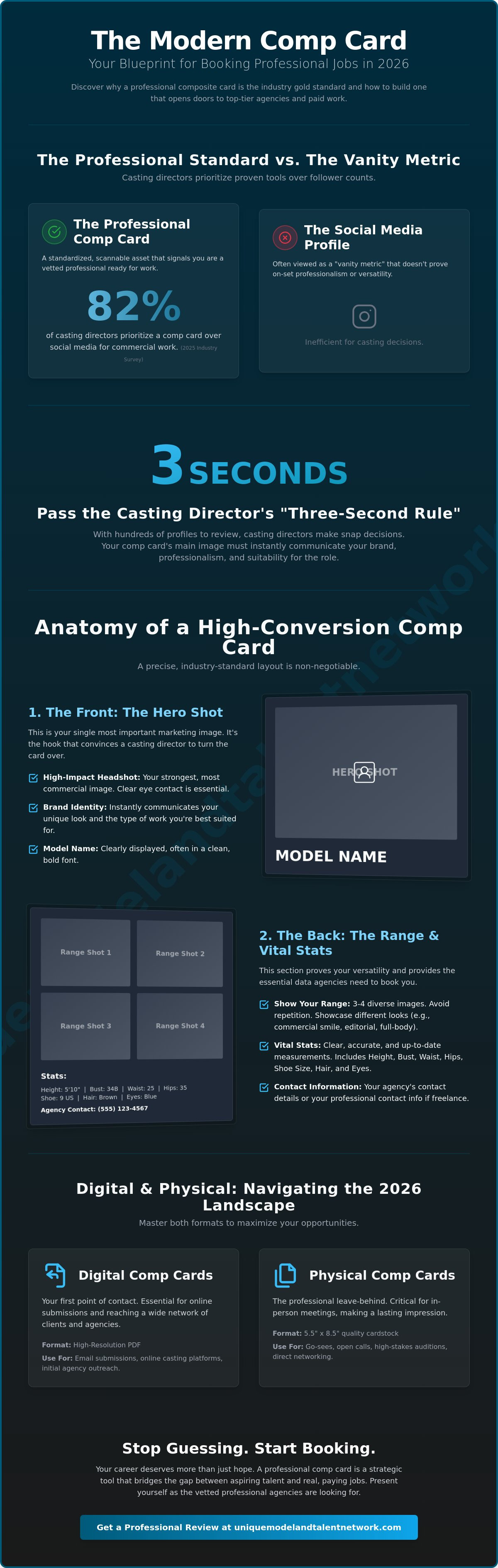
Your Instagram follower count is a vanity metric that won't help you land a contract on a professional set. In fact, a 2025 industry survey revealed that 82% of casting directors prioritize a standardized composite card over a social media profile when selecting talent for commercial work. If you're tired of being overlooked by agencies, then it's time to shift your focus from vanity metrics to professional assets. Mastering comp cards modeling is the fastest way to stop guessing and start presenting yourself as a vetted professional who is ready to work.
You probably feel the frustration of investing in expensive photo shoots that yield zero callbacks. It's exhausting to navigate an industry that often feels like it's built on noise rather than results. This guide will show you how to cut through that clutter and build a professional presence that gets noticed. You'll gain a clear roadmap for creating a card that meets current industry standards while showcasing your unique range. We'll break down the essential five-shot layout, the technical specifications required for 2026, and the business strategies you need to secure real, paying jobs.
Key Takeaways
- Understand why the comp card remains the industry gold standard for presenting yourself as a vetted professional to top-tier agencies in 2026.
- Master the essential layout of comp cards modeling to ensure your primary headshot and supporting images effectively showcase your professional versatility.
- Navigate the modern landscape by learning how to format high-impact digital submissions while maintaining physical prints for high-stakes auditions.
- Stop guessing which photos to include and learn how to ruthlessly audit your current imagery to identify your strongest, agency-ready "Hero" shot.
- Move beyond the "noise" of social media and use your professional card as a strategic bridge to secure real, paying jobs through direct networking.
Understanding the Strategic Role of Comp Cards in Modeling
If you want to secure real, paying jobs in 2026, you need a tool that speaks the language of casting directors. A modeling comp card, often called a Zed card, is a double-sided marketing asset designed to showcase your range at a single glance. While the history of comp cards dates back decades, their role has evolved from a simple handout into a critical filter for a saturated market. It's a business card for your face, your brand, and your professional capability.
Professional agencies don't have time to scroll through your Instagram feed or navigate messy DMs. They require a standardized format that proves you understand the business side of the industry. Carrying a professional card signals that you are a vetted professional. It moves you beyond the noise of social media and into a curated space of legitimate career development. This card provides instant clarity on your height, measurements, and versatility, allowing decision-makers to see exactly how you fit their specific needs without the guesswork.
The "Three-Second Rule" in Casting
Casting directors often review hundreds of talent profiles during a single high-volume call. They use the "three-second rule" to filter out anyone who doesn't immediately fit the brief. Your hero shot, which is the main image on the front of your card, must communicate your brand identity instantly. Don't fall into the trap of using "pretty" selfies or generic vacation photos that lack professional polish. Successful comp cards modeling requires images that demonstrate your ability to sell a product or tell a specific story. If your card doesn't show professional capability within those first few seconds, it ends up in the digital trash bin. Your card must prove you are ready for a professional set on day one.
Comp Cards vs. Portfolios: Knowing the Difference
Think of your portfolio as the full story of your career and your comp card as the elevator pitch. Your portfolio is a deep dive used during final selection rounds, while the comp card is the tool that gets you through the initial door. You'll use your card during submissions and go-sees to leave a permanent footprint with the decision-makers. To ensure your marketing is consistent, your card must align with your professional portfolio review for actors. This alignment helps you stop guessing about which photos work and starts ensuring you are seen as a cohesive, bookable brand.
When you provide a standardized card, you are following an organized value system that industry pros respect. It's about efficiency and professional growth. A well-constructed card includes:
- The Hero Shot: Your strongest, most commercial image on the front.
- The Range: Three to four diverse images on the back showing different looks or expressions.
- Vital Stats: Clear, accurate measurements and contact information.
- Consistency: A visual style that matches your current physical appearance exactly.
By focusing on these elements, you position yourself as a savvy industry insider who is ready to work. This isn't just about vanity; it's about providing a streamlined hub of information that makes it easy for a client to say "yes" to your talent.
The Anatomy of a High-Conversion Modeling Comp Card
If you're an aspiring model, your comp card is your most powerful tool for securing real, paying jobs. It's your visual business card, designed to tell a story in less than five seconds. To stop guessing why your submissions aren't converting, you must understand that comp cards modeling standards are about precision, not just pretty pictures. The front of the card must feature your absolute strongest headshot. This image needs to be high-impact, with clear eye contact that establishes an immediate connection with the casting director. It's the "hook" that earns you the right to have your card turned over.
The back of the card is where you demonstrate your range. You have space for three to four images, and every single one must serve a distinct purpose. Repetition is the fastest way to lose a booker's interest. If you show three photos with the same expression or lighting, you've wasted valuable real estate. Instead, curate a selection that shows you can handle different genres of work. When you present yourself as a versatile professional, you make it easier for a client to see you in their specific campaign.
Professionalism lives in the details of your mandatory stats. Include your height, bust, waist, hips, shoe size, eye color, and hair color. In 2026, industry standards demand total accuracy. Listing "aspirational" measurements is a major red flag that can get you blacklisted from reputable agencies. Finally, keep your contact info strictly professional. List your agency's logo and contact details or a dedicated talent email address. Using personal DMs or social media handles for booking suggests a hobbyist mindset. If you want to be treated like a pro, you must provide a streamlined way for clients to reach you without the noise of social media distractions.
Demonstrating Range: The Four Essential Looks
- The Commercial Look: This shot should be friendly, accessible, and relatable. Think of brands you see in everyday retail or pharmaceutical ads. A warm smile and natural lighting are key here.
- The Editorial/High-Fashion Look: This is about artistic expression. Use strong angles, high-concept styling, and a more "intense" or "vacant" expression to show you can handle luxury branding.
- The Lifestyle Look: Show movement and authenticity. This shot should look like a "candid" moment in a real-world setting, proving you can look natural in front of a camera.
- The Clean Look: This is your "blank canvas" shot. Use minimal makeup and simple clothing, like a white tee and jeans, so casting directors can see your natural features and skin texture.
Technical Specifications for 2026
The physical quality of your card speaks volumes about your career investment. The industry standard remains 5.5 x 8.5 inches. For your paper stock, a heavy 12pt or 14pt cardstock is essential so the card doesn't feel flimsy. While glossy finishes were popular in the past, matte or "silk" finishes are the preferred choice for 2026. Matte surfaces are easier to read under the harsh fluorescent lights of a casting office and don't show fingerprints. Keep your typography clean. Use simple sans-serif fonts like Helvetica or Montserrat. Your name should be legible, but it shouldn't distract from the photography.
Digital vs. Physical Comp Cards: Navigating the 2026 Landscape
In 2026, the industry demands a hybrid approach to self-promotion. You can't rely solely on a PDF, nor can you show up empty-handed to a casting office. If you want to stop guessing how to present yourself, you must master both formats. Digital cards offer speed and global reach, while physical cards provide a tactile memory for casting directors. Success in comp cards modeling requires a strategy that bridges the gap between your screen and their desk.
Optimizing for Digital Submissions
Digital submissions are your primary tool for securing real, paying jobs through online casting portals. Agencies receive hundreds of emails daily; your file must be easy to find and even easier to open. Use the standard naming convention "Firstname_Lastname_CompCard.pdf" to ensure your name stays attached to your images in every folder. Keep the file size under 2 MB to avoid clogging inboxes or being flagged by spam filters. High-resolution files that take minutes to download often get deleted before they're even seen.
Ensure your stats are searchable. Many casting database algorithms scan for keywords within PDF text. If your height, hair color, and location are embedded as images rather than text, you might miss out on filtered searches. Don't be intrusive with cold agency submissions; keep your introductory email brief and professional. Stick to official submission forms or professional email threads to maintain your status as a vetted professional and avoid the noise of messy social media DMs.
The Etiquette of the Physical Hand-Off
Physical prints remain the gold standard for go-sees and auditions. They serve as a professional leave-behind that keeps your face on the casting director’s desk long after you've left the room. Timing is everything. Offer your card at the end of the meeting unless specifically asked for it upon entry. This ensures the focus remains on your performance first. To maintain your professional image, follow these standards:
- Keep them mint: Use a dedicated professional card carrier. A bent corner or a smudge suggests a lack of discipline and respect for your craft.
- Personalize the back: If a casting director mentions a specific detail during your conversation, like your ability to speak a second language or a unique athletic skill, jot it down on the back. This small note helps you stay memorable for the right reasons.
- The QR Revolution: Place a QR code on the back of your card. This should link directly to your profile on a curated acting industry networking platform.
This digital-to-physical bridge allows professionals to see your most recent self-tapes and updated credits without you needing to reprint your physical stock. It creates a streamlined hub for your career and removes the uncertainty of outdated information. By managing your presence on a vetted network, you ensure that every hand-off leads to a live, updated portfolio of your work. This level of organization signals that you're ready for the demands of a high-level production environment.
How to Design and Curate Your Comp Card: A Step-by-Step Guide
Creating a high-impact comp card requires a shift in mindset. You're no longer looking at your favorite photos; you're curating a professional marketing asset. Start by auditing your current portfolio. If a photo isn't "agency-ready," it doesn't make the cut. Every image must demonstrate your range and your ability to sell a specific look or product. Your "Hero" image, the large headshot on the front, is the most critical choice. It needs to be your absolute strongest shot, showing clear skin, bright eyes, and a confident expression. If you're unsure which image wins, you need to stop guessing and seek professional eyes.
Photo Selection: The "Stop Guessing" Method
Don't ask your friends or family for their opinions. They love you, so they'll love every photo. Instead, seek objective feedback from industry veterans. This is where modeling career coaching becomes invaluable. A coach identifies which images actually meet 2026 market demands. Avoid the "Selfie Trap" entirely. Even the best smartphone cameras lack the depth and lighting of a professional studio setup. Casting directors spot amateur lighting in less than two seconds, which can immediately disqualify you from vetted, high-paying roles.
Your layout should follow a clean, industry-standard grid. Typically, this includes your Hero image on the front and four supporting images on the back. Accuracy is non-negotiable. Get professional measurements taken by a tailor or a coach. If your height or waist size is off by even an inch, it can lead to fit issues on set and damage your reputation. Finally, proofread your contact information three times. A typo in your email or phone number is the number one booking killer. If they can't reach you, they can't hire you.
Printing and Production
Quality matters when your card lands on a casting director's desk. Use a reputable industry printer that specializes in comp cards modeling materials. Local general-purpose shops often use the wrong paper weight or finish, making your card feel flimsy. Aim for a heavy 14pt cardstock with a matte or semi-gloss finish. Print in small batches of 25 to 50. This allows you to update your images or stats as your career evolves without wasting money. While a professional print run requires an upfront cost, the ROI is clear. A single booking for a commercial or catalog shoot can return your investment 15 times over.
Professionalizing Your Brand: Beyond the Comp Card
If you believe a high-quality digital file is the final step in your career, you're only halfway there. A card is your entry ticket, but your vetted reputation is what secures the contract. In 2026, the industry has shifted away from the noise of unorganized social media platforms toward curated environments where talent is actually seen. You need to stop guessing which photos work and start building a brand that casting directors trust.
Networking with intent means using your materials as a bridge to establish meaningful relationships. Don't just send a link; provide a solution to a casting director's problem. This requires continuous professional development. Diversifying your skill set through acting workshops online ensures you're prepared for the multi-faceted demands of modern sets. When you combine a sharp image with verified skills, you move from the "aspiring" pile to the "working" list.
Leveraging The Network for Growth
Unique Model & Talent Network acts as a safe haven for those serious about their craft. Members don't just post photos; they get their materials reviewed by industry pros who provide direct, actionable feedback. If you're looking to keep your comp cards modeling assets fresh, our monthly challenges provide the structure to generate new, high-value content. This guided mentorship helps you bypass the messy DMs of traditional platforms and gives you direct access to decision-makers who hire vetted talent for real, paying jobs.
Staying Current: When to Update Your Card
The industry moves fast, and your materials must keep pace. Follow the "Look Change" rule: if you change your hair color, shift into a new age bracket, or significantly alter your physique, you need a new card immediately. Beyond physical changes, perform a "Six-Month Audit" of your portfolio. Update your stats every 180 days to maintain professional credibility with agencies. This disciplined approach ensures your most recent, high-impact work is always the first thing a client sees. Keeping your comp cards modeling data accurate prevents the frustration of showing up to a set looking different than your photos, which is the fastest way to damage a professional reputation.
Take Control of Your Professional Modeling Career
The industry moves fast, and your comp cards modeling strategy is the primary tool that determines if you're booked or bypassed. Research from industry experts suggests casting professionals spend approximately 6 seconds reviewing a talent's initial materials. By implementing the 2026 standards for layout and curation, you've positioned yourself as a serious professional ready for legitimate, paying jobs. You now understand how to balance digital accessibility with the high-impact presence of physical cards.
Don't let your hard work get lost in the noise of unorganized social media groups or messy DMs. If you're ready to professionalize your brand, our private network offers the streamlined hub you've been looking for. You'll get direct access to casting directors and professional reviews of your portfolio to ensure every image works in your favor. It's time to move beyond the guesswork and join a community of vetted talent who are focused on career security and meaningful industry relationships.
Stop guessing and get your materials vetted; Join The Network today.
You have the talent and the drive to make 2026 your most successful year yet. We're here to help you navigate the path and ensure you're truly seen by those who matter.
Frequently Asked Questions
What is the standard size for a modeling comp card in 2026?
The industry standard size for a modeling comp card is 5.5 by 8.5 inches. This specific dimension, often called an A5 size, ensures your card fits perfectly into the standard portfolios and filing systems used by 95% of top-tier agencies. If you choose a non-standard size, you risk your materials being discarded because they don't fit into the organized workflow of a busy casting director.
Can I include my Instagram handle on my comp card?
You should definitely include your professional Instagram handle on your card. In the 2026 market, social media acts as a secondary living portfolio where 72% of casting directors look for your personality and movement. If you're serious about getting booked, ensure your account is public and curated with professional content rather than personal snapshots or unrelated noise.
Do I need different comp cards for commercial and fashion modeling?
You need distinct comp cards modeling different looks if you want to target both the commercial and fashion sectors. A fashion card focuses on high-editorial poses and avant-garde styling, while a commercial card highlights a relatable, friendly personality for lifestyle brands. Using a single card for both niches often results in a 40% lower booking rate because you don't look like a specialist to the client.
How many photos should be on a comp card?
A professional comp card features exactly five high-quality images. The front side is reserved for your strongest headshot, while the back contains four supporting images that showcase your versatility and physical range. This layout is the industry gold standard because it allows a client to evaluate your potential in less than 3 seconds without getting distracted by unnecessary clutter.
Is it okay to use a selfie on a comp card if the lighting is good?
It's never acceptable to use a selfie for comp cards modeling regardless of the lighting quality. Professionalism is your primary currency in this industry; 100% of reputable agencies require high-resolution photography captured by a professional. If you submit a selfie, you signal to the casting team that you're a hobbyist who isn't ready for the demands of a real, paying job.
What measurements (stats) are absolutely required on a modeling card?
You must list your height, bust, waist, hips, shoe size, hair color, and eye color. For male talent, chest and inseam measurements are also mandatory requirements. Providing these seven specific data points ensures that wardrobe stylists can pull the correct sizes for a shoot without the need for multiple follow-up emails, which streamlines the booking process for everyone involved.
How much does it typically cost to print professional comp cards?
Professional printing for a batch of 100 double-sided cards typically costs between $1.00 and $1.50 per card according to 2024 industry pricing reports. If you order smaller quantities, such as a batch of 25, the price per unit usually increases by 30%. Always invest in a heavy cardstock with a matte or semi-gloss finish to ensure your presentation feels high-end and durable.
Should I include my home address on my comp card for safety?
You should never include your home address on your comp card for any reason. Instead, list your agency's contact details or a dedicated professional email address and phone number. Keeping your personal location private protects you from the predatory side of the industry and ensures that all professional inquiries are routed through a secure, vetted channel where your safety is the priority.


