

What is a chemistry read really testing: instant sparks, or how two actors build a believable relationship together? If you’re unsure how it differs from a regular audition or callback, you’re not alone. Performing opposite an unfamiliar actor can feel daunting, especially if you worry casting expects immediate romantic chemistry.
The goal isn’t to force a connection or outshine your scene partner. Casting teams want to see how you listen, respond, and make the scene feel alive together. Chemistry reads can test any on-screen relationship, from friends and rivals to family members, not just romantic pairings.
This guide explains what happens in a chemistry read, what casting teams may look for, and how to prepare without locking yourself into a performance. You’ll learn how to get comfortable with the material, stay open to your partner’s choices, and approach in-person or virtual reads with confidence. Because casting is looking for the right pairing, not simply the strongest solo performance, you’ll also learn how to assess your own work without treating the result as a verdict on your talent.
Key Takeaways
- Understand what is a chemistry read and how it may fit into the casting process after an audition or callback.
- Know what to expect from a typical session, while staying flexible because each casting office may run it differently.
- Prepare by grounding yourself in the scene’s circumstances, your character’s objective, and the relationship between the roles.
- After the read, reflect on your preparation and professionalism without treating the casting outcome as a complete measure of your work.
What Is a Chemistry Read, and When Does Casting Use One?
If you’re asking what is a chemistry read, the key difference is that you’re not being assessed in isolation. You read with another actor so casting can see how your performances work together in a scene. The pairing may help the team assess whether the characters’ relationship feels convincing and serves the story.
A chemistry read is an audition in which actors perform a scene together so casting can assess how their characters and performances connect. That plain-English definition aligns with Wiktionary’s chemistry read entry. A chemistry read may happen after an initial audition or callback, but there’s no universal sequence. An invitation to read with a particular actor doesn’t guarantee a role or mean casting has made a final decision.
How a chemistry read differs from an audition or callback
An individual audition puts the focus on your interpretation, presence, and fit for a role. In a chemistry read, casting can observe how you interact: whether you pick up your partner’s cues, share the scene’s rhythm, and respond in ways that make the exchange believable.
A callback is a return invitation for further evaluation, not a single fixed format. It might involve new material, direction, a different scene partner, or a paired read. Productions choose the process that suits their needs, so treat each request as its own step rather than assuming every callback includes a chemistry read.
Why casting teams pair actors
A scene partner changes what a performance can do. A pause may feel charged or awkward; a quick reply may build momentum or shut the other character down. Casting observes those choices in context, including how each actor’s pacing, energy, and tone shape the audience’s sense of the relationship.
Teams may compare more than one pairing against the characters and the story. They’re evaluating what happens in the scene, not making a reliable judgment about the actors’ private personalities or whether they feel personal attraction. The useful question is whether the performance makes the relationship on the page specific and credible.
- Pacing: Do the actors leave space for important beats, or does the exchange feel rushed?
- Responsiveness: Do their reactions appear connected to what just happened in the scene?
- Tone: Does the pairing support the emotional world of the story?
These are observable performance choices, not a demand to manufacture a bond off camera. Bring a clear interpretation while staying attentive to the person opposite you. Casting is looking at the combined scene, and a strong read can help the team understand a pairing without settling the final casting decision.
What Happens During a Chemistry Read, Step by Step?
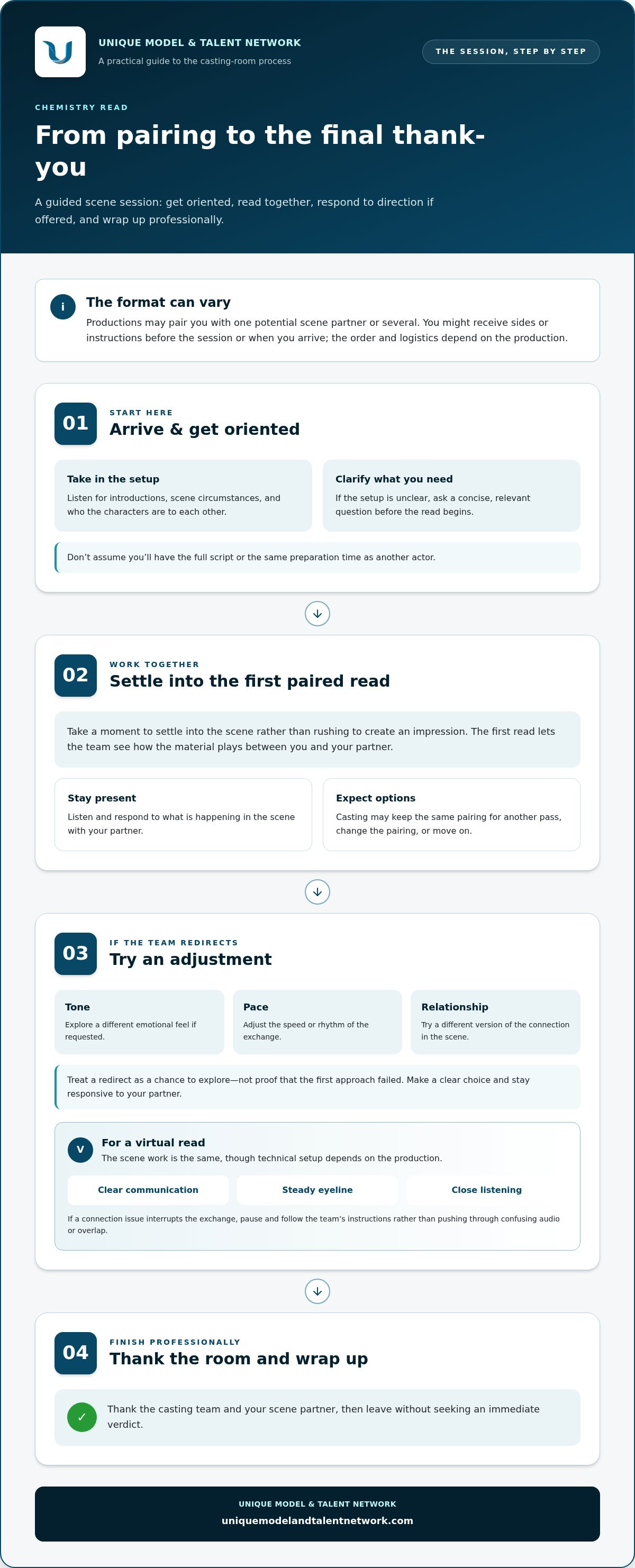
There isn’t one script for the session itself. The casting team may pair you with one potential scene partner or ask you to read with several, depending on the production and the roles being considered. A useful way to understand what is a chemistry read in practice is to think of it as a guided scene session: you arrive, get oriented, read together, respond to any direction, and wrap up professionally. The exact order and logistics can vary.
A typical chemistry read moves from introductions and scene context to one or more paired reads, possible direction or adjustments, and a brief professional close, though each production sets its own format. Actor-focused coverage such as What Is a Chemistry Read? also explores the purpose of reading actors together. Here’s what the process may look like.
From pairing and sides to the first read
You may receive sides or instructions before the session, or get material and context when you arrive. Don’t assume you’ll have the full script or the same preparation time as another actor. Casting may briefly introduce the people in the room, explain the scene’s circumstances, or clarify who the characters are to each other. If anything about the setup is unclear, listen for guidance and ask a concise, relevant question before the read begins.
Once you’re paired, take a moment to settle into the scene rather than rushing to create an impression. The first read gives the team a chance to see how the material plays between you and your partner. They may keep you with that actor for another pass, change the pairing, or move on, depending on the session’s goals.
Redirects, repeat takes, and virtual sessions
A casting team may offer a direction and invite you to try the scene again. Treat it as a chance to explore a different version, not as proof that your first approach failed. The note might shift the tone, pace, or relationship in the scene. Take in the adjustment, make a clear choice, and stay responsive to your partner rather than trying to guess what the team wants.
For remote reads, the same scene work happens through a screen, though the technical setup depends on the production. Focus on clear communication, a steady eyeline, and listening closely even if the timing feels less immediate. If a connection issue interrupts the exchange, pause and follow the team’s instructions instead of pushing through confusing audio or overlap.
- Introductions: Settle in and note any scene or character context.
- Scene work: Read with your assigned partner, staying present and prepared for another pairing.
- Direction: Try a new adjustment if requested, keeping the performance grounded.
- Wrap-up: Thank the team and scene partner, then leave without seeking an immediate verdict.
For steady development beyond a single session, expert perspectives and ongoing skill-building can help you reflect on your work. Explore the actor network community to keep learning between auditions through industry workshops, expert Q&A sessions, and peer networking.
What Does Casting Look for, and Is Chemistry Just Romantic Spark?
If you’re wondering what is a chemistry read really measuring, start by setting aside the idea that two actors must feel instant attraction. Chemistry isn’t limited to romance, and it doesn’t require performers to have a personal bond. Casting may observe how well the scene works between them: whether they listen, respond, share a tone, and create a believable dynamic through their choices.
Chemistry is the believable interaction actors create through choices that fit the scene and their characters. It can be subtle. A shift in timing, a held pause, or a reaction that changes after a partner’s line may tell the story more clearly than a grand display of emotion.
Chemistry in romantic, comic, and dramatic scenes
Connection takes its shape from the material. In a romantic scene, it might show up as trust or tension; in a comedy, as shared rhythm or playful friction. A dramatic scene between siblings could feel close but strained, while two rivals might create a compelling dynamic through conflict. These are examples, not fixed casting preferences.
Your task is to serve the characters and the scene, not imitate a real-life relationship. If the script suggests that one character is hiding something, a guarded response may be more truthful than easy warmth. If a comic exchange depends on one character misunderstanding the other, playing the mismatch clearly may create more connection than trying to make every beat charming.
What strong collaboration looks like on the page
Strong collaboration is visible in the work. You listen through your partner’s lines, let their choices affect yours, and make reactions specific to what’s happening. Leave room for the other actor to land a moment. If casting offers a redirect, take it as a chance to explore another version of the scene and show that you can adjust without losing focus.
There’s a difference between actively building a scene and trying to manufacture a dramatic spark. The first keeps attention on the characters; the second can pull focus toward the actor’s effort to seem compelling. Use this quick contrast to check your approach:
- Productive: Make a clear character choice, listen, and let your partner’s performance influence your next beat.
- Counterproductive: Push every line for maximum intensity, compete for attention, or force intimacy that the scene hasn’t earned.
Imagine a scene where one character delivers difficult news. A responsive partner might allow the news to register before answering, making the silence part of the exchange. An actor who rushes to top that moment with a bigger emotional display may weaken the shared scene. The aim isn’t to disappear or dominate. Make choices that support the story while giving your scene partner something real to respond to.
How to Prepare for a Chemistry Read Without Forcing the Connection
A chemistry read calls for preparation, but not a preplanned display of closeness. Your goal is to understand the scene well enough to stay present with the other actor and adjust if casting gives direction. If you’ve wondered what is a chemistry read asking you to do, think of it as prepared, flexible scene work, not a test of whether you can manufacture an instant bond.
For broader audition context, review this film audition preparation guide. Then use this checklist to focus your work:
- Clarify the circumstances: Identify what has just happened and what each character knows at the start of the scene.
- Find your character’s objective: Ask what your character wants from the other person in this moment.
- Track the relationship: Consider the history or tension the scene suggests, without deciding what your scene partner must do.
- Notice the turning point: Identify where new information, a reaction, or a change in tactics shifts the scene.
- Stay secure on the lines: Familiarity with the material frees you to pay attention to your partner.
Prepare the scene, not a rehearsed idea of chemistry
Build a clear interpretation, but keep it responsive. Instead of planning a fixed gesture, such as touching your partner’s arm at a particular line, know what your character is trying to achieve and let the moment guide your behavior. Consider one alternate approach too. If the scene begins guarded, for instance, explore what changes if your character becomes more direct, while keeping the same circumstances and objective in view.
This gives you something specific to play without locking the scene into a performance that depends on your partner following a script you’ve invented. Your choices can be strong and still leave room for surprise.
Work professionally with an unfamiliar scene partner
Listen to the full thought, not just the cue that tells you when to speak. Let your partner’s timing and delivery affect your reaction. Follow the casting team’s instructions about staging and keep appropriate personal boundaries. Don’t add physical contact or forced intimacy that the scene or direction doesn’t call for.
A rehearsal may feel different from the actual read. Your partner might pause longer, make an unexpected choice, or respond with a different energy. Stay composed and work with what’s happening rather than showing frustration or abandoning the scene. Generosity means supporting the shared moment, not agreeing with every choice or giving up your own point of view.
Preparation becomes more useful with practice and informed feedback. Explore the actor network membership for ongoing industry learning and expert perspectives that can support your development beyond a single audition.
What to Do After a Chemistry Read, and How to Keep Growing
Once the session ends, you may not hear anything right away. A chemistry read is one part of a larger casting process, and the decision can depend on the pairing, the production’s needs, and other factors you can’t see from the room. Silence afterward doesn’t tell you why a decision was made. Try not to turn an uncertain timeline into a judgment about your talent or how the read went.
How to handle the waiting period professionally
Follow any communication instructions from the casting team or production. If they provide a timeline or ask you to wait for an update, respect that direction. Repeated follow-ups are unlikely to provide useful clarity, and a delayed response isn’t a reliable measure of your performance.
After the read, make a short private note while the experience is fresh. Keep it specific and constructive:
- Was I familiar enough with the scene to stay present?
- Did I listen and respond, or did I wait for my next line?
- How did I handle direction or an unexpected choice?
- Was I respectful, focused, and professional throughout?
Choose one useful lesson, if you find one, then let the rest go. Return your attention to current training, upcoming auditions, and other career-building work. You can take responsibility for your preparation without assuming responsibility for every casting outcome.
Build stronger scene-partner skills between auditions
Collaboration improves with practice, especially when you work with partners who make choices you didn’t predict. Try reading a scene more than once with a partner. On a later pass, respond to a different pace, pause, or emotional tone instead of repeating your first interpretation exactly. Notice what changed in your performance and what helped you stay connected to the exchange.
Informed feedback can help you spot habits that are hard to catch on your own, such as rushing through a partner’s lines or holding onto a choice after the scene has shifted. Unique Model & Talent Network offers live industry workshops, portfolio and reel reviews, skill-building challenges, and expert Q&A sessions to help members keep developing beyond any single casting experience.
The Network Membership brings together live industry workshops, portfolio and reel reviews, and expert Q&A sessions. Explore the Network Membership to keep building your skills and learning from industry perspectives. These opportunities support your development, but no workshop or review can determine a particular casting result.
Carry Your Next Scene Forward
Every paired read is a chance to practice the kind of work that grows through repetition: staying curious, making clear choices, and responding to what’s happening in the moment. Knowing what is a chemistry read can take some uncertainty out of the room, but confidence builds as you keep developing your craft beyond any single casting decision.
That growth doesn’t have to happen alone. The Network Membership is a private, moderated professional community where actors can continue learning through live workshops, expert Q&A sessions, portfolio and reel reviews, and skill-building challenges. Members also connect with industry experts and peers while working toward their own goals.
Explore the Network Membership and build your craft with industry guidance. Keep showing up prepared, open, and ready to work with the scene in front of you. Each experience can strengthen the professional skills you bring to the next one.
Frequently Asked Questions
Is a chemistry read the same as a callback?
No. A callback is another stage of consideration, while a chemistry read describes a paired scene-read format that may happen during that stage. If you’re trying to understand what is a chemistry read, think of the callback as the invitation and the paired read as one possible activity within it. A callback might instead ask you to revisit a scene, try new material, or explore a different interpretation on your own.
Can you have a chemistry read without a romantic scene?
Yes. The scene could involve characters who are friends, relatives, rivals, or colleagues. For example, a pair playing business partners might need to suggest years of trust while disagreeing over a decision. You don’t need to add flirtation or physical closeness unless the material calls for it. Follow the script’s clues about the relationship, such as how the characters address each other and what they risk in the exchange.
Does a chemistry read mean casting has already chosen you?
No. It means casting wants to assess you in a particular scene dynamic, not that the role is secured or a final choice is imminent. The team may still be considering other actors, combinations, or creative possibilities. Treat the invitation as a professional opportunity to do the work well. Avoid making major career or scheduling decisions based on the read unless you receive an actual offer and clear next steps.
What should actors wear to a chemistry read?
Choose a neat, comfortable audition outfit that supports the character without turning into a costume. For instance, a simple jacket might suggest a professional role, while avoiding logos or elaborate accessories that draw attention away from the scene. Follow any specific wardrobe direction from casting. If no guidance is given, prioritize clothing you can move in and that helps you feel prepared, rather than trying to guess the production’s final styling.
Can a chemistry read be self-taped or virtual?
Yes, depending on the production’s process. You might read live with another actor online or submit a recording using a reader or setup specified by casting. Follow the instructions for framing, sound, eyeline, and file delivery, and test your equipment before recording or joining. If your partner is remote, allow a little space for video delay and keep listening closely so that technical timing doesn’t pull you away from the scene.
What happens if the chemistry read feels awkward?
An awkward moment doesn’t automatically mean the read has gone badly. You may be adjusting to unfamiliar material, a new partner, or the pressure of the room. Rather than apologizing or trying to cover every pause, take a breath and return to the next moment in the scene. If you stumble over a line, recover as naturally as you can and continue. One uneasy beat doesn’t determine the full casting decision.
Should actors memorize the sides for a chemistry read?
Follow the casting team’s instructions; expectations can differ between productions. If memorizing isn’t requested, learn the scene’s turns and your character’s intention so you can look up and engage with your partner. If you choose to memorize, avoid treating the lines as fixed cues. For example, if your partner pauses unexpectedly, let the pause register before speaking instead of rushing to deliver the response exactly as rehearsed.


