

What if the tattoos you worry will close doors could also help define your look? Can you be a model with tattoos? Yes. In 2026, tattooed models appear in mainstream agency rosters and on major runways, but that doesn’t mean every tattoo suits every assignment. The brief, placement, visibility, and style all shape whether your look fits.
It’s understandable to wonder whether visible ink will affect agency interest or casting decisions. Tattoos don’t automatically rule you out, and covering them isn’t always necessary. What matters is presenting your appearance clearly and understanding what a client needs for a specific project.
This guide explains how tattoos can influence different modeling opportunities, when to show or cover them, and how to disclose them professionally. You’ll also learn how to prepare digitals and portfolio images that show your range. Expert feedback and industry education can help you develop your materials and judgment, without promising representation or bookings. The goal is to make professional choices based on the brief, not assumptions about your appearance.
Key Takeaways
- Can you be a model with tattoos? Yes, but suitability depends on the assignment, including the tattoo’s placement, visibility, style, and subject matter.
- Compare your look with the brief before deciding whether to show tattoos, cover them, or include images that present both options.
- Prepare submissions with relevant portfolio images, accurate details, and close attention to each casting’s instructions.
- Assess opportunities by clarifying the role and its appearance requirements. A specific look request isn’t a judgment on your talent or worth.
- Build your industry knowledge and presentation skills through expert Q&As, workshops, portfolio reviews, and peer networking.
Can You Be a Model with Tattoos? The Direct Answer
Tattoos don’t automatically disqualify you from modeling, but a particular tattoo may or may not fit a particular brief. The question “can you be a model with tattoos” has a straightforward answer: yes. The more useful question is whether your look matches the assignment’s creative direction and appearance requirements.
There’s no single tattoo rule across fashion, commercial, beauty, fitness, and character work. One client may want visible ink as part of a specific aesthetic; another may need images with no visible tattoos. Requirements can even change between campaigns in the same category. Having tattoos and being asked to show them are separate considerations.
Tattoo visibility is an assignment-specific casting consideration, not a universal test of model eligibility. Assess each opportunity against its actual brief rather than assuming every agency or client has the same preference.
Why there is no one-size-fits-all rule
Clients and creative teams define the look they need for each assignment. A visible floral tattoo might complement a lifestyle campaign built around personal expression, while that same tattoo could conflict with a beauty image that calls for an uninterrupted view of the skin. Neither decision says anything universal about the tattoo or your potential as a model.
Placement, size, color, subject matter, wardrobe, and concept all affect how ink reads in an image. Tattoos can also carry personal and cultural meaning; understanding the history and cultural significance of tattoos can offer useful context when thinking about how your body art is represented. Don’t assume tattoos are always an advantage or always a drawback. Fit depends on the work.
What tattooed aspiring models should take from the answer
Build a career plan around your appearance, strengths, and interests. You don’t need to hide your tattoos to seem professional, and you don’t need to treat every casting preference as a verdict on your look. Read each brief carefully, present your appearance accurately, and consider whether the assignment suits you.
Confidence matters, but assumptions can get in the way. Avoid deciding that all agencies want unmarked skin or that every client will welcome visible ink. Informed feedback can help you prepare digitals, refine your portfolio, and understand how your look may translate across different assignments. It can’t guarantee bookings, but it can help you make clearer choices and approach your development with realistic expectations.
How Tattoo Placement, Visibility, and Style Affect Modeling Opportunities
A tattoo’s effect on a casting depends on more than whether it’s visible. Placement, size, color, subject matter, and the assignment concept can all shape how the ink reads in an image. A small design beneath a sleeve may be easy to keep out of frame, while a tattoo on the hand, neck, or face can be harder to conceal in certain poses or close-ups. Neither situation determines your career potential.
Tattoo visibility may matter differently from one assignment to the next because each brief defines its own visual needs. One project may feature your ink; another may request a particular look with tattoos covered. That’s a specific creative requirement, not a universal rule about which tattoo styles or placements are acceptable.
| Tattoo visibility | Possible brief considerations | Honest presentation approach |
|---|---|---|
| Discreet or usually covered | The tattoo may not appear in the planned wardrobe or framing, but could show in alternate poses or styling. | Show it clearly in at least one portfolio image, and include images that reflect the look requested for the assignment. |
| Easily covered by wardrobe | Clothing may conceal the tattoo in some looks, while other outfits or movement may reveal it. | Present both covered and visible versions if they represent your range and follow the submission instructions. |
| Highly visible | Hand, neck, or face tattoos may remain in frame across multiple looks and could be central to the requested appearance. | Use clear, current images that show the tattoo without misleading edits or cropping. |
Visible tattoos and assignment fit
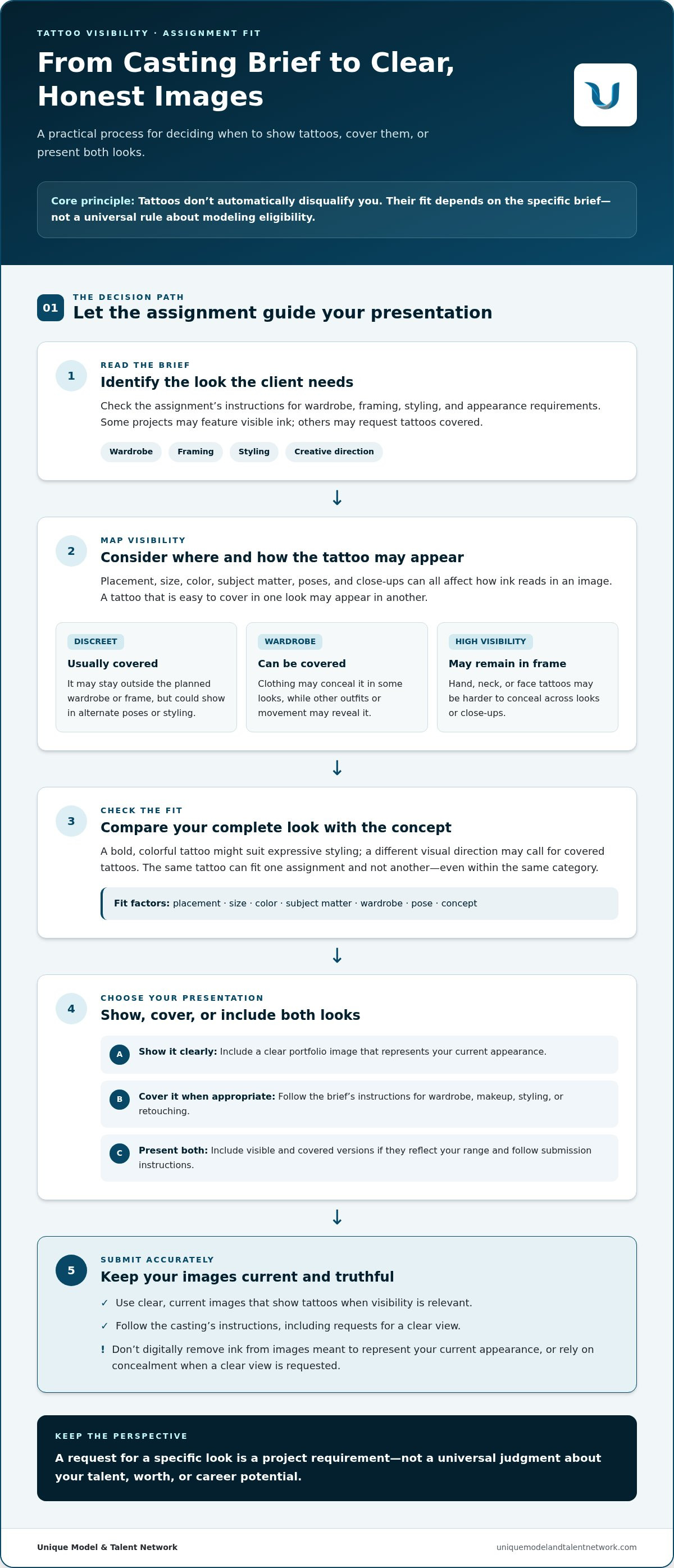
Read the brief for details about wardrobe, framing, styling, and the look the client wants. A bold, colorful tattoo might suit a concept that calls for expressive styling, while a project with a different visual direction may ask for tattoos to be covered. The deciding factor is the specific image or role, not a blanket judgment about tattoo placement. If you’re asking “can you be a model with tattoos,” consider how your complete look fits the opportunities you pursue.
Covering or showing tattoos in photographs
Follow the assignment’s instructions on styling, wardrobe, makeup, or retouching. Covering a tattoo can be a temporary presentation choice for a particular image, but it isn’t a promise that every tattoo can be concealed in every setting. Keep your portfolio truthful: don’t digitally remove ink from images meant to represent your current appearance, and don’t rely on wardrobe that hides a tattoo when the submission requests a clear view.
If you want informed feedback on how your images present your range, portfolio reviews and industry education can help you refine your professional materials.
How to Present Tattoos in Model Digitals, Portfolios, and Submissions
Once you understand how your look relates to an assignment, make your materials easy to assess. Current digitals and portfolio images should represent you accurately, including tattoos that may be visible in the work. Clear images help casting decision-makers judge whether your appearance fits a concept, wardrobe, or role without having to guess what’s outside the frame.
Use this simple process for each submission:
- Review the brief. Note the requested look, wardrobe, image types, and any instructions about visible tattoos.
- Select relevant images. Choose current photos that match the assignment. If useful and appropriate, include images showing your tattoos and images where they’re naturally covered.
- Disclose accurately. If the notice asks about tattoos or other appearance details, describe yours clearly and factually. Don’t hide relevant information or apologize for your look.
- Follow the submission instructions. Send the requested images and details in the specified format. Don’t substitute your preferred materials for what the casting asks to see.
Choose images that represent your current look
A strong portfolio gives a clear, honest impression of your appearance as it is now. Keep images current, and avoid edits that remove tattoos or make them appear smaller, lighter, or differently placed. Select photos for the work you’re pursuing: a brief centered on visible body art calls for images that show it clearly, while a submission requesting a covered look calls for relevant examples of that presentation. There’s no universal image count or format, so follow the casting’s instructions.
For broader principles on selecting and organizing professional images, see this acting portfolio guide. The same focus on relevant, representative material can help you make your modeling portfolio more purposeful.
Make submissions clear and professional
Read each casting notice carefully. Follow its requests for images, measurements, and submission details, and mention tattoos when the brief asks for relevant appearance information. Keep captions concise: “Small floral tattoo on left forearm” is clearer than a long explanation or an apology. If you’re wondering, “can you be a model with tattoos,” remember that strong presentation isn’t about persuading every client to want the same look. It’s about giving each decision-maker accurate information to assess your fit.
When a requested image calls for covered tattoos, choose styling that follows the instructions and reflects the look you can actually present. Treat concealment as specific to that image or assignment, not as a promise that every tattoo can always be hidden.
How to Evaluate Modeling Opportunities When You Have Tattoos
A casting notice is more useful than assumptions about what clients generally prefer. If you’re asking, “can you be a model with tattoos,” use each opportunity’s details to decide whether to apply. A specific appearance request describes the needs of that project. It isn’t a judgment on your talent, professionalism, or worth.
Read the brief before deciding whether to apply
Before preparing a submission, check what the role involves and what the casting asks for. Look for wardrobe notes, appearance requirements, requested images, and any instructions about tattoos. Then consider whether your tattoos can be shown, covered, or styled to fit that particular concept. Don’t reject yourself based only on a broad assumption about modeling work.
- Understand the role: Identify the project type and the look it’s seeking.
- Check appearance requirements: Note any specific requests about visible tattoos, wardrobe, or styling.
- Assess image fit: Decide whether your current photos clearly show the look the brief requires.
- Submit accurately: Provide the requested details and images without altering your appearance in a misleading way.
If a requirement is genuinely unclear, ask a concise, professional question through the listed submission channel. For example: “The notice requests a clear view of my forearm. Should my tattoo be visible in the submitted image?” A direct question can clarify expectations without overexplaining your appearance. For broader guidance on finding opportunities, read this casting websites guide.
Recognize professional boundaries and warning signs
Before committing, make sure you have clear written information about the role, expected work, and how your appearance will be presented. A legitimate brief should give you enough context to understand what you’re being asked to do. If someone pressures you to act immediately, makes vague promises about future work, or requests something that feels unsafe or unrelated to the stated assignment, pause. You’re allowed to ask for clarity or decline.
Keep opportunity discovery separate from guaranteed employment. A casting platform or listing can help you find calls, but access to a listing doesn’t promise a booking or paid work. Evaluate the specific opportunity, follow its stated process, and keep your professional boundaries in view.
For informed feedback as you assess your materials and career direction, explore industry education and professional feedback.
Build a Modeling Career That Works With Your Look
Once you’ve assessed your appearance and prepared honest materials, shift your focus from eligibility anxiety to career development. Ask which assignments interest you, what skills they call for, and how you can present your look with confidence. If you’re still wondering, “can you be a model with tattoos,” remember that a thoughtful career plan is built one informed decision at a time, not on assumptions about what every client wants.
Use feedback to strengthen your professional presentation
A portfolio review can help you assess whether your images are clear, current, and aligned with your goals. For example, you might seek feedback on whether your portfolio shows the range you want to pursue or whether your photos communicate your appearance accurately. Treat suggestions as direction for improvement, not a prediction of acceptance or work.
Ongoing industry education can help you make stronger decisions, too. Live workshops and industry expert Q&A sessions offer opportunities to build knowledge and learn how professionals approach career development. Peer networking can add perspective from people working toward similar goals. The Network Membership brings learning and connection opportunities together in a professional community, with portfolio reviews, live workshops, skill-building challenges, expert Q&A, and peer networking. It supports education and networking, not direct talent representation or guaranteed bookings.
Turn uncertainty into a practical next step
Start with a manageable plan. Identify the kinds of assignments you want to pursue, review what those briefs ask for, and prepare accurate images that represent your current look. Then build skills consistently and seek informed input on your materials. This gives you a grounded way to refine your approach without treating online speculation as a rule for the entire industry.
Professional growth also comes from repeated practice: applying thoughtfully, learning from feedback, and building connections with peers and industry professionals. No workshop, portfolio review, or membership can promise a particular casting outcome. Each can help you develop your judgment and prepare with greater clarity.
If you’re ready to keep learning and connect with a professional community, explore the professional community and its resources for skill-building, expert insight, portfolio feedback, and peer networking.
Build Your Next Step With Confidence
Can you be a model with tattoos? Yes. Tattoos don’t automatically rule out modeling, but each assignment has its own appearance requirements. Placement, visibility, and the creative brief help determine whether your look fits.
Present yourself clearly with current, honest portfolio images, and assess each casting on its own terms. A request for a particular appearance isn’t a judgment of your talent or potential. Focus on the work you want to pursue, prepare thoughtfully, and keep building your industry knowledge.
The Network Membership offers a professional setting for continued development, with portfolio reviews and live workshops, plus a moderated community for industry expert Q&A and peer networking. These resources support learning and professional connection, not representation or guaranteed bookings.
Explore the professional community and career resources to take a practical next step. Your look is part of your professional presentation, and you can build your career with clarity, skill, and confidence.
Frequently Asked Questions
Can you be a model with visible tattoos?
Yes, visible tattoos don’t automatically prevent you from modeling. Can you be a model with tattoos and pursue different kinds of work? Often, but each client’s brief defines the look needed for that assignment. A tattoo may suit one campaign and conflict with another. Share current, accurate images so decision-makers can assess your appearance, and avoid assuming that one casting preference applies to every opportunity.
Do modeling agencies accept models with tattoos?
Yes, some mainstream agencies represent models with tattoos. IMG Models is one example, but agency preferences and opportunities vary. An agency’s openness to tattooed talent doesn’t mean every client or casting will request visible ink. Present your current appearance accurately, review submission instructions, and consider whether the agency’s work aligns with your goals. No agency’s interest or acceptance can guarantee specific bookings.
Should I cover my tattoos in model digitals?
Don’t hide tattoos in a way that misrepresents your current appearance. Digitals should give a clear, honest view of you, so include images where visible tattoos can be assessed. If you can also provide photos with tattoos naturally covered, those may help show your range. Follow specific agency or casting instructions, since requested images and formats can differ.
Can you be a runway model with tattoos?
Yes. Models with tattoos have walked in runway shows for major designers, including Bella Hadid, Sarah Brannon, and Faretta. That shows tattoos aren’t a universal barrier to runway work, but it doesn’t mean every designer or show has the same requirements. Runway opportunities depend on the casting and overall creative direction, as well as the model’s fit for that specific presentation.
Should I mention my tattoos when applying for modeling work?
Yes, if the casting notice asks about tattoos or other appearance details, answer accurately. If visible tattoos are relevant to the requested look, include clear images that show them. Keep your description factual and concise, such as noting the placement and general size. You don’t need to apologize or provide a personal explanation. Follow the submission instructions, and don’t alter photos to conceal relevant details.
Can tattoos limit the types of modeling jobs I can book?
They can affect your fit for particular assignments, especially if the brief requests a specific appearance or tattoos would be prominent in the planned images. That doesn’t define your overall potential. Placement, size, color, subject matter, wardrobe, and framing can all influence whether a tattoo suits the concept. Assess each opportunity individually rather than treating one client’s preference as a rule for every category of modeling.
Should I remove a tattoo to become a model?
Don’t assume you need tattoo removal to pursue modeling. Tattoos don’t automatically disqualify you, and removing one won’t guarantee agency interest or bookings. Consider your personal reasons, the permanence of the decision, and the kinds of assignments you want before making any changes to your body. You can first build a portfolio that reflects your current look and evaluate opportunities based on their specific requirements.


