

What if the strongest connection with a casting director starts with a thoughtful conversation, not a request for an audition? Learning how to network with casting directors means approaching each interaction with preparation, relevance, and respect.
It’s understandable to wonder where a professional conversation is welcome, how to follow up without seeming pushy, or whether a brief introduction will lead anywhere. You don’t need to turn every encounter into an opportunity pitch. Instead, show genuine interest, communicate clearly, and give a professional relationship room to develop over time.
This guide explains how to prepare for relevant conversations, choose appropriate moments to connect, and follow up while respecting casting professionals’ boundaries. You’ll also learn how to maintain a credible presence between introductions, so your interactions feel consistent rather than transactional.
We cover in-person events, email, social media, and workshops, with practical ways to build industry fluency through ongoing education and constructive portfolio or reel feedback. The goal is meaningful professional connection, not an expectation of immediate access to auditions, representation, or bookings.
Key Takeaways
- Think of networking as steady, relevant professional interaction, not a shortcut to casting outcomes.
- Choose industry settings for learning and conversation, and arrive with a clear purpose.
- Make introductions and follow-ups respectful, specific, and low-pressure.
- Avoid repeated messages, unsolicited materials, and immediate audition requests that can undermine a professional connection.
- Build confidence through ongoing practice, expert learning, constructive feedback, and peer connection.
What Networking with Casting Directors Really Means for Your Career
Approaching a casting director can feel intimidating, especially when you’re early in your career and unsure whether a conversation is welcome. That pressure often comes from treating every introduction as a chance to secure work. A more useful approach is to see networking as professional relationship-building: relevant interaction, mutual respect, and sustained awareness of the industry.
Networking means building respectful professional familiarity through relevant conversations and consistent engagement. It does not guarantee auditions, bookings, or special consideration. This distinction keeps expectations grounded and your attention on what you can control: preparation, communication, and craft.
How casting directors and performers interact professionally
Casting directors help identify and evaluate performers for specific projects, considering the role, production needs, and casting brief. Their work is project-focused, not an open invitation to consider every performer for every opportunity. A Casting Director Overview offers more context on the role and its place in the entertainment industry.
Professional contact doesn’t replace an audition or the requirements of a casting brief. If a role calls for a particular profile, the casting team assesses performers against that project’s needs. A friendly exchange at an event may help you understand the process, but it doesn’t substitute for submitting through the requested channels or preparing for an audition.
Respect the person’s time. At a panel, for example, introduce yourself briefly and ask a question connected to something they’ve shared. “I’m an actor working on grounded contemporary roles. Could you share what makes a self-tape feel specific to a scene?” is more focused than launching into your biography or asking to be considered for future work.
Why relationships matter without promising a booking
Professional familiarity can make future interactions feel less daunting. You may better understand the language casting teams use, feel more prepared to ask a relevant question, and recognize how your materials communicate your strengths. Those are meaningful gains even when a conversation doesn’t lead directly to an audition.
Visibility is not the same as guaranteed consideration. A casting director can remember a thoughtful exchange and still have no suitable role for you. The right fit depends on the project and its casting brief, as well as your preparation and performance. Networking should support your professional fluency, not help you bypass the process.
So, how to network with casting directors in a way that supports your career? Focus on learning, listening, and making appropriate connections. Develop your craft, keep your materials aligned with your current strengths, and approach each opportunity on its own terms. The goal isn’t preferential treatment. It’s to become a prepared, credible professional who can participate in the industry with confidence.
Where to Meet Casting Directors and How to Prepare
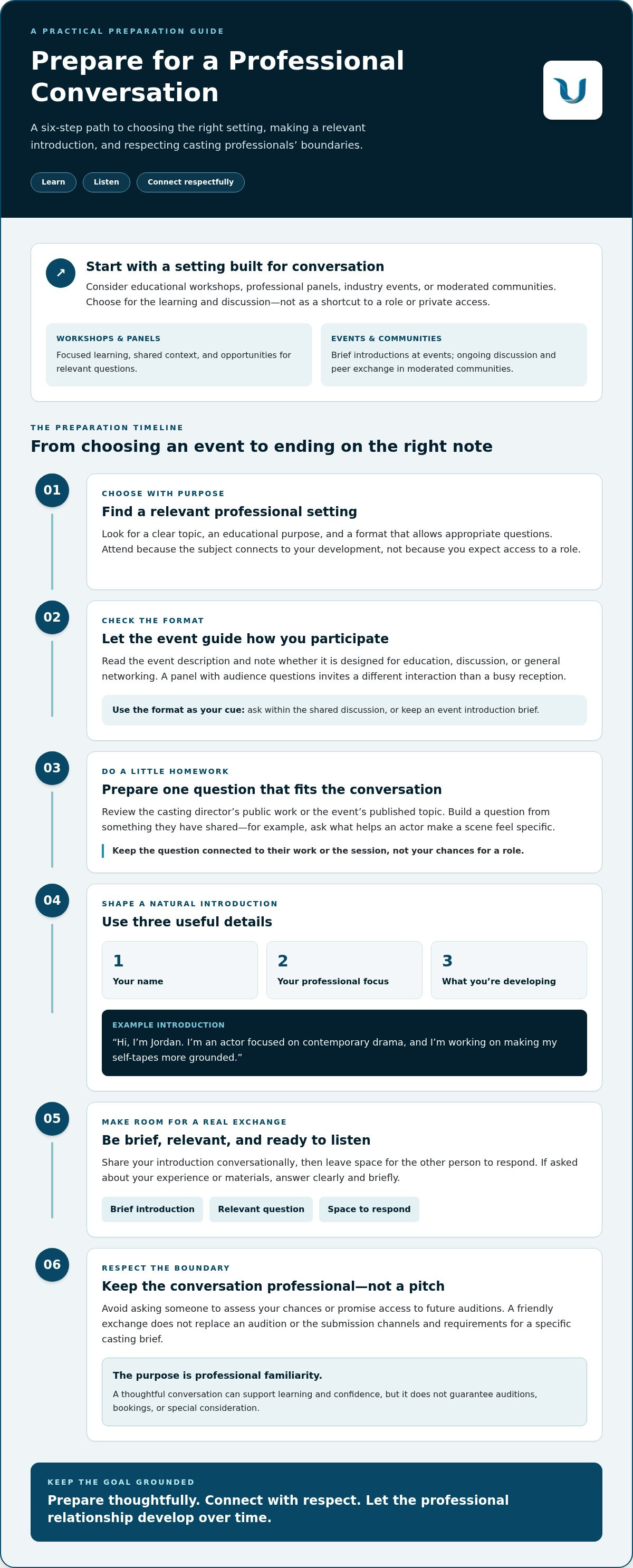
The best setting for a professional conversation is one where the purpose is clear and interaction is welcome. Educational workshops, industry events, professional panels, and moderated communities can all create opportunities to learn about casting and meet people working in the field. Choose an event because its subject connects to your development, not because you expect access to a role or a private conversation.
Before committing your time, read the event description. Is it designed for education, discussion, or general networking? A panel with audience questions invites a different kind of interaction than a busy reception. Respect the format and let its purpose guide how you take part.
Choose settings that support meaningful professional interaction
Workshops offer focused learning and a chance to hear an industry professional discuss their approach. Panels provide context and often make it possible to ask a relevant question in a shared setting. Industry events may allow brief introductions, while a moderated professional community can support ongoing discussion, peer exchange, and structured learning.
Look for substance: a clear topic, a stated educational purpose, and a format that allows appropriate questions. Don’t treat an event as an audition or a guaranteed path to a casting office. Casting platforms can help you research roles, submission instructions, and the kinds of projects being produced. They serve a different purpose from professional conversation, and a profile or submission isn’t a reason to send unsolicited pitches.
Prepare an introduction that feels natural and specific
A short introduction gives the other person a useful snapshot without turning the exchange into a sales pitch. Prepare three details: your name, your professional focus, and what you’re currently developing. For example: “Hi, I’m Jordan. I’m an actor focused on contemporary drama, and I’m working on making my self-tapes more grounded.” Keep it conversational, then leave room for the other person to respond.
Do a little homework first. Review the casting director’s public work or the event’s published topic, then prepare one question that follows naturally from it. If they’ve spoken about casting a particular genre, ask what qualities help an actor make a scene feel specific. Avoid asking them to assess your chances for a role or promise access to future auditions.
If someone asks about your experience or materials, answer clearly and briefly. Mention the kind of work you’ve done or the skill you’re building, then offer to share a reel or résumé only if it’s relevant and welcomed. You don’t need to memorize a speech. Practice the main points so you can speak naturally and adapt to the moment.
For actors who want structured opportunities to learn and practice these conversations, a private professional community for performers can complement one-off events with workshops, expert discussions, and peer connection. Practicing in an ongoing learning environment can help you decide how to network with casting directors with purpose, rather than relying on cold outreach alone.
Does Networking Mean Asking Casting Directors for Auditions?
No. Networking can help you build professional familiarity and understand the industry, but it can’t promise an audition or influence whether you fit a particular role. Casting decisions are tied to each project’s requirements and process. A casting director may remember a thoughtful conversation and still have no role that suits your profile. That isn’t a failed connection; it’s a reminder that a professional relationship and a casting decision serve different purposes.
Networking can create access to learning and professional conversation, but it can’t guarantee access to a role. Keep that distinction in mind when deciding what to ask for, what to share, and what a workshop or introduction can reasonably offer.
Professional visibility versus a guaranteed opportunity
A respectful introduction gives a casting professional context about who you are and what you’re developing. It doesn’t change the criteria for an audition or create an obligation to contact you later. If a suitable opportunity arises, the casting brief and submission process still guide how performers are considered.
Workshops can be worthwhile for what you learn, even if no audition follows. You might gain a clearer understanding of how casting teams discuss a role, practice applying direction, or identify a skill to strengthen. Assess the value by the education and professional insight offered, not by the promise of a booking. If your only reason to attend is the hope of being cast, your expectations may not match the event’s purpose.
Signs an interaction is becoming too transactional
Before approaching someone, consider whether your next move suits the setting and respects the professional’s boundaries. An interaction can start to feel like a pitch when every question is designed to get access, a referral, or an immediate career advantage. Keep the exchange focused on the conversation you’re actually having.
- Leading with a request. Asking for representation, an audition, or special consideration turns an introduction into a demand for an outcome.
- Sending repeated messages. If a professional doesn’t reply, take the silence as a cue to pause rather than following up through multiple channels.
- Ignoring submission instructions. Don’t use a personal connection to bypass the process stated for a role or send materials that weren’t requested.
- Holding the conversation too long. If the person is busy or the moment feels closed, thank them and end the exchange graciously.
For example, after a workshop, thank the casting director for a useful insight and mention what you’ll apply in your next scene study. That closes the interaction on a genuine note without asking for future auditions or a promise to stay in touch.
Understanding how to network with casting directors means measuring progress by what you learn and how professionally you engage, not by whether a conversation produces immediate work. Stay open to connection, but let each casting opportunity follow its own process.
How to Start a Conversation and Follow Up with Professionalism
A useful conversation doesn’t need a perfect script. It needs a clear purpose, attention to the other person, and a respectful ending. Use this five-step sequence to stay present instead of worrying about what to say next.
- Prepare. Review the event topic and the casting director’s public work. Decide why you’re approaching them and choose one relevant question.
- Introduce yourself. Give your name and a concise description of your professional focus.
- Listen. Pay attention to the answer and respond to what they actually say, rather than waiting for a chance to pitch yourself.
- Close politely. Thank them for their time. If the conversation has reached a natural pause, let it end without pushing for contact details.
- Follow up once, when appropriate. Refer to the specific exchange, keep the message brief, and respect any communication preferences they’ve stated.
What to say during a brief introduction
Try: “Hi, I’m Maya. I’m an actor focused on comedy, and I’m currently developing my audition technique for grounded, conversational scenes.” Then ask a question connected to the event or the casting director’s public expertise, such as: “In your panel, you mentioned finding specificity in comedy. What helps a performer make a choice feel fresh without pushing it too far?”
That gives the other person a clear opening to respond. Listen closely, acknowledge their answer, and let the exchange develop naturally. If they’re short on time or the conversation is winding down, say, “Thanks, that’s helpful. I appreciate you sharing it,” and move on. A thoughtful ending is more professional than forcing in a résumé or reel pitch.
How to follow up without creating pressure
If the setting and conversation make a follow-up appropriate, send a short thank-you within 24 to 48 hours, unless the casting director has specified otherwise. Mention where you met and one detail you appreciated. For example: “Thank you for your perspective at the panel on preparing self-tapes. Your point about making a clear choice gave me a useful focus for my next practice session.”
The strongest follow-up is brief, specific to the conversation, and easy to receive without requiring a response. Don’t attach headshots, a résumé, or a reel unless invited, or unless you’re following the stated submission process for a particular opportunity. If there’s no reply, don’t send repeated messages or switch platforms to get noticed. Respecting silence and stated boundaries is part of professional communication.
To build these habits through structured learning and peer connection, explore the Network Membership. Practicing relevant conversations in an educational community can help you approach industry interactions with greater clarity and confidence.
Build a Consistent Networking Practice with Expert Guidance
Strong professional relationships grow alongside a performer’s readiness. Preparation helps you speak clearly about your work; constructive feedback can show you where your materials or skills need attention; and a developing point of view helps you contribute something specific to industry conversations. Treat networking as one part of a steady career practice, not a burst of outreach whenever you want a role.
It can be difficult to sustain that practice alone. A structured learning environment gives you a place to build industry fluency, ask informed questions, and learn alongside peers. The focus stays on becoming a more prepared professional, not gaining special access to decision-makers.
Use workshops and reviews to strengthen professional readiness
Live workshops led by industry professionals provide structured learning and a setting to explore aspects of the work. Listen, ask relevant questions, and consider how each insight applies to your development. Industry Expert Q&A sessions offer another opportunity to learn directly from people working in the field, without treating the exchange as a request for auditions or representation.
Portfolio and reel reviews create a setting for constructive feedback on how you present your work. Use that input to make thoughtful adjustments, then apply what you’ve learned before your next industry interaction. For example, if feedback helps clarify the roles or qualities your materials communicate, you can describe your professional focus more precisely in a conversation.
Make peer connection part of a long-term career practice
A moderated community can support purposeful peer discussion and accountability. Talking with other actors and models about preparation, craft, and professional goals gives you a chance to reflect and learn from perspectives beyond your own. The value comes from ongoing exchange, not from trying to turn every interaction into a route to a casting director.
Monthly Skill-Building Challenges can keep your development active between workshops and events. Choose a challenge, apply it to your practice, and notice what changes in your work or confidence. That steady rhythm supports the preparation that makes networking more natural over time.
The Network Membership brings together private peer connection, live workshops, portfolio and reel reviews, skill-building challenges, and expert Q&A sessions. It supports professional development, but doesn’t guarantee representation, auditions, or bookings. If you’re ready to strengthen your preparation and build industry fluency in a professional community, Explore the Network Membership.
Make Your Next Industry Connection Count
Your next step doesn’t need to be a major introduction. Choose one professional setting that supports your growth, arrive ready to listen, and treat the conversation as a chance to learn. Over time, those small, considered actions can help you develop a clearer professional point of view and approach new connections with greater confidence. That’s a grounded way to put how to network with casting directors into practice: focus on the quality of your participation, not a promised outcome.
If you’d benefit from a consistent place to keep building, the Network Membership offers a private, moderated community with live workshops, expert Q&A sessions, portfolio and reel reviews, and monthly skill-building challenges. These resources support learning and professional development, not guaranteed representation, auditions, or bookings.
Every thoughtful conversation is practice in showing up as the professional you’re working to become. Keep developing your craft, stay curious, and let genuine connection grow at its own pace. Explore the Network Membership and take a purposeful next step in your growth as a performer.
Frequently Asked Questions
Can I network with casting directors without an agent?
Yes. An agent isn’t the only way to take part in professional conversations. You can attend relevant panels, workshops, and educational events, or participate in moderated industry communities. To practice how to network with casting directors, set a learning goal for each interaction, such as understanding how a casting process works or getting more comfortable describing your current focus. Keep submitting through appropriate channels and developing your craft; networking alone doesn’t secure auditions.
Do casting directors respond to actors who contact them directly?
Some may respond in a suitable professional context, while others may not accept unsolicited messages or have time to reply. Before sending anything, review their public communication preferences and submission instructions. If you’re following up on an actual conversation, say where you met and what you’re referring to. If you don’t receive a response, don’t interpret that as an invitation to try another channel or send repeated messages.
Should I send my headshot and résumé when I meet a casting director?
Not unless the person invites you to share them or a specific project’s submission process requests them. In a brief introduction, focus on making a professional connection rather than handing over materials unexpectedly. If you’re asked to send a résumé, confirm the preferred method and follow through using that channel. Keep your files current and easy to identify so they’re ready when there’s a clear, appropriate reason to share them.
What should I do if a casting director gives me feedback?
Listen, thank them, and note the specific suggestion so you can consider it later. If the setting allows, ask one focused question to clarify what they mean, such as whether they’re referring to your pacing or your character choices. Avoid asking them to assess your overall prospects or provide ongoing coaching. Feedback can guide your practice, but it isn’t a prediction of whether you’ll be cast in a particular project.
Are paid casting-director workshops a guarantee of auditions?
No. A workshop is an educational experience, not a promise of auditions or paid work. Before enrolling, read its stated purpose and consider whether the subject fits a skill you want to develop. For example, a session focused on scene work may be useful if you’re actively practicing that area. Measure the experience by the learning and preparation it offers, rather than expecting it to lead directly to a casting opportunity.
How can I tell whether a networking opportunity is professionally credible?
Look for clear information about who is hosting, what participants will do, and what the event is intended to teach or discuss. Be wary of claims that participation guarantees a role, representation, or a career breakthrough. Take time to understand the format and expectations before committing. A professional opportunity should explain its purpose without pressuring you to decide immediately or suggesting that a casting outcome is certain.
Can social media help me network with casting directors?
Yes, it can help you follow public project updates and learn about a casting professional’s work. Keep your engagement relevant: a thoughtful comment on a public post about a project is more appropriate than a message asking to be considered for roles. Don’t send unsolicited headshots or reels through direct messages. Use social platforms to stay informed, and follow the stated submission process when responding to a specific opportunity.


