

A callback is encouraging, but it isn’t a booking. If you’re asking what is a callback audition, think of it as another opportunity for casting to evaluate your fit, not a promise that the role is yours. You may be asked to read new sides, adjust your performance, or work opposite another actor. Those are normal possibilities, not signs that you should already know what comes next.
This guide explains how a callback differs from an initial audition, what casting teams may assess, and how to prepare for new material, redirection, or chemistry reads. You’ll also learn what a callback does and doesn’t signal, and how to respond afterward without putting your career on hold. The goal isn’t to predict a casting decision. It’s to help you arrive ready to listen, make clear choices, and stay flexible, then leave with a realistic view of what may happen next.
Key Takeaways
- Understand what is a callback audition and how casting may use another round to assess your fit for a role.
- Prepare for possible new sides, scene adjustments, or reads with other performers, while staying open to direction.
- Use a simple checklist to review callback details and organize your preparation before you arrive or log on.
- Keep casting decisions in perspective: role fit, ensemble chemistry, and production needs can all shape the outcome.
- Follow communication instructions after the audition, then carry useful observations forward without overanalyzing the result.
What Is a Callback Audition vs. the First Audition?
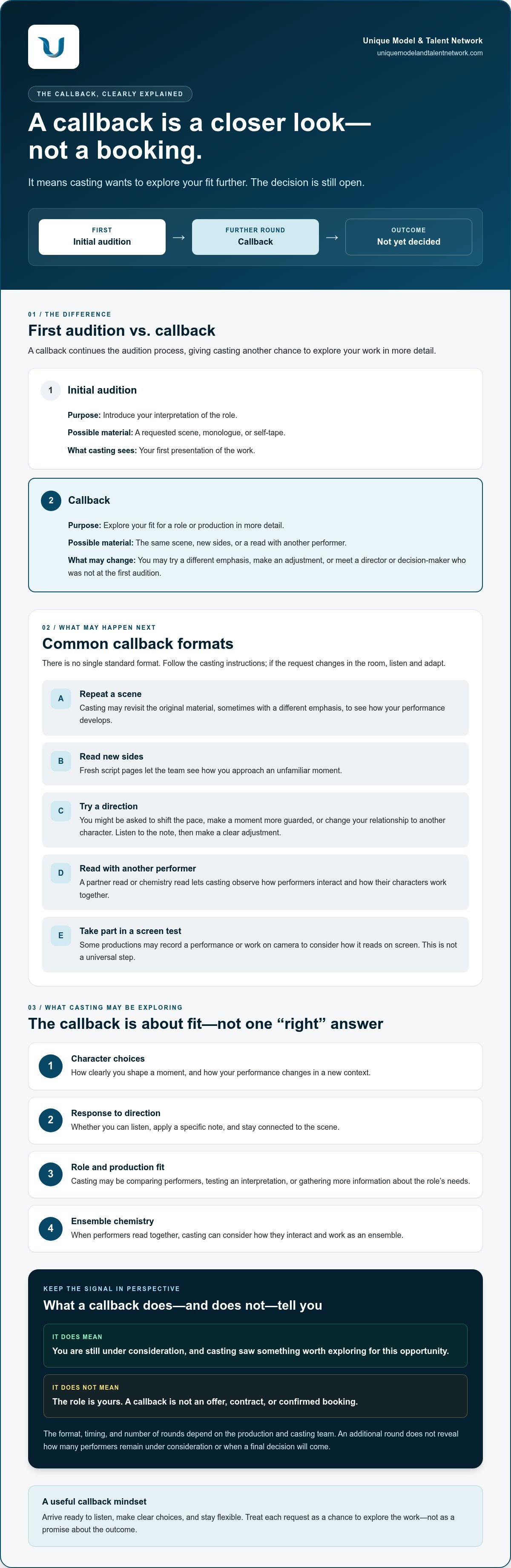
If you’re asking what is a callback audition, it’s a further audition round that follows an initial audition. Casting teams invite selected performers to explore their fit for a role or production in more detail.
A callback invitation means you’re still under consideration. It isn’t a role offer, contract, or confirmed booking. The team may be comparing performers, testing a particular interpretation, or gathering more information before deciding. The Callback (performing arts) overview describes this additional round as a way to assess performers for specific characters.
What does a callback invitation actually mean?
It means the casting team saw something worth exploring for this specific opportunity. They may want to see another acting choice, how you respond to an adjustment, or how your performance changes in a new context. Treat the invitation as a chance to continue the process, not evidence that the outcome is settled.
There’s no single callback schedule. Timing, format, and the number of rounds depend on the production and casting team. You might hear back quickly or wait while the team coordinates schedules and considers the role’s needs. An additional round may bring the team closer to a decision, but it doesn’t reveal how many performers remain under consideration or when a final decision will come.
How does a callback differ from an initial audition?
An initial audition is often your first chance to introduce your interpretation of the role through a requested scene, monologue, or self-tape. A callback gives casting a closer look. The team may revisit the same material to see how your performance develops, or share new sides to test how you approach a different moment.
The people in the room may change, too. A director or decision-maker who wasn’t present for the first audition may want to see your work firsthand. You could also be asked to read with a scene partner, giving the team a chance to observe how you interact. These are possibilities, not a fixed sequence every actor experiences.
- Same scene: You may repeat the original material, sometimes with a different emphasis.
- New sides: Fresh pages can reveal how you make choices with unfamiliar material.
- Partner read: A scene with another performer may help the team explore character dynamics.
Whatever the format, the callback is still an audition. It’s a further evaluation, not a hidden offer. Knowing the difference lets you appreciate the invitation while keeping your expectations grounded.
What Happens at a Callback Audition? Common Formats and Evaluation
There isn’t one standard callback format. Depending on the production, you might repeat a scene, work with new sides, read with another performer, or try a different approach. The invitation or casting instructions should tell you what to prepare. If the format changes in the room, listen carefully and adapt.
The team may be assessing more than whether you can deliver a polished scene. They could be looking at how clearly you make character choices, how you respond to direction, and whether your performance fits the role. Treat each request as information about what the team wants to explore, rather than a puzzle with one hidden, correct answer.
Reading sides, taking direction, and trying a new choice
Sides are selected pages from a script prepared for an audition. At a callback, you may receive new sides or be asked to revisit material you’ve already performed. A casting team might ask you to make a moment more guarded, change the pace, or shift your relationship to another character.
Take in the note before you begin. Make a clear adjustment, even if it feels different from your first interpretation. The aim isn’t to guess what the room wants or abandon your instincts. It’s to show that you can listen, apply a specific note, and stay connected to the scene. If the direction isn’t clear, ask a brief, professional question so you can respond accurately.
Chemistry reads, screen tests, and additional rounds
A solo callback lets the team focus on your individual performance. A chemistry read adds a scene partner so casting can observe how two or more performers interact in the material. A chemistry read is an audition scene performed with another actor so casting can assess how their characters and performances work together. It may feel less like presenting a finished monologue and more like actively listening, responding, and building a shared moment.
Some productions may also use a screen test, which can involve recording a performance or working on camera. The setup depends on the project. A screen test may help the team consider how a performance reads on camera, while other callbacks focus on live scene work. Neither format is universal, and not every actor will be asked to do both.
There may be more than one callback round, or the production may use a different process. The sequence depends on the role and the team’s needs, so don’t treat any single exercise as a reliable signal of the final decision. To keep developing, review your audition practice with thoughtful peers or use professional actor development resources, then apply what you learn to your next opportunity.
Does a Callback Mean You Will Be Cast? Realistic Expectations
A callback is positive progress, but it doesn’t guarantee a role. The answer to “what is a callback audition?” includes an important distinction: it’s another chance for casting to evaluate your fit, not a confirmed booking. You’re still under consideration, which is worth recognizing, while the outcome remains undecided.
Casting decisions can depend on factors beyond an individual performance. The team may be considering how performers fit together as an ensemble, the production’s needs, or changes in its plans. A strong callback doesn’t remove those variables. Likewise, not receiving an offer doesn’t automatically mean your work fell short or that you lack ability.
Why actors may not receive an offer after a callback
A performer can deliver a compelling audition and still not be the final choice. Casting may need a different quality for the role, or another actor may complement the ensemble in a way that better serves the production. Practical or creative needs can also shift as a project develops. These choices are specific to the opportunity, not a definitive assessment of your talent or future potential.
Try not to build a story around what you think happened in the room. Unless the team shares a reason, you’re unlikely to know every factor behind its decision. You can acknowledge disappointment without turning it into a verdict on your career. Each audition is one professional opportunity, not a complete measure of what you can do.
How to manage nerves while staying professional
Approach the callback as a fresh chance to do the work, not a test of perfection. Before you begin, focus on what you prepared and what the room is asking of you now. Listen to the full direction, take a breath, then make a specific, responsive choice. If a note changes your approach, treat that as part of the work rather than proof that your first version was wrong.
Some parts of the process are yours to influence; others aren’t. Keep your attention on what you can control:
- Your preparation: Review the material and arrive ready to work.
- Your response: Listen closely, apply direction, and stay present with scene partners.
- Your professionalism: Follow instructions and communicate respectfully.
- The casting outcome: Leave the final decision to the team. Role fit and production needs aren’t yours to determine.
If the answer is no, give yourself room to feel disappointed, then turn your attention to the next step in your development. Write down one choice you felt good about and one thing you’d like to strengthen. Keep the notes specific and constructive. That turns the experience into useful information without treating the result as a prediction of what you’ll book next.
How to Prepare for a Callback Audition: A Practical Checklist
Once you know what is a callback audition, prepare for the specific request in front of you. Use this checklist to get organized without overloading your performance with extra choices or materials. Let the invitation guide you, and stay ready to adjust if the team gives you direction.
- Read the invitation carefully. Confirm the date and time, location or online link, role or project, and any instructions about what to prepare. Note any reply or submission deadline. If a detail is unclear, ask a concise, professional question through the stated contact method rather than making assumptions.
- Prepare the requested material. Review the assigned sides and any notes from casting. Learn the scene well enough to stay present with another performer or the camera, but avoid adding props, costume choices, or extra material unless requested. For additional context on preparing, read this professional guide to film industry auditions.
- Plan the logistics before audition day. For an in-person callback, check the location and plan your route so you can arrive composed and have time to settle in. For a virtual session, test your device, connection, sound, and camera position ahead of time. Keep the invitation, sides, and requested materials easy to access so you’re not searching for them at the last minute.
- Prepare to take direction. Rehearse your choices, but don’t lock yourself into one delivery. Casting may ask for a change in pace, tone, or intention. Listen to the complete note, clarify briefly if needed, then make a distinct adjustment. Focus on responding to the direction, not guessing at an unspoken “right” version.
- Follow self-tape instructions exactly. If the callback is recorded, check the requested framing, file format, labeling, and submission method. Keep the performance clear and the setup simple. Don’t add edits, music, or creative effects unless the instructions ask for them. Following the directions makes it easier for the team to review your work.
- Build adaptable audition habits over time. Regular practice can help you feel more comfortable with new material and redirection. Online acting workshops offer structured learning and feedback as you continue to develop these skills.
A checklist can steady your preparation, but flexibility matters once the audition begins. For ongoing development, connect with a professional actor network and keep building your skills alongside industry experts.
After the Callback: How to Keep Building Your Career
Once the audition is over, follow the production’s communication process and keep your career moving. Understanding what is a callback audition also means recognizing that the work doesn’t end when you leave the room. You can reflect on what you learned, stay professional, and continue pursuing roles that fit your skills.
Follow up appropriately and keep auditioning
If the casting team gives a timeline or specific follow-up instructions, follow them. A brief thank-you may be appropriate if it fits the production’s process, but repeated messages asking for a status update aren’t useful. If you haven’t heard back, silence alone doesn’t confirm either rejection or an upcoming offer. Give the team space to complete its process.
While you wait, keep preparing for other suitable auditions. That doesn’t mean you’re dismissing this opportunity; it’s a practical way to maintain momentum without making your plans depend on one decision. If the production contacts you with an update, respond promptly and follow its instructions. Until then, keep your schedule and attention open to work that aligns with your experience and goals.
Build skills and industry connections beyond one audition
Write down a few specific observations while they’re fresh. Perhaps you felt grounded in the scene, found a direction note challenging, or noticed that you rushed a moment. Keep the notes factual and useful. Avoid replaying every expression or pause in search of clues about the outcome. Focus instead on what you can apply in your next audition.
Ongoing development can come from structured learning and professional feedback. Unique Model & Talent Network connects emerging actors and models with industry experts through live workshops and expert Q&A sessions. Members can also access portfolio and reel reviews, plus monthly skill-building challenges. These opportunities support learning and professional connection.
Whether this callback leads to another step or not, use the experience to strengthen your craft and build a more informed approach to future auditions. If you’re looking for a professional community centered on learning and connection, explore the Network membership.
Turn Your Next Audition Into a Growth Opportunity
Understanding what is a callback audition can help you approach each opportunity with a clearer head, but your development doesn’t have to depend on one casting decision. Choose a next step you can control: strengthen a skill, seek thoughtful feedback, or build professional relationships that support your ongoing work.
The Unique Model & Talent Network offers a place to keep learning alongside industry professionals. Members can take part in live workshops led by experts, including casting directors and photographers, and access portfolio and reel reviews, skill-building challenges, and expert Q&A sessions. The Network Membership brings these educational resources and connections together in a professional community.
Join the Unique Model & Talent Network to build your craft and industry connections. Keep showing up for the work, stay curious, and let each audition help you take your next step with greater confidence.
Frequently Asked Questions
How long does it usually take to hear back after a callback?
There’s no universal timeline for hearing back after a callback. A production might decide quickly or need more time to coordinate the cast and continue its process. If the casting team shared an expected date, use it as a guide. Otherwise, don’t treat a quiet inbox as a signal. Keep your audition calendar active, check messages regularly, and make sure the contact details you submitted are current.
Can you be called back more than once for the same role?
Yes, a production may invite you to additional rounds as it explores performance choices or how different actors work together. Each invitation is a new audition opportunity, not a promise of the next stage. Keep your preparation organized by noting which sides or direction you’ve already worked on. For another round, rely on the latest instructions rather than assuming the team wants a repeat of your previous approach.
What should you wear to a callback audition?
Choose neat, comfortable clothes that suggest the role without turning your outfit into a costume. If the character is a doctor, for example, a simple, professional look is usually clearer than bringing a full uniform, unless casting specifically asks for one. Avoid distracting patterns or accessories that compete with your performance. Follow any wardrobe request in the callback invitation, even if it differs from your usual audition choice.
Can a callback audition be self-taped?
Yes, a casting team may request a self-taped callback. Follow its technical instructions closely, including framing, file format, labeling, and how to submit the recording. Before sending it, watch the take once to catch preventable issues such as muffled sound, an incomplete scene, or a file that won’t play. If casting requests another take or a change, address that note directly instead of adding extra versions they didn’t request.
Should you email the casting team after a callback?
Follow the production’s communication instructions. If a thank-you is appropriate, send a brief, courteous message to the designated contact, focused on appreciation rather than asking for a decision. Don’t attach new materials or add a pitch unless the team requests them. If the instructions say not to follow up, respect that boundary. A professional note should leave a clear, positive impression without creating pressure for a response.
Is a chemistry read the same as a callback audition?
No. A chemistry read is one possible activity within a callback process, not another name for the entire process. If you’re wondering what is a callback audition, it refers to a further audition round, which may include a read with another actor. During a chemistry read, focus on listening and responding to your scene partner rather than trying to dominate the exchange. A generous, connected performance gives the scene room to work.


