
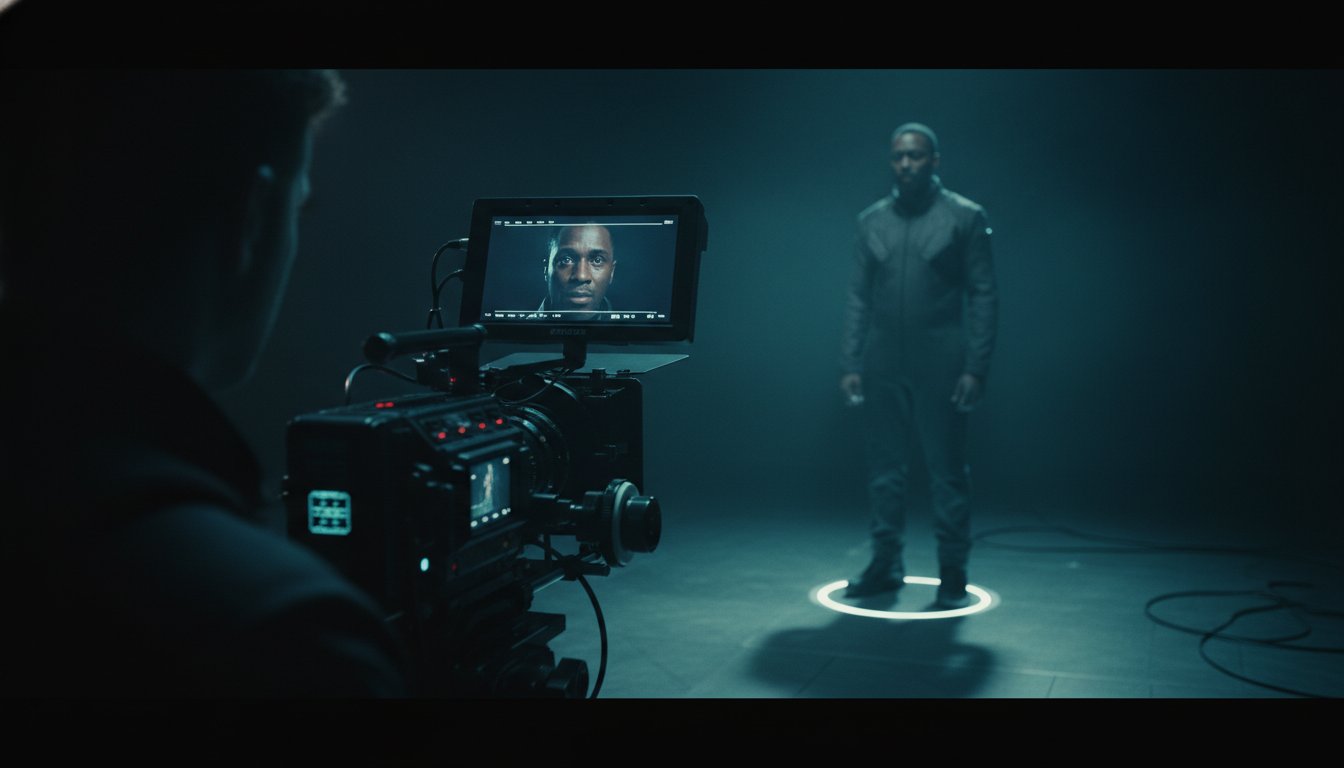
The very skills that earned you a standing ovation on stage are often the same ones sabotaging your screen career. While theater demands you reach the back row, the camera requires you to internalize that energy so the lens can find it. It's a common frustration for dedicated actors to feel "too big" or technically clumsy during a playback. Mastering acting techniques for film isn't about doing less; it's about doing something entirely different.
You likely know the sting of a "theatrical" feedback note or the confusion of missing a mark while trying to stay in the moment. We understand that the industry feels increasingly chaotic, especially with 62% of casting directors now using AI-assisted shortlisting in their workflows. You deserve a clear roadmap to handle these shifts. This article provides the technical and psychological tools you need to translate your craft for the screen and secure the professional representation you've earned. We'll explore the intimacy of the lens, the power of technical stillness, and how to protect your digital likeness under the latest 2026 SAG-AFTRA regulations.
Key Takeaways
- Understand the magnification factor and how to master physical economy so your performance translates naturally from the stage to the screen.
- Discover how to adapt classic acting techniques for film, including Meisner and Adler, to maintain emotional authenticity in disjointed shooting environments.
- Learn the technical "Eyeline" rule to stay fully in character while navigating the strict physical marks required on a professional set.
- Treat your self-tape setup as an extension of your craft by optimizing lighting, sound, and framing to meet 2026 industry standards.
- Bridge the gap between technical mastery and career success by leveraging professional visibility within an elite talent network.
Stage vs. Screen: Why Acting Techniques for Film Require a Different Toolkit
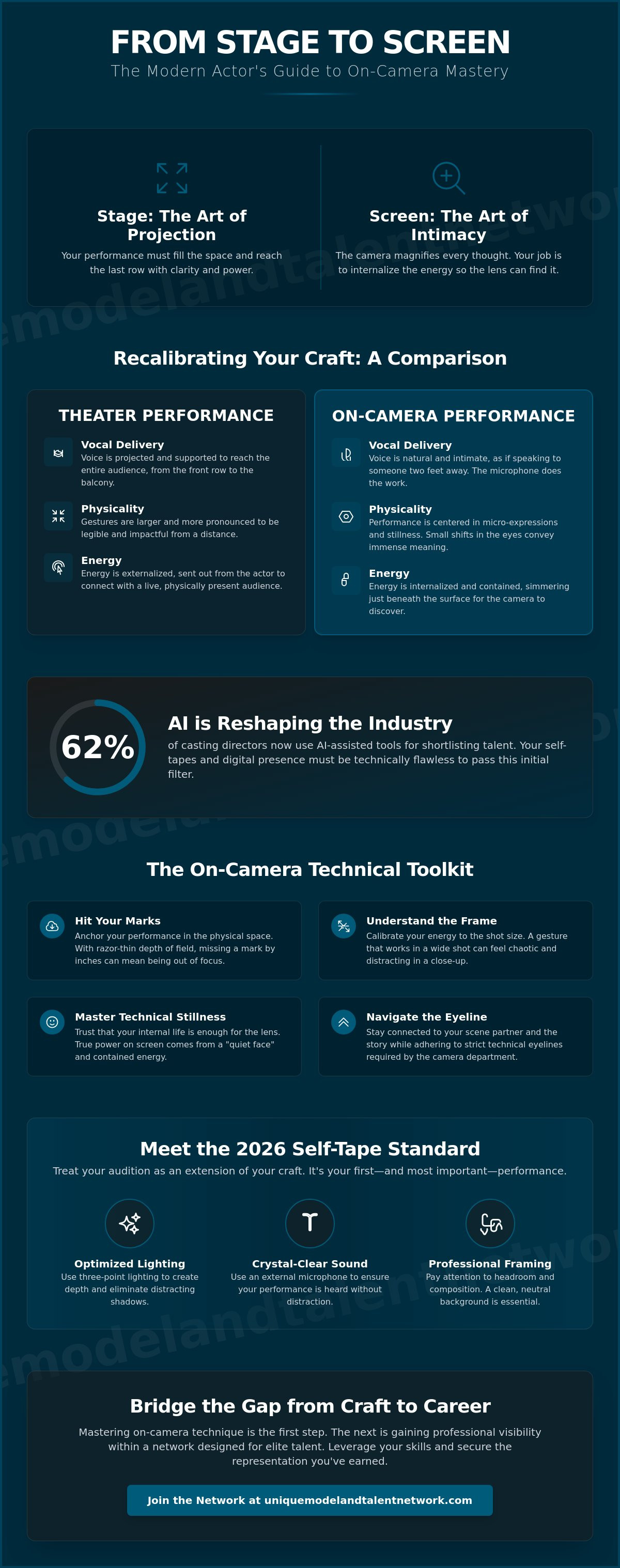
If you've spent years training for the stage, you've mastered the art of projection. You know how to send your voice to the balcony. You make your physical choices legible from fifty feet away. This is a vital foundation, but the lens demands a radical re-calibration. While theater is the art of projection, film is the art of intimacy. On a film set, the camera isn't a passive observer. It's a persistent, invasive presence that sees everything you think before you even say it.
This magnification factor is why classic acting methods must be adapted for the screen. If you "show" an emotion on camera the way you would on stage, it often reads as false. Professional acting techniques for film focus on the internal process. Because the camera captures the flicker of a thought in your eyes, your primary job is to simply experience the moment. If the thought is real, the lens will find it. You don't need to help the audience understand; you only need to exist.
The Power of the Close-Up
In a close-up, your face becomes a landscape. Micro-expressions carry more weight than a three-minute monologue. These are the involuntary twitches of a muscle or shifts in eye-contact. When the framing is tight, the inner life of the character is the only thing that matters. You must learn to trust that your stillness is active. Cinematic intimacy is the actor's ability to be vulnerable within inches of a lens.
Projection vs. Internalization
The transition from a 500-seat house to a boom mic requires a complete shift in energy management. While your objective remains the same, your delivery must be contained. Consider these key differences:
- Vocal Volume: On stage, you support your voice to reach the back row. On film, you speak to the person standing two feet away.
- Physical Economy: Large gestures that feel natural in a theater can look chaotic on a 40-foot cinema screen.
- Contained Energy: You must keep your stakes high but your physical output low.
Many actors make the mistake of "over-acting" because they fear they aren't doing enough. They try to compensate for the lack of movement by adding facial "acting" or unnecessary head tilts. This usually results in a performance that feels busy rather than grounded. True screen mastery comes from internalizing that theatrical energy. You let it simmer just beneath the surface. It's about being, not showing.
The Technical Fundamentals of On-Camera Mastery
Emotional truth provides the heart of a performance, but technical precision is the skeleton that supports it. On a professional set, your ability to "feel" the character is useless if you are consistently out of focus or blocking your co-star's light. Masterful acting techniques for film require you to maintain a dual consciousness. You must be deeply immersed in your character's psyche while remaining hyper-aware of the physical boundaries of the frame.
Hitting your marks is the most basic yet vital skill in this technical dance. In 2026, the prevalence of high-resolution digital sensors means that depth of field is often razor-thin. If you miss your mark by even three inches, you might be a blur. Professional actors treat these marks as subconscious anchors. You don't look down to find them; you feel them with your feet while keeping your eyes locked on your scene partner. This level of coordination distinguishes a seasoned professional from a novice. Modern academic acting pedagogy emphasizes this bridge between psychological intent and physical constraint, proving that technicality doesn't hinder creativity; it enables it.
Understanding the frame is equally critical. Your performance must scale according to the lens. In a wide master shot, your physical relationship to the environment tells the story. In a tight close-up, the camera is effectively inside your mind. Large gestures that feel authentic in a wide shot will look chaotic and distracting in a tight frame. Refining these technical nuances is exactly what we focus on during our Live Industry Workshops, where actors learn to calibrate their energy for different shot sizes.
Technical Stillness and 'The Quiet Face'
Physical economy is the secret to a professional screen presence. On film, the most powerful moments often happen in the silence between the lines. Unnecessary head nodding, frequent blinking, or shifting your weight can break the cinematic illusion. These small movements create "visual noise" that distracts the audience from your internal life. Try this exercise: Sit in front of a mirror and deliver a high-stakes monologue. If your head moves more than an inch in any direction, stop and restart. The goal is to let the energy live entirely in your eyes and voice without leaking through purposeless physical ticks.
Eyelines and the 'Third Wall'
The "Eyeline" rule is a technical necessity that often feels counterintuitive. You are frequently asked to look at a piece of colored tape on a matte box rather than your actual scene partner. This happens to ensure your eyes are visible to the camera. To master this, use the "imaginary partner" technique. Project the essence of your co-star onto that technical mark. You must also maintain eye-level consistency across multiple takes to help the editor. If you look up on one line and down on the next, the "cut" won't feel seamless. Ignoring a thirty-person crew while staying emotionally connected to a piece of tape is the ultimate test of your acting techniques for film.
Adapting Classic Methods: Meisner, Adler, and Stanislavsky for the Screen
Classic theater training is often criticized for being too broad for the camera, but the core philosophies of the masters remain the most effective acting techniques for film when applied with precision. The primary difference lies in the environment. On a stage, you have the luxury of a linear emotional journey. On a film set, you might shoot the climax of the movie on day one and the introduction on day twenty. You need a psychological toolkit that allows for instant, authentic emotional access regardless of the production's chaos.
Stella Adler's focus on "The Given Circumstances" is more relevant than ever in 2026. With the rise of virtual production and green-screen environments, actors are frequently asked to perform in empty voids. If you haven't built a rich, detailed world in your imagination, the camera will capture your confusion rather than your character's reality. Similarly, Stanislavsky's "Inner Monologue" is the secret weapon for long reaction shots. The camera often stays on you long after you've finished your lines. If your internal dialogue stops, the performance dies. You must keep the camera interested by thinking the character's thoughts in real time.
Practical Aesthetics also offers a streamlined approach for the busy professional. This method prioritizes "Action" over "Feeling." When the clock is ticking and the sun is setting, you don't always have time to find a deep emotional connection. You need an actionable goal. By focusing on what you are trying to do to the other person, you create a dynamic performance that feels grounded and urgent.
The Meisner Advantage: Spontaneity in the Edit
Meisner's repetition exercise is designed to get you out of your head and into your scene partner. In the disjointed world of film, this reactivity is what makes a performance feel alive through fifteen takes. If you're truly listening, every take will be slightly different. This gives the editor a variety of authentic moments to choose from. Many actors find that acting workshops online provide the perfect environment to sharpen these reactive skills before stepping onto a high-stakes set. Listening is the key to the great reaction shots that define cinematic storytelling.
Stanislavsky and the 'Magic If' for Screen Actors
When your scene partner is a piece of green tape on a tripod, Stanislavsky's "Magic If" becomes a technical necessity. You must use substitution to project a real person's essence onto that mark. This isn't just about emotion; it's about maintaining a clear objective. On a 12-hour shoot day, your physical energy will inevitably flag. Having a specific, actionable goal for your character keeps your intensity high even when you're exhausted. While "The Method" often focuses on emotional recall, Stanislavsky's original "System" offers a more sustainable approach to on-set mental health by emphasizing imagination over personal trauma.
Modern Application: Film Techniques for Self-Tapes and Digital Auditions
The self-tape is no longer a mere hurdle to clear before an in-person meeting. It is the most important "film" you will ever act in. In 2026, 62% of casting directors utilize hybrid workflows that include AI-assisted shortlisting. This means your tape must be technically indistinguishable from a professional production to even reach human eyes. Your technical setup, including lighting, sound, and framing, is not a separate task from your acting; it is an extension of your acting techniques for film. If the viewer cannot see the micro-expressions in your eyes or hear the nuances of your breath, the performance effectively does not exist.
Mastering the "Self-Tape Eyeline" is a vital technical skill. You must look just to the side of the camera lens, never directly into it, unless the script specifically calls for a fourth-wall break. Place your reader at eye level and close to the camera to ensure the casting director can see both of your eyes. When it comes to "The Slate," your professional persona is on display. Transition from your character back to your authentic self with ease. This brief moment proves you are a disciplined, professional colleague who is ready to handle the pressures of a high-budget set.
The 18-Inch Performance
Most home studios offer limited space, requiring you to master the 18-inch performance. You must maintain the emotional scale of the scene without physically moving out of your lighting "sweet spot." Use "The Lead-In" to establish your world. This is a three-second silent moment before your first line where you are already in the scene. It grounds the performance and provides the editor with a clean starting point. Understanding these nuances is a core part of the film industry auditions process where technical precision leads to bookings.
Mastering the Digital Call-Back
The digital call-back via Zoom or EcoCast introduces the challenge of technical lag. You must prioritize active listening even when the connection is imperfect. Stay present in your "digital box" by reacting to your partner's lines with your eyes and facial shifts rather than vocal interruptions. To create the illusion of genuine eye contact in a digital audition, you must look directly into your camera lens rather than at the person's face on your screen. This small adjustment makes the casting director feel like you are looking at them, which builds immediate intimacy. To ensure your home setup and technical execution meet elite standards, you can submit your work for our Portfolio & Reel Reviews to receive professional feedback.
From Craft to Career: Leveraging Your Technique in a Managed Network
Even the most refined acting techniques for film won't book jobs if your work remains in a vacuum. Mastery of the lens is only the first half of the professional equation. The second half is visibility. In an industry often characterized by noise and unorganized communication, serious actors must find a way to distinguish themselves from the hobbyist crowd. You need a platform that translates your technical skill into professional recognition.
Your acting portfolio serves as the primary vessel for this transition. It isn't just a collection of photos; it's a strategic showcase of your technical range. A high-quality portfolio demonstrates your ability to handle different shot sizes and emotional stakes with the precision we've discussed. However, a portfolio is only effective if it's placed in a gated, professional environment where decision-makers are actually looking. Private communities provide the necessary focus to get your reel in front of those who have the authority to hire you.
Consistency is the hallmark of a professional. To keep your "film muscles" sharp between bookings, you must engage in deliberate practice. Our Monthly Skill-Building Challenges are designed to simulate the pressures of a real set. They force you to apply technical stillness and eyeline mastery under specific constraints. This disciplined approach ensures that when you finally step onto a union set, your technique is second nature rather than a conscious struggle.
Direct Access to Industry Experts
One of the greatest risks to an emerging career is taking advice from unvetted sources. General social media platforms are often filled with predatory or simply incorrect guidance. Our Live Industry Workshops with Casting Directors allow you to test your acting techniques for film in real-time. You receive immediate, high-level feedback that is grounded in current market needs. The Unique Model & Talent Network functions as a safe, elite space for this growth, prioritizing your career security over superficial engagement.
Building a Career That Lasts
Transitioning from an "aspiring" actor to a working professional requires a shift in mindset. It means valuing financial legitimacy and professional standards above all else. A managed network acts as a bridge, connecting you to vetted opportunities that respect your craft. By surrounding yourself with a community of high-standard peers and industry experts, you build a foundation for a career that lasts. It's time to move past the distractions of the open market. Join a community that values the craft as much as the career and start booking the professional work you've trained for.
Take Command of Your Professional Screen Career
Success on set in 2026 requires more than just raw talent; it demands a sophisticated understanding of the magnification factor and the technical discipline of the lens. We've explored how acting techniques for film prioritize internal thought over outward projection. By mastering stillness and adapting classic methods for the modern frame, you position yourself as a reliable professional. However, talent alone is rarely enough in a chaotic industry. You need a structured environment where your craft is visible to those who make casting decisions.
Don't navigate this path in isolation. Join the Unique Model & Talent Network to sharpen your craft and connect with industry pros. You'll gain exclusive access to live workshops with Casting Directors and monthly skill-building challenges designed to keep your performance sharp. Our private community provides the career security and vetted feedback you need to move from aspiring to established. Your technical journey is just beginning, and we're ready to help you bridge the gap to professional success. The camera is ready. It's time to ensure you are too.
Frequently Asked Questions
What is the difference between Method Acting and the Meisner Technique?
Method acting focuses on internal emotional recall and sensory memory, while Meisner emphasizes external reactivity and living truthfully under imaginary circumstances. Method actors often use personal experiences to trigger specific emotions for a scene. Meisner actors focus entirely on their partner's behavior to spark spontaneous, authentic reactions. Both are valid acting techniques for film when you adjust your physical output for the camera's intimacy.
Do I need a degree in acting to be successful in film?
No, a formal degree is not a requirement for success, although structured training is essential for professional development. Casting directors prioritize your reel, your professional reputation, and your technical ability over academic credentials. Many successful actors substitute a traditional four-year degree with intensive workshops and consistent skill-building within professional networks to stay competitive in the current market.
How do I stop 'over-acting' when I'm on camera?
You stop over-acting by internalizing your energy and trusting that the camera can read your thoughts without extra effort. Physical stillness is your greatest ally on set. Focus on your specific objective and your scene partner rather than trying to show the audience how you feel. If your internal life is active, the lens will capture every nuance without you needing to push.
What are the best acting exercises I can do at home for film?
The mirror monologue is excellent for mastering physical economy and reducing unnecessary head movement during dialogue. You can also record yourself performing short scenes to analyze your eyeline consistency and vocal levels. Practicing your 18-inch performance in a home-studio setup helps you refine the specific acting techniques for film required for modern self-tape auditions and digital call-backs.
How do I find an eyeline if my scene partner isn't there?
You find an eyeline by placing a specific physical mark, like a piece of colored tape, just to the side of the camera lens at eye level. Treat this mark as your imaginary partner by visualizing their essence and reactions on that spot. Consistency is key; looking at the same mark for every take ensures the editor can cut the scene together seamlessly.
Is it better to focus on one acting technique or mix several?
Most professionals find that a hybrid approach is most effective on a modern film set. While mastering one foundation is helpful, mixing techniques allows you to adapt to different directorial styles and production challenges. You might use Meisner for reactivity in a dialogue-heavy scene but rely on Stanislavsky's Magic If when performing against a green screen or a piece of tape.
How can a professional network help me improve my film acting skills?
A professional network provides access to live workshops and expert feedback that you simply can't find on general social media. It offers a safe space to test your techniques and receive vetted critiques from industry insiders. Engaging in monthly skill-building challenges within a managed community keeps your film muscles sharp and ensures your portfolio remains competitive for high-level recruitment.
What do casting directors look for in a film actor's technique?
Casting directors look for authenticity, technical precision, and what many call the quiet face. They want to see an actor who can hit their marks and maintain eyelines without breaking character or looking distracted. In 2026, they also look for actors who understand the technical requirements of self-tapes, as 62% of casting directors now use hybrid workflows for shortlisting talent.


