

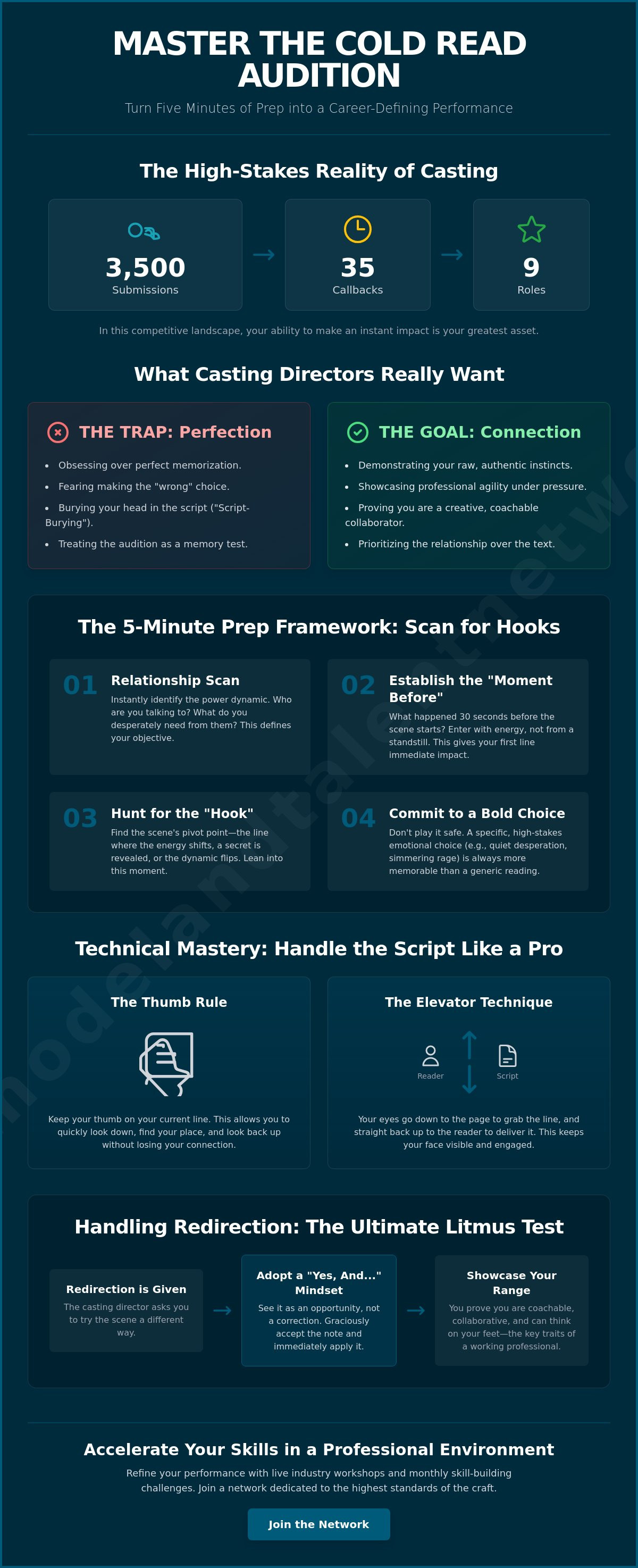
In a recent casting breakdown, 3,500 actors submitted for just nine roles, and only 35 were ultimately brought in for callbacks. In such a high-stakes environment, learning how to prepare for a cold read audition is no longer just an elective skill; it is your primary competitive advantage. When you have only five minutes to review a script, the pressure to be perfect can often lead to script-burying, where you lose eye contact and, consequently, the room.
It's understandable to feel nervous about making the wrong choice or stumbling over unfamiliar dialogue. However, professional casting directors aren't looking for a polished, memorized performance. They're looking for your instincts and your ability to take direction under pressure. This guide will show you how to turn that brief script review into a booking-ready audition by mastering technical script handling and bold character choices.
We will break down specific techniques to maintain engagement while reading, how to absorb redirection gracefully, and the mental shifts required to walk into any room with seasoned confidence. By the end of this article, you'll have a clear roadmap to navigate the most unpredictable part of the casting process.
Key Takeaways
- Shift your focus from word-perfect memorization to demonstrating professional agility and authentic instincts during the read.
- Learn how to prepare for a cold read audition in under five minutes by identifying core relationship hooks and the "Moment Before" the scene starts.
- Master the physical "Thumb Rule" and "Elevator Technique" to maintain eye contact and keep your face visible while referencing the script.
- Adopt a "Yes, And" mindset to treat redirection as an opportunity to showcase your coachability and range to casting directors.
- Refine your performance in a safe, high-standard environment through live industry workshops and monthly skill-building challenges.
What is a Cold Read Audition and Why It Is Your Secret Weapon
Many actors view the cold read as a high-wire act without a net. In reality, it's your most powerful tool for demonstrating professional agility. What is a cold reading? Essentially, it's the act of performing a scene with minimal time to prepare; you'll often receive the "sides" just minutes before walking into the room. Casting directors don't use this method to trip you up. They use it to strip away the over-rehearsed layers of a prepared monologue. They want to see your raw instincts, your ability to listen to a reader, and how effectively you process redirection under pressure.
From an insider's perspective, the cold read is actually your best chance to book. While other actors obsess over perfect memorization, you can focus on the connection. By 2026, the industry has shifted toward rapid-turnaround digital callbacks and virtual "live" reads. This means your ability to quickly synthesize a character's essence is the primary metric for talent evaluation. It's less about a flawless performance and more about showing you're a reliable, creative collaborator who can think on their feet. When you treat the audition as a professional meeting rather than a test, you immediately stand out from the crowd.
The Myth of "Impossible Preparation"
The biggest mistake is assuming you can't get ready. Understanding how to prepare for a cold read audition starts long before you see the script. You must research the project's tone and the casting director's specific style. A gritty procedural drama requires a completely different energy than a multi-cam sitcom. Use the casting breakdown to infer your character's function in the story. Are you the obstacle, the comic relief, or the emotional anchor? This context provides the "why" behind the words, allowing you to make a bold choice the moment you see the page.
Cold Reading vs. Sight Reading
Don't confuse performing with simply reading aloud. Sight reading is a mechanical skill; cold reading is a professional performance. If you focus solely on "getting the words right," you'll bury your head in the script and lose the connection with your partner. In modern film industry auditions, professional literacy means prioritizing the relationship over the text. Casting directors will forgive a stumbled word if the emotional truth is present. They won't forgive a flat, disconnected reading that ignores the scene's stakes.
The 5-Minute Prep Framework: Scanning for Hooks
When you're standing in a hallway with a fresh set of sides, you don't have the luxury of a deep character study. You need a surgical approach to how to prepare for a cold read audition that prioritizes impact over perfection. This four-step framework is designed to help you synthesize the scene's pulse in under five minutes. First, perform a Relationship Scan. Identify who you are speaking to and, more importantly, what you need from them. Second, establish your "Moment Before." If you don't know what happened 30 seconds before the first line, your performance will start at zero energy.
Next, hunt for the "Hook." Every well-written scene has a pivot point where the energy shifts or a secret is revealed. This is your opportunity to show the casting director that you understand the narrative arc. Finally, commit to a "Bold Choice." In a sea of safe, middle-of-the-road readings, the actor who chooses a specific, high-stakes emotion is the one who gets remembered. Whether it's a quiet desperation or a simmering professional rivalry, a singular commitment always beats a generalized performance. Practicing these cold reading techniques regularly will make this process second nature.
Analyzing Relationship and Objective
The core of any scene is the power dynamic. Before you speak, determine who holds the status in the room. Are you the one seeking permission, or are you the one granting it? Once you've identified the dynamic, define your "Want." Every line you deliver should be a tactic to achieve a specific goal, such as extracting an apology or winning an argument. Without a clear objective, your reading will inevitably fall into a flat, monotone rhythm that fails to engage the casting director's imagination.
The First and Last Line Rule
Your first line is your handshake with the room; it must land with a specific, intentional energy that demands attention. Don't wait for the second or third line to "get into" the character. Similarly, your last line is your final professional impression. Instead of simply stopping when the words end, "leave the room" with your eyes and your energy. The "Moment After" is the internal reaction to the scene's resolution that keeps the character alive even after the dialogue stops. If you find yourself struggling to maintain this focus alone, joining a professional network membership can provide the peer feedback necessary to sharpen these instincts.
Technical Mastery: How to Handle the Script Like a Pro
Your preparation is only as good as your execution. Once you understand the scene's pulse, you must master the physical mechanics of the script. One of the most effective ways to ace a cold read audition is to treat the paper as an extension of your body, not a shield. The "Thumb Rule" is your primary safeguard; keep your thumb anchored directly under the line you're about to speak. This simple physical marker prevents the mid-scene panic of losing your place after looking at your partner. It allows you to return to the text instantly without breaking the flow of the performance.
Positioning is equally critical. Use the "Elevator Technique" to hold your sides at chest level. If you hold them too low, you'll bury your chin and muffle your voice. If you hold them too high, you'll block your facial expressions from the casting director's view. Aim for a height that allows your eyes to flick down and back up with minimal head movement. In a modern setting, you might be reading from a tablet or phone. If so, ensure your device is in "Do Not Disturb" mode and adjust the brightness to avoid casting a distracting digital glow on your face. Digital sides require a steady hand, as scrolling is often far more jarring than a clean, professional page turn.
Aim for an 80/20 eye contact ratio. You should spend 80% of the scene looking at your partner and only 20% looking at the page. This ratio signals that you're listening and reacting, which are the two most important traits being evaluated. Learning how to prepare for a cold read audition involves practicing this balance until you can "grab" a line of text in a split second without breaking the emotional tension. If you're looking at the script more than your partner, you're not acting; you're just reading aloud.
The Art of the "Lift and Look"
The "Lift and Look" is the hallmark of a seasoned professional. The process follows a specific "Pulse": breathe, read the line silently, look at your partner, and then speak. You should never speak while your eyes are still on the page. Delivering dialogue while looking down suggests you're disconnected from the stakes of the scene. By holding the line in your mind before speaking, you ensure that every word is delivered with the intent and objective you identified during your initial prep. This technique transforms a cold read into a living, breathing performance.
Physicality and Blocking
Keep your feet planted to provide a stable emotional base. While your lower body remains still, your upper body should stay expressive and responsive to your partner's choices. The script can even serve as a prop if the scene allows it, but it should never become a crutch that limits your range of motion. Refining these physical nuances often requires professional feedback. Participating in acting workshops online is an excellent way to record yourself and identify any distracting physical habits that might be undermining your presence in the room.
Handling Redirection: The Ultimate Professional Litmus Test
If a Casting Director (CD) stops you mid-scene to give a note, take a breath and smile. This is the highest compliment you can receive in an audition room. It means they've seen a spark in your initial performance and want to verify that you're actually coachable on a professional set. Part of how to prepare for a cold read audition is mentally preparing for this pivot. Many actors make the mistake of defending their first choice or explaining why they did what they did. Don't do that. Instead, adopt a "Yes, And" mindset. Take the note, say "thank you," and immediately incorporate the change without ego. This demonstrates that you're a collaborator who can handle the rapid pace of a production environment.
You must also learn to manage the room's energy. Sometimes a CD might seem distracted, looking at a laptop or whispering to an associate while you're performing. Stay grounded in your character's objective. Their behavior isn't a reflection of your talent; it's the reality of a busy recruitment process. If you stumble over a difficult word, don't break character or look at the floor in shame. A professional recovery is often more impressive than a perfect, sterile read because it proves you can maintain your focus under pressure. Your job is to stay in the scene until the very end, regardless of what's happening on the other side of the table.
The "Take" Transformation
When you're asked for a "different take," the CD is looking for range. They might ask you to completely flip your objective, moving from a position of power to one of total vulnerability. This isn't a sign that your first attempt was "wrong." It's a test to see if you can shed your previous work and start fresh with a new intent. Flexibility is far more important than a polished first read because it shows you can adapt to a director's specific vision. Your ability to be directed is what gets you booked for long-term projects where the script might change every single morning.
Mistakes vs. Character Moments
A missed word or a slight hesitation can actually be a gift if you handle it correctly. Instead of stopping to apologize, which immediately breaks the reality of the scene, turn the stumble into a character beat. A search for words can look like a moment of genuine contemplation or a flash of internal conflict. Never apologize for a mistake unless the CD stops the scene to reset. Maintaining your professional aura from the moment you enter until the moment you leave preserves the illusion you've created. To refine these high-level room skills, consider joining The Network Membership for access to industry-standard training and peer reviews.
Accelerate Your Skills with the Unique Model & Talent Network
Mastering the technical mechanics of a script is only half the battle. To truly understand how to prepare for a cold read audition, you must practice these skills in an environment that mirrors the pressure of a real casting office. Our acting industry networking platform serves as a professional gym where you can refine your instincts without the high-stakes risk of losing a job. Through our Live Industry Workshops, members receive direct, real-time feedback from guest casting directors who are actively hiring in 2026. This level of access ensures that your "bold choices" are actually aligned with current industry standards.
We believe that professional growth happens through repetition and community support. Our Monthly Skill-Building Challenges provide you with fresh scripts and specific objectives, forcing you to sharpen your five-minute prep framework regularly. This isn't about social media vanity or chasing followers; it's about disciplined business development alongside peers who value integrity and craft. By engaging with other serious professionals, you'll find that the fear of the unknown in a cold read quickly transforms into a sense of prepared excitement. Consistent practice within a gated community removes the external distractions that often plague general acting groups.
Mentorship and Expert Q&A
Clarity is the ultimate antidote to audition anxiety. Our Industry Expert Q&A sessions peel back the curtain on what recruitment professionals are prioritizing right now. Having a protective mentor in your corner prevents you from falling into the unorganized communication methods often found in hobbyist circles. We also encourage a modeling career coaching approach for our talent. This strategy helps you diversify your booking potential by understanding how to maintain a professional presence across different visual mediums, whether you're in a commercial callback or a high-fashion procedural drama.
Join the Network Today
There is a massive difference between public casting sites and a vetted, private community. While general platforms are often cluttered with noise, our network is designed for those committed to a sustainable, financially legitimate career. You have the opportunity to move from "aspiring" to "working" by consistently engaging with our Portfolio & Reel Reviews and expert-led sessions. If you are ready to take your career seriously and master how to prepare for a cold read audition with a team of advocates behind you, it's time to level up. Apply for The Network Membership today to start your professional journey with the clarity and support you deserve.
Master Your Next Room With Seasoned Confidence
Mastering the mechanics of the script and the mental agility required for redirection is what separates hobbyists from working professionals. By utilizing the five-minute prep framework and the "Thumb Rule" for technical precision, you ensure that your focus remains on the connection rather than the page. Learning how to prepare for a cold read audition transforms a high-pressure moment into a showcase of your professional range and coachability. You're no longer just reading lines; you're demonstrating that you're a reliable collaborator ready for a professional set.
Success in this industry is rarely a solo journey. It requires a high-standard environment where you can practice without the fear of a missed booking. Our private, moderated community of professional talent offers direct access to casting directors and photographers through live workshops with real-time industry feedback. This is your space to refine your instincts and build legitimate professional bonds with those who are serious about their craft.
Master your craft and connect with the pros—Join The Network today.
You have the talent and the tools to succeed. It's time to step into the room with the clarity and authority of a true industry insider.
Frequently Asked Questions
Do I need to have the lines memorized for a cold read?
No, you are not expected to have your lines memorized for a cold read. In fact, casting directors expect to see the script in your hand as it signals you're working with the material for the first time. Trying to memorize on the fly often leads to a rigid performance. Focus instead on being familiar enough with the text to maintain a strong connection with your scene partner.
What should I do if I can’t read the handwriting on the script?
Ask for clarification immediately if you cannot read a specific word or note on the script. It's far more professional to resolve a technical issue before the scene starts than to stumble mid-performance. Casting directors appreciate actors who take ownership of their preparation. Simply point to the line and ask for a quick translation so you can stay grounded in the character's reality.
Is it okay to ask the casting director questions before I start?
Yes, it's acceptable to ask brief, targeted questions regarding the scene's tone or the relationship between characters. Avoid asking questions already answered in the casting breakdown or the script itself. If you need clarity on the "Moment Before" to make a stronger choice, ask concisely. This shows you're considering how to prepare for a cold read audition with a professional mindset and specific intent.
How much eye contact is too much in a cold read?
Continuous eye contact can feel unnatural and may suggest you're over-rehearsed for a cold read. Stick to the 80/20 rule, where you look at your partner for the majority of the scene but return to the script for your next line. If you never look at the page, you lose the "live" energy that casting directors are looking for. Balance ensures you remain connected without appearing rigid.
Should I dress in character for a cold read audition?
You shouldn't wear a full costume for a cold read audition. Instead, choose professional attire that hints at the character's world without being literal. If you're auditioning for a corporate executive, a clean blazer is appropriate; for a fitness instructor, professional athletic wear works well. Dressing with a "suggestion" of the role helps the casting director's imagination without becoming a distraction in the room.
What happens if I completely blank on a line?
If you blank on a line, simply look down at your script and find your place while staying in character. The script is your safety net, so use it without apology. You can even turn the pause into a character beat, such as a moment of internal conflict or hesitation. Never stop the scene or break the professional aura unless the casting director specifically asks you to reset.
Can I use a tablet or phone to read my sides?
Using a tablet or phone is increasingly common in modern auditions, but you must ensure the device is prepared. Set your screen to "Always On" and activate "Do Not Disturb" to prevent notifications from interrupting the scene. Be aware that digital screens can cast a glow on your face, so adjust the brightness. Knowing how to prepare for a cold read audition with digital sides requires extra focus on steady handling.
How do I handle a cold read if there is no reader and I have to imagine the other person?
If there's no reader, place your imaginary scene partner slightly to the left or right of the camera lens. Never look directly into the camera unless specifically instructed, as this breaks the fourth wall. Maintain the same eye contact ratios you would with a real person. Visualizing a specific focal point helps you stay consistent with your eye lines and emotional reactions throughout the performance.


