

Imagine receiving a notification for a high-stakes guest star role with a 24-hour turnaround. With the current SAG-AFTRA daily minimum sitting at $1,246, the pressure to deliver a flawless performance is immense. Yet, you are stuck staring at three pages of sides, wondering how to memorize lines quickly without sounding like a Siri recording. If you've ever felt the panic of a blank mind during a self-tape, you know that rote repetition is often a recipe for a stiff, amateurish delivery.
We understand the frustration of wasting hours on memorization that simply doesn't stick when the camera starts rolling. You want to be fully off-book so you can actually listen, react, and take direction rather than just hunting for your next word. This guide provides the professional blueprint to master your script in record time using science-backed techniques that anchor your dialogue to physical intent.
You'll discover the "Emergency 60-Minute Protocol" for last-minute auditions, a breakdown of the top-rated memorization apps for 2026, and the industry secrets that move you from reciting to living the scene. It's time to stop worrying about the words and start focusing on the craft that gets you booked.
Key Takeaways
- Understand why rote repetition often triggers the "panic response" and how to shift your focus toward professional-grade script retention.
- Leverage the power of embodied cognition to anchor your dialogue to physical actions, ensuring your performance remains fluid and natural under pressure.
- Implement a strategic 60-minute emergency protocol to learn how to memorize lines quickly when faced with tight turnaround times for high-stakes self-tapes.
- Navigate the modern digital landscape by choosing the right tools, from the latest line-learning apps to the high-value interaction of live readers.
- Reclaim your mental bandwidth to respond to direction and elevate your professional craft once the words are fully internalized.
The Science of "Off-Book": Why Rote Repetition Fails Actors
In a professional casting environment, "knowing the lines" and being "off-book" are two entirely different states of being. Knowing the lines is a fragile, intellectual grasp of the words. Being off-book is a deep, cellular integration that allows you to remain present and reactive. If you are still hunting for your next sentence, you aren't acting; you are just reciting. This is why many performers struggle to understand how to memorize lines quickly while maintaining the integrity of their performance. When you rely solely on rote repetition, you build a house of cards that collapses the moment a casting director gives you a redirect.
This collapse is often caused by the "Panic Response." During high-pressure auditions, your brain releases cortisol, which can effectively shut down access to short-term memory. To combat this, you must move beyond passive reading and embrace active recall. According to The Science of Memorization, the act of forcing your brain to retrieve information strengthens neural pathways far more effectively than simply seeing the information again. Testing yourself is the only way to ensure the dialogue survives the adrenaline of the room.
Success in this field requires a shift in perspective. Follow the 12-word rule: Understand the character's core intent before you attempt to memorize the dialogue.
Short-Term vs. Muscle Memory
Reading a script 100 times creates a dangerous "false sense of fluency." Your brain recognizes the words on the page, so it stops working to store them. While the hippocampus handles the initial intake of dialogue, it is easily disrupted by stress. To truly master how to memorize lines quickly, you must transition the material into your performance memory. You achieve this through varied repetition, such as saying lines while performing unrelated tasks. This forces the brain to decouple the words from the physical act of reading, storing the information in the basal ganglia where it remains accessible even during a high-stakes callback.
The Intent-First Approach
When you understand the "Why" behind a scene, the "What" becomes inevitable. Your character's objective acts as a logical spine for the entire script. By identifying "Beat Changes," you create mental anchors that signal a shift in tactics or emotion. These shifts serve as signposts, making long monologues feel like a series of logical steps rather than a wall of text. Professional script analysis isn't just homework; it is the most efficient map for your memory. It allows you to trust your preparation, freeing up your mental bandwidth to actually listen and respond to your scene partner.
Embodied Cognition: Using Movement to Anchor Dialogue
Professional actors don't just sit at a desk and stare at a page. They move. This approach is rooted in the theory of Embodied Cognition, which suggests that your cognitive processes are deeply intertwined with your physical state. When you engage your body while studying, you bypass the analytical "blocking" that often occurs when you try to force words into your head through sheer willpower. If you want to master how to memorize lines quickly, you must stop treating your brain like a hard drive and start treating it like part of a living system.
Physical anchoring is the neurological process of tethering specific dialogue to sensory input or motor actions to ensure the words remain accessible even under extreme performance stress. This technique creates a secondary retrieval path for your memory. If your brain "blanks" on a word, the muscle memory of the associated movement can often trigger the recall you need to stay in the scene.
There is a risk, however, of "locking in" a specific vocal inflection or physical choice too early in the process. To avoid this, keep your movements varied and unrelated to the scene's actual blocking. Pacing, tossing a tennis ball, or even doing push-ups keeps the words fluid and adaptable. This ensures you are memorizing the content rather than a rigid way of saying it, which is vital for taking direction during a callback.
The "Action-Task" Technique
Try the "Action-Task" technique during your initial study sessions. Perform a mundane chore like folding laundry or washing dishes while reciting your sides. By occupying your conscious mind with a simple physical task, you allow your subconscious to absorb the dialogue more naturally. You can also match subtle gestures to key trigger words in the script. This creates a physical cue that helps you retrieve the line when you need it most. If you find yourself struggling to stay consistent with your practice, participating in Monthly Skill-Building Challenges can help you refine these physical techniques alongside other serious professionals.
Walking the "Script Map"
Another powerful tool is walking the "Script Map." Assign different beats of the scene to specific areas of your room. As you move from one corner to the next, you physically transition through the character’s emotional arc. This spatial memory is incredibly durable because it engages the part of the brain used for navigation. Once the lines are secure, you can scale these large movements back into the subtle stillness required for film industry auditions. This transition ensures your performance is grounded in truth rather than just memorized text.
The Professional’s Toolkit: Digital vs. Human Readers
Modern casting demands speed. When you are juggling multiple self-tapes, the method you choose to rehearse determines whether you show up prepared or merely rehearsed. Digital tools offer immediate accessibility, while human readers provide the emotional unpredictability of a real set. Choosing the right combination is a fundamental step in learning how to memorize lines quickly without sacrificing the spontaneity of your performance. While an app is available at 3:00 AM, a human partner remains the gold standard for testing your readiness for the high-stakes environment of a professional audition.
The cost-benefit analysis is clear. Popular apps like Rehearsal Pro require a $20 one-time fee, while LineLearner offers a streamlined experience for a $5 one-time payment. In contrast, the average hourly rate for a professional audition reader in the United States is $19.75. While digital tools are cost-effective for initial memorization, they cannot replicate the "dynamic feedback" of a live partner. To bridge this gap, many successful actors utilize a talent network to find reliable rehearsal partners who understand the nuances of the industry.
Leveraging AI and Apps
Digital tools are excellent for the "Italian" run, a rapid-fire speed run where you recite lines as fast as possible without emotion. This strips away any "pre-planned" delivery. When using apps like coldRead, which costs between $7 and $11 per month, record your cue lines with a flat, neutral tone. This prevents you from falling into the "Voice Memo trap." If you listen to a recording of your own voice delivering the lines, you will unconsciously memorize your own inflections. This makes you sound robotic and prevents you from taking direction during the actual session. Use the app to learn the sequence of the words, but keep the performance fluid.
The Power of Professional Peer Support
Running lines with a fellow professional actor is transformative. Unlike a well-meaning friend, a professional "line buddy" won't give you a line reading or move at a predictable pace. They provide the necessary friction that forces you to truly listen and respond. You can find these high-caliber partners within a gated community like Unique Model & Talent, where members are committed to their professional growth. This peer support prepares you for the unpredictability of a casting office. If a reader in the room changes their pace or tone, you'll have the mental bandwidth to adapt because you haven't memorized the scene in a vacuum. This is the ultimate secret to how to memorize lines quickly while staying "off-book" in a way that actually wins the role.
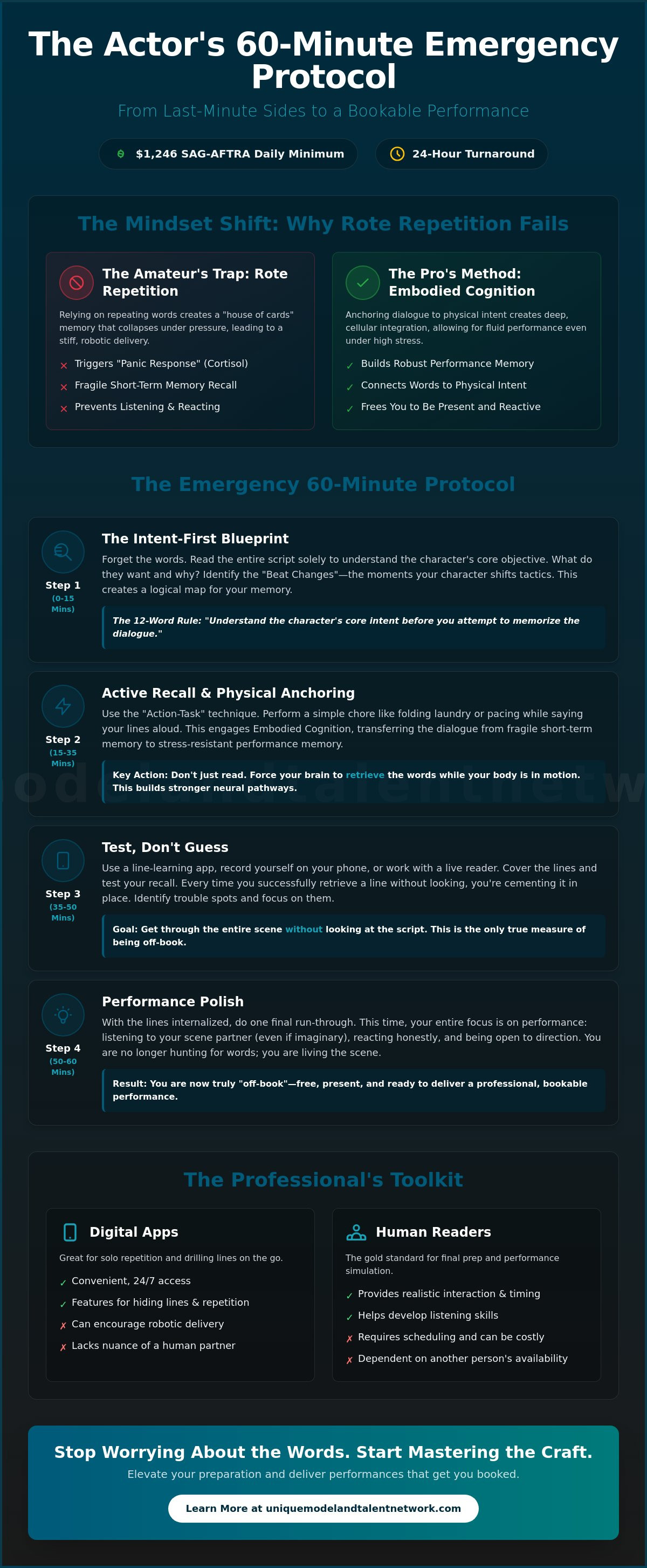
The Emergency 60-Minute Protocol for Last-Minute Sides
In a landscape where self-tapes are the primary first-round audition format, you will often receive seven pages of sides with a 24-hour deadline. Panic is a luxury you cannot afford. To succeed, you need a disciplined, timed system that bypasses the slow process of rote repetition. This emergency protocol is designed to help you understand how to memorize lines quickly by engaging multiple neural pathways in a single hour. If you follow this structure, you'll move from a cold read to a performance-ready state before the clock runs out.
- Step 1: The Silent Read (0-10 mins). Don't try to memorize yet. Identify the "Who, What, and Where." Determine your relationship to the other character and your immediate objective. Context provides the "hooks" your memory needs later.
- Step 2: The Handwritten Transcription (10-25 mins). Write out your lines by hand. Research confirms that the tactile act of writing engages the brain more deeply than typing or reading. This step builds the initial physical connection to the text.
- Step 3: The First Letter Method (25-40 mins). Create a mnemonic cheat sheet using only the first letter of each word. This forces your brain to work for the answer, which is the core of active recall.
- Step 4: The Italian Run (40-55 mins). Recite the entire scene at double speed. Strip away all emotion and inflection. This ensures you know the raw data of the script so well that you won't "go up" when the stakes rise.
- Step 5: The Verification Test (55-60 mins). Recite the lines while performing a high-focus task, such as sorting coins or balancing on one foot. If the lines stay in your head while your focus is elsewhere, you are truly off-book.
The First Letter Mnemonic
The First Letter Method is arguably the most powerful tool for actors who need to know how to memorize lines quickly. Instead of looking at the full script, you look at a sequence like "W D Y W F M?" (What do you want from me?). This acts as a mental prompt. It bridges the gap between looking at the page and full recall. If you can "read" the scene from your mnemonic sheet without hesitation, you have successfully moved the dialogue into your long-term storage. This method is far more effective than highlighting because it prevents the "false sense of fluency" that comes from passive reading.
Why Speed is Your Secret Weapon
The "Italian Run" is a staple in professional theater and film. By removing all inflection, you prevent yourself from getting stuck in a specific "line reading." This keeps your delivery flexible, allowing you to take direction easily during a virtual callback. While your brain processes the sequence of the words during these speed runs, you can simultaneously prepare your acting portfolio or set up your lighting. Mastering the raw data of the script is what gives you the freedom to be an artist once the camera is on.
Ready to put these high-speed techniques into practice with industry pros? Join our next Live Industry Workshops to sharpen your audition skills in real-time.
Beyond the Words: Mastering the Craft with Unique Model & Talent
Memorization is the entry fee for the professional actor. It is the baseline expectation that allows you to step onto a set or into an audition room with confidence. If you're still struggling with the text, you lack the mental bandwidth required to actually act. True artistry begins when the lines are so ingrained that they become second nature. This freedom allows you to focus on your partner, respond to the environment, and deliver a nuanced performance. While mastering how to memorize lines quickly is essential, the goal is always to move beyond the words and into the truth of the scene.
A common pitfall for emerging talent is "perfect" memorization that lacks flexibility. If you've practiced your lines in a vacuum without considering different emotional beats, you might find it impossible to take direction. A casting director’s redirect isn't a critique of your memory; it’s a test of your range. If you are locked into one way of speaking, you appear amateurish. Professional networks like Unique Model & Talent provide the environment you need to test your preparation against real-world scenarios before the stakes are high. When you know how to memorize lines quickly, you can use your preparation time to explore multiple choices rather than just surviving the dialogue.
Live Workshops and Real-Time Feedback
Testing your recall in a safe but professional setting is vital for career growth. Our acting workshops online connect you with seasoned coaches who push you to stay present while off-book. These sessions allow you to receive real-time feedback on your presence and your ability to pivot during a scene. By participating in Monthly Skill-Building Challenges, you turn the chore of memorization into a refined, competitive skill. This consistent practice ensures that when you receive a last-minute script, your process is efficient and reliable.
Joining a Community of Serious Talent
Success in the entertainment industry requires a focused environment. General social media platforms are filled with distractions and unverified advice that can derail your development. Joining a private, gated community of serious professionals provides a clear path to career security. You gain access to a library of expert content on script analysis and industry standards, moving you from a student mindset to a professional one. This community acts as a protective mentor, ensuring you have the resources to succeed without the noise of the public internet. Ready to take the next step in your professional development? Join the Unique Model & Talent Network to accelerate your career.
Elevate Your Audition Performance Through Strategic Preparation
Mastering your dialogue is simply the baseline for a successful acting career. By moving away from mindless repetition and embracing active recall, you reclaim the mental space needed for true spontaneity. You've learned how to memorize lines quickly using our 60-minute emergency protocol and modern digital tools. These techniques ensure you are always ready for the next high-stakes opportunity, even with the tightest turnaround times.
If you are serious about your craft, real growth happens within a community that values professional integrity and excellence. As a member of the Unique Model & Talent Network, you gain access to live workshops with casting directors and monthly skill-building challenges designed to keep your recall sharp. This private community of vetted industry professionals provides the clarity and security you need to navigate this competitive field with confidence.
Master Your Craft: Join The Network Membership Today
Your next big role is waiting. Step into the room with the confidence of an actor who is truly off-book and ready to shine.
Frequently Asked Questions
How do I memorize lines in 10 minutes?
You can memorize short sections in 10 minutes by using the first-letter mnemonic method. Write down only the first letter of every word in your script. This forces your brain into active recall rather than passive recognition. It's a high-intensity technique that builds the mental muscle needed for rapid retention. Don't waste time on rote repetition when you have a tight deadline.
Is it better to memorize lines before or after script analysis?
You should always prioritize script analysis before memorization. Identifying your character's objective and the beats of the scene provides a logical map for your brain. If you memorize before understanding the why, you'll likely lock in a rigid delivery. Analysis creates the emotional anchors that make the words feel like a natural response to your scene partner.
What is the "Italian Run" in acting?
The Italian Run is a rehearsal technique where you recite the entire script at maximum speed without any emotion. This method helps you master the raw data of the dialogue. It removes the risk of line-reading and ensures the words are stored in your muscle memory. Professional actors use this to stay flexible and responsive to a director's notes on set.
Can I use a teleprompter for self-tape auditions?
Avoid using teleprompters for your self-tape auditions. While it might seem like a shortcut, casting directors can easily spot the lack of focus and the scanning motion of your eyes. Professional standards require you to be off-book so you can fully engage with the scene. If you need to know how to memorize lines quickly, use the emergency protocol instead of relying on digital crutches.
How do I stop my lines from sounding robotic?
Stop lines from sounding robotic by practicing them while doing an unrelated physical task. Engaging in a mundane chore like folding laundry or pacing the room prevents you from over-analyzing your vocal inflection. This embodied cognition approach ensures the words are connected to your subconscious. It allows you to take direction more effectively because your delivery isn't tied to a specific sound.
What should I do if I blank on my lines during an audition?
If you blank during an audition, don't break character or apologize. Stay in the moment and let the silence work for the scene. If the memory doesn't return, take a breath and find the next logical beat. Casting directors value your ability to handle pressure and stay present. In a self-tape environment, you have the luxury of resetting and starting a fresh take.
How many times should I read a script to memorize it?
Reading a script multiple times is less effective than active testing. Instead of focusing on a specific number of reads, try to recite the lines from memory after your initial analysis. Testing your recall early is the most efficient way to learn how to memorize lines quickly. This method moves the information from short-term working memory into performance-ready muscle memory much faster than passive reading.
Does writing lines by hand actually help more than typing?
Writing lines by hand is significantly more effective than typing them. The tactile engagement of handwriting creates stronger neural connections and encourages deeper cognitive processing. This slow, deliberate act helps the brain anchor the dialogue to physical movement. It's a proven method for actors who need their lines to stick under the high-pressure conditions of a professional casting office.


