
What if the "no" you received yesterday wasn't a critique of your talent, but a necessary data point for your next major booking? It's natural to feel isolated when your inbox stays empty, especially in an industry where approximately 90% of performers are looking for work at any given time. You've likely spent nights equating a lack of callbacks with a lack of ability, feeling the crushing weight of an endless submission cycle. Mastering how to handle rejection as an actor isn't about simply developing thick skin. It's about shifting your perspective from a wounded artist to a savvy, resilient business owner.
We understand the frustration of seeing AI-driven casting filters and "invisible breakdowns" make the path to a role feel more opaque than ever. This guide will transform your relationship with rejection by providing the psychological and strategic tools used by industry insiders to maintain career momentum. You'll learn how to analyze feedback objectively, leverage private networking opportunities, and implement a resilience strategy that turns every missed role into a stepping stone toward professional success. It's time to stop taking the industry's silence personally and start using it to fuel your professional growth.
Key Takeaways
- Reframe rejection as an unavoidable business expense to neutralize the biological sting of exclusion and maintain your professional momentum.
- Apply the "Puzzle Piece" theory to recognize that casting decisions often rely on ensemble chemistry and physical archetypes rather than a critique of your talent.
- Discover how to handle rejection as an actor by using a five-minute audition debrief ritual to collect objective data and track your career conversion rates.
- Protect your long-term mental health by establishing a resilience infrastructure that separates your personal identity from your professional results.
- Shift your strategy from the cycle of cold submissions to high-value networking to secure the warm introductions that lead to elite opportunities.
The Psychological Reality of Acting Rejection
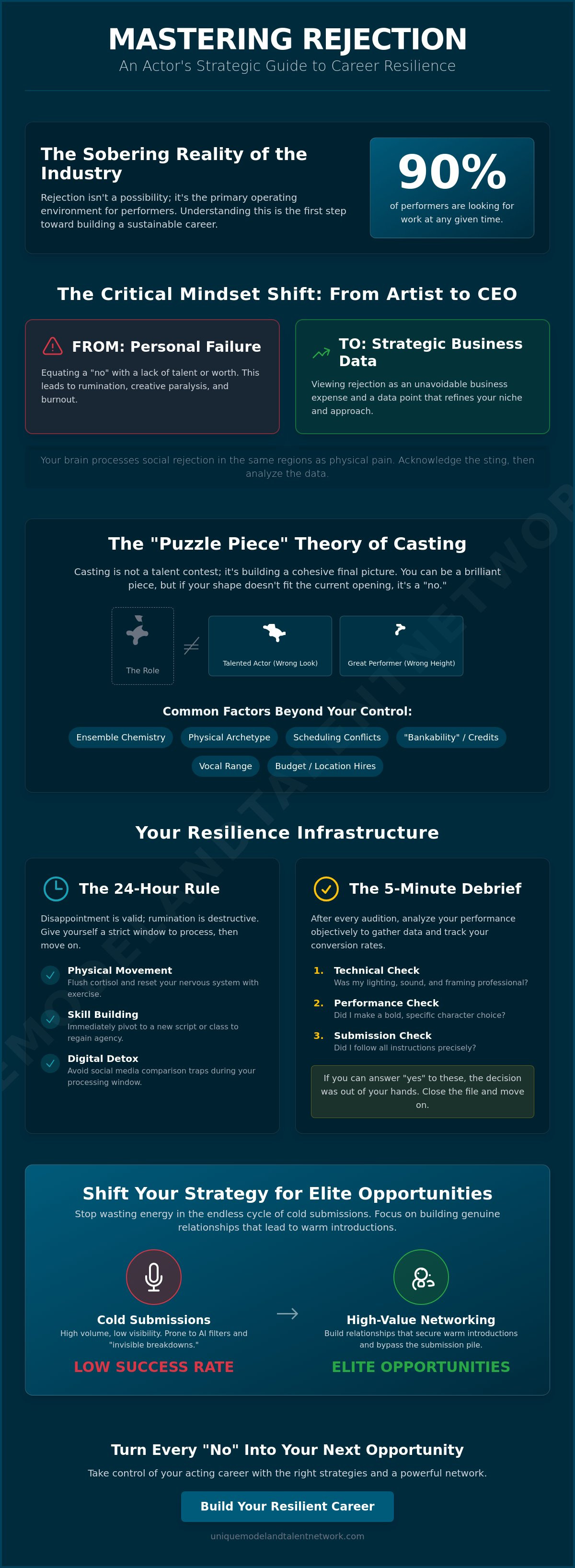
In an industry where approximately 90% of performers are unemployed at any given time, rejection isn't an anomaly; it's the primary operating environment. To master how to handle rejection as an actor, you must first accept it as a standard business cost. Think of it as a startup's marketing spend that doesn't always result in an immediate sale. This isn't just about "toughening up" for the sake of it. The Psychological Reality of Acting Rejection involves a genuine biological response where your brain processes exclusion in the same regions that register physical pain. Acknowledging this sting as a natural survival instinct allows you to detach from the emotion and treat it as a professional data point rather than a personal failure.
Seasoned professionals distinguish between destructive rejection and constructive redirection. A "no" for one role is often a redirection toward a project where your specific archetype is the missing puzzle piece. If you maintain high standards, every "no" brings you statistically closer to your next "yes" by narrowing down the variables of your niche and strengthening your reputation with casting directors who value your consistency.
Redefining the 'No' as Professional Feedback
Transitioning from "I failed" to "this project wasn't the right fit" is essential for career longevity. You must separate your self-worth from your professional booking rate. Use objective self-assessment to review your work: Was your lighting professional? Did you make a bold character choice? If the answer is yes, then the decision was likely based on factors beyond your talent, such as ensemble chemistry or specific physical requirements. Subjective self-criticism only drains your energy, while objective analysis builds your craft and prepares you for the next opportunity.
The 24-Hour Rule for Emotional Processing
Disappointment is part of the creative process, but rumination is a career killer. Implement a strict 24-hour rule to process your emotions. Allow yourself a limited window to feel the frustration, then close the file. Practical steps to reset your creative energy include:
- Physical Movement: Use exercise to flush the cortisol associated with the biological "sting" of rejection.
- Skill-Building: Immediately pivot to a new script or a skill-building challenge to regain a sense of agency.
- Digital Detox: Avoid social media highlight reels that trigger destructive comparison traps during your processing window.
Healthy venting with a trusted mentor is productive, but public venting on social media is a professional liability. Protect your reputation and your peace by keeping your processing private and focused on growth. Once the 24-hour window closes, your focus should return entirely to your business development and the next submission.
Behind the Casting Table: Why It’s Rarely About Your Talent
Casting is less like a talent competition and more like a high-stakes jigsaw puzzle. When you understand this reality, learning how to handle rejection as an actor becomes a matter of logic rather than emotion. A casting director isn't just looking for the "best" actor; they're building a cohesive ensemble. If the lead actor is 5'10", they might pass on a brilliant 6'4" performer simply because the height difference disrupts the frame. Talent is the baseline requirement to get into the room, but the final choice often hinges on variables like hair color, vocal range, or chemistry with a lead you've never met.
In high-stakes productions, "bankability" and previous credits often influence the final decision. While a 2026 report indicates that 37% of new lead roles in mid-budget genre films are being cast with younger, lesser-known actors, many projects still rely on established names to secure financing. Sometimes, a great audition results in a "no" simply because of logistical conflicts or a change in the filming location that favors local hires. These factors are entirely external to your performance.
Factors Beyond the Actor's Control
Commercial casting introduces even more specific variables. A brand might reject a phenomenal actor because their look is too similar to a competitor's current campaign. Diversity mandates and the need for a balanced ensemble also dictate casting choices to ensure the cast reflects the project's specific world. Scheduling is another silent killer; if you aren't available for the specific dates of a shoot in a tax-incentive-driven location, the role will go to the next person on the list. These are business decisions, not talent evaluations.
Winning the Room vs. Booking the Job
Every professional actor knows that "winning the room" is the real goal. If you receive a callback, you've already won. You've proven your talent and professional standards to the casting director. Even if you don't book the job, you've earned a spot in their "mental file" for future projects. Building a Resilience Infrastructure requires recognizing these small victories to maintain your creative fire. To ensure your materials are making the right impact before you even step into the room, consider getting a professional Portfolio & Reel Review. Casting directors often keep notes on performers who were "great but wrong for this," leading to direct offers months or even years later. Your job is to leave a professional impression every single time, regardless of the immediate outcome.
Turning Rejection into a Strategic Career Asset
Success in this industry requires moving beyond the "just keep going" mentality that leads to burnout. If you want to break the cycle of exhaustion, you must treat your career like a data-driven enterprise. Learning how to handle rejection as an actor is most effective when you convert silence into a strategic asset through a disciplined "Audition Debrief." This five-minute ritual, performed immediately after every submission or session, allows you to collect objective information before the emotional weight of a "no" sets in. By documenting your choices while they're fresh, you create a roadmap for improvement that doesn't rely on guesswork.
Analyzing your professional "conversion rate" is the fastest way to identify where your strategy needs adjustment. If you're making hundreds of submissions but receiving zero requests for tapes, the market is signaling that your materials aren't landing. This is a clear indicator that it's time to update your acting portfolio to better reflect your current archetype and skill level. Conversely, if you're consistently reaching the callback stage but failing to book, the data suggests your performance is strong but you might be targeting the wrong character types or genres. Identifying these patterns prevents you from repeating the same mistakes and helps you pivot toward roles where your booking probability is higher.
Audition Debriefing: Analyzing the Data
In 2026, many major productions use AI algorithms to filter thousands of submissions before a human casting director ever sees them. During your debrief, ask yourself: Did my self-taped audition meet the current technical standards for sound and lighting? Consistency is equally vital. Ensure your look in the room matches your digital profiles. If you've changed your hair or gained significant muscle since your last headshot, you're creating a "visual mismatch" that leads to instant rejection. Finally, evaluate your coachability. Did you take direction effectively, or were you too married to your prepared choices?
Maintaining 'In-Room' Relationships
A "no" today is often an invitation for tomorrow if you manage the relationship professionally. Casting directors value reliability and talent over ego. Following up with a brief, professional thank-you note keeps you on their radar without appearing desperate. You want to be remembered as "the actor they liked but couldn't use today." If you find yourself stuck in a rejection loop, leverage that "no" as a catalyst to seek expert feedback. Asking for a professional portfolio review for actors shows that you're serious about your craft and committed to meeting the high standards of the elite industry.
Building a Resilience Infrastructure
Developing a long-term career requires more than just a thick skin; it demands a robust resilience infrastructure. Mastering how to handle rejection as an actor is often about what you do during the quiet periods between bookings. The primary threat to your mental health is the social media highlight reel. These platforms present a distorted reality where peers appear to be booking constantly, which triggers a destructive comparison trap. A professional infrastructure replaces these external distractions with a focused, private environment where you can grow without the noise of public performance.
One of the most effective shields against burnout is maintaining a non-acting identity. If your entire self-worth is tied to your booking rate, every "no" feels like a personal erasure. Cultivating interests and identities outside of the industry provides the necessary perspective to see a missed role as a business outcome rather than a personal failure. During dry spells, redirecting your energy into acting workshops online keeps your skills sharp and maintains your sense of agency. This proactive approach ensures that when the right opportunity arrives, your craft is ready for the high standards of the industry.
Combatting the Isolation of Rejection
Isolation is the silent partner of rejection. You need a community that understands the specific nuances of the business, from the frustration of a missed callback to the technical hurdles of self-taping. Unlike general social media, a private, moderated environment protects you from toxic positivity and unorganized communication. It allows you to celebrate peer wins as evidence that the system works, rather than feeling diminished by their success. Finding a protective mentor who offers constructive mentorship is the fastest way to navigate the industry's chaos with clarity.
Financial and Creative Diversification
Resilience is also built on financial stability. Developing survival income that doesn't drain your creative energy is a professional necessity, not a sign of failure. This financial security allows you to say no to projects that don't align with your brand, giving you more power in the room. Additionally, creating your own content, such as web series or short films, ensures you remain a creator rather than just a seeker of permission. Continuous skill-building and content creation act as a shield, keeping you engaged with your craft regardless of the current casting climate. To find a secure space where you can build these professional bonds and access elite resources, join The Network Membership today.
Navigating the Industry Through Professional Networking
The most effective way to master how to handle rejection as an actor is to stop playing the exhausting numbers game of cold submissions. While public platforms are a necessary part of the ecosystem, they often feel like shouting into a void where your tapes are filtered by AI before a human ever sees them. Strategic networking shifts your career from the "cold submission" pile to the world of "warm introductions." When a casting director or photographer already knows your professional standards and work ethic, the frequency of rejection drops significantly. This direct access bypasses the noise and places you in a higher-tier pool of talent where opportunities are built on professional bonds rather than just luck.
If you find yourself consistently auditioning without booking, you need an objective diagnosis of your professional materials. This is where modeling career coaching becomes a critical asset. A seasoned coach can identify whether your visual archetype, your reel, or your digital presence is the silent cause of your rejection loop. Unlike public casting websites that are often saturated with hobbyist-level competition, a private, gated community ensures that every opportunity is legitimate and meets high professional standards. This clarity allows you to focus your energy on roles you're actually qualified to book.
The Power of a Private Talent Community
The Unique Model & Talent Network serves as a bridge between emerging talent and the industry's decision-makers. By removing the distractions and unorganized communication typical of general social media, we provide a concentrated space for career acceleration. Here, you receive real-time feedback from experts who understand the 2026 market landscape. This consistent stream of vetted opportunities reduces the "rejection sting" because you aren't just a face in a database; you're a recognized member of an elite professional circle. Networking in this environment turns every interaction into a potential career breakthrough.
Advocacy and Protection in the Industry
In an industry often perceived as chaotic, having a protective mentor is your greatest defense. Professional mentorship safeguards you against predatory practices and ensures you're pursuing opportunities with financial legitimacy. Being "vetted" in a high-standard digital space elevates your perceived status and signals to recruiters that you're serious about your craft. It moves you away from the vanity of social media fame and toward the security of a sustainable, productive career. Join the Unique Model & Talent Network today to find the advocacy and support you need to book your next major role.
Master Your Professional Momentum
Rejection is no longer a verdict on your talent when you treat it as a strategic business asset. By implementing a disciplined audition debrief ritual and understanding the logistical "puzzle" of casting, you gain the clarity needed to pivot toward success. Mastering how to handle rejection as an actor requires a shift from isolated submission cycles to a resilience infrastructure built on elite professional standards. It's about recognizing that every "no" is simply a redirection toward the role that fits your specific archetype and professional trajectory.
You don't have to navigate this competitive landscape alone. Our private community of 1,000+ industry professionals offers the protection and advocacy you need to thrive. With direct access to casting directors and live skill-building workshops, we provide the tangible tools to transform your relationship with the industry. Stop shouting into the void and start building the professional bonds that lead to consistent bookings. Ready to turn your 'no' into a 'yes'? Join our professional network today.
Your next major role is waiting for the professional you are becoming. Keep your craft sharp and your perspective grounded; your career is just getting started.
Frequently Asked Questions
Is it normal to feel depressed after a big acting rejection?
It is entirely normal to feel a deep sense of disappointment or sadness after losing a role you valued. Your brain processes social exclusion in the same way it registers physical pain, making the "sting" a biological reality. To maintain your professional health, acknowledge these feelings within a strict 24-hour window before pivoting back to your business development. This structured processing prevents temporary sadness from turning into long-term career burnout.
How many auditions does the average actor go on before booking a job?
While there is no fixed number, many industry reports suggest it can take 50 to 100 auditions to secure a single booking. The reality is that approximately 90% of actors are looking for work at any given time, making the process a statistical numbers game. Understanding how to handle rejection as an actor involves recognizing that every "no" is a data point that brings you closer to a successful conversion.
Should I ask for feedback from a casting director after a 'no'?
You should generally avoid asking a casting director for direct feedback after a rejection. These professionals often review hundreds of tapes per role and don't have the capacity for individual coaching. Instead, rely on your internal "Audition Debrief" or seek a professional portfolio review from a mentor. A professional network provides the safe space for this evaluation that a busy casting office cannot offer.
How do I know if I'm being rejected because of my talent or my look?
You can distinguish between talent and look by analyzing your callback rate. If you're consistently getting into the room but not booking, your talent is recognized, but you may not fit the specific "Puzzle Piece" or ensemble chemistry required for those roles. If you aren't getting auditions at all, your marketing materials, such as your headshots or reel, likely don't align with your current archetype or the industry's technical standards.
What is the best way to stay motivated when I'm not booking work?
The best way to stay motivated is to focus on the variables you can control rather than the booking itself. Engage in monthly skill-building challenges or attend live industry workshops to maintain a sense of creative agency. By shifting your focus from "getting a job" to "mastering the craft," you protect your creative energy from the volatility of the casting cycle and build a sustainable career infrastructure.
Can a professional network really help me handle rejection better?
A professional network helps you manage rejection by replacing "cold submissions" with "warm introductions" and vetted access. It provides a moderated environment where you can receive objective feedback without the toxic comparison traps of general social media. Being part of a high-standard community reminds you that you're a business owner in a professional field, which helps detach your personal self-worth from individual casting decisions.
How do I update my acting portfolio after a string of rejections?
Update your acting portfolio by first identifying patterns in your recent rejections. If you've recently changed your look or if your current tapes don't meet the 2026 technical standards for sound and lighting, your materials need a refresh. Ensure your digital profiles and headshots are perfectly aligned with the character types you're currently targeting. A professional reel review can provide the clarity needed to ensure your portfolio is working for you.
Is it okay to take a break from acting after a particularly hard rejection?
It is perfectly acceptable and often necessary to take a strategic break after a particularly grueling rejection. A brief reset allows you to reconnect with your non-acting identity and prevents the exhaustion that leads to poor performance in future rooms. If you find that the industry's demands are draining your creative spark, a planned hiatus can provide the perspective needed to return with renewed professional discipline and focus.


