
What if the secret to standing out in a crowded casting room isn't about working harder on your delivery, but about changing how you hunt for material? You likely know the sinking feeling of hearing the actor before you perform the exact same "stale" piece you've prepared. It's difficult to feel confident when you're worried your material is overused or doesn't meet professional standards. Learning how to find monologues for auditions that truly fit your "type" is the first step toward moving from a passive searcher to an active scout.
I understand the frustration of feeling invisible or being confused about whether a movie script is appropriate for a professional stage call. In this guide, you'll discover the industry-vetted strategy for finding, selecting, and refining monologues that command immediate attention. We will look at the vital difference between active scouting and passive searching, how to leverage modern digital libraries like Everand effectively, and how to ensure your signature piece aligns with the latest SAG-AFTRA and Equity guidelines. By the end, you'll have a clear roadmap to material that feels both authentic and industry-standard.
Key Takeaways
- Stop using overplayed scenes and learn how to find monologues for auditions that showcase your unique professional range.
- Prioritize published plays over digital databases to ensure your material meets the high standards of top-tier agents and casting directors.
- Master the "Active Search" method by reading the surrounding context of a scene to build a character arc that feels authentic.
- Learn the professional technique for cutting a full scene into a punchy 90-second audition piece that maintains its emotional impact.
- Explore the benefits of road-testing your material in live workshops to gain real-time feedback from industry experts.
Why Your Monologue Choice is Your Most Important Audition Tool
Every time you step into an audition room, your material acts as your professional calling card. It isn't just a speech; it's a concentrated 90-second demonstration of your range, your preparation, and your understanding of the industry. If you're struggling with how to find monologues for auditions, start by viewing your selection as a branding decision rather than a purely literary one. You are presenting a product: yourself.
Casting directors often sit through dozens of performers in a single day. When you choose "the classics" or pieces from over-circulated monologue books, you risk blending into the background. Professionals value fresh material because it shows you're actively engaged with contemporary theater. It suggests you've done the work to find something unique that resonates with your specific energy. This creates a psychological connection; the auditor stops looking at your technique and starts seeing the character.
To understand the technical foundation of your search, it helps to look at the broad definition of what is a monologue in a theatrical context. However, an "Audition Monologue" is a specialized subset of that definition. It must function as a self-contained dramatic arc with a clear objective. You don't have the luxury of a three-act buildup. You need a piece where the character is actively pursuing a goal from the first syllable to the last.
Defining Your 'Type' Before You Search
Before scouring play scripts, you must identify your character archetypes. Are you the disruptive best friend, the stoic professional, or the vulnerable ingenue? Playing against type is a common mistake for emerging talent. It creates a disconnect between your physical presence and the material, which can confuse a casting director. Once you understand your bracket, knowing how to find monologues for auditions becomes a targeted exercise in brand management. Define your casting bracket in one sentence: "I am a 20-something male who often plays high-status, intellectually driven characters in contemporary dramas."
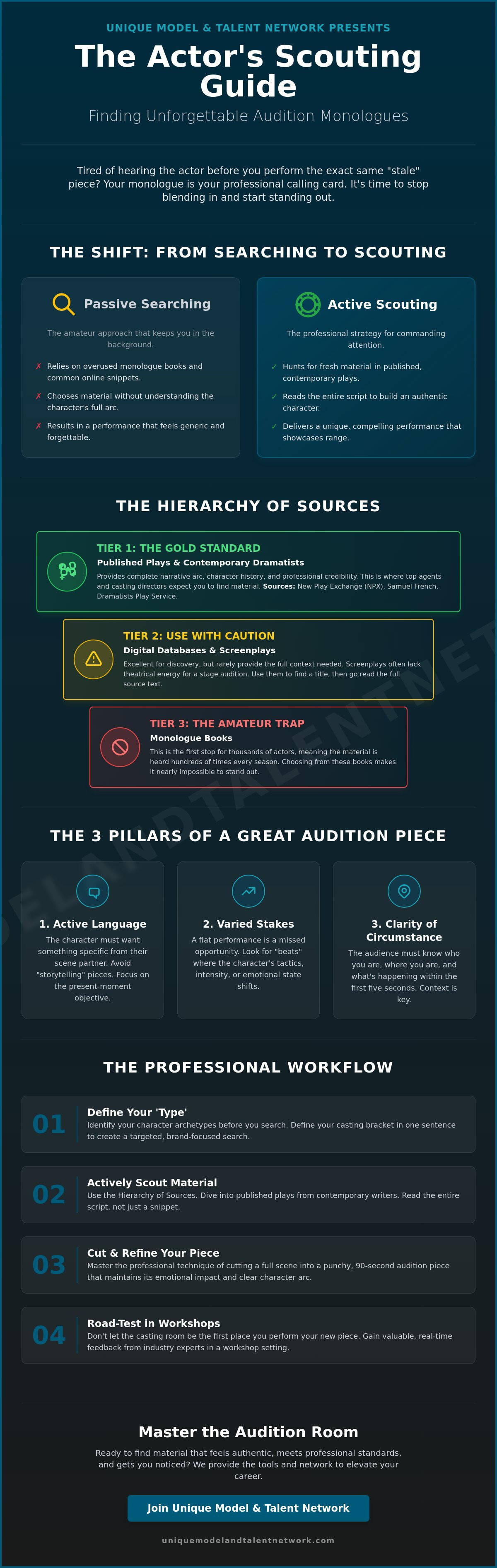
The Three Pillars of a Great Audition Piece
A monologue that captures attention usually rests on three foundational pillars:
- Active Language: The character must want something specific from their silent partner. Avoid "storytelling" pieces where you simply recount the past; focus on the present moment.
- Varied Stakes: A flat emotional performance is a missed opportunity. Look for "beats" where the character's tactics or intensity shifts.
- Clarity of Circumstance: Ensure the audience knows exactly who you are and where you are within the first five seconds.
The Hierarchy of Sources: Where to Find Monologues That Stand Out
If you want to move beyond the amateur level, you must understand that not all sources are created equal. Top-tier agents and casting directors view published plays as the gold standard for a reason. A play provides a complete narrative arc, allowing you to inhabit a character with a tangible history and emotional depth. While screenplays from film or television can offer punchy dialogue, they often lack the sustained theatrical energy required for a stage audition. Worse still is the "Monologue Book" trap. These collections are the first stop for thousands of actors, which means the pieces inside are heard hundreds of times every season. To truly stand out, you have to look where others don't.
Digital databases are incredibly convenient, but they should be treated as a starting point rather than your final destination. These sites are excellent for identifying a character name or a brief excerpt, but they rarely provide the full picture. Learning how to find monologues for auditions effectively means using these tools to discover a title and then going back to the source text to do the real work. If you rely solely on a 200-word snippet from a website, you're essentially flying blind without knowing the character's true motivations or the events that led to that moment.
Scouting Published Plays and Contemporary Dramatists
Scouting for fresh material requires a proactive approach. The New Play Exchange (NPX) is an invaluable digital resource for discovering works by emerging playwrights before they even hit the mainstream. If you're looking for recently licensed hits, browse the catalogs of Samuel French or Dramatists Play Service. A savvy insider trick is the "Amazon-to-Library" pipeline. Find an actor whose work matches your casting type, look up their recent stage credits on a site like Amazon, and then head to a digital service like Everand or your local library to read the full script. This ensures your material is grounded in a real, professional context that hasn't been overplayed.
Utilizing Professional Casting Platforms
Professional casting platforms can also serve as a compass for your search. By reviewing casting websites, you can see which character archetypes and play styles are currently trending in the industry. Platforms like Actors Access or Casting Networks often provide sides for similar roles. Use these as a jumping-off point to find the full plays they were taken from. You can even set up alerts for "new material" notifications on professional acting databases to stay ahead of the curve. If you're feeling stuck on the selection process, joining The Network Membership provides a community of peers and mentors who share vetted material and scouting tips.
The Selection Strategy: Picking Material That Casts You
Choosing material isn't just about what you like; it's about what casts you. Many actors fail because they pick a piece based on a vague emotional connection without considering the business reality of the room. If you're mastering how to find monologues for auditions, you must adopt the "Active Search" method. This involves reading at least 10 pages before and after the monologue in the original script. This context reveals the character's true arc and prevents you from making superficial choices that lack depth.
Avoid "storytelling" monologues at all costs. These are pieces where a character reminisces about a childhood pet or a past relationship. While they might feel emotional, they lack an immediate objective. Casting directors want to see you do something to another person in the room right now. You need active language where you're trying to change the other person's mind or force them to act. If your character is just talking about the past, you're not acting; you're just reciting.
Stay grounded in your current look and age. Attempting to play 20 years older or younger than your actual age is a common pitfall that signals a lack of professional awareness. Similarly, respect the "One-Minute Rule." A tight, 60-second performance that leaves the auditors wanting more is infinitely better than a dragging two-minute piece that tests their patience. In a high-volume casting environment, brevity is a sign of professional respect.
Identifying Overused Material
Certain pieces have become so common they're effectively on an industry "Blacklist." Monologues like "Starfire" or the "Tuna Fish" speech are heard so often that auditors can often recite them along with you. Before you commit to a piece, search for it on TikTok or YouTube. If you see high view counts for other actors performing that same text, it's likely overexposed. A better alternative is to find a lesser-known scene within a popular play. This allows you to benefit from the playwright's recognized quality while presenting a "Unique" version that feels fresh. Knowing how to find monologues for auditions that aren't overplayed is what separates the working pro from the hobbyist.
Matching the Monologue to the Project
Your selection must align with the specific film industry auditions you're targeting. A theatrical casting call for a contemporary drama requires a different energy than a commercial audition or a sitcom pilot. Always prepare a "Contrast Pair" consisting of one contemporary and one classical piece. This demonstrates your range and technical versatility. Tailor your choice to the project's specific tone; don't bring a broad comedic piece to a gritty indie film audition unless specifically requested.
Refining Your Selection: Preparation and Professional Polish
Securing a high-quality script is only the first step in mastering how to find monologues for auditions. Once you've identified a piece that fits your casting bracket, you must transition from a researcher to a ruthless editor. A raw scene from a published play often contains "fluff" or transitional dialogue that dilutes your impact in a short audition window. Your goal is to distill a three-minute interaction into a high-octane 90-second showcase of your professional abilities. This requires a technical eye and a willingness to cut anything that doesn't serve your immediate objective.
Beyond the text, your preparation must include the "Moment Before." This is the immediate history of the character right before the first line is spoken. If you start your monologue from a dead stop, the audience sees a "performer" rather than a character in crisis. You should also focus on vocal dynamics. A common mistake is staying on a single emotional note, such as constant anger or sustained sadness. True professional range is shown through shifts in tactics and tone. Self-taping your rehearsals is the most efficient way to identify pacing issues or distracting physical ticks that you might not notice in the moment.
The Technical Edit: Removing the 'Fluff'
When you're refining your piece, identify the "inciting incident" of the monologue and start as close to it as possible. Remove internal dialogue, parentheticals, or stage directions that break the flow of the performance. If a character is described as [turning away] or [lighting a cigarette], decide if that action is essential to the stakes or just a distraction. Finally, ensure the piece ends on a "button." This is a clear concluding thought or realization that lets the casting director know you've finished without you having to say "scene."
Getting an External Perspective
You cannot be the sole judge of your own audition material. Because you are so close to the work, your perception of what is translating to the audience is often skewed. Peer groups are excellent for testing if the humor or drama of a piece is actually landing. For a more authoritative assessment, consider a professional portfolio review for actors to ensure your material matches your current industry image. The final phase of learning how to find monologues for auditions involves getting your work in front of experts who can provide objective feedback. To get real-time critiques from seasoned pros, join The Network Membership and start road-testing your material in a protected, professional environment.
Master the Audition with Unique Model & Talent Network
Finding the right script is a critical first step, but the path from discovery to a booked job requires more than just a good eye for text. It requires a space to fail, refine, and receive professional validation. Most actors get stuck in a cycle of searching without ever knowing if their choices land with the people who actually hire. This is where a private, professional community becomes your most valuable asset. Within the Unique Model & Talent Network, you move beyond the theory of how to find monologues for auditions and into the practical application of high-level performance.
Our Monthly Skill-Building Challenges are designed specifically to keep your repertoire fresh and competitive. Instead of relying on a single piece for years, you are encouraged to find and perfect new material every thirty days. This disciplined approach ensures you always have a "signature" monologue ready for a last-minute call. By road-testing your material within a gated network of serious peers, you eliminate the uncertainty that often plagues the self-tape process. You get to see what works for others and adapt those successful strategies to your own scouting process.
Direct Access to Industry Decision-Makers
The most direct way to bridge the gap between "finding" and "booking" is through expert intervention. Participating in acting workshops online allows you to see exactly what monologues are currently resonating with top casting directors. You don't have to guess if your contemporary piece is too edgy or if your classical choice is too dry. During our Industry Expert Q&A Sessions, you can ask specific questions about your repertoire choices and receive the kind of vetted mentorship that isn't available on public forums. This direct line of communication provides a level of clarity that transforms your audition prep from a hopeful guess into a strategic business move.
Join the Network Today
The entertainment industry is often chaotic, but your career development shouldn't be. The Unique Model & Talent Network is built to remove the social media noise and distractions that dilute your professional focus. By joining a managed talent community, you are investing in long-term career growth alongside professionals who value integrity and efficiency. You will gain access to Portfolio & Reel Reviews that ensure your material matches your professional brand. This ensures that your knowledge of how to find monologues for auditions translates directly into a portfolio that agents and casting directors respect.
Stop searching in a vacuum and start building a career supported by industry insiders. Join the Unique Model & Talent Network and perfect your audition repertoire today.
Elevate Your Audition Repertoire
Your material serves as a reflection of your professional standards and your unique casting type. By prioritizing published plays over overused database snippets and mastering the technical edit, you ensure that every 90-second performance leaves a lasting impression. Mastering how to find monologues for auditions is more than just a search; it's a strategic branding decision that sets the stage for your future bookings.
Transitioning from a solitary searcher to a connected professional is the most efficient way to see tangible results. The Unique Model & Talent Network provides the clarity and direction you need through direct access to live workshops with Casting Directors and monthly skill-building challenges. This managed community of industry experts acts as a protective mentor, helping you refine your repertoire in a high-standard environment that values your growth over superficiality.
Take control of your professional development and start presenting the version of yourself that the industry is looking for. Your next great role is simply waiting for the right material to unlock it.
Frequently Asked Questions
Is it okay to use a monologue from a movie for a stage audition?
Stick to published plays whenever possible. Stage auditions require a specific theatrical energy and sustain that movie scripts, which rely on close-ups and editing, often lack. Using a theatrical piece demonstrates your respect for the medium and your professional training. It also ensures the language is suited for the acoustic demands of a live performance space.
How long should an audition monologue be in 2026?
The standard length is 60 to 90 seconds. While some Equity calls in 2026 specify three-minute presentations for a pair of monologues, a single piece should be tight and punchy. Mastering how to find monologues for auditions that land within this window shows you respect the casting director's schedule. A shorter, high-impact piece is always better than a long, dragging one.
Should I look directly at the casting director during my monologue?
Avoid direct eye contact with the casting director during your performance. Place your focal point slightly to the left or right of the camera or just above the auditor's head. This creates a "fourth wall" that allows them to evaluate your work objectively without being forced into the scene as your partner. It keeps the focus on your craft rather than their reaction.
What is the best way to find comedic monologues that aren't 'cheesy'?
Search for contemporary satires or dark comedies by established playwrights. Avoid generic "joke-heavy" pieces found in online databases. High-quality comedy is born from a character's high stakes and desperate objectives; the humor should come from the situation rather than a punchline. Look for characters who are taking their ridiculous circumstances completely seriously to find the most grounded material.
Can I use a monologue I wrote myself for a professional audition?
Using self-written material is generally discouraged unless you are an established, produced playwright. Casting directors want to see your ability to interpret professional scripts and complex dialogue. Bringing your own writing can sometimes be perceived as a lack of industry awareness or a way to hide technical weaknesses. Stick to vetted material to prove you can handle professional-grade text.
How many monologues should an actor have in their 'repertoire'?
You should maintain a core repertoire of four distinct pieces. This includes one contemporary dramatic, one contemporary comedic, one classical dramatic, and one classical comedic. Having this variety ensures you're ready for any casting call and can provide immediate contrast if an auditor asks for something different. Keep these pieces "polished and ready" so you don't have to scramble before a big call.
Where can I find free monologues that are actually high quality?
Your local public library is the best source for free, high-quality plays. If you prefer digital access, platforms like Everand offer over 1.5 million titles for a monthly fee, including many contemporary scripts. When researching how to find monologues for auditions, always prioritize reading the full script to ensure your performance has depth. Excerpt sites often strip away the context you need for a professional performance.
What should I do if the casting director asks for a second monologue I haven't prepared?
Be honest and professional about your current preparation. If you don't have a second piece ready, ask if you can read a scene you're currently developing or if they have sides available for a cold read. It's better to admit you aren't prepared for that specific request than to give a sloppy, unmemorized performance. Most auditors will appreciate your honesty and professional boundaries.


