
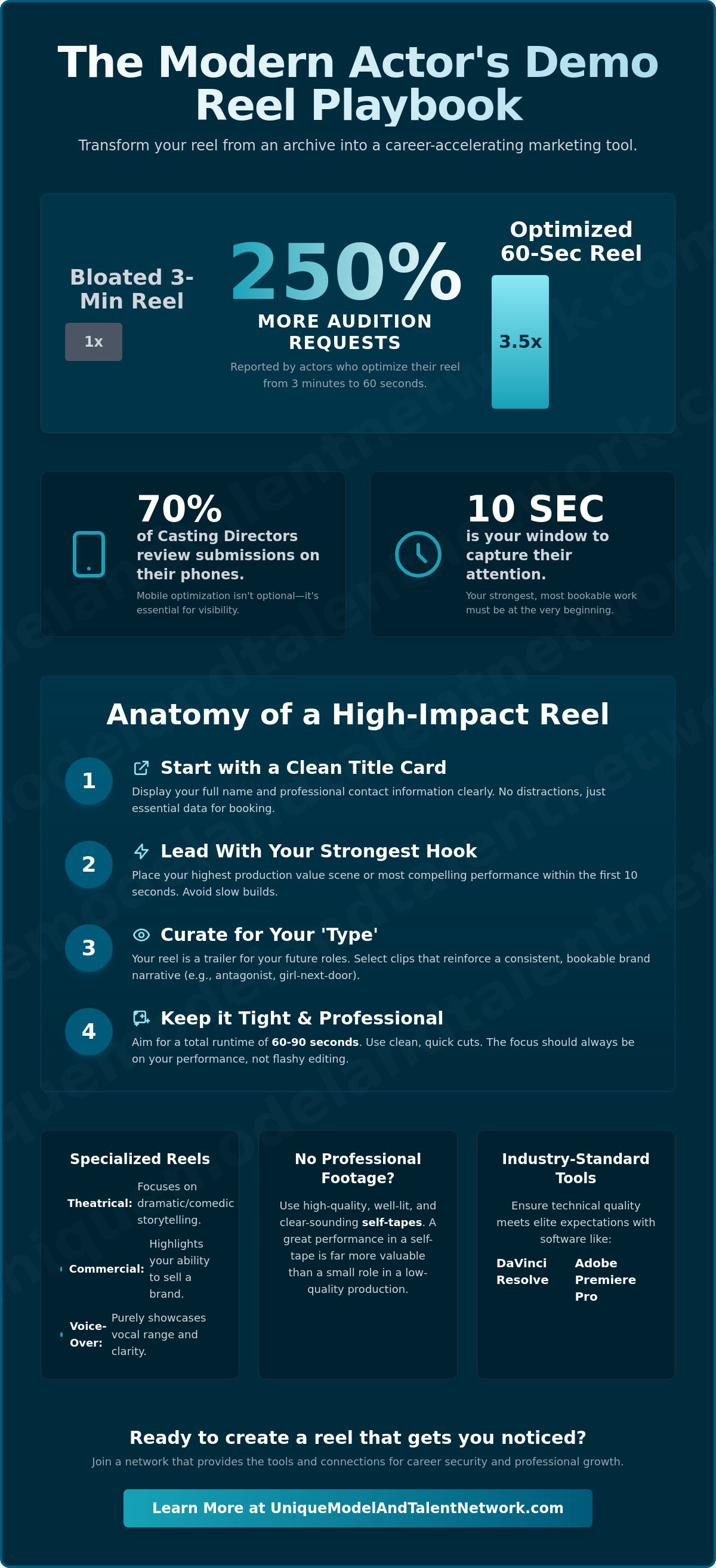
Did you know that actors who trade their bloated three-minute reels for an optimized sixty-second version report 250% more audition requests? In a fast-paced industry where 70% of casting directors review submissions directly on their phones, your first ten seconds determine your career trajectory. Learning how to create a demo reel that commands attention is the most critical business move you can make this year. You don't need a massive budget or a decade of footage to stand out. You need a strategic highlight of your most bookable brand.
You likely feel the pressure of rising production costs and the uncertainty of which clips truly showcase your range. It's frustrating to have the talent but lack the polished proof that gets you into the room for higher-level roles. We'll bridge that gap by teaching you how to master high-impact reels that capture casting directors' attention and accelerate your career. This article provides the clarity you need to move toward legitimate career security and professional recognition.
We'll explore how to handle the lack of professional footage while utilizing modern AI-powered editing tools to save time. You'll also get a breakdown of industry-standard software like DaVinci Resolve and Adobe Premiere Pro to ensure your technical quality meets elite expectations. This is your roadmap to a polished reel that gets opened, viewed, and respected by the industry's top gatekeepers.
Key Takeaways
- Transform your reel from a simple archive of past work into a strategic "trailer for your future" that targets the specific roles you want to book.
- Learn to identify and curate footage based on your unique industry brand to create a cohesive narrative that casting directors can easily categorize.
- Master how to create a demo reel without professional credits by using high-quality self-tapes that demonstrate your range and technical competence.
- Streamline your editing process by organizing footage by "vibe" and adopting a clean, professional style that keeps the focus entirely on your performance.
- Optimize your digital footprint by hosting your finished reel on platforms that prioritize visibility and fast-loading speeds for mobile-first recruiters.
What is a Demo Reel and Why is it Essential in 2026?
Your Showreel is far more than a collection of past credits. It's your professional calling card, a concentrated blast of your talent designed to prove you can do the job before you ever step into the room. While resumes list what you've done, a reel shows what you can do. It's a shift from the static archives of the past to a high-octane trailer for your future. Casting directors in 2026 prioritize video because it eliminates guesswork. They can see your essence, hear your voice, and evaluate your screen presence in seconds. If you aren't showing them how to create a demo reel that hits these marks, you're essentially invisible to high-level recruitment. The market now demands shorter, punchier content. While 90 seconds was once the limit, the 2026 standard has tightened to 60 seconds, with some streaming platforms preferring 30 to 45-second character-specific bursts.
The Anatomy of a High-Impact Showreel
A successful reel isn't just a random montage. It requires a specific structure to look professional and disciplined. Start with a clean title card featuring your name and professional contact information. From there, you must lead with your strongest work. The "hook" is everything. Since 70% of casting directors watch submissions on their phones, the first 10 seconds determine if they keep watching or swipe away. Avoid slow builds or long scenery shots. Instead, jump straight into a high-stakes moment. Understanding how to create a demo reel with the right anatomy is the difference between a booking and a pass. You should also maintain separate reels for different markets. A theatrical reel focuses on dramatic or comedic storytelling, while a commercial reel highlights your ability to sell a brand. If you're a voice artist, your VO reel should be even more concise, focusing purely on vocal range and clarity.
Why a Reel is Your Most Powerful Networking Tool
Your reel acts as a 24/7 advocate for your career. When shared within a managed talent community, it allows you to bypass traditional gatekeepers and get your face in front of decision-makers who value integrity and professional growth. It builds immediate trust with directors and photographers who need to see how you move and react on camera. Think of it as the centerpiece of a modern acting portfolio. By presenting a curated look at your skills, you remove the friction of recruitment. You aren't just asking for a job; you're providing a solution to a casting director's problem. This professional standard is what separates serious talent from the hobbyist crowd and ensures your career security in an often chaotic industry.
Strategic Content Selection: Curating for Your 'Type'
Most actors treat their reel as a historical archive. This is a mistake. Your reel is a strategic marketing asset. To master how to create a demo reel that actually generates income, you must first identify your "type." Are you the young professional, the reliable neighbor, or the intense antagonist? Casting directors aren't looking for a chameleon; they're looking for a specific solution to a casting problem. By selecting clips that reinforce a consistent brand narrative, you provide clarity in an uncertain industry. Quality is your only currency here. One high-production scene with exceptional acting is infinitely more valuable than five mediocre clips that dilute your talent.
The 10-Second Rule for Casting Directors
Industry data confirms that 70% of casting directors review submissions on their phones. This means your window of opportunity is minuscule. If your best performance is buried at the end of a three-minute montage, it will never be seen. You must front-load your reel with your most recognizable work or your highest production-value scenes. This opening must immediately answer the question, "Who is this person?" and demonstrate your bookability. Leading with your strongest performance isn't just a suggestion. It's a requirement for professional survival in 2026.
Curating Clips That Sell Your Future Bookings
Your reel should be a preview of the roles you want to book next, not just a record of what you've done. If you're targeting gritty dramas but only have commercial clips, you need to bridge that gap. You can learn how to create a demo reel with no footage by focusing on high-quality self-tapes that mirror the roles you're chasing. Remove any "filler" footage that doesn't contribute to your professional brand. Even a slightly weak clip can pull down the perceived value of your entire reel.
Use direct feedback from modeling career coaching to refine your selection and ensure your visual brand aligns with current market demands. If you're struggling to decide which scenes to cut, our Portfolio & Reel Reviews offer the objective, expert perspective needed to trim the fat. We focus on tangible success and career security, helping you present a polished, professional image that gets respected by top-tier gatekeepers.
How to Create a Demo Reel with No Experience
Many aspiring professionals feel paralyzed by a lack of broadcast-quality footage. In 2026, this is an obsolete barrier. If you're serious about your craft, you don't wait for permission to be seen; you create the evidence of your talent yourself. Learning how to create a demo reel from scratch involves a combination of high-production self-tapes, student film collaborations, and curated workshop footage. Casting directors today are more interested in your ability to inhabit a character than the size of the production budget behind you. As long as the acting is grounded and the technical quality is clean, a self-shot scene is a perfectly valid entry point into the industry.
Professional Self-Tape Standards for Reels
A self-tape that looks like a home movie will hurt your professional reputation. To use a self-tape as a reel segment, it must meet strict technical standards. Use a simple three-point lighting setup to eliminate distracting shadows and a dedicated external microphone to ensure crisp audio. Your background should be a neutral, solid color, preferably grey or blue, to keep the focus entirely on your performance. When selecting material, avoid overexposed scenes from blockbuster films. Instead, choose "under-the-radar" scripts or original scenes that allow your specific "type" to shine without direct comparison to famous actors. Proper framing is essential. Keep the shot in a medium close-up and maintain consistent eye lines just off-camera to ensure you're engaging the viewer correctly.
Generating Footage Through Industry Workshops
Participating in acting workshops online is one of the most efficient ways to acquire professional-grade material. These environments provide more than just education; they offer a controlled space to record high-quality performances under the guidance of industry experts. You get the benefit of real-time feedback, allowing you to refine your delivery before the final recording. Our Monthly Skill-Building Challenges are specifically designed to help you generate fresh footage that meets 2026 industry standards. By turning class exercises and challenges into polished segments, you build a reel that reflects your current growth and readiness for higher-level roles.
Don't overlook the value of student films and independent projects. While these sets may have smaller budgets, they often provide the high-resolution, multi-camera footage that gives a reel professional weight. Focus on projects with high production values and clear sound. Every scene you record, whether in a workshop or on an indie set, should be treated as a potential cornerstone of your portfolio. This proactive approach ensures you aren't just waiting for a career to happen; you're building the infrastructure to support it. Understanding how to create a demo reel through these diverse sources gives you the confidence to submit for roles that previously felt out of reach.
The Technical Process: Editing Your Reel for Success
Once you've selected your strongest scenes, the assembly phase begins. This is where your marketing strategy becomes a tangible asset. Before you open your software, organize and log your footage by its specific "vibe" and technical quality. Grouping clips into categories like "Gritty Drama" or "High-Energy Commercial" helps you maintain a cohesive narrative flow. When you start cutting, choose a simple, clean editing style. Professional casting directors aren't impressed by flashy transitions, wipes, or dissolves; they want invisible cuts that keep the focus on your eyes and your reactions. Understanding how to create a demo reel with technical precision shows that you respect the viewer's time and understand industry standards.
Edit for pace above all else. Every second must earn its place. If a scene lingers too long on a landscape or a co-star, cut it. Your goal is to move quickly between high-impact moments to keep the recruiter engaged. After the visual cut is finished, prioritize audio leveling and basic color grading. Inconsistent volume between clips is a hallmark of amateur work and can be jarring for anyone wearing headphones. Finally, export your file in a format optimized for various casting websites. Most platforms in 2026 require H.264 or H.265 MP4 files to ensure fast loading speeds on mobile devices.
DIY vs. Professional Editing: When to Invest
You can learn how to create a demo reel using user-friendly software, but you must be honest about your results. If your DIY edit features choppy audio, poor sync, or "muddy" exports, it's hurting your professional image. Investing in a professional editor is a business development expense that pays for itself through higher-quality bookings. If you choose to hire a pro, save money by preparing your files beforehand. Provide a clear "edit list" with timecodes and high-resolution source files. This organization allows the editor to focus on the creative "polish" rather than searching for clips. If you're unsure if your current edit is up to par, our Portfolio & Reel Reviews provide the expert feedback needed to decide if a professional overhaul is necessary.
Technical Checklist for 2026 Standards
- Resolution: 1080p is the absolute minimum standard. If your footage is lower resolution, it suggests the work is dated or unprofessional.
- The "No Music" Rule: Never use background music during your acting scenes. It's a distraction that masks the nuances of your vocal performance.
- Titling: Use a clean, readable font for your opening and closing slates. Include your name, union status, and professional contact information.
- Framing: Ensure your face is clearly visible and well-lit in every clip. Avoid scenes where you are a small figure in a wide shot.
Optimizing and Distributing Your Finished Reel
Completing your edit is a significant professional milestone, but the final phase of your strategy involves a precise distribution plan. In 2026, simply uploading a file to a public video site isn't enough to secure high-level work. These unorganized spaces lack the professional standards and concentrated focus required for effective recruitment. To truly master how to create a demo reel that functions as a business asset, you must integrate it into a focused digital footprint that builds immediate trust with industry gatekeepers. This involves hosting your work on reputable casting portals while leveraging the security and exclusivity of a managed talent network to bypass general market noise.
Getting Noticed on Casting Platforms
When uploading your materials to platforms like Actors Access or other industry-standard portals, organization is your primary advantage. Don't just upload a single file; use individual, high-impact clips alongside your master reel to target specific film industry auditions. If a recruiter is searching for a specific character archetype, providing a searchable 15-second clip makes their decision-making process effortless. This level of preparation reflects a disciplined professional who understands the logistics of modern casting. Ensure you keep your media library updated; as you book more paid jobs, replace older footage with your most current, high-production scenes.
The Power of Professional Portfolio & Reel Reviews
The most common mistake talent makes is distributing a reel without an objective, professional evaluation. You're often too close to your own performances to see the technical or narrative flaws that a seasoned coach identifies instantly. A professional review provides the clarity needed to ensure your edit aligns with current market demands and elite industry expectations. At Unique Model & Talent Network, our Portfolio & Reel Reviews offer direct feedback from experts who understand what's booking right now. This protective layer of mentorship ensures your career security by vetting your materials before they reach a casting director's desk.
This final step transforms your video from a creative project into a definitive tool for career acceleration. By adhering to these professional standards, you align yourself with a community that values integrity, efficiency, and tangible success. Once your reel has been refined through expert feedback, use it to start high-value conversations within our private network. This positions you as a reliable, bookable professional who is ready to step into higher-level roles and navigate the industry with confidence.
Master Your Professional Narrative
Your demo reel is the most influential business asset in your professional arsenal. By prioritizing quality over quantity and front-loading your strongest performances, you move away from the chaos of amateur submissions toward a career defined by security and recognition. We've explored how to create a demo reel that respects the fast-paced habits of modern casting directors while maintaining the high technical standards expected in 2026. Whether you're curating existing footage or generating new scenes through skill-building exercises, your focus must remain on brand consistency and professional polish.
Don't let uncertainty or a lack of access hold your talent back. You deserve a clear path to success in an industry that often feels unorganized. Join The Network Membership to get your reel reviewed by industry pros today! Our community provides direct access to casting directors, monthly skill-building challenges, and professional portfolio & reel reviews to ensure your work is always submission-ready. You have the talent; now it's time to build the infrastructure that proves it. Take this final step and start booking the higher-level roles you've worked so hard to earn.
Frequently Asked Questions
How long should a demo reel be in 2026?
The current industry standard for a master reel is between 60 and 90 seconds. With 70% of casting directors reviewing submissions on mobile devices, brevity is essential for maintaining engagement. You must ensure your most bookable moments appear within the first 10 seconds to capitalize on short attention spans. Anything longer than 90 seconds risks being skipped before your best work is even seen.
Can I use self-tapes in my professional demo reel?
You can use self-tapes as long as they meet the high-resolution technical standards required by modern recruiters. Professional self-tapes have become a legitimate way to show your range when you are still learning how to create a demo reel with limited credits. Ensure you use a neutral background, external microphone, and crisp lighting to prove you can deliver professional results regardless of the setting.
Is it better to have one long reel or several short clips?
It is most effective to maintain a 60-second master reel along with several 15 to 30-second character-specific clips. This modular approach allows you to tailor your submission to the exact needs of a specific role on platforms like Actors Access. By providing segmented footage, you make the recruiter's job easier and demonstrate that you are a disciplined professional who understands digital-first casting workflows.
How much does it typically cost to have a professional demo reel edited?
Professional video editing rates in 2026 generally range from $25 to over $150 per hour. For a freelance specialist, you can expect to pay an average of $60 to $90 per hour. While beginner editors may offer lower rates, investing in an experienced pro ensures your reel has the technical polish and pacing required to compete for higher-level roles. Always confirm their experience with acting reels specifically before hiring.
What happens if I don't have any professional film credits yet?
If you lack professional credits, you should generate footage through student films, independent projects, and industry workshops. Participating in Monthly Skill-Building Challenges is a proactive way to build a library of scenes that showcase your specific "type." Learning how to create a demo reel through these alternative sources allows you to build a professional identity and career security without waiting for a traditional gatekeeper to hire you first.
Should I include background work or extra roles in my reel?
You should never include background or extra work in your demo reel. These roles do not showcase your acting ability and can actually damage your professional image by signaling a lack of experience in featured roles. Casting directors need to see you speaking and interacting with other characters to evaluate your talent. Focus exclusively on scenes where you are the primary focus of the shot.
How often should I update my demo reel with new footage?
You should update your reel every 6 to 12 months or immediately following a significant change in your physical appearance. If you book a high-production job that showcases a new aspect of your brand, swap out your weakest clip for this new footage right away. Keeping your materials current demonstrates professional growth and ensures that your digital footprint accurately reflects your current bookability and look.
Can I use music in the background of my acting scenes?
Avoid using background music during your acting scenes as it is a major distraction for casting professionals. Music can mask the nuances of your vocal performance and make it difficult for recruiters to hear your natural tone and clarity. Keep the audio clean and focused entirely on your dialogue. This disciplined approach ensures that your talent remains the center of attention without unnecessary artistic interference.


