
What if the secret to booking consistent work in 2026 has nothing to do with your height or your follower count and everything to do with understanding your specific "type" as a business asset? You likely feel the weight of uncertainty about where you fit or fear that predatory modeling schools are waiting to take advantage of your ambition. It is frustrating to lack direct access to the decision-makers who actually sign the checks.
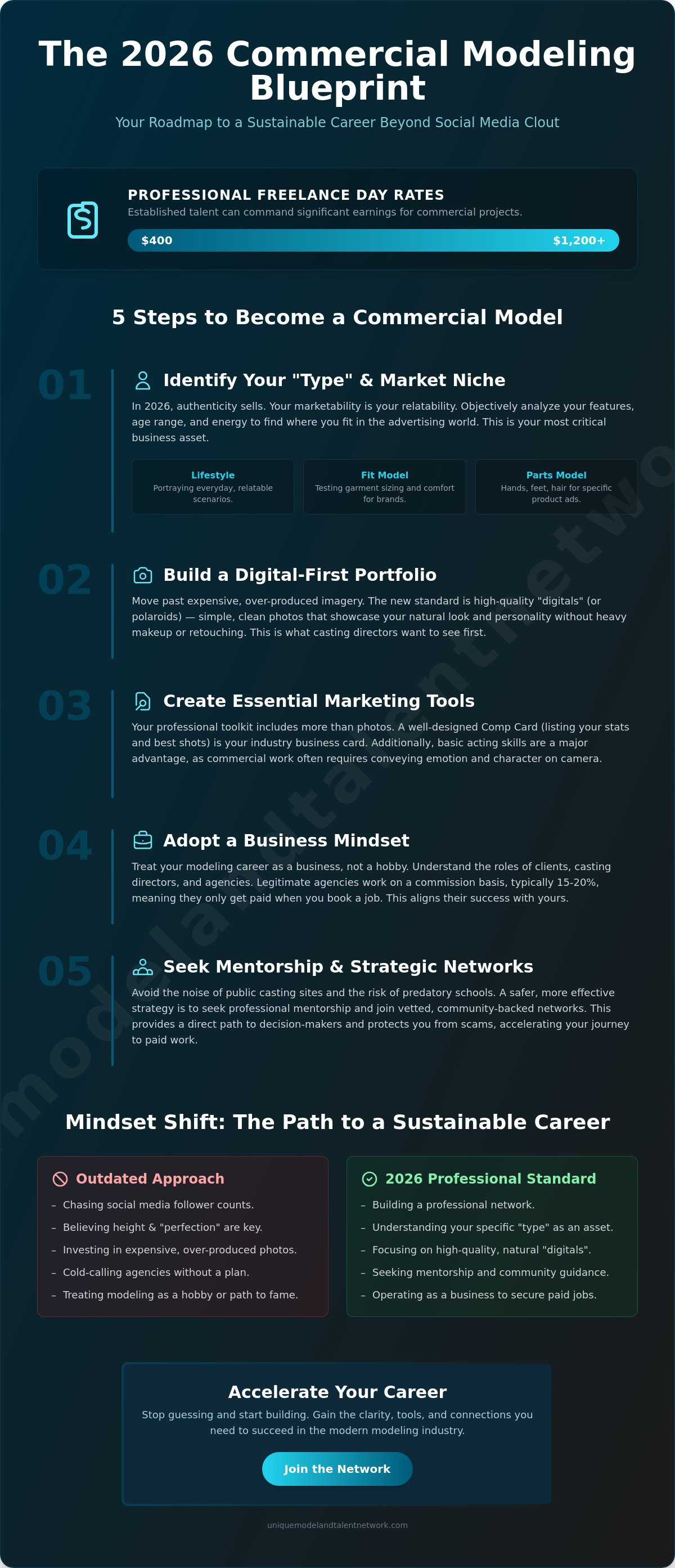
This guide provides the professional clarity you've been searching for. You will discover exactly how to become a commercial model by mastering the business side of the industry, from identifying your unique marketability to building a network that bypasses the noise of social media. We're laying out a step-by-step roadmap to help you secure legitimate paid jobs. This includes a look at how to build a portfolio that justifies professional freelance day rates, which currently range from $400 to $1,200 for established talent. Prepare to move past the superficiality of the "influencer" era and into a sustainable, high-standard career.
Key Takeaways
- Learn how to become a commercial model by identifying your specific "type" and aligning your unique aesthetic with the 2026 demand for authentic talent.
- Master the digital-first standards for modern portfolios, focusing on high-quality "digitals" that capture your personality rather than expensive, over-produced imagery.
- Navigate the essential steps to building a professional Comp Card and understand where acting skills overlap with commercial modeling success.
- Discover why seeking professional mentorship and community-backed guidance is a safer, more effective strategy than cold-calling agencies without a roadmap.
- Shift your focus toward the business side of the industry to build a sustainable career through expert workshops and strategic networking.
What is Commercial Modeling? Defining the 2026 Landscape
Commercial modeling is the strategic heart of the advertising world. Unlike high fashion, which often prioritizes artistic expression and extreme proportions, commercial work focuses on the promotion of products, services, and lifestyles. If you have ever wondered What is a Model? in a professional context, it is essentially a talent who acts as a bridge between a brand and its target consumer. This sector is the most inclusive and financially rewarding branch of the industry, welcoming a vast range of ages, sizes, and ethnic backgrounds.
The landscape in 2026 has undergone a significant shift toward radical authenticity. Brands are no longer looking for "perfect" faces that feel distant. Instead, they demand relatable talent that reflects the real world. This means your unique features, whether it's a gap in your teeth or a specific "parent" vibe, are now your greatest competitive advantages. If you want to learn how to become a commercial model, you must first accept that your marketability is rooted in your relatability.
The Diversity of Commercial Niches
The commercial market is highly segmented, allowing talent to find success in specific pockets of the industry. Understanding these niches helps you position yourself as a specialist rather than a generalist. It creates a sense of career security when you know exactly where your "look" fits best.
- Lifestyle Modeling: This involves portraying everyday scenarios, such as a professional in an office, a couple on vacation, or a student at a cafe. It's about selling a mood or an experience that feels attainable to the viewer.
- Fit Modeling: Brands hire fit models to test the sizing and movement of new clothing lines. This requires consistent physical measurements and the ability to provide professional feedback on garment comfort.
- Parts Modeling: This niche focuses on specific body parts like hands, feet, or hair. If you have clear skin and well-proportioned features, you can book high-paying jobs for jewelry, skincare, or tech brands.
Why Commercial Modeling is a Business, Not a Hobby
Entering this field requires you to treat your image as a professional asset. Many aspiring models fail because they view the industry as a hobby or a path to social media fame. In reality, commercial modeling is a disciplined business environment involving multiple stakeholders. You must understand the roles of the client who funds the project, the casting director who selects the talent, and the agency that manages the logistics. Legitimate agencies typically operate on a 15% to 20% commission, meaning they only profit when you do.
If you are serious about how to become a commercial model, you need to focus on career security and professional standards. This involves moving away from the chaotic nature of public casting sites and toward vetted communities that provide mentorship and advocacy. By prioritizing professional accreditation and high-level networking, you protect yourself from predatory practices while accelerating your path to tangible success. It's about building professional bonds that lead to consistent, paid opportunities.
Identifying Your 'Type' and Marketable Look
Your "type" is the single most important factor in booking commercial work. In 2026, casting directors aren't looking for vague beauty; they're looking for specific characters that fit a brand's narrative. To understand how to become a commercial model, you must first understand how the market perceives you. This requires a level of objective self-analysis that most beginners struggle to achieve. You need to look at your physical features, your age range, and your energy to see which consumer demographic you represent.
A successful strategy for identifying your type is the "Comps" method. Look at current advertisements for insurance, tech, and consumer goods. Find the models who share your physical characteristics and "vibe." If you see yourself in a pharmaceutical ad or a luxury car commercial, those brands are your competitors and your targets. Honesty about your age range is vital here. If you are 35 but trying to book "college student" roles, you'll find yourself overlooked. Embracing your actual demographic leads to higher booking rates and professional respect. Understanding what commercial modeling is from a marketing perspective shows that brands value authenticity over vanity.
The 'Archetype' Framework for Models
If you are serious about learning how to become a commercial model, identifying your archetype is the first step toward a paid career. Casting calls often use specific archetypes to describe the talent they need:
- The Young Professional: This look is clean-cut, trustworthy, and corporate. It works well for banking, software, and real estate brands.
- The Active Parent: This type feels relatable, nurturing, and energetic. It's the backbone of household product and pharmaceutical advertising.
- The Trendy Student: Edgy, expressive, and youth-culture oriented. This archetype is in high demand for fashion e-commerce and tech startups.
Validating Your Type with Professional Feedback
Relying on family and friends for career advice is a common mistake. They love you, so they aren't objective. This is where modeling career coaching provides a necessary reality check. A coach can tell you exactly how a casting director will view your portfolio before you ever step into a room. You don't want to waste time marketing yourself as a "high-fashion" look if your true strength lies in being the "approachable neighbor."
Participating in live industry workshops allows you to test your look in front of experts who understand the current 2026 market trends. These sessions help you refine your "vibe" and ensure your marketing materials are hitting the right notes. When you align your self-perception with industry reality, you stop guessing and start booking. Joining a professional network can provide the objective feedback needed to refine your category and build professional bonds with other serious talent.
Building a Professional Portfolio That Books Jobs
Quality over quantity is the 2026 gold standard for talent. You don't need a hundred photos to show you know how to become a commercial model. In fact, a bloated gallery often suggests you're a hobbyist rather than a professional. A concise, high-impact selection of five to eight images is far more effective. Modern casting directors prioritize your "Digitals" first. These are clean, unedited snapshots that show your current look without the distraction of heavy makeup or styling. While professional modeling photography typically costs between $200 and $1,000, your primary goal is to ensure every shot serves a purpose.
Because commercial jobs often involve storytelling, your acting portfolio and modeling book will frequently overlap. Brands aren't just looking for a face; they're looking for a character who can perform. If your portfolio shows you can look "approachable" in one shot and "authoritative" in another, you're twice as bookable. Alongside your digital book, you must maintain a Comp Card. Also known as a Sedcard, this remains the industry's business card. It features your best four images on one side and your vital statistics on the other, providing a quick reference for decision-makers during high-speed casting calls.
The Essential Shots Every Commercial Model Needs
To secure consistent work, your portfolio must demonstrate versatility within your identified type. Focus on these three core images:
- The Commercial Headshot: This is your most important asset. It should be well-lit and approachable, featuring a genuine smile that reveals your personality.
- The Full Body Shot: Use simple, form-fitting clothing like a plain t-shirt and jeans. This shot shows your proportions and posture without the clutter of high-fashion styling.
- The Lifestyle Shot: This is where you show you can act. It should depict you in a branded scenario, such as using a laptop in a cafe or laughing with friends, demonstrating your ability to sell a lifestyle.
DIY vs. Professional Photography
Don't rush into expensive shoots. Clean, well-lit digital snapshots taken on a smartphone are sufficient for initial submissions to professional networks. Agency digitals, sometimes called polaroids, can cost around $120 AUD as an add-on to a session, but you can often start with high-quality DIY versions. Be wary of "portfolio mills" or modeling schools that demand large upfront fees for photography packages. Legitimate industry professionals make money when you do, not by selling you pictures. To ensure your images are actually doing their job, consider a Portfolio & Reel Review. This professional audit helps you filter out weak shots and ensures your best work aligns with the 2026 market demands. Protecting your career from scams starts with vetting every photographer and seeking guidance from a community that values professional standards over vanity.
How to Become a Commercial Model: 5 Steps to Success
Execution is what separates a dreamer from a working professional. You have identified your niche and organized your portfolio, but the transition into paid work requires a disciplined, step-by-step approach. The commercial industry in 2026 moves faster than ever. If you want to understand how to become a commercial model who actually books jobs, you must stop treating the process like a lottery. Success is the result of a repeatable business strategy.
- Step 1: Define your niche. Use the archetypes we discussed to decide if you are marketing yourself as the "Active Parent" or the "Young Professional." Your marketing must be consistent.
- Step 2: Secure your assets. Get your high-quality digitals and a basic Comp Card ready. These are your primary sales tools.
- Step 3: Master the Self-Tape. In 2026, most initial screenings happen via video. You need a clean background, excellent lighting, and clear audio to show you can handle a professional environment.
- Step 4: Audit your sources. Research legitimate casting websites to find open calls, but be selective. Avoid platforms that feel like unorganized social media.
- Step 5: Prioritize networking. Shift your focus from merely applying to jobs to building professional bonds within a gated community. This is where the highest-paying opportunities are found.
Navigating Casting Calls and Auditions
When you receive a casting breakdown, your first task is to read it with a critical eye. Determine if you are a legitimate fit for the physical requirements and the "vibe" the client is requesting. Professionalism at this stage is non-negotiable. The etiquette of film industry auditions applies directly to commercial work. You must be punctual, prepared, and have your Comp Card in hand. If you are serious about how to become a commercial model, you should treat every audition like a high-level business meeting. Your reputation in the room is just as important as your look.
The Networking Advantage
Many industry professionals report that up to 70% of commercial jobs are filled through existing relationships before they ever reach a public casting site. This "hidden" job market is why a private acting industry networking platform is so valuable. It allows you to bypass the noise and distractions of general social media. Instead of shouting into the void, you gain direct access to casting directors and mentors in a moderated space. By engaging in Live Industry Workshops, you build the professional recognition necessary to move from an outsider to a trusted insider. This focused environment ensures your career development is protected and your successes are tangible.
Accelerating Your Career with Unique Model & Talent Network
Finding a legitimate path is the hardest part of figuring out how to become a commercial model. While many beginners spend years waiting for an agent to notice them, serious professionals take an active approach. Unique Model & Talent Network serves as a protective authority, offering a private community where you can build your career with precision. It's vital to understand the "Mentor vs. Agent" distinction. An agent's job is to negotiate contracts and take a commission, which is standardly 15% to 20% of your earnings. A mentor's job is to ensure you're actually ready for those contracts. We provide the guidance, accreditation, and internal industry perspectives you need before you ever sign with a representative.
The Network Membership provides exclusive access to Live Industry Workshops and Expert Q&A Sessions. These aren't just lectures; they're opportunities to engage with real casting directors in a moderated environment. Monthly Skill-Building Challenges help you develop the discipline required for professional bookings. By participating, you move away from the superficiality of social media and toward a sense of career security and community belonging. It's about building professional bonds that lead to tangible success.
Beyond the Casting Call: Real Industry Access
Participating in acting workshops online allows you to refine your commercial craft from any location. This high-level training ensures your self-tapes and lifestyle shots meet the 2026 standard for authenticity. Our digital space is designed to be distraction-free, focusing entirely on professional growth. Every opportunity shared within the network is vetted, ensuring you never fall victim to the predatory "modeling schools" that often target emerging talent. You gain the clarity needed to navigate an uncertain field with confidence.
Your Next Steps Toward a Paid Career
Waiting for an agent is a passive strategy that often leads to stagnation. If you want to master how to become a commercial model, you must take active control of your career. Continuous skill-building and regular portfolio updates are the hallmarks of a savvy industry insider. Join a community that advocates for your success and offers Portfolio & Reel Reviews to keep your marketing materials sharp. Your journey toward a paid career starts with the decision to prioritize professional standards over vanity. By joining a gated network, you position yourself as a serious professional ready for the $400 to $1,200 day rates common in the freelance commercial market.
Take Direct Control of Your Commercial Modeling Career
The 2026 landscape rewards those who treat their image as a professional asset rather than a hobby. By identifying your specific archetype and building a digital-first portfolio, you have already moved ahead of the competition. Mastering how to become a commercial model is no longer about waiting for a lucky break; it's about strategic networking and continuous skill-building within a protected environment.
Success in this industry is built on professional bonds and legitimate access. Instead of navigating the chaos of public platforms alone, you can find career security through a focused community. Our private network on Mighty Networks offers you direct access to live industry workshops with casting directors and monthly skill-building challenges designed for all levels. You don't have to guess your way through this business. Join the Unique Model & Talent Network and connect with industry pros today!
Your look is unique, and the market is ready for your authenticity. Take the next step with the confidence of an insider and start booking the work you deserve. We're here to advocate for your growth every step of the way.
Frequently Asked Questions
Do I need to be a certain height to be a commercial model?
No, height is not a strict requirement for commercial modeling. While runway models often need to be 5'9" or taller, commercial brands prioritize "types" and relatability over specific measurements. If you look the part for a specific demographic, such as a young parent or a corporate professional, your height is rarely a dealbreaker. This inclusivity makes the field accessible to a much wider range of talent.
How much do commercial models get paid in 2026?
Commercial model rates vary depending on your experience and contract type. Freelance models often earn between $50 and $150 per hour, while day rates for agency-represented talent typically range from $800 to $1,500 for e-commerce shoots. High-level campaigns can command $2,000 to $5,000 per day. Understanding these financial standards is a key part of learning how to become a commercial model in 2026.
Is it possible to become a commercial model without an agent?
Yes, it is entirely possible to build a career without an agent by leveraging professional networking platforms and private communities. Many brands now look for talent directly through vetted networks to save on the 20% commission typically paid to agencies. While an agent can provide representation, taking active control of your career through direct networking often leads to faster results and greater career security in the early stages.
What is the difference between a fashion model and a commercial model?
The primary difference lies in the end goal of the imagery. Fashion modeling focuses on editorial art and high-end clothing, often requiring specific body measurements and a "high-fashion" look. Commercial modeling is about advertising everyday products and services to a broad audience. It values authenticity, relatability, and the ability to portray various life stages. This branch of the industry is much more inclusive regarding age and body type.
How do I avoid modeling scams when starting out?
You can avoid scams by remembering that legitimate agencies only make money when you do. They typically operate on a 15% to 20% commission and don't charge upfront fees for registration or mandatory photography packages. If a "modeling school" or scout demands immediate payment for a guarantee of work, it is a significant red flag. Always verify the professional standards of any group before sharing your personal information.
Do I need professional photos to join a talent network?
No, professional photos aren't required to start your journey. Clean, well-lit "digitals" or snapshots taken on a smartphone are the industry standard for initial evaluations. These photos should show your natural face and body without heavy makeup or styling. Once you establish your marketable "type," you can invest in a targeted portfolio that specifically sells your look to clients, which typically costs between $200 and $1,000.
What should I wear to a commercial model casting call?
Wear simple, form-fitting clothing in neutral colors to a commercial casting call. A plain t-shirt and well-fitted jeans allow casting directors to see your proportions and visualize you in different branded roles. Avoid loud patterns, heavy jewelry, or excessive makeup that might distract from your natural features. Your goal is to present a "blank canvas" that can be easily transformed into the client's specific character.
Can I do commercial modeling if I have tattoos or piercings?
Yes, you can book work with tattoos and piercings in 2026. Many brands actively seek talent with unique features to enhance their relatability and "authentic" appeal. While some conservative clients may still prefer a clean look, there is a massive market for models who reflect modern culture. When learning how to become a commercial model, focus on finding brands that align with your personal aesthetic and professional brand.


