
Your Instagram doesn’t need to look famous to look professional. If you’re wondering what casting directors want to see on instagram, start with a profile that makes your current skills, look, and professional identity easy to understand, not a feed built around chasing likes.
It’s understandable to worry that a small account, an imperfect photo, or an inconsistent posting schedule could cost you an opportunity. Social media visibility isn’t a casting guarantee, and your profile doesn’t need to perform like an influencer’s to serve you well. Think of it as a supporting snapshot of your work, not a replacement for submissions, auditions, or professional materials.
This guide explains what to feature, how to share relevant performance or modeling content, and where to set sensible boundaries. The goal is to help industry professionals quickly understand what you bring, while keeping your energy focused on your craft and the formal steps that move your career forward.
Key Takeaways
- Learn what casting directors want to see on instagram: relevant, current context about your professional focus and work.
- Use a practical checklist to sharpen your account name, bio, profile image, links, visuals, and credits.
- Assess your profile by its relevance, clarity, and accuracy rather than assuming follower counts or viral reach are universal casting requirements.
- Audit your account for current representation, public-facing content, and privacy boundaries without erasing your personality.
- Use workshops, portfolio and reel reviews, skill-building challenges, and expert Q&A to support ongoing professional development.
Casting on Instagram: Clear Professional Signals
Casting professionals need relevant, current context, not a universal Instagram formula. A profile can help someone understand your creative focus, presentation, and recent work, but it’s one part of a broader professional picture. The practical answer to what casting directors want to see on instagram is information that helps them identify who you are and what you do, without asking your account to prove everything about your ability.
Casting directors connect performers with the needs of a particular production. Their role, outlined in Casting Director Wikipedia, involves casting performers for productions, but the process and requirements vary by project. Instagram may offer useful context or help someone discover your work. It doesn’t replace the specific submission instructions, audition, or materials requested for a role.
What a casting professional can understand at a glance
Make the basics easy to read. A recognizable profile image, a name that identifies you, and a concise bio reduce guesswork. Visitors should be able to tell whether you’re an actor, a model, or both, and see relevant details such as your location or professional focus if you choose to share them.
Keep the information accurate and current. If your profile presents you as an actor, a short description of your screen or stage focus can orient visitors. If you model, clarify the type of work you pursue without suggesting there’s only one valid look or career path. A link to relevant professional materials gives visitors a useful next step, provided it works and reflects your current information.
Your profile doesn’t need to tell your whole career story. It should identify the account owner and creative focus, then let the posts offer supporting context. If your work or professional direction changes, review the bio and links so they don’t leave visitors with an outdated impression.
Instagram visibility is not the same as being cast
Discovery and selection are different stages. A casting professional might come across a profile, but that doesn’t mean the performer has auditioned or been considered for a specific role. Formal submissions and auditions give a production a structured way to evaluate candidates against its brief. If a project requests particular materials or asks you to apply through a specified process, follow those instructions rather than assuming an Instagram profile takes their place.
Talent and project fit remain central. A polished account can provide context, but it can’t establish by itself how you’ll perform a role, meet a production’s needs, or handle the materials required for evaluation. Casting professionals don’t all search Instagram, and those who do may use it differently. No single profile formula guarantees attention or makes every performer right for every project.
A useful professional signal makes your focus easier to understand; it isn’t a booking guarantee. Treat Instagram as a supporting window into your work, not a substitute for your craft, current materials, or formal submissions. That distinction lets you use the platform with purpose, without measuring your prospects by how visible your account appears.
Build an Instagram Profile That Makes Your Talent Easy to Understand
A professional-facing profile works best when essential details are easy to find and still sound like you. Think of the bio and profile image as orientation, and the posts as context. You don’t need a particular aesthetic or to present a more established career than you have. Make your discipline, current focus, and professional materials simple to identify.
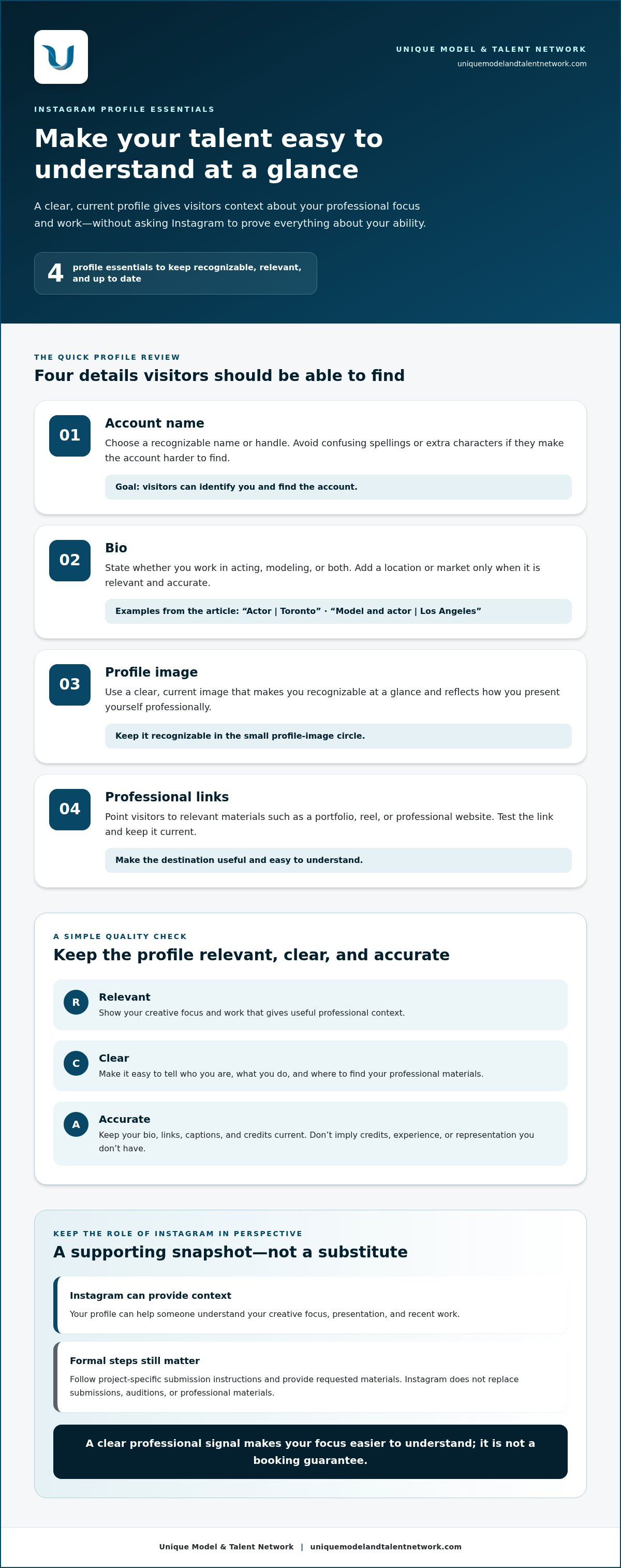
Use this quick checklist to review the parts visitors see first:
- Account name: Choose a recognizable name or handle. Avoid confusing spellings or extra characters if they make the account harder to find.
- Bio: State whether you work in acting, modeling, or both. Add a location or market only if it’s relevant and accurate.
- Profile image: Use a clear, current image that makes you recognizable at a glance and reflects how you present yourself professionally.
- Professional links: Direct visitors to relevant materials, such as a portfolio, reel, or professional website. Test the link and keep it up to date.
Write a bio that communicates your professional lane
Keep your bio factual and concise. For example, “Actor | Toronto” or “Model and actor | Los Angeles” can quickly establish a focus when those details are true. Add a specialty or preferred type of work if it helps explain your direction, but don’t imply credits, experience, or representation you don’t have.
Choose one useful route to more information rather than crowding the bio with personal details. Make sure the link takes visitors to relevant professional materials, not a page where they have to guess what to look at. For guidance on organizing acting materials beyond Instagram, see this acting portfolio guide.
Choose profile images and posts that represent you now
Use recent visuals that reflect your current appearance and professional presentation. A profile image should be recognizable in a small circle; the wider feed can show more range. A deliberate mix of polished and natural images offers context without requiring every post to look like a formal headshot or campaign image.
Check that captions and credits are accurate, and don’t present someone else’s work as your own. Your feed can show personality while still giving visitors a clear sense of your current creative focus. You don’t need to remove every personal post. Consider whether the overall profile feels like an honest, appropriate snapshot of you today.
Keep Instagram’s role in perspective. Selecting headshots, reels, and portfolio images deserves more focused attention than a general feed strategy. Build a profile that points clearly toward those materials, then use the materials themselves to present your work in depth. If structured feedback would help you strengthen your portfolio or reel, the professional community for actors and models offers reviews alongside other opportunities for industry learning.
Professional Content vs. Follower Counts: What Matters More on Instagram?
A large audience can attract attention, but it isn’t a universal casting requirement. For most profile reviews, professional relevance, clarity, and consistency give a more useful picture than a follower total alone. There’s no one-size-fits-all answer to what casting directors want to see on instagram: the project brief determines which qualities and materials matter.
Use this comparison to separate signals you can shape from popularity metrics you can’t control:
| Professional signals | Popularity metrics |
|---|---|
| Relevant work or updates that align with your creative goals | Follower count, likes, and viral reach |
| A profile that clearly communicates your focus | A high number that may not explain your professional fit |
| Consistent, accurate presentation over time | A sudden spike in attention with little context |
Popularity can be useful in some circumstances, but it doesn’t automatically demonstrate role suitability, acting ability, or modeling range. Treat metrics as one possible piece of context, not a scorecard for your career.
Do casting directors care how many followers you have?
Some projects may consider audience reach, especially when a brief includes promotional or commercial objectives. That’s a project-specific consideration, not a general standard for actors and models. Don’t assume you need a certain number of followers to be considered, and don’t treat a viral post as proof that you’re right for a role.
Read each opportunity’s requirements carefully. If a project asks for social metrics, respond accurately and provide what’s requested. If it doesn’t, prioritize the stated submission process and role-specific materials. Social platforms and formal casting channels serve different purposes; this casting websites guide can help clarify how dedicated platforms fit into your search.
Which posts provide useful professional context?
Choose posts that support the impression you want your professional profile to give. Depending on your work and comfort level, useful examples might include a current work sample, a brief behind-the-scenes moment you’re permitted to share, or an update about a relevant project. You don’t need to turn every post into a performance or make your personal life public.
Keep the context truthful and respectful. Credit collaborators appropriately, don’t imply you created work that belongs to someone else, and avoid claims about credits or experience you can’t support. Before sharing material connected to a production, consider whether it’s approved for public posting. Don’t reveal confidential project details or images.
Set boundaries that feel sustainable. You can keep private parts of your life off your professional-facing feed and still share enough work-related context to make your profile useful. If you’d value structured feedback on your professional materials, industry workshops and portfolio reviews can support continued development beyond social metrics.
A Practical Instagram Audit for Actors and Models
You don’t need to erase your personality or rebuild your account to make it more useful professionally. A brief audit can help you spot outdated details, unclear information, or privacy choices you’d like to revisit. Look at what a new visitor can understand, then make changes that serve your current goals.
Review your profile from a casting professional’s perspective
Take a fresh look at the account as if you’ve never seen it. Can you identify the person, their professional focus, and the best route to current materials? This practical check gets closer to what casting directors want to see on instagram than trying to imitate another performer’s feed. Review the details, not your follower count.
- Confirm your identity and focus. Check that your name, bio, and public-facing details accurately describe you and the work you pursue. If you act, model, or do both, make that clear without suggesting a career path that isn’t yours.
- Review representation and credits. If you list representation, make sure the information is current and accurate. Check credits and captions for errors, and don’t imply representation, experience, or work you don’t have. Update or remove details that no longer apply.
- Test your professional route. Open every profile link and check that it leads to the intended, current material. Review any listed contact route for accuracy, too. A broken link or old contact detail can make it harder for someone to follow up appropriately.
- Scan what the public can see. Look through recent posts, older content, captions, and tagged material. Ask whether each item still fits your professional goals and privacy preferences. Archive or remove content only when it conflicts with those priorities; you don’t need to strip the account of personal expression.
- Set boundaries for visibility and contact. Decide what you’re comfortable sharing publicly and what belongs in a private space. Avoid posting sensitive personal details, and use caution with unsolicited messages, requests for money, or requests for private material. For submissions and project communication, follow established, appropriate channels rather than treating a social message as a substitute for formal instructions.
Make the audit part of your routine
Revisit the account periodically and after a meaningful professional change, such as a new credit, updated materials, or a change in representation. You don’t need a posting quota. Keep the information you choose to share accurate, accessible, and comfortable for you.
Quick audit: confirm your identity, focus, representation, credits, links, public content, and privacy boundaries. Update only what no longer reflects your current professional life.
If expert perspective would help you develop your materials and industry knowledge, explore the Network Membership, which includes portfolio and reel reviews, live workshops, skill-building challenges, and expert Q&A sessions.
Turn Instagram Feedback Into Professional Growth With the Network
Instagram can show how people respond to a post, but likes and comments can’t tell you everything about a portfolio, reel, or developing skill. Use social feedback as one small signal, not a substitute for informed input. A clearer profile is useful, but steady career development also means evaluating your materials and building your understanding of the industry.
Get informed feedback beyond likes and comments
A strong response to a clip doesn’t necessarily tell you whether it showcases the work you want to pursue. Structured portfolio and reel reviews give you a focused way to consider how your professional materials present your strengths and where they may need attention. Treat feedback as perspective for your next steps, not as a promise of casting approval or a particular outcome.
That perspective can help you ask better questions: Does this material represent my current abilities? Is the work easy to understand? What skill would strengthen my next project? Live workshops led by industry guests and expert Q&A sessions offer opportunities to build industry knowledge and hear perspectives beyond a public comment thread. For ideas on building professional relationships, explore this acting industry networking guide.
Choose a deliberate next step for your career
Keep your plan manageable. Choose one profile improvement, such as updating a link or correcting an outdated detail, and one skill-development priority, such as practicing a particular scene or strengthening your on-camera technique. A focused next step is more useful than trying to overhaul your account or measure your progress by follower growth.
The Network Membership is a private, moderated digital community for aspiring actors and models to develop industry knowledge and professional connections. Learning opportunities include live industry workshops, portfolio and reel reviews, monthly skill-building challenges, and industry expert Q&A sessions. Each can support a different part of your development, from reflecting on professional materials to building skills and asking informed questions.
That’s the practical answer behind what casting directors want to see on instagram: a clear professional signal can provide context, while ongoing learning helps you develop the work behind that signal. Membership supports education and connection. It isn’t direct talent representation, and it can’t guarantee auditions, bookings, or paid work.
If you’re ready to take a considered next step, explore the Unique Model & Talent Network and choose the learning opportunities that fit your current priorities.
Take One Intentional Step Forward
Your Instagram doesn’t have to be perfect to support your professional goals. Treat it as a living snapshot: update it as your work develops, keep your choices aligned with your boundaries, and give your energy to the craft behind the profile. That’s a more sustainable way to approach what casting directors want to see on instagram than trying to predict every viewer’s preferences or chasing attention for its own sake.
Choose one practical action today. You might refresh a detail that no longer reflects your work, make time to develop a skill, or seek thoughtful input on materials you’re preparing. Small, deliberate steps can help you move forward with greater clarity while leaving room for your own voice and creative direction.
If you’re ready to build your industry knowledge and professional connections in a focused community, explore the Unique Model & Talent Network. Keep developing your craft with confidence, and let your online presence support the work you’re building.
Frequently Asked Questions
Do casting directors look at actors’ Instagram accounts?
Some casting professionals may look at an actor’s Instagram, but practices vary by person and project. A profile might offer extra context about your work or public presentation, while another casting process may rely on submitted materials and auditions. Treat Instagram as a possible point of discovery, not a required step. Keep any public-facing information accurate and relevant.
Do casting directors care about how many followers an actor has?
Follower count isn’t a universal requirement for actors. A particular project may specify audience reach as part of its brief, but don’t assume every role depends on social metrics. If a casting notice asks for your account or audience information, provide it honestly. Otherwise, focus on meeting the stated requirements and presenting materials that help the team assess your fit for that specific role.
Should actors have a separate professional Instagram account?
A separate account can help if you want a clearly defined space for acting updates while keeping personal sharing among people you know. It also means maintaining another profile and deciding which account to keep current. If you prefer one account, review its audience, older posts, and privacy settings to decide what you’re comfortable making public. Choose the setup you can manage consistently without feeling pressured to share more than you want.
Can a private Instagram account affect casting opportunities?
A private account limits what people who don’t follow you can see, so it may offer less public context if someone visits your profile. That doesn’t automatically rule you out of a role. If you prefer privacy, you can still share requested professional materials through the project’s stated submission process. Decide which information belongs on a public profile and which is better shared only through appropriate professional channels.
What should actors avoid posting on Instagram?
Avoid sharing confidential project details, material you aren’t authorized to publish, or credits that could give a misleading impression of your role. Think carefully before posting sensitive personal information or content that conflicts with the professional boundaries you want to maintain. You don’t need to make your feed impersonal. Before sharing, consider whether the post is accurate, respectful, and appropriate for its intended audience.
How often should actors post on Instagram?
There’s no single posting schedule actors need to follow for casting purposes. Choose a pace that lets you share meaningful updates without distracting from training, auditions, or other work. For instance, you might post when you have a new approved project update or a useful work sample, rather than publishing simply to meet a quota. If your schedule changes, that alone doesn’t mean your professional presence has failed.
Should I message a casting director on Instagram?
Message a casting director only when they invite contact through Instagram or provide clear instructions for doing so. Otherwise, use the submission route named in the casting notice, and avoid sending unsolicited scripts, reels, or repeated follow-ups in direct messages. Be cautious if someone asks for money or private material through an unexpected message. Handle professional opportunities through clear, appropriate channels, not pressure or vague promises.


