

Virtual auditions can widen the casting room without moving it. Finding diverse talent for film and TV becomes more accessible when actors can submit self-tapes from anywhere, giving casting directors a broader pool to consider. Technology can expand access, while inclusive casting practices shape who gets seen and how talent is assessed.
Broader reach matters, but virtual auditions work best when role requirements are clear and candidates are assessed on the skills and qualities the production needs. Consistent criteria help keep decisions purposeful instead of relying on familiar networks or narrow assumptions about who fits a role.
This guide explores how virtual auditions can support diverse casting, what casting directors and production companies can do to widen access, and which recruitment resources can help screen-industry talent find meaningful opportunities. You’ll come away with practical ways to build a more inclusive search, from writing accessible casting notices to reaching beyond closed networks.
Key Takeaways
- Use virtual auditions and self-tapes to widen access to performers beyond local casting networks.
- Make role requirements clear, assess candidates consistently, and focus on the skills the production needs.
- Reach underrepresented talent through inclusive job notices and recruitment channels that are open beyond closed groups.
- Build industry skills and strengthen portfolios with structured learning and feedback opportunities.
How can casting directors push for change in film and TV?
Casting directors can encourage diverse casting by presenting directors and producers with a varied shortlist for each role. This makes representation part of the selection process, not an afterthought. For a feature film seeking a female lead, for example, teams can define role-related skills first, then search across a broader range of talent networks.
Directories can turn that intention into a wider search. Actor directories support searches by performance type, location, and relevant experience. Writer and director directories can help productions find creatives beyond familiar referral circles. For worldwide crew searches, organize profiles by department, role, and region, then consider international candidates when the production can work across locations. Inclusive directories and profiles can also make relevant experience and accessibility needs easier to identify.
The National Registers of Communication Professionals Working with Deaf and Deaf/blind People is a UK resource for finding language service professionals who support communication access. It is a voluntary regulator for more than 1,700 professionals. Productions can use a resource like this to identify communication support for accessible auditions or sets, while searching separate directories for actors and crew.
Direct messages can help casting teams reach talent whose profiles match a role. Make each message useful: identify the project and role, explain how to submit, and include key dates. A detailed profile with a reel, credits, skills, and preferred contact method gives casting teams practical information beyond existing personal networks.
Unions and guilds can support diversity hiring by encouraging productions to broaden access and consider more inclusive casting. Kara Sullivan says SAG-AFTRA offers incentives to encourage productions to embrace diversity. Casting directors can pair that support with concrete steps: suggest varied candidates, keep criteria relevant to the role, and use a consistent audition process.
Production companies promoting underrepresented talent
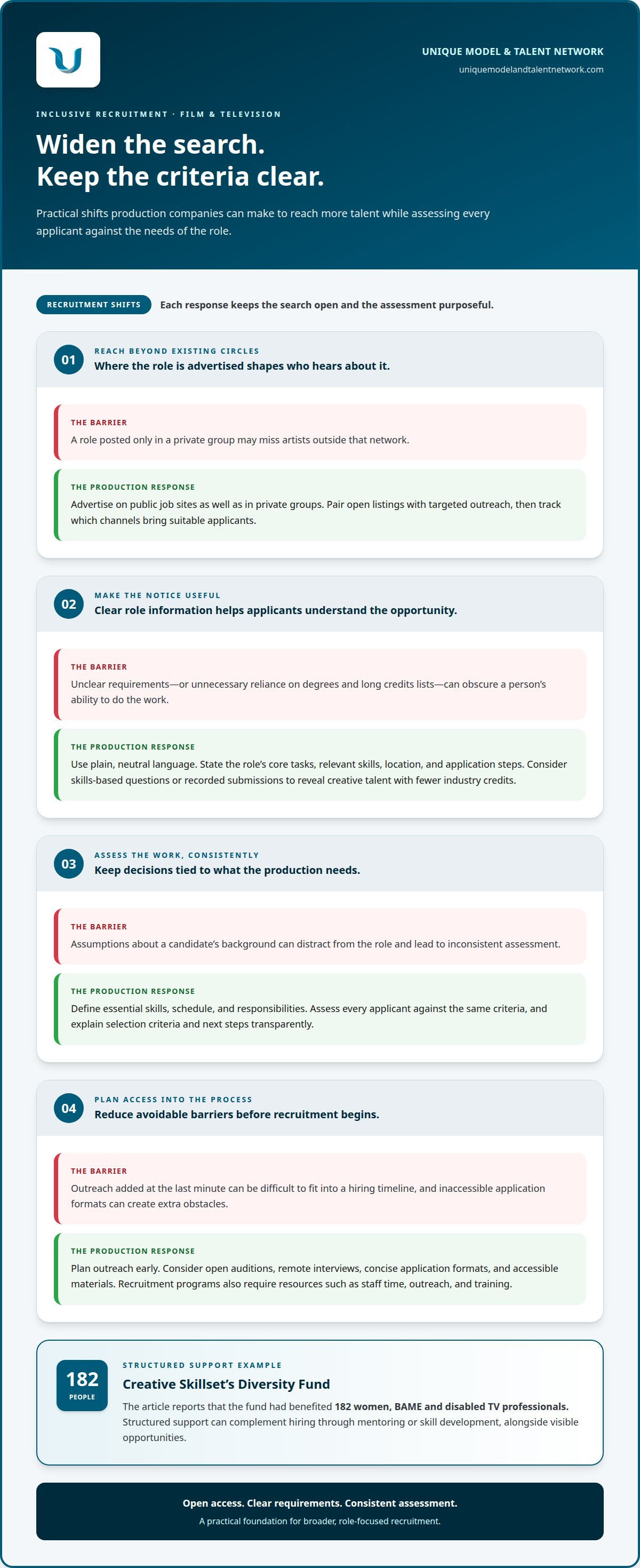
Production companies can widen access by advertising screen-industry roles on public job sites as well as in private groups. A role posted only in a closed network may miss artists beyond its existing connections. Pair open listings with targeted outreach, then track which channels bring suitable applicants. This helps producers broaden recruitment while keeping the search aligned with the production’s needs.
Write each notice in plain, neutral language that welcomes applicants across gender identities and cultures. State the role’s core tasks, relevant skills, location, and application steps. Don’t treat a university degree or long credits list as a substitute for ability. Skills-based questions or recorded submissions can reveal creative talent with fewer industry credits.
Recruitment programs require resources, including staff time, outreach, accessible materials, and training. They can help productions reach a wider pool, support emerging professionals in building experience, and bring a broader range of perspectives to the work. The balance depends on program design, the support offered, and how well opportunities match production needs.
Base budget decisions on the role, not assumptions about a candidate’s background. Define essential skills, schedule, and responsibilities, then assess every applicant against the same criteria. Open auditions, remote interviews, and concise application formats can reduce unnecessary barriers. Plan outreach early so it fits the hiring timeline instead of becoming a last-minute addition.
Creative Skillset’s Diversity Fund had benefited 182 women, BAME and disabled TV professionals. That example shows how structured support can complement hiring: a production can pair outreach with mentoring or skill development, then make opportunities visible through public listings. Keep the process transparent by explaining selection criteria and communicating next steps to applicants.
Authentic and inclusive casting
Diversity in film and television means bringing varied identities, backgrounds, and lived experiences into stories and creative teams. Underrepresented talent can include people of color, women, disabled people, and others whose perspectives have had less visibility on screen or behind the camera. Representation matters throughout a production, from the cast to the team shaping its stories.
A UCLA study examined nearly 1,200 movies and television shows from 2011-2012 for gender and racial representation. In the United States, there are three nonwhite people for every nonwhite character on the big screen, and seven for every nonwhite lead in broadcast television comedies and dramas. Women appear in films at half the rate of their share of the real-life population.
Inclusive casting calls start with a specific role description. Identify the character’s essential traits and performance needs, then explain which criteria are flexible. Use clear, respectful language, outline how to audition, and offer a way to request accessible formats. During auditions, ask every candidate the same core questions and assess their work against role-related criteria.
A casting breakdown turns those criteria into a clear brief. It helps teams describe the role, avoid irrelevant restrictions, and share consistent information with talent networks. If a character’s background is central to the story, explain why. Don’t use identity as a shortcut for assumptions about appearance, accent, or behavior.
Authenticity depends on decisions beyond casting. Review whether scripts give represented characters agency, distinct motivations, and meaningful relationships. Ask consultants or community members with relevant experience to identify stereotypes or gaps before filming. During production, consider how wardrobe, dialogue, and camera choices shape a character’s portrayal. These steps carry inclusive intent from the audition room through to the finished work.
Recruitment resources for diverse screen-industry talent
Useful recruitment resources do more than publish vacancies. They can connect talent with training, funding, professional networks, and clear routes into screen careers. A focused strategy makes finding diverse talent for film and TV more organized by matching each need to a useful resource. A grant may support project development, while a workshop can build practical skills or industry knowledge.
For U.S. The Pan African Film Festival is a nonprofit 501(c)(3) corporation and offers another connection to the film community. These resources serve different purposes: one provides development funding, while the festival supports visibility and professional connection.
To find city-level opportunities, start with the film commission serving the production’s location. A local commission can point productions toward regional resources and connections within the area’s screen industry. For finding diverse talent for film and TV locally, identify the relevant city or state, then explore its commission and workforce programs.
National programs can address access across the industry. The TV Access Project aims to achieve full disability inclusion in television by 2030. Though British rather than U.S.-based, it illustrates how a coordinated initiative can focus attention on long-term inclusion. U.S. productions can connect national diversity and inclusion goals with local opportunities, role-specific outreach, and accessible applications.
Give each resource a defined next step: submit a proposal to a funding program, attend a relevant career event, or share an open role through a local industry channel. Live Industry Workshops and Industry Expert Q&A Sessions can help emerging professionals develop skills and gain practical insight into screen careers. To explore a professional development opportunity that supports finding diverse talent for film and TV, choose a relevant network resource.
Unique Model & Talent Network
Unique Model & Talent Network gives emerging actors and models a professional community to build skills and connect with industry experts. If you’re developing your screen career or strengthening your portfolio, The Network Membership offers a structured way to engage with industry professionals and fellow creatives.
Live Industry Workshops and Industry Expert Q&A Sessions offer opportunities to learn from experienced professionals, while Portfolio & Reel Reviews provide focused feedback on how you present your work. Monthly Skill-Building Challenges help you keep developing your craft and maintain momentum between auditions.
These resources support career development and industry learning, rather than direct talent representation or commission-based booking. To explore how the network can support your next step, contact Unique Model & Talent Network.
Make inclusive hiring part of every next project
Lasting change comes from making inclusive hiring a repeatable production practice. After each project, note which outreach channels brought forward strong candidates, where applicants faced barriers, and which criteria helped identify relevant skills. Use those observations to refine the next casting or crew search. This creates a practical learning loop, helping each production widen access more intentionally.
A sustained approach to finding diverse talent for film and TV also depends on professional growth between opportunities. Actors and emerging creatives can use feedback to sharpen their materials, build confidence, and prepare for new roles. Producers and industry professionals can keep strengthening the networks that help talent become visible.
If you’re ready to take a practical next step in your industry journey, contact Unique Model & Talent Network. Your skills and perspective have a place in the screen industry. Keep developing them, and keep moving forward.
Frequently Asked Questions
Have technological innovations such as virtual auditions had an impact on casting diversely?
Yes. Virtual auditions and self-tapes let actors audition from beyond a production’s immediate area. Amanda Lenker Doyle reports that casting workflows have expanded from reading fifteen people for a role to reading thousands. That wider reach can broaden the pool, but it also makes clear submission instructions and organized reviews essential. Remote auditions expand access; they don’t replace thoughtful evaluation.
How do you approach diverse, inclusive and authentic casting for your clients?
A thoughtful approach connects the story’s needs with casting decisions instead of treating representation as a visual checklist. Productions can consider whose perspective shapes a character, whether that character has agency, and whether the creative team has relevant insight. For a role rooted in a specific lived experience, bring informed perspectives into development and review choices beyond casting, including dialogue and performance context.
How do you see diverse casting practices evolving in the next few years?
Make inclusion part of the full production process, from early story development through hiring and review. Teams can examine who receives opportunities, who advances, and where candidates disengage. They can also plan for accessible participation in auditions and production work. These practices make diversity and inclusion an ongoing responsibility, not a single casting decision or short-term campaign.
What are some of the biggest challenges and watch-outs for casting mindfully?
Watch for tokenism, stereotypes, and criteria that aren’t genuinely needed for a role. A character’s identity shouldn’t substitute for a developed personality or meaningful story. Casting teams can document why each requirement matters, avoid pressuring candidates to disclose personal information, and assess performances against consistent, role-related standards. Consider how costumes, accents, and camera choices may reinforce assumptions after casting.
How can film and TV producers recruit diverse talent beyond traditional networks?
Producers can combine open submissions with outreach through community organizations, training programs, cultural events, and local creative groups. Make opportunities easy to share by providing a clear role description and submission process. For example, a production seeking a regional crew member could invite applications through local arts programs, not just personal referrals. Track which channels lead to conversations with qualified candidates, then build on those connections.
What employment and anti-discrimination laws apply to diversity hiring in U.S. entertainment?
The rules that apply depend on the work location, hiring arrangement, and role. A production should distinguish employment from other types of engagement and account for relevant federal, state, and local requirements. Keep selection criteria tied to the work, apply them consistently, and document hiring decisions. Because entertainment projects can involve different jurisdictions and contracts, seek advice from qualified employment counsel for a specific situation.


