

What if confidence isn’t a prerequisite for taking your next creative step? Dealing with imposter syndrome as a creative can make sharing a portfolio, auditioning, submitting work, or pursuing an opportunity feel like a test of whether you truly belong. When your work is personal and feedback is subjective, a rejection or a peer’s polished online portfolio can seem like proof that you’re falling behind. It isn’t proof of professional inadequacy.
It’s understandable to want certainty before putting your work forward. But waiting until self-doubt disappears can keep you from gaining the experience, feedback, and connections that help confidence grow. You can acknowledge the feeling without letting it make career decisions for you.
This article offers practical ways to challenge harsh self-talk, track evidence of your progress, and keep building skills through manageable actions. You’ll also learn how to seek constructive feedback and supportive professional connections, so you can pursue appropriate opportunities without waiting to feel completely confident.
Key Takeaways
- Learn why auditions, subjective feedback, and visibility can bring self-doubt forward without treating that feeling as a diagnosis.
- Separate a specific skill you can develop from a sweeping judgment that you don’t belong.
- When dealing with imposter syndrome as a creative, use a repeatable process: name the thought, check the evidence, and choose one useful next step.
- Make feedback more useful by seeking specific, constructive perspectives from people you trust.
- Explore how structured learning and supportive creative connections can help you keep progressing without waiting for perfect confidence.
Dealing with Imposter Syndrome as a Creative: What the Feeling Can and Cannot Tell You
When someone responds to a performance, design, photograph, or piece of writing, their reaction can feel like a verdict. Praise may seem undeserved; criticism may feel like confirmation that you don’t belong. If you’re dealing with imposter syndrome as a creative, that response can be intense, but the feeling itself is not a reliable measure of your ability.
Imposter feelings are persistent doubts about whether you deserve your achievements, even when the evidence doesn’t support that doubt. The phrase describes an experience, not a formal diagnosis. The overview of Impostor syndrome provides more background on how the term is used and understood.
How imposter feelings can show up in creative careers
You might dismiss a compliment as politeness, delay submitting a portfolio because it isn’t “ready,” or spend an upcoming audition worrying that others will discover you’re not qualified. These reactions can lead you to put off work that could give you useful experience.
Perfectionism may make it difficult to finish or share a project. Comparison can also distort your sense of progress, especially when you measure your early drafts against someone else’s polished portfolio. Neither pattern affects everyone in the same way. Your creative discipline, career stage, and personal circumstances all shape how self-doubt shows up.
Why creative work can make self-doubt feel personal
Creative feedback is often shaped by taste, context, and the needs of a particular project. A response to one performance or design can therefore feel like a judgment of your identity, even when it addresses a specific choice. Try separating what was said about the work from what you fear it means about you.
Irregular opportunities and public-facing work may add pressure for some people. An audition decision, a quiet period between projects, or a visible comparison with peers can prompt broad conclusions from limited evidence. But doubt alone can’t establish whether you’re talented or professionally suited to a discipline.
Look for something specific you can act on. “I need more practice with this technique” points to a skill you can develop. “I’m not a real creative” is a sweeping judgment, not an assessment. Dealing with imposter syndrome as a creative starts with noticing that difference: feelings deserve attention, but they don’t have to make the decision for you.
Why Imposter Syndrome Can Intensify Around Auditions, Feedback, and Creative Visibility
Some creative work happens under evaluation: a casting decision, a client’s response, a submission deadline, or an audience seeing the finished piece. Those moments can make uncertainty feel especially sharp. They don’t affect everyone in the same way, but they can bring comparison, rejection, and questions about progress into focus.
When auditions, submissions, or rejection trigger doubts
A casting or commissioning decision is specific to a project. Fit, timing, and project needs may all matter, but unless decision-makers share their reasons, you can’t know which factors shaped the outcome. Avoid filling that gap with a story that you failed because you lack talent.
One rejection is not a complete measure of your creative ability or future potential.
If useful feedback is available, look for what it actually says: perhaps a clear strength, a craft detail to practise, or a note about suitability for that particular project. If no explanation is offered, you can still review what was within your control, such as preparation or the quality of your submission, without treating an unknown reason as fact.
When comparison makes another creative’s progress feel like your failure
A peer’s new role, exhibition, published work, or polished showreel is visible. The practice behind it, the revisions, the support, the unsuccessful attempts, and the time spent learning usually aren’t. Social media can make the contrast feel even sharper because it often presents selected outcomes rather than the full development process.
Bring comparison back to something useful. Instead of asking why you aren’t at the same milestone, identify a relevant craft skill you want to strengthen or compare your current work with an earlier version of your own. For actors, structured learning can offer a more grounded reference point than scrolling through announcements. This professional guide to acting workshops online explores how workshops can support craft development.
Hearing creative industry professionals discuss their experiences and approaches to confidence can offer another perspective. Varied viewpoints may help put your own doubts in context, without suggesting that everyone faces the same pressures.
When dealing with imposter syndrome as a creative, focus on evidence and next steps, not imagined explanations. If a more structured learning environment would help you build skills and connect with peers, explore creative learning and community options through the Network Membership.
Does Feeling Like an Imposter Mean You Are Not Ready? Separate Fear from Useful Feedback
No. Feeling unqualified is not, by itself, evidence that you’re unqualified. At the same time, confidence isn’t a reason to ignore a clear craft note. A useful assessment starts with what can be observed in the work, not a verdict about your worth or identity.
Use this simple check to separate a possible skill gap from a global self-judgment:
| Situation | Observable evidence | Interpretation to check | Useful next step |
|---|---|---|---|
| A reviewer says a scene feels rushed. | Several lines are delivered quickly, and the emotional shift is hard to follow. | “I’m a terrible actor” is broader than the note supports. | Practise pacing the scene and ask whether the change reads more clearly. |
| You worry your portfolio isn’t strong enough. | Some images or materials don’t match the roles or projects you’re pursuing. | “I’m not suited to this career” isn’t established by a portfolio concern. | Compare the materials with your professional goals and identify what needs updating. |
| Feedback from two people conflicts. | One recommends a change; another prefers the original choice. | The difference may reflect taste, context, or different goals. | Clarify the purpose of the work and seek a relevant second perspective. |
How to tell constructive critique from a global self-judgment
Constructive critique points to something specific in a scene, image, or technique. “The framing distracts from the subject” gives you a choice to test. “You have no eye” turns one response into a claim about your ability. Consider who gave the feedback, what they were responding to, and whether their perspective fits your goals. Then turn a useful note into one focused practice goal, such as testing a different composition on your next shoot.
What to do when you cannot tell whether a concern is accurate
If feedback is vague or conflicting, pause before accepting or rejecting it. Ask a second qualified person who understands the kind of work you’re pursuing. Keep dated samples of your work and notes about what you practised; reviewing them over time can show changes that a single anxious moment may hide.
If you’re reviewing acting materials, this acting portfolio guide offers a related resource. Dealing with imposter syndrome as a creative doesn’t mean dismissing every concern. It means testing concerns against evidence, keeping feedback specific, and choosing a next step you can act on.
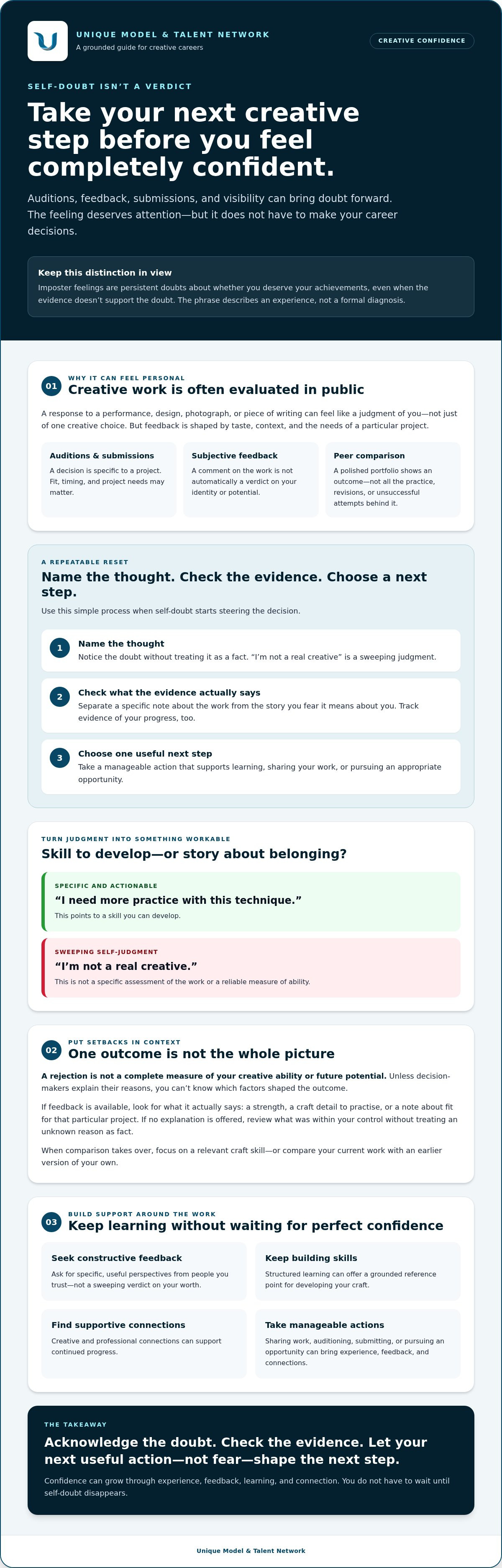
How to Deal with Imposter Syndrome as a Creative: Five Practical Steps
When self-doubt tells you to withdraw, over-prepare, or put off sharing your work, use a simple process to choose your next move. These steps are practical guidance for reflection and skill-building, not treatment. You can work through them in a few minutes before a submission or after receiving critique.
- 1. Name the thought. Describe what’s happening without treating the thought as a fact. “I’m worried my work isn’t ready” is more useful than “I’m a fraud.” Naming the worry creates room to decide what to do next.
- 2. Check the evidence. Ask: What happened? What did I conclude? What observable evidence supports that conclusion? Replace an absolute judgment with a precise description of the present challenge, such as “I haven’t practised this section enough yet.”
- 3. Choose one controllable action. Pick a task you can complete during your workday: rehearse one section, make one revision based on a clear note, or complete and send the submission. The aim isn’t to guarantee an outcome. It’s to keep a fear-driven delay from making the choice for you.
- 4. Seek useful feedback. If you need another perspective, ask a trusted, relevant person a specific question. For example: “Is the intention in this scene clear?” Specific feedback is easier to assess and apply than a general request to judge whether you’re good enough.
- 5. Review your progress. Record what you completed, which skills you practised, and any specific feedback you received. Look back periodically to notice development, even when a particular submission or project doesn’t lead to the outcome you hoped for.
For example, before sending a portfolio, you might name the thought, “They’ll see I’m not ready.” Check whether you have evidence for that conclusion, then choose one practical step: review the materials against the submission requirements and send them if they meet the brief. Afterward, note what you did and any feedback you can use next time.
Make the process sustainable
Keep your record brief. A few lines after a work session can capture more useful evidence than a vague memory of how confident you felt. If checking peers’ updates repeatedly disrupts focused work, set a boundary, such as closing the app while you prepare or practise. You don’t need to eliminate comparison; you can protect time for your own goals.
Dealing with imposter syndrome as a creative is less about forcing confidence and more about responding to doubt with evidence, focused action, and constructive input. If structured learning and peer connection would support your next steps, explore the Network Membership.
Find Support and Keep Building Your Creative Career Without Waiting for Perfect Confidence
Confidence doesn’t have to come first. It may grow as you practise, share work, learn from feedback, and take appropriate opportunities while some uncertainty remains. Support can make those steps feel more manageable, but different people serve different needs.
A trusted peer can offer perspective and encouragement. A mentor may help you think through career decisions, while a coach can focus on developing a particular craft or professional skill. If self-doubt is affecting your wellbeing or daily life, a qualified mental health professional can provide support suited to that need. Choose based on the question you’re trying to answer.
Choose feedback and community that support your actual goals
Look for feedback that’s specific, respectful, and relevant to the work in front of you. Before sharing a scene, image, or reel, decide what you want input on. A focused question helps you assess whether the response is useful, rather than treating every opinion as a verdict.
It’s also reasonable to set boundaries. Step back from spaces that rely on constant comparison, pressure you to make decisions quickly, or promote unsupported promises. For actors considering where to build professional connections, this guide to acting industry networking platforms offers a starting point for thinking about peer communities and industry access.
A talent community can provide professional education and connection, not representation or guaranteed work. Look for clear information about what a community offers and decide whether it fits your current goals.
Make one career-development move this week
Choose one action small enough to complete: practise a challenging section, update a portfolio image, ask a trusted person to review a specific part of your work, or research an opportunity that matches your experience. One considered step is more useful than waiting for doubt to disappear completely.
If a structured learning environment would help, options can include live industry workshops, portfolio and reel reviews, skill-building challenges, and expert Q&A sessions. These formats can offer opportunities to develop skills, get relevant input, and connect with peers and professionals. Unique Model & Talent Network’s paid Network Membership brings these learning and connection opportunities together, including a private, moderated community. It isn’t a treatment for imposter feelings or a route that guarantees bookings.
If that kind of professional learning and connection fits what you need now, you can explore the Network Membership. Keep building at a pace that works for you. Confidence can follow the work; it doesn’t have to authorize every next step.
Keep Moving Forward, Even When Confidence Wavers
Self-doubt can be part of creative work, but it isn’t a verdict on your talent or readiness. When dealing with imposter syndrome as a creative, separate a specific skill to develop from a sweeping judgment about whether you belong. Then choose one manageable action, use feedback that’s relevant to your goals, and keep a record of the work you’re doing.
You don’t need to wait until every doubt disappears before you build momentum. Consistent practice and supportive professional connections can help you keep learning and make your next steps clearer.
For a more structured environment, the Unique Model & Talent Network Membership offers live industry workshops, expert Q&A sessions, portfolio and reel reviews, skill-building challenges, and a private, moderated community connecting talent with peers and professionals. These are opportunities for learning and connection, not a guarantee of work or representation.
Explore the Unique Model & Talent Network to see whether its professional learning and community options fit your goals. Your next step doesn’t require perfect confidence. It only needs to be a step you’re ready to take.
Frequently Asked Questions
Is imposter syndrome common among creatives?
Imposter feelings are familiar to some creatives, though experiences vary across disciplines, career stages, and personal circumstances. Subjective feedback, auditions, public-facing work, and comparison can make self-doubt more noticeable for some people. The term describes feelings of doubting your achievements or belonging; it isn’t a formal diagnosis. Recognizing the experience can help you respond to it without assuming every creative has the same triggers.
How do I deal with imposter syndrome as a creative?
Start by naming the thought, then ask what observable evidence supports it. If you’re worried that a submission isn’t ready, identify a specific concern, such as missing materials or a skill you want to practise. Choose one manageable next action, seek focused feedback if it would help, and record what you completed. This approach gives you something concrete to work with, even if confidence hasn’t caught up.
Can imposter syndrome stop me from pursuing creative opportunities?
Self-doubt can contribute to delaying an audition, avoiding a submission, or turning down an opportunity before you’ve assessed it. It doesn’t have to make the decision for you. Check the opportunity’s requirements, consider whether it fits your experience and goals, and identify what preparation is reasonably needed. If you meet the stated criteria, consider applying while acknowledging that you may still feel uncertain.
Does feeling like an imposter mean I am not talented?
No. A feeling of being unqualified doesn’t establish whether you’re talented or ready for a particular opportunity. Look instead at specific evidence: the work you’ve completed, skills you’ve developed, and relevant feedback from people who understand your craft. If you find a clear gap, treat it as a development target rather than a verdict on your worth. You can build a skill without proving that you already know everything.
How can creatives handle rejection without taking it personally?
Give yourself room to feel disappointed, then separate the decision from your identity. A casting or commissioning outcome may reflect fit, timing, or project needs, and you may not know the exact reason. If feedback is offered, identify any specific, actionable note. If it isn’t, review what you can control, such as preparation or submission requirements, without inventing an explanation for the decision.
Should I tell someone I feel like an imposter?
You can choose to tell someone you trust, especially if keeping the worry private makes it harder to take a next step. Be specific about the support you want: listening, perspective on a piece of work, or advice about an opportunity. A trusted peer, mentor, or coach may offer a useful professional viewpoint. Sharing doesn’t require you to disclose more than feels comfortable, and asking for input doesn’t make you look inexperienced.
When should a creative seek professional help for self-doubt?
Consider speaking with a qualified mental health professional if self-doubt is persistent, causes significant distress, or interferes with daily life, relationships, or your ability to work. A professional can help you explore what’s happening and discuss support suited to your circumstances. Peer feedback and creative communities can offer connection and learning, but they aren’t substitutes for mental health care. If you’re unsure where to start, a healthcare provider can help you consider options.


