

Learning how to manage your time as a freelance actor starts with making room for change, not filling every open hour. An audition notice can reshape a planned workday, while admin, training, paid work, and personal commitments all compete for attention. When bookings slow down, an open calendar can feel unproductive, even when it gives you time to prepare, learn, or recover.
That pressure is real, but a packed schedule isn’t the same as a productive career. Freelance acting calls for a flexible rhythm that can absorb last-minute auditions without pushing craft, income, or rest aside. You need clear priorities and room to adjust, not a rigid plan that makes every change feel like a setback.
This guide lays out a practical weekly system for auditions, skill development, career administration, paid work, and rest. You’ll learn how to set flexible priorities, protect time for career-building tasks, and track meaningful progress beyond bookings alone. We’ll start with a planning framework, then look at how to adapt it when opportunities or quiet periods change your week.
Key Takeaways
- Learn how to manage your time as a freelance actor by planning around priorities while leaving room for casting changes.
- Use a weekly reset to identify fixed commitments, schedule movable career tasks, and preserve flexible space.
- Sort acting responsibilities by urgency so audition deadlines, recurring craft practice, and optional tasks get appropriate attention.
- When an audition or freelance shift arrives, reassess deadlines first, then move flexible tasks instead of rebuilding your whole week.
- Give professional development a regular place in your routine through focused learning, expert feedback, or peer accountability.
Why time management as a freelance actor requires flexibility
Actor time management means balancing limited time across paid work, auditions, craft, career administration, and recovery. It isn’t about filling every hour. Casting notices can come with short deadlines, callbacks may change your plans, and production dates can affect your availability. Income needs and personal responsibilities still need attention, whatever the casting calendar looks like.
That mix makes a freelance acting schedule different from one built around steady, predictable shifts. Call times vary, audition requests can arrive at short notice, and some periods bring fewer acting opportunities. Your circumstances matter, too: you might balance acting with flexible income work, fixed shifts, training, or caregiving. A useful system reflects your actual commitments rather than assuming every actor follows the same career path.
Flexibility matters more than filling every hour: plan the work you can control, and leave room for opportunities you can’t predict. That’s the foundation of how to manage your time as a freelance actor without treating every open block as a problem to solve.
What makes a freelance acting schedule different?
Acting work often depends on decisions and timelines outside your control. A casting notice may require focused preparation quickly; a callback or production date may then affect other commitments. As a freelance actor, you’re balancing creative work with the practical demands of building a career. Acting also spans varied forms of performance, so schedules and priorities differ widely.
Instead of planning for a “typical” week, identify what your own week needs to hold: income work, personal commitments, audition availability, practice, and rest. The balance can change from one week to the next, so review the plan as new information comes in.
Which parts of your acting career can you plan?
Separate commitments with set times, such as a shift or scheduled appointment, from repeatable tasks you can move when plans change. You may not control when an audition arrives, but you can make room for preparation, timely follow-up, and skill practice. Treat these as process goals: actions you can complete, not promises of a particular casting result.
Planning gives you structure without asking you to predict whether you’ll be booked. Preparing an audition and practicing consistently are meaningful inputs, even when the outcome is uncertain. This distinction helps you assess your effort fairly and gives your weekly plan a steadier starting point.
Build a weekly time-blocking system around acting work
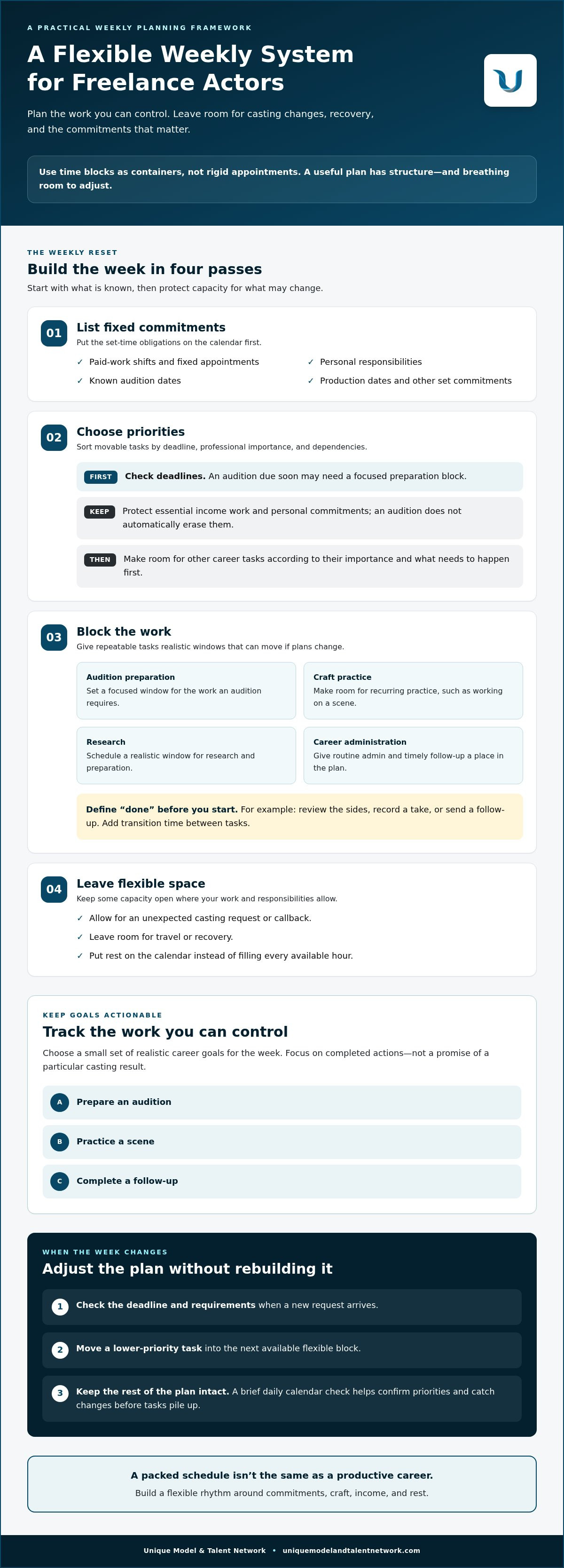
A useful weekly plan gives important work a place without pretending every day will go as expected. Use this reset at the start of the week, then adjust it as casting information comes in:
- List commitments. Add fixed appointments, paid-work shifts, personal responsibilities, and any known audition or production dates.
- Choose priorities. Sort remaining tasks by deadline, professional importance, and dependencies. Protect essential income work, then make room for urgent audition preparation.
- Block the work. Set realistic windows for preparation, craft practice, research, and administration. Add transition time so one task doesn’t run straight into the next.
- Leave flexible space. Keep some capacity open where practical for a casting request, callback, travel, or recovery. Don’t turn every available hour into a commitment.
This is a practical way to manage your time as a freelance actor: use blocks as containers, not rigid appointments. A self-tape may need a focused preparation window, while research or routine admin can often move to another day. Before committing a block, be specific about the task and what “done” means, such as reviewing the sides, recording a take, or sending a follow-up. Avoid planning every minute. A schedule with breathing room is easier to adjust and more likely to hold up.
How do you prioritize acting tasks for the week?
Start with deadlines, then weigh each task’s professional importance and dependencies. An audition due soon deserves focused preparation, but it shouldn’t automatically erase a paid shift or personal commitment. Choose a small set of career goals you can review at week’s end, such as preparing an audition, practicing a scene, and completing a follow-up. Make each goal specific enough to act on, but realistic for the week you actually have.
For example, an adaptable week might place income work and fixed appointments first, followed by a movable craft block and an admin window. A known audition gets a priority block; an open period can stay available for a callback or travel. Put rest on the calendar, too. Choose days and time blocks based on your commitments, not someone else’s template.
How can you leave room for last-minute auditions?
Reserve unscheduled capacity when your work and responsibilities allow it. If a new request comes in, check its deadline and requirements, then move a lower-priority task into the next available flexible block. Don’t scrap the entire plan. A brief daily calendar check helps you spot changes, confirm the day’s priorities, and make deliberate adjustments before tasks pile up.
If structured learning helps you protect time for development, the Unique Model & Talent Network community brings together workshops, feedback, and peer support for actors and models.
Balance auditions, paid work, training, and actor administration
Every acting task can feel urgent when it’s tied to your career, but tasks have different purposes and deadlines. Use this comparison to decide what needs attention now, what deserves a recurring place, and what can wait for a quieter week.
| Task type | Examples | How to schedule it |
|---|---|---|
| Time-sensitive | Audition preparation, submissions, callback requirements | Work backward from the deadline and protect the time needed to meet the brief. |
| Recurring | Craft practice, follow-up, records, professional administration | Reserve bounded, repeatable blocks so important maintenance doesn’t disappear from the week. |
| Optional | Broad casting research, extra exercises, non-urgent profile updates | Use flexible capacity after deadlines and essential commitments are covered. |
Balance tasks by urgency and purpose, not by whichever feels most visible. A new casting notice may demand immediate focus, while routine records or practice can feel less pressing. Both support your working life in different ways. Treat paid work as a foundation for financial stability, not a distraction from acting. Protect those commitments, then fit career tasks around the time you genuinely have.
How much time should actors spend on auditions and preparation?
There’s no universal number of hours to set aside. A brief audition and a detailed self-tape may call for different preparation, and the deadline matters just as much as the role. Read the sides, casting brief, and submission requirements first. Then choose a focused block for interpretation, rehearsal, recording, and final checks. Leave enough transition time to avoid rushing the submission.
Keep casting research targeted. Before you start, define what you need to learn, such as the project’s requirements or the submission details. Stop when you have a clear next action. Unstructured browsing can absorb time without helping you move forward.
How can you keep training and administration from taking over?
Give craft practice and business upkeep recurring, bounded sessions. Batch similar tasks, such as submissions, follow-up messages, and record updates, so you’re not switching between admin and creative work every few minutes. If you’re planning structured learning, use this professional acting workshop guide to decide what belongs in your development routine.
To put time-management principles into practice, review the balance at week’s end: Did urgent auditions get focused preparation? Did paid work remain protected? Did training and administration receive deliberate, limited space? Adjust the next week based on those answers, not on how busy the calendar looked.
Stay on schedule when auditions and freelance work change
A new audition doesn’t have to erase your whole day. Use a short reset to fit the new commitment into your plan while keeping deadlines and essential responsibilities visible:
- Name the change. Note the audition, callback, work shift, or travel commitment, including its deadline and any fixed timing.
- Recheck priorities. Identify what must happen before the new commitment and what can move without creating a problem.
- Reschedule deliberately. Move flexible tasks to open blocks, and update any follow-up that depends on the change.
Keep time-specific commitments and work blocks on your calendar; use a task list for actions that can happen within those blocks. They don’t need to be in the same app. The calendar shows when you’re available, while the list helps you decide what to do next. After rescheduling, check that submission steps, replies, and other essential follow-ups haven’t disappeared from view.
What should you do when an audition disrupts your plan?
Protect the preparation and submission window first, then move tasks without fixed deadlines. If practice and profile updates both need to shift, choose a new slot for one and decide whether the other can wait. Avoid trying to recover every delayed task in one day. Set a realistic limit, then carry forward what doesn’t fit instead of turning a changed plan into an impossible catch-up list.
Overbooking often starts with treating every request as an automatic yes. Check the actual deadline, your paid-work commitments, and the preparation required before adding an audition or task to your schedule. To reduce procrastination, define the next physical action, such as reviewing the sides or organizing materials. To curb social-media drift, set a purpose and stopping point for online research, then return to the scheduled task.
How can actors avoid burnout during a slow or busy period?
Recovery and personal commitments belong in the schedule; they aren’t leftover time. During a quiet period, choose a focused development task, such as practicing a scene or reviewing your materials, rather than filling every open hour with career activity. In a busy stretch, reduce optional tasks and allow realistic time for transitions and sleep. Sustainable planning changes with your workload.
At the end of the week, review actions you completed and commitments coming up, not bookings alone. Did you prepare, follow up, practice, and protect the time you needed? That review gives you evidence to adjust your next plan without judging the week solely by an outcome you can’t control. For structured learning and peer support as part of your development routine, explore the Network Membership.
Create a sustainable acting routine with focused support
A routine works when it can bend without breaking. Build a simple cycle: plan your priorities, protect focused time for them, then review what actually happened. Keep the structure steady, but let the specific tasks change with auditions, paid work, and personal commitments. That’s a practical way to manage your time as a freelance actor over the long term, rather than relying on bursts of effort that are hard to maintain.
Turn your plan into a career routine you can maintain
At the end of each week, note what you completed, what moved, and what needs attention next. Track preparation, practice, learning, and administration alongside auditions and bookings. These actions show whether your system is supporting your career, even when casting outcomes are outside your control.
Then adjust one part of the routine at a time. If a regular practice block keeps getting displaced, try a different window or make the task more manageable. A consistent commitment you can repeat is more useful than an ambitious plan that quickly becomes another source of pressure.
Where can actors find focused learning and feedback?
Professional development is easier to protect when it has a clear activity and purpose. Live workshops led by industry professionals can give learning a defined place in your schedule. Portfolio and reel reviews offer focused feedback on your materials, while expert Q&A sessions create a structured opportunity to learn from industry perspectives. Monthly skill-building challenges can turn a broad goal, such as strengthening a specific performance skill, into a concrete activity to work on.
For audition preparation, use this film industry auditions guide to inform your preparation routine. To build professional connections with intention, look for opportunities to learn from industry experts and connect with peers. Then decide what learning or connection goals deserve space in your coming week.
If expert feedback or peer accountability would help you stay consistent, the Network Membership, live workshops, portfolio and reel reviews, monthly challenges, and expert Q&A sessions offer focused ways to support your development. Choose what fits your priorities and give it a realistic place in your routine. Structured learning can strengthen your professional practice without promising auditions or bookings.
Build a weekly rhythm that supports your acting career
Learning how to manage your time as a freelance actor isn’t about controlling every change. It’s about building a flexible weekly rhythm: protect fixed commitments, give auditions and craft focused time, and leave space to adjust when work shifts. Prioritize tasks by deadline and purpose, then review the preparation, learning, and administration you completed, not just the bookings you received.
A sustainable plan also makes room for recovery. Small, repeatable career habits can support your progress without turning every open hour into another task. If focused learning and professional feedback would help you maintain that rhythm, the Unique Model & Talent Network offers live industry workshops, expert Q&A sessions, portfolio and reel reviews, monthly skill-building challenges, and a private professional community.
Explore the Unique Model & Talent Network and find support that fits your development goals. Build a plan that can flex with your career, and keep moving forward one purposeful week at a time.
Frequently Asked Questions
How do freelance actors manage their time?
Freelance actors manage their time by prioritizing deadlines and protecting flexible space in their week. List fixed commitments first, including paid work and personal responsibilities, then set realistic blocks for audition preparation, craft, and administration. Keep some capacity open for changes, and review the plan as new information arrives. To learn how to manage your time as a freelance actor, focus on actions you can control, such as preparation and follow-up, rather than bookings alone.
How many hours a day should an actor spend on acting?
There’s no set number of hours every actor should spend on acting each day. The right amount depends on audition deadlines, role requirements, paid work, training needs, and personal responsibilities. A focused practice or audition-preparation block can be more useful than a long session without a clear purpose. Choose a sustainable amount of time you can repeat, then adjust it when a deadline or production commitment changes your week.
How do actors balance auditions with a full-time job?
Actors with full-time jobs can balance auditions by planning around fixed work hours and identifying realistic windows for preparation and submissions. Check audition deadlines promptly, then decide what can fit without jeopardizing essential job responsibilities or rest. If an audition requires more preparation than your schedule allows, reassess other flexible tasks instead of assuming every commitment can be squeezed in. Keep audition materials organized so you can use available time efficiently.
How can I stay productive when I am not booking acting jobs?
During a quiet booking period, choose specific career actions rather than trying to fill every open hour. You might practice a scene, review your reel, update professional records, follow up on outstanding matters, or take part in structured learning. Set goals based on completed work, not casting outcomes. A week can include meaningful progress even without a booking, especially when you protect time for craft, career upkeep, and recovery.
What should an actor include in a weekly schedule?
An actor’s weekly schedule should reflect their own commitments, but it can include fixed work and personal appointments, audition preparation, craft practice, professional administration, and recovery. Add transition time around focused work and leave some space for changes. Give recurring tasks a regular place, while keeping deadline-driven audition work flexible enough to move forward when needed. A weekly review can help identify what needs attention next without making the calendar rigid.
How do actors handle last-minute auditions without falling behind?
Actors can handle a last-minute audition by identifying its deadline and requirements, protecting the preparation time it needs, then moving flexible tasks to later openings. Update a calendar or task list with submission steps and any necessary follow-up. Don’t try to recover every postponed task in one day. Choose what matters most, carry forward the rest, and check the revised plan so the audition doesn’t make other commitments disappear.
Can a time-management system help actors avoid burnout?
A time-management system can support a more sustainable routine by making space for recovery, personal commitments, and realistic workloads. It can also help actors reduce optional tasks during busy periods and choose purposeful development activities during quieter ones. No schedule removes the uncertainty of freelance work, but a flexible plan can make priorities clearer and discourage constant catch-up. Review it regularly, and adjust it if it leaves too little room for rest.


