

What if the clearest introduction to your career isn’t a list of everything you can do, but one sentence about the value you bring? Learning how to write a logline for your personal brand can help you move beyond vague descriptions and give people a memorable way to understand your focus, strengths, and the work you want to pursue. The challenge is making that sentence specific without making your experience seem narrower than it is.
If you’ve struggled to sum yourself up, you’re not alone. A concise logline isn’t a complete account of your skills or a permanent label. It’s a focused introduction that gives people a credible starting point for understanding your work and direction.
In this guide, you’ll learn how to identify your audience, choose a relevant strength, and shape those ideas into a clear sentence. You’ll also learn how to adapt your logline for profiles, professional introductions, and industry conversations, then refine it as your career develops.
Key Takeaways
- A personal-brand logline is a focused professional introduction, not a biography, tagline, or complete career history.
- Learn how to write a logline for your personal brand with a four-step process that starts with your audience and ends with a concise draft.
- Make your statement distinctive by grounding it in observable skills, relevant training, or focused creative interests rather than unsupported claims.
- Use a simple checklist to assess clarity, credibility, relevance, and how naturally your logline sounds when spoken aloud.
- Adapt your logline for different professional settings, and revisit it when your experience or direction changes.
What Is a Personal-Brand Logline, and What Should It Explain?
A personal-brand logline summarizes your professional identity and value in one sentence. For an actor or model, it gives people a clear starting point: your focus, a relevant strength, and the kind of work or audience you’re speaking to. It’s not a screenplay premise, biography, tagline, or complete career history. Think of it as a concise introduction, not a sentence that has to capture everything you can do.
Use a logline when introducing yourself, writing a profile, meeting industry peers, preparing a workshop bio, or adding context to a portfolio. It can keep your message consistent across settings while allowing you to adjust details for the conversation. If you’re learning how to write a logline for your personal brand, aim for clarity rather than a promise of attention or opportunity. A strong sentence can explain your direction, but it can’t guarantee work, representation, or a particular response.
How Is a Personal-Brand Logline Different From a Film Logline?
A film logline summarizes a story, often introducing its central character, conflict, and stakes. A personal-brand logline introduces a professional by focusing on strengths, creative direction, and intended audience. For example, a film logline might describe a musician trying to save a neighborhood venue; a brand logline might introduce a vocalist focused on intimate live performance and jazz repertoire. These examples show the difference in purpose, not a template every performer should follow.
An elevator pitch is related, but it gives you more room to expand in conversation. Your logline is the compact anchor: a listener should understand its main idea before you add context, credits, or a question. It should sound natural aloud, not like a slogan written for an advertisement.
Why Does a Clear Logline Help Actors and Models?
Industry conversations move quickly. A focused sentence helps someone understand your work without having to sort through a list of roles, skills, and ambitions. It can also align your profile, portfolio description, and spoken introduction. The logline doesn’t replace those materials; it gives them a shared point of focus.
You don’t need an extensive credit list to describe yourself credibly. If you’re emerging, name relevant training, a skill you’re developing, or a specific creative direction, as long as it accurately reflects your experience. That gives others a clearer picture without overstating your background. As your craft and focus evolve, your introduction can evolve too.
How to Write a Personal-Brand Logline in Four Clear Steps
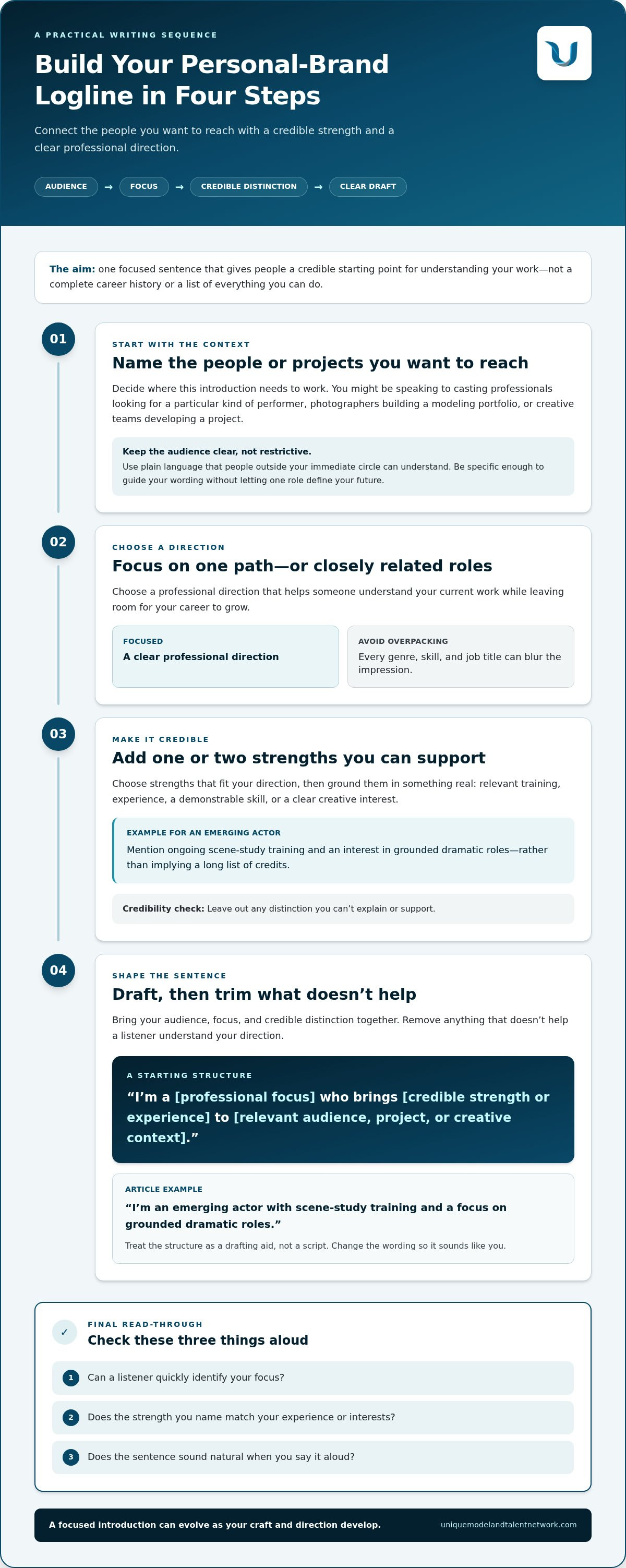
To learn how to write a logline for your personal brand, build it from four parts: audience, focus, credible distinction, and a clear draft. You don’t need to fit every skill or possibility into one sentence. Choose a professional direction that helps someone understand your current work while leaving room for your career to grow.
A useful logline connects the people you want to reach with a strength you can support and a direction you’re ready to pursue.
Step One: Name the People or Projects You Want to Reach
Start with the context where you want this introduction to be useful. Are you speaking to casting professionals looking for a particular kind of performer, photographers building a modeling portfolio, or creative teams developing a project? Be specific enough to guide your wording, but not so narrow that one role defines your future. Choose plain language that someone outside your immediate circle can understand.
Steps Two Through Four: Choose, Support, and Shape Your Message
Step two: Choose a focus. Select one professional direction or a small group of closely related roles. Mentioning every genre, skill, and job title can blur the impression you want to make.
Step three: Add a credible distinction. Identify one or two strengths that fit that direction. Support them with something real: relevant training, experience, a demonstrable skill, or a clear creative interest. An emerging actor, for example, might mention ongoing scene-study training and an interest in grounded dramatic roles, rather than imply a long list of credits.
Step four: Draft and trim. Bring the pieces into one sentence, then remove anything that doesn’t help a listener understand your focus. Use this fill-in-the-blank as a starting point:
I’m a [professional focus] who brings [credible strength or experience] to [relevant audience, project, or creative context].
For example: “I’m an emerging actor with scene-study training and a focus on grounded dramatic roles.” Treat this as a drafting aid, not a script. Change the wording so it sounds like you, and leave out any distinction you can’t explain or support.
- Can a listener quickly identify your focus?
- Does the strength you name match your experience or interests?
- Does the sentence sound natural when you say it aloud?
Feedback can reveal unclear wording. A peer or industry expert may notice where your sentence feels broad, overpacked, or difficult to follow. Industry feedback and peer perspectives can offer useful context as you refine your introduction.
How to Make Your Logline Specific Without Sounding Generic or Overconfident
A logline is more memorable when it replaces broad praise with details people can picture. “Talented, versatile performer” could describe almost anyone. A specific skill, relevant training, work sample, or focused creative interest gives the reader something concrete. The goal isn’t to sound exceptional at any cost. It’s to make an accurate introduction that helps the right people understand your direction.
| Vague wording | More specific wording | Why the revision works |
|---|---|---|
| “I’m a versatile model.” | “I’m a model focused on editorial and studio portrait work.” | Names creative contexts instead of relying on a broad label. |
| “I’m a one-of-a-kind actor.” | “I’m an actor with comedic improv training and an interest in character-driven comedy.” | Replaces an unsupported superlative with relevant, explainable details. |
| “I can do anything on camera.” | “I’m a presenter drawn to lifestyle and interview formats.” | Shows a current direction without claiming every possible capability. |
What Makes a Personal-Brand Logline Sound Believable?
Make sure each claim has a clear basis: training you’ve completed, experience you can describe, a skill you can demonstrate, or an interest you’re actively pursuing. Words like “one of a kind,” “in-demand,” and “award-winning” can sound hollow if you can’t support them. Don’t imply credits, credentials, or outcomes you haven’t earned. A grounded statement can still be distinctive because its details reflect your real strengths and goals.
How Can You Keep One Sentence From Limiting Your Career?
Think of your logline as a useful introduction for this stage of your career, not a permanent definition. Keep a central identity while adjusting the emphasis for acting, modeling, or an adjacent creative context. That focus helps people understand your current direction without ruling out future possibilities.
Your logline should work alongside your materials, not replace them. Use it to frame the work a reader is about to see, then let your portfolio provide the fuller picture. For guidance on presenting acting experience and work samples, explore this acting portfolio guide.
As you practice how to write a logline for your personal brand, check that each phrase is clear and supportable. If a line sounds impressive but doesn’t sound like you, revise it. Credibility doesn’t limit ambition; it gives your introduction a solid foundation while your work and skills continue to develop.
How to Test, Refine, and Adapt Your Personal-Brand Logline
A good logline should make sense to someone who doesn’t already know your work. Read it aloud, then ask a trusted peer to listen once and tell you what they understood. If they repeat the main idea accurately, your wording is doing its job. If they focus on a detail you didn’t intend, revise for clarity rather than adding more claims.
What Questions Should You Ask Before Using Your Logline?
Use this short checklist to check whether your sentence is ready:
- Clarity: Can a new contact understand the work or direction you’re describing?
- Specificity: Does the wording give a concrete sense of your focus?
- Credibility: Can you explain or demonstrate each claim?
- Relevance: Does the statement fit the person, project, or setting you’re addressing?
- Natural delivery: Would you say it this way in a real professional conversation?
A profile may call for a polished written version, while a networking conversation should sound easy to say and follow. In a workshop bio, you might emphasize relevant training or a current creative interest. Keep the central message consistent, but adjust the emphasis to suit the context. That’s adaptation, not contradiction.
How Can Feedback Improve Your Draft?
Ask a peer to describe what they remember after hearing your sentence once. Their answer can show whether your focus came through or a phrase felt unclear. If they misunderstand, look for the word or idea that caused confusion. Don’t try to solve every issue by listing more skills. A cleaner, more direct sentence is often stronger.
Conversations with peers and industry professionals can offer useful perspective as your goals develop. For more ways to build those connections, read this guide to acting industry networking. Workshops, expert Q&A sessions, and portfolio or reel reviews can also help you assess whether your introduction matches the work you’re presenting.
Revisit your logline when your direction, skills, or professional materials change in a meaningful way. You don’t need to rewrite it after every new experience. Let real conversations and thoughtful feedback guide revisions. To connect with talent and industry peers, explore the Network Membership.
Turn Your Logline Into a Clearer Professional Introduction
A logline becomes useful when you put it to work. Choose an audience, name a strength, support it with something real, then refine the wording until it’s clear and comfortable to say. That’s the practical answer to how to write a logline for your personal brand: create a focused introduction, not a promise about what your career will deliver.
Use the sentence to open a conversation, then let your craft, preparation, and work speak for themselves. A logline can help someone understand where to begin, but it can’t replace your skills or the materials that show them. Think of it as a doorway to a fuller professional introduction.
What Should You Do After Writing Your First Draft?
Save your draft and try it in a relevant setting, such as a profile or an introduction to a peer. Pay attention to what happens next. Do people ask about the creative focus you hoped to communicate, or seem unsure what a phrase means? Useful follow-up questions suggest your main point landed. Confusion points to wording that may need work.
Make one thoughtful revision at a time. Keep your claims accurate and the phrasing personal. If feedback suggests adding another skill, consider whether it sharpens your message or simply makes the sentence longer. Your logline should clarify your direction, not become a checklist of everything you’ve done or hope to do.
How Can Industry Learning Support Your Next Steps?
Career goals and professional language develop alongside your craft. Live Industry Workshops provide structured learning, while Portfolio & Reel Reviews offer feedback on the materials that support your introduction. Monthly Skill-Building Challenges encourage continued practice, and Industry Expert Q&A Sessions create opportunities to hear professional perspectives. These experiences can help you assess whether your stated focus reflects the work you’re developing.
Use what you learn to keep your introduction aligned with your progress. A clearer logline won’t guarantee work or representation, but it can help you communicate your direction with greater confidence. The Unique Model & Talent Network brings emerging talent and industry professionals together through a professional community and learning resources.
Put Your Logline to Work
A clear personal-brand logline gives people a confident starting point for understanding your professional direction. As you practice how to write a logline for your personal brand, keep it focused on an audience, a genuine strength, and wording you can support. Test it aloud, listen to how others understand it, and revise as your skills and goals develop.
Your logline is an introduction, not a substitute for your craft or a promise of career outcomes. Let it open the conversation, then use your work and continued learning to give that introduction substance. Live workshops, industry expert Q&A sessions, and portfolio and reel reviews can support practical development and offer useful perspectives as you refine how you present yourself.
Ready to keep building your skills alongside a professional community? Explore the Unique Model & Talent Network and its professional learning resources. Start with what’s true today, and let your introduction evolve as you do.
Frequently Asked Questions
What is a personal-brand logline?
A personal-brand logline is a concise sentence that introduces your professional focus, a relevant strength, and the people or projects you hope to serve. It’s a starting point for understanding your work, not a biography or a list of every skill. If you’re considering how to write a logline for your personal brand, choose details that are clear, accurate, and easy to explain in conversation.
How long should a personal-brand logline be?
A personal-brand logline should usually fit into one clear sentence. There’s no fixed word count, but it needs to be brief enough to say naturally and specific enough to communicate your direction. Read your draft aloud: if you have to rush, take a breath, or explain several unrelated claims, trim it. You can add context in a longer profile or conversation.
How do I write a logline if I am a beginner actor or model?
Focus on an honest current direction, not a credit list you haven’t built yet. Name relevant training, a skill, or a creative interest you can discuss. For example, an aspiring actor might mention scene-study training and an interest in dramatic roles. Keep the wording grounded, and avoid implying professional experience or credentials you don’t have. Your introduction can develop as your skills and work grow.
What is the difference between a logline and an elevator pitch?
A logline is a compact introduction that gives someone the main idea of your professional focus. An elevator pitch is a brief spoken explanation that can build on that idea with more context, examples, or goals. Use your logline as the opening line of a conversation, then expand if the other person wants to know more. Neither needs to sound memorized or overly promotional.
Can I use the same personal-brand logline on every platform?
You can keep the central message consistent while adjusting its emphasis for each setting. A profile may need a polished written sentence, while an in-person introduction should sound conversational. A workshop bio might highlight relevant training or a current creative focus. Adapt the details to fit the context, but keep your claims accurate and your professional direction recognizable across platforms.
How do I make my personal-brand logline sound less generic?
Replace broad praise, such as “talented” or “versatile,” with a detail people can understand or verify. Name a specific skill, relevant training, type of work, or focused creative interest. “Actor with improv training and an interest in character-driven comedy” gives a clearer picture than “versatile performer.” Choose details that matter to your intended audience, and leave out claims you can’t support.
When should I update my personal-brand logline?
Revisit your logline when your goals, skills, or professional materials change in a meaningful way. New training, a clearer creative direction, or work samples that reflect a different focus may call for revised wording. You don’t need to rewrite it after every small change. Test an updated draft aloud and ask someone you trust what they understand before using it in profiles or introductions.


