
Why does a performer with undeniable talent and a decade of training get ignored while others seem to book every guest star role that hits their inbox? If you have been sending out hundreds of submissions only to be met with total silence, you are not alone. It is easy to feel isolated in 2026, especially when self-tapes now account for nearly 90 percent of first-round auditions and generative video tools are shifting the standards of the game. You might feel like the industry has become a black box, but the truth is often found in the subtle professional blunders that signal "amateur" to a casting director.
We understand the frustration of working hard without a clear roadmap for success. This guide identifies the specific common actor mistakes to avoid so you can stop guessing and start booking. We will provide a definitive checklist of current professional standards, helping you refine your digital presence and master the technical nuances of the modern industry. By the end of this article, you will have the confidence and the tools to present yourself as a high-level professional who is truly ready for paid work.
Key Takeaways
- Learn how to treat your professional toolkit as a dynamic digital ecosystem to ensure your materials always meet 2026 industry standards.
- Master the technical nuances of home auditions by eliminating the lighting and audio errors that distract casting directors from your performance.
- Discover why the "lone wolf" approach is a career killer and how professional community vetting can get your materials past the spam folder.
- Identify the common actor mistakes to avoid when managing your digital profiles to prevent being filtered out of high-value casting searches.
- Shift from a hobbyist mindset to a professional strategy by leveraging live workshops and expert feedback to accelerate your booking ratio.
The 'Bare Minimum' Trap: Avoiding Technical and Material Mistakes
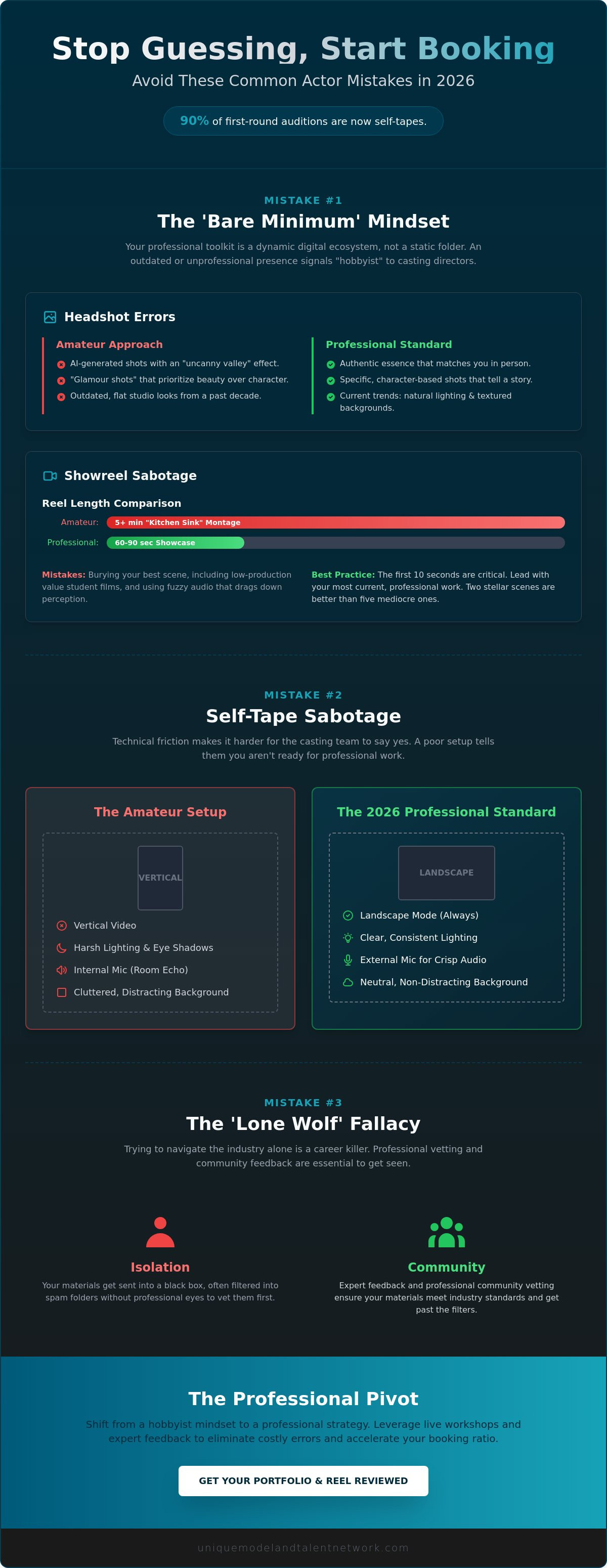
Your professional profile is not a static folder of PDFs and JPEGs. It is a dynamic digital ecosystem that requires constant maintenance to reflect your current age, type, and professional credits. Treating your materials as a one-time chore is one of the most common actor mistakes to avoid if you want to be taken seriously by high-level casting offices. If your IMDbPro page is missing a current headshot or lacks updated credits, you are essentially invisible to the people who make hiring decisions. Casting directors view an unoptimized IMDbPro page as a sign that an actor is either a hobbyist or out of touch with industry standards. Professionalism in 2026 means every digital touchpoint must be polished, accurate, and ready for immediate review.
Understanding the audition process requires recognizing that casting directors make decisions in seconds, not minutes. They don't have the luxury of searching for your best work or wondering if you still look like your 2022 headshot. You must present a clear, cohesive brand that proves you are a solution to their casting problem. This starts with the materials you submit before you even speak a line of dialogue.
Headshot Errors: Beyond the Basics
The rise of AI-generated headshots has created a new pitfall for emerging talent. While these images might look polished, they often lose your authentic essence and produce a "uncanny valley" effect that irritates casting professionals. If you walk into a room and don't match the person in the photo, the trust is broken immediately. You should also avoid the mistake of using "glamour shots" that prioritize beauty over character. In 2026, the industry demands specific, character-based headshots that tell a story about who you are and what roles you can play. Your portfolio must reflect current trends, such as the preference for natural lighting and textured backgrounds, rather than the flat, studio looks of the past decade.
Showreel Sabotage: Length and Quality
Many actors fall into the "kitchen sink" trap, submitting five-minute montages that bury their best performances. A Competitive 2026 Showreel is a high-impact, 60-90 second showcase that prioritizes your most current, professional work over dated montages. Don't make the mistake of putting your best scene second; the first ten seconds determine if the viewer keeps watching. It's also vital to remove low-production value student film clips. If the audio is fuzzy or the lighting is poor, it drags down the perceived quality of your acting. It's better to have two stellar, professional scenes than a long reel filled with amateur technical errors.
Self-Tape Sabotage: Technical and Performance Errors in Home Auditions
Self-taping is no longer a temporary solution; it is the primary way you will be seen for 80 percent to 90 percent of your first-round auditions. When you treat your home setup as an afterthought, you are telling casting directors that you aren't ready for professional-level work. Many common actor mistakes occur before the first line is even spoken. If your lighting creates heavy shadows over your eyes, you have already lost the connection with the viewer. Audio is equally critical. Using an internal camera mic captures the echo of the room rather than the nuance of your voice. This technical friction makes it harder for the casting team to say yes. Don't let a poor setup kill your chances. It's a choice you make every time you hit record.
The Technical Standard for 2026 Auditions
In 2026, a dedicated self-tape space is a requirement for serious performers. You don't need a professional studio, but you do need a neutral background and a consistent lighting setup. One of the most frustrating errors for casting sites is the "vertical video" mistake. Unless specifically requested for a social media campaign, always film in landscape mode to ensure your framing meets industry requirements. For a deeper dive into organizing your digital assets, see The Ultimate Guide to Building an Acting Portfolio That Books in 2026. If you are struggling with the technical side, getting a Portfolio & Reel Review can provide the professional eyes you need to fix these errors before your next submission.
Performance Nuances in the Digital Age
Acting for a self-tape is different from acting for the stage. A major blunder is "theatrical" acting that feels too big for a tight close-up frame. Keep your movements contained and your internal life active. Pay close attention to the eye line; looking directly into the lens is almost always a mistake unless the script specifically calls for it. You should also ensure your reader is not over-active. If their voice is louder or more emotional than yours, it distracts from the talent being evaluated. Administrative failures are just as damaging. If you ignore the slate instructions or fail to name your files correctly, your tape might get lost in the shuffle. Being too "in character" during your slate can also be a turn-off. Casting directors want to see the person they will be working with on set, not a continuation of the scene's intensity. Following every "Special Instruction" in the breakdown is the simplest way to prove you are a professional who respects the casting team's time. These are the common actor mistakes to avoid to ensure your talent remains the focus of the audition.
The 'Lone Wolf' Fallacy: Why Isolation is a Career Killer
Many actors believe that once they secure an agent, their business development is complete. This is a dangerous misconception. An agent is a partner, not a savior; relying solely on them for access to casting directors is a high-risk strategy that often leads to stagnation. In 2026, the industry moves too fast for a passive approach. One of the most common actor mistakes to avoid is the "lone wolf" mentality that assumes talent alone will open doors without active relationship building. If you are sending cold emails to casting offices without a warm introduction or a verified community standing, your message is likely heading straight to the spam folder. Decision-makers prioritize talent who come recommended by trusted networks or show a history of professional engagement.
Another common pitfall is the echo-chamber of feedback. Relying on friends or family to critique your materials feels safe, but it rarely leads to professional growth. You need objective, professional evaluations to ensure your portfolio meets current market demands. Without this outside perspective, you will likely miss out on the "unlisted" market. This refers to the significant percentage of jobs filled through personal recommendations and private networking before they ever hit a public casting site. Isolation doesn't just feel lonely; it's a measurable drain on your booking potential.
The Power of the Managed Community
Social media groups are often filled with distractions, negativity, and outdated advice. Transitioning to a private, managed community allows you to focus on high-value interactions without the noise of public platforms. These spaces provide peer-to-peer accountability, which is essential for preventing the burnout that follows months of isolated submissions. For a comprehensive look at how to choose the right space for your career, check out The Ultimate Acting Industry Networking Platform Guide for 2026. Joining a professional network ensures you are surrounded by individuals who share your high standards and commitment to excellence.
Direct Access vs. Gatekeepers
Stop waiting for permission to build your career. You don't need an agent's approval to engage with the industry in a meaningful way. By participating in Industry Expert Q&A Sessions, you gain direct insight into what decision-makers are actually looking for in a performance. Strategic Networking is the process of building value-based industry relationships before you need a favor. This proactive method turns gatekeepers into collaborators. If you feel stuck, engaging in Monthly Skill-Building Challenges within a professional network can help you maintain momentum while building the visibility you need to book paid work.
Digital Profile Blunders: How Your Presence Might Be Filtered Out
Your online profile is your digital storefront. In 2026, casting directors use advanced filters to narrow down thousands of submissions in a matter of seconds. If you treat platforms like Casting Networks or Backstage as "set it and forget it" resumes, you are missing out on high-value roles. One of the most common actor mistakes to avoid is leaving mandatory fields blank. Missing data like height, weight, or eye color can cause the algorithm to hide your profile during a specific search. Consistency is also vital. Your branding on Actors Access must match your IMDbPro page and your personal website. A disjointed presence suggests a lack of professional organization. Professionals also look for a "Vetted" status or professional accreditation. This separates serious talent from the millions of hobbyists who spend over $1.2 billion annually on casting subscriptions without ever optimizing their profiles.
Optimizing for Casting Site Algorithms
Casting sites function like search engines. You must use keyword-rich descriptions in your "Special Skills" section to appear in specific searches. Listing "dialects" is too vague; list "Standard British (RP)" or "Southern American (Rhotic)" instead. If you have training in stage combat or firearms, be specific about your certifications. It's also essential to update your "availability" status every week. Even if your schedule hasn't changed, the timestamp on your last update tells casting directors that you are active and reachable. Many actors forget that these platforms are tools for the casting office, not just a place to store photos. For a deeper look at which platforms deserve your time and money, read The Best Casting Websites in 2026: An Insider’s Guide to Booking Real Work.
Professionalism in Digital Communication
Your digital presence extends to your inbox. Using an unprofessional email address or informal slang in a submission is a quick way to get ignored. When a "Check Avail" request arrives, the industry standard for a response is a two-hour window. If you take all day to reply, the production has likely moved on to the next candidate. Professional follow-ups are a lost art. If you haven't heard back after a callback, a polite, brief check-in can keep you on their radar without appearing desperate. Don't be the actor who ghosts a casting director because you were too busy to check your notifications. To ensure your digital storefront is optimized for 2026 standards, consider booking a Portfolio & Reel Review to identify any hidden errors in your presentation.
The Professional Pivot: How Unique Model & Talent Network Eliminates Costly Errors
Transitioning from a hobbyist approach to a pro-network strategy is the single most effective way to eliminate the common actor mistakes to avoid. While many performers wander through general social media groups, serious professionals seek the clarity of a gated community. The Network Membership provides a structured environment where your career growth is treated with the same respect as your craft. You no longer have to guess why a submission failed or wonder if your reel is hitting the mark. By surrounding yourself with elite talent and seasoned mentors, you move from a place of uncertainty to a position of career security. It's about moving away from the chaotic noise of the general market and into a space designed for tangible success.
This level of focused development is mirrored in other high-stakes arenas; for example, students in grades 6–12 often work with Personify to receive 1-on-1 mentorship from experts at top universities, helping them build a standout project that defines their college application. Whether in academics or the arts, professional guidance is the key to rising above the competition.
Vetted Access to Industry Experts
Agents are often too busy to provide the granular feedback required to fix subtle errors in your presentation. This is where Live Industry Workshops become a game-changer for your development. These sessions offer real-time interaction with casting directors who can identify the technical or performance hurdles holding you back. When you combine this with Monthly Skill-Building Challenges, you ensure your audition muscles remain sharp even during slow periods. For a deeper look at navigating these opportunities, see The Professional Guide to Acting Workshops Online in 2026. Industry Expert Q&A Sessions further demystify the casting process, removing the fear that often leads to performance-stifling tension. You'll learn exactly what decision-makers need, allowing you to submit with absolute confidence.
Your Next Steps for a Mistake-Free Career
Isolation is the enemy of professional standards. A private, moderated environment protects you from the misinformation rampant in public forums while providing a clear roadmap for your business development. Joining the Network is your next step toward a legitimate resume and consistent paid work. You gain access to Portfolio & Reel Reviews from professionals who actually book talent, ensuring every piece of your digital storefront is optimized for 2026 standards. This proactive approach turns your career from a series of guesses into a disciplined, organized pursuit of excellence. Don't let your talent go unnoticed because of avoidable administrative errors. Join a community that values your craft as much as your career growth; it's time to stop acting like a lone wolf and start operating like an industry insider.
Take Command of Your Professional Narrative
Talent is your entry fee, but your business development is what secures the booking. By auditing your digital storefront and mastering the technical nuances of the self-tape, you remove the friction that prevents casting directors from saying yes. You've learned that treating your career as a solo endeavor is one of the most common actor mistakes to avoid in a field that relies heavily on vetted relationships and professional standards. Efficiency and organization aren't just traits; they're your competitive advantages.
It's time to stop trying to manage the field in isolation. You deserve a clear roadmap and a support system that values your ambition. Through our private, vetted community of professional creatives, you can gain direct access to Casting Directors and Industry Experts who provide the clarity you need to excel. Participate in Monthly Skill-Building Challenges to keep your performance sharp and ensure your materials always meet the highest standards. Secure your spot in the Unique Model & Talent Network and start building your career today.
Your talent is ready for the spotlight. Now, make sure your professional presentation is ready to meet it.
Frequently Asked Questions
What is the most common mistake actors make on their first professional audition?
The most common mistake is failing to treat the audition as a professional business meeting rather than a performance recital. Many performers over-act to "show range" instead of delivering the grounded, natural performance casting directors seek in 2026. You must arrive prepared for technical adjustments and show that you are a collaborator. Being too rigid or "in character" before the camera rolls can signal that you are difficult to direct on set.
Can I use a high-quality smartphone for my self-tapes in 2026?
You can absolutely use a high-quality smartphone for self-tapes in 2026, as long as you prioritize lighting and audio. Most modern phones shoot in 4K, which exceeds the technical requirements for casting sites. However, using the internal mic is a major error; you must use an external microphone to capture voice nuance. Pair your phone with a $50 to $200 lighting kit to ensure your eyes are visible and the image is crisp.
How often should I update my acting headshots?
You should update your headshots every one to two years or immediately if your physical appearance changes, such as a new hair color or significant weight shift. In major markets like Los Angeles, professional sessions typically range from $300 to $800. Using outdated photos is one of the most common actor mistakes to avoid, as it breaks the trust between you and the casting director the moment you walk into the room.
Do I really need an IMDbPro subscription if I don't have many credits yet?
Yes, an IMDbPro subscription is essential for any actor serious about booking paid work, regardless of credit count. It costs $19.99 monthly or $149.99 annually and serves as the industry’s primary recruitment and research tool. Without it, you lack the ability to research casting directors or track the status of active productions. It also allows you to claim your page and upload professional images that recruiters use to evaluate your marketability.
Why am I getting auditions through casting sites but not booking the roles?
If you are getting auditions but failing to book, the issue usually lies in technical friction or a lack of "type" clarity. Casting directors might like your look but find your self-tape audio distracting or your performance too "theatrical" for the frame. It's also possible your materials don't accurately reflect the roles you are currently being called for. Refining your presentation through objective portfolio reviews can help identify these subtle booking killers.
Is it a mistake to submit for roles if I don't have an agent?
It is not a mistake to submit for roles without an agent, provided you maintain professional administrative standards. In 2026, many actors find success by leveraging casting sites like Actors Access, where clip uploads cost $22 per minute. However, without an agent, you must be your own advocate and researcher. You'll need to work harder to build relationships and ensure your digital profiles are fully optimized to avoid being filtered out by casting algorithms.
What are the 'red flags' casting directors look for on an actor's resume?
Casting directors look for "extra" work listed as principal credits or vague training descriptions as major red flags. Listing background work on a professional resume suggests you don't understand industry hierarchies. Other red flags include outdated contact information and missing height or weight data on digital profiles. To ensure you are presenting a legitimate image, focus on listing accredited training and professional credits that casting offices can verify through industry databases.
How do I avoid being scammed by fake casting calls on public websites?
You can avoid scams by ignoring calls that ask for upfront fees for "representation" or "required" photo packages from a specific vendor. Legitimate casting calls never ask for money to audition. To stay safe, transition from public, unorganized social media groups to a private, gated community. These networks provide financial legitimacy and a layer of protection by vetting opportunities before they reach the membership, ensuring you only spend time on professional, paid work.


