
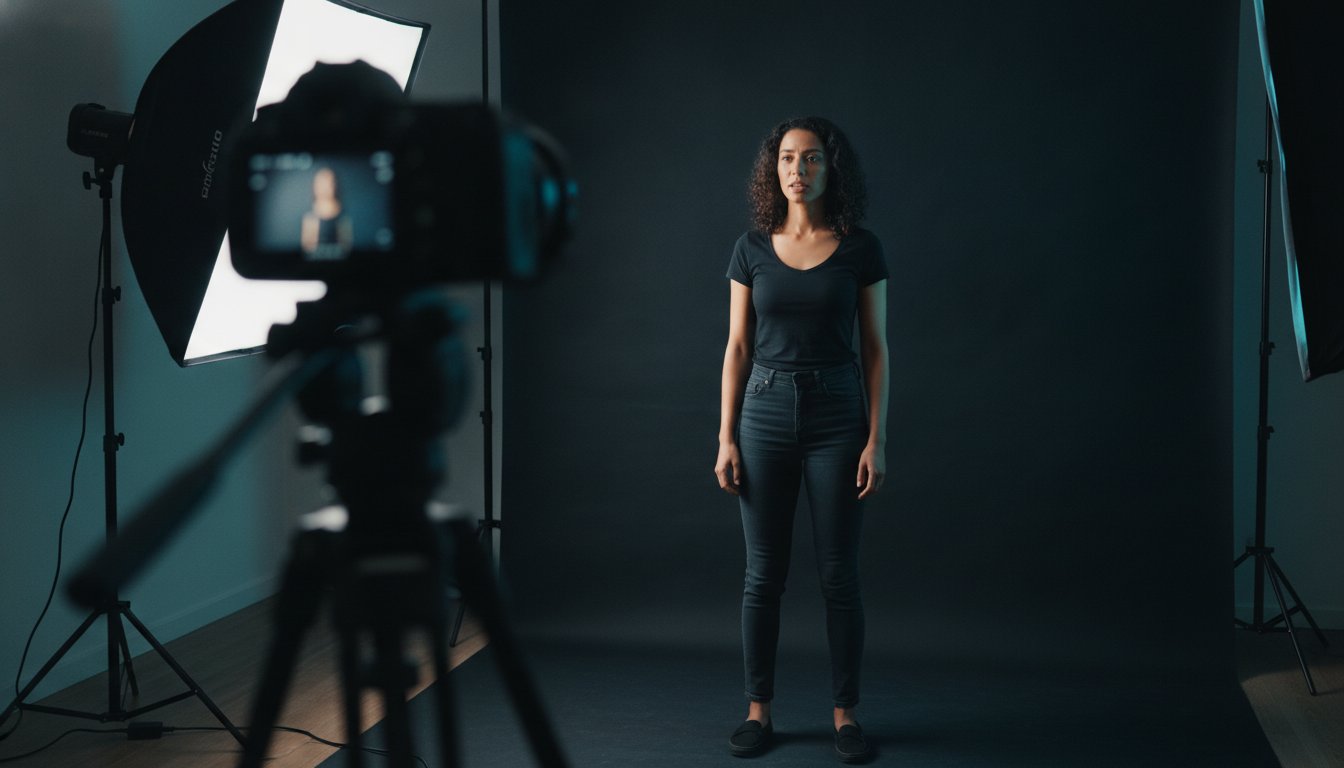
Did you know that casting directors reject the majority of submissions within the first 20 seconds because of technical errors? It is a sobering reality in 2026, where the volume of digital submissions has reached an all-time high. You aren't losing roles because you lack talent. You're likely losing them because your setup doesn't meet the professional standards required to keep a viewer's attention. If you are looking for self tape audition tips that actually move the needle, you must treat your recording space like a high-stakes digital boardroom.
We understand the frustration of feeling flat in a tight frame or struggling with audio that never seems to meet the professional mark. It's exhausting to navigate the 2026 SAG-AFTRA regulations while trying to deliver a grounded, authentic performance. This guide will provide you with a repeatable, professional workflow to eliminate technical anxiety and ensure your work stands out. We will explore the nuances of current industry standards, from the latest page limits to the performance shifts that turn a simple video into a powerful networking tool.
Key Takeaways
- Build a "Pro-Home" studio environment that removes technical distractions so your performance remains the central focus.
- Capture attention in the first 10 seconds by mastering the psychology of the frame and precise eyeline placement.
- Apply professional self tape audition tips to your post-production workflow to ensure your audio and visuals meet elite industry standards.
- Navigate 2026 submission regulations with a streamlined checklist that respects casting directors' time and highlights your professional reliability.
- Transform your submissions into long-term networking assets by using every tape as a bridge to future opportunities and expert feedback.
What is a Professional Self-Tape in 2026?
In 2026, a self-tape is no longer just a temporary substitute for an in-person meeting. It has evolved into your primary digital calling card and most critical professional audition tool. Casting directors now overwhelmingly prefer this format over the traditional "cattle call" because it streamlines the initial selection process and allows them to review a wider range of talent with greater efficiency. This shift toward Digital Casting means that your submission is often the only chance you'll get to make a first impression. It's the gatekeeper to the next stage of your career.
If you want to book work, you must move past the idea of "passable" quality. The industry now expects a broadcast-standard presentation, even for entry-level roles. Your self-tape acts as a high-fidelity preview of how you will look and sound on a professional set. Learning the best self tape audition tips is now a requirement for any actor serious about career acceleration. It functions as a core component of your broader acting portfolio, providing proof that you understand the technical demands of modern production. Without this technical polish, your talent may never even be seen.
The Evolution of Digital Casting Standards
The bar for technical excellence has been raised significantly. In an environment where casting directors might receive 200 tapes for a single role, 4K resolution and studio-grade audio are the baseline. These aren't just vanity metrics. They signal professional reliability. When you provide a clean, well-lit, and perfectly audible tape, you demonstrate that you're a disciplined professional who respects the casting team's time. Private talent networks prioritize this "vetted" quality because it ensures that every actor presented is ready for immediate recruitment. It moves you from the "hobbyist" category into the "professional" tier.
Self-Tape vs. In-Person: The Key Differences
Auditioning for a lens requires a different set of skills than performing in a room. You must manage the extreme intimacy of the tight frame, where every micro-expression is magnified. Unlike in-person auditions, self-taping allows for self-curation and multiple takes. This is a double-edged sword. While you can perfect your performance, your final choice must feel spontaneous and alive. Applying the right self tape audition tips helps you bridge this gap, ensuring your digital presence aligns perfectly with the professional credentials on your resume. It's about translating your energy into a format that works for the screen.
The Essential Self-Tape Technical Setup
Your talent deserves a clean canvas. If you want to compete at the highest level in 2026, your home setup must mimic the controlled environment of a professional studio. Casting directors are looking for reasons to say "no" to thin the herd of hundreds of submissions. A cluttered background or a visible ceiling fan instantly signals a lack of professional discipline. By creating a distraction-free environment, you force the viewer to focus entirely on your performance choices rather than your living room decor.
- Visuals: A smartphone capable of 4K recording or a dedicated mirrorless camera.
- Stability: A sturdy tripod with a fluid head for precise framing.
- Lighting: A minimum of two softboxes or a high-output ring light with adjustable color temperature.
- Audio: An external shotgun or lavalier microphone to bypass the tinny sound of internal camera mics.
- Backdrop: A wrinkle-free, solid-colored pop-up screen or a dedicated "audition grey" or "casting blue" wall.
If you are unsure whether your current setup meets these rigorous standards, participating in Live Industry Workshops can provide the direct feedback you need to refine your space before your next big submission.
Lighting for the Camera: The 3-Point Rule
Flat lighting kills the dimension of your face, making you look tired or uninspired. While ring lights are popular for their portability, softboxes provide a more natural, cinematic look that mimics professional sets. Position your primary key light at a 45-degree angle to your face to create subtle shadows that define your features. Most importantly, ensure you have a "catchlight"—a small reflection of light in your pupils. This tiny detail is one of the most effective self tape audition tips for conveying emotional depth and keeping the viewer engaged with your eyes.
Audio Mastery and Background Selection
According to industry data published in April 2026, poor audio quality is the most common reason for a casting director to stop watching a self-tape. Echo and ambient noise are performance killers. Use an external microphone and dampen your room with rugs or sound blankets to achieve a studio-clean sound. Pair this audio clarity with a neutral background. While white can wash you out and black can feel too heavy, mid-tone grey or navy blue are the 2026 standards for making skin tones pop and keeping the focus on your eyes.
Performance Secrets: Winning the First 10 Seconds
Your performance begins the moment the record button is pressed, not when the first line is delivered. In the high-stakes environment of 2026 digital casting, those initial ten seconds are your most valuable real estate. Casting directors often decide whether to watch your full tape or move to the next candidate based on the "life" they see in your eyes before you even speak. This is the psychology of the frame. You aren't performing for a back row; you're inviting a camera into a private, high-stakes moment. If you can't hook them immediately, your technical setup won't matter.
To master this, you must prioritize the "moment before." If your character is entering a room in the scene, you should already be in the middle of that physical and emotional journey when the clip starts. This immediate immersion is one of the most critical self tape audition tips for capturing attention. It eliminates the "acting" and replaces it with "being," which is exactly what high-level recruitment looks for in a professional asset. High energy in a tight frame doesn't mean big gestures. It means high internal stakes. Your thoughts must be louder than your voice.
Eyeline and Focal Points
Depth is the difference between a flat submission and a cinematic one. Never look directly into the lens during the scene unless the breakdown specifically requests it. Instead, place your reader just to the left or right of the camera lens, at eye level. This creates a natural three-quarter profile that allows the casting director to see the nuances of your expression. If the scene involves multiple characters, assign a specific focal point for each one. This prevents the "shifty eye" trap where your gaze wanders aimlessly, breaking the reality of the scene. Consistency in your focal points signals a disciplined, professional actor who knows how to work with the medium.
The Final Moments and the Slate
How you end the scene is just as important as how you begin. Don't rush to turn off the camera. Hold the "button," which is the emotional residue of the final moment, for at least two seconds after your last line. This allows the casting director to process the impact of your performance before the clip ends. Once the scene is finished, transition into your slate. In 2026, a professional slate should be concise, usually under 15 seconds, covering your name, height, location, and availability. This is your chance to show your actual personality outside of the character. Treat the slate as a brief, professional meeting; it’s the final piece of evidence that proves you are a reliable professional ready for the set.
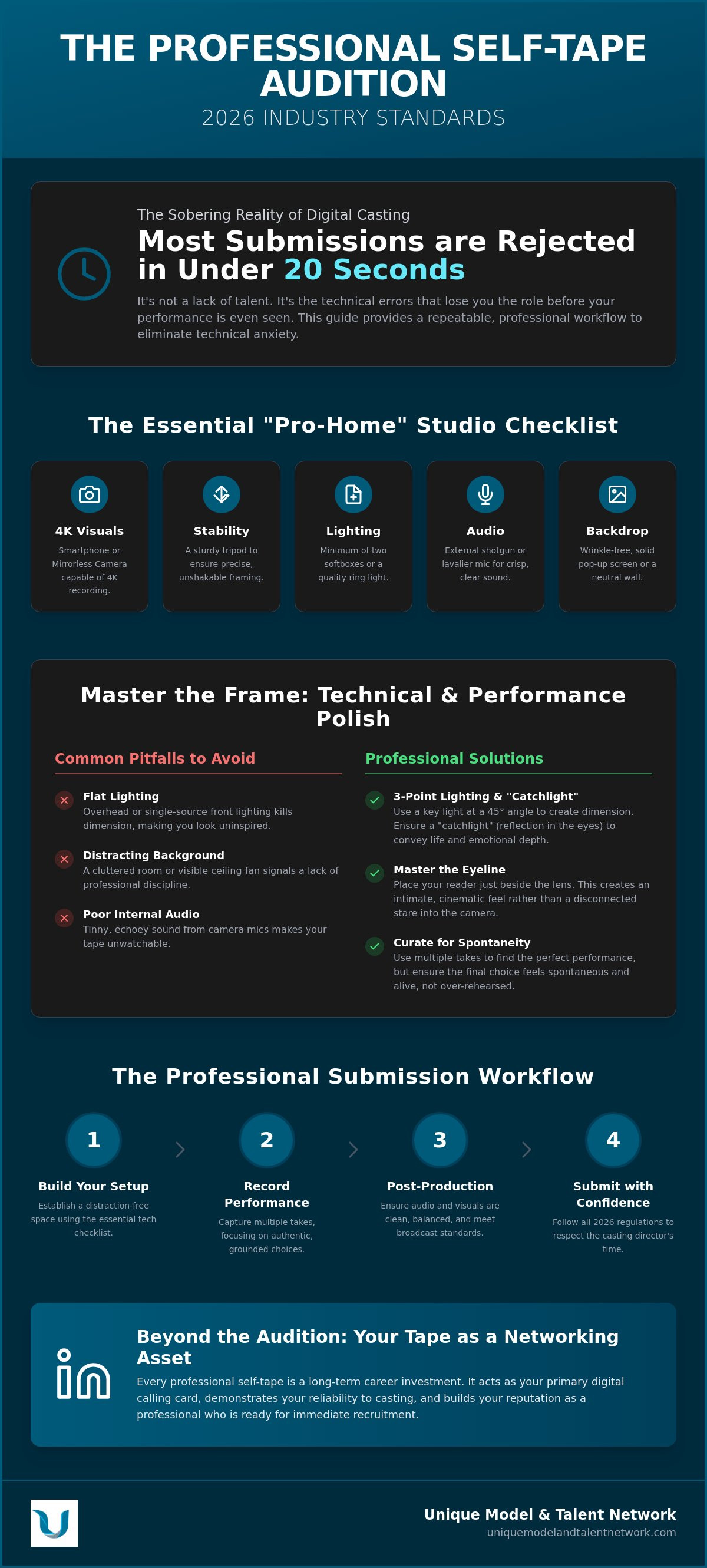
The Post-Production and Submission Checklist
The work doesn't end when you stop recording. Post-production is where you prove you understand the logistics of professional production. If you send a five-minute file for a two-page scene, you're signaling that you don't respect the casting director's schedule. Professional self-tapes prioritize impact and efficiency. You want the viewer to focus on your performance. Don't make them wait for a massive file to buffer or struggle with inconsistent volume levels between your scene and your slate. These small details are what separate a hobbyist from a booking-ready professional.
Keep your edits simple. Flashy transitions, title cards, or background music are the hallmarks of an amateur. Your goal is a "clean" cut. Trim the dead air at the start and end of your takes so the action begins immediately. If you need direct feedback on your final presentation before submitting, our Portfolio & Reel Reviews provide the professional eye needed to identify technical flaws that might be holding you back.
Editing and Formatting for 2026 Standards
Stick to MP4 or MOV formats. These are universally compatible and offer the best balance of quality and file size for fast uploading to various casting websites. Ensure your audio levels are consistent. It's jarring for a casting director to adjust their volume between your scene and your slate. Apply a light color grade only if your footage looks washed out. The goal is a natural, broadcast look that highlights your eyes and skin tone without looking over-processed or filtered.
Naming and Sending Your Tape
Organization is a mark of professionalism. If your file is named "IMG_4321.mp4", it will likely get lost in a sea of digital files. Use the industry-standard naming format: YOURNAME_ROLE_PROJECT_AGENCY. This allows casting teams to search for and identify your file instantly. Always double-check submission deadlines. Remember that "end of day" usually refers to the casting office's time zone, not yours. If you're using transfer methods like WeTransfer or Dropbox, ensure the link remains active until well after the deadline. Applying these practical self tape audition tips often determines whether your tape is actually reviewed or discarded as a technical failure.
Leveraging Self-Tapes for Long-Term Career Growth
Stop viewing your submission as a simple pass-fail test. In the 2026 market, a self-tape is a persistent digital asset that functions as a relationship starter. Even if you don't book the specific role you're aiming for, a high-quality tape puts you on a casting director's internal "ones to watch" list for future projects. This is why following rigorous self tape audition tips is about more than just one job. It's about building a reputation for technical and creative excellence that precedes you in every room you enter.
You should integrate your strongest tapes into your broader film industry auditions strategy. A "rejected" tape isn't a failure if it showcases a specific range or skill that can be added to your portfolio. By archiving and reviewing your past work, you can identify patterns in your performance and technical setup that need refinement. Use these clips to demonstrate your consistency and professional growth over time, turning every "no" into a data point for future success.
The Feedback Loop: Improving Your Craft
You need a closed loop to improve your craft effectively. Within the Unique Model & Talent Network, you can access Portfolio & Reel Reviews to get an objective, professional look at your work. Participating in Monthly Skill-Building Challenges keeps your technique sharp between bookings and ensures you're always ready for a last-minute request. Real-time feedback from industry experts transforms standard self tape audition tips from abstract theory into a repeatable, booking-ready workflow. This organized approach to development is what separates the elite from the hobbyists.
Joining a Professional Network
Public casting calls are often saturated, unorganized, and full of distractions. Moving into a private, gated community gives you access to vetted opportunities that aren't visible to the general public. You can refine your technical skills and performance nuances through acting workshops online, ensuring your setup remains at the broadcast standard required for high-level recruitment. This focus on professional standards and career security provides the clarity you need in an often chaotic industry. It's time to treat your career with the discipline it deserves.
Ready to elevate your career? Join the Unique Model & Talent Network today.
Take Control of Your Digital Casting Future
Mastering the technical and performance nuances of modern casting is no longer optional. It's the difference between a file that gets opened and one that gets deleted. By applying these self tape audition tips, you've built a foundation of technical excellence and psychological depth that commands attention. You now understand that a professional submission is a high-fidelity preview of your work on set. This level of discipline signals to casting directors that you're ready for the rigors of a professional production environment.
To truly accelerate your career, you need more than just a guide; you need a community that prioritizes your growth and provides the professional clarity you deserve. Our network offers access to Live Industry Workshops, Monthly Skill-Building Challenges, and Portfolio & Reel Reviews designed to keep you at the top of your game. You don't have to navigate this industry alone.
Elevate your auditions and join our professional network to transform your self-tapes into booking-ready assets. Your talent is your craft, but your presentation is your business. We are here to help you master both.
Frequently Asked Questions
Do I need a professional camera for my self-tape auditions?
No, you don't need a dedicated professional camera to produce a booking-ready audition. Most casting directors in 2026 accept footage recorded on high-end smartphones, provided the technical execution is flawless. Focus your investment on stability and lighting rather than expensive lens kits. As long as your device supports 4K resolution and you use a sturdy tripod, your technical quality will meet the necessary industry standards for recruitment.
Should I be off-book (memorized) for a self-tape?
While the 2026 SAG-AFTRA TV/Theatrical Agreement states that performers cannot be required to memorize sides, being off-book is a significant professional advantage. Memorization allows you to maintain consistent eyelines and react authentically to your reader. If you choose to hold your sides, ensure they remain outside the frame. Your primary goal is to keep your eyes active and connected to the high-stakes moment of the scene.
What should I wear for a self-tape audition in 2026?
You should wear solid, jewel-toned colors that suggest the character's essence without crossing into a full costume. Avoid busy patterns, logos, or bright white fabrics that can cause technical issues with your camera's exposure. The goal is to highlight your features and skin tone, ensuring the casting director focuses on your performance rather than your wardrobe. Pick a professional outfit that reflects the world of the project.
Do I need a professional reader for my self-tapes?
You don't need a professional actor to read with you, but your reader must be capable of delivering lines clearly and at a lower volume than your own. A reader who is too loud or overly dramatic can distract the casting director from your work. If you don't have a reliable partner available, many professionals now use high-quality digital reader apps or remote reading services to maintain a consistent performance level.
How long should a self-tape slate be?
A professional slate should be concise, typically lasting no more than 15 seconds. Unless the instructions specify otherwise, state your name, height, current location, and availability for the shoot dates. This is your opportunity to show your natural personality and professional reliability. Keep it simple, look directly into the lens, and maintain the same high-quality lighting and audio used for your performance takes.
Can I use my phone to record a professional self-tape?
Yes, modern smartphones are the industry standard for recording high-quality submissions. Applying these self tape audition tips to your phone's settings, such as locking your exposure and focus, ensures your footage looks broadcast-ready. Always use the rear-facing camera for better resolution and record in landscape mode. This setup is often more efficient for fast-paced digital casting environments than using a bulky DSLR or mirrorless camera system.
What is the best backdrop color for an acting self-tape?
The most effective backdrop colors for a professional submission are neutral grey or a soft "casting blue." These tones are universally flattering for most skin tones and help your features pop on screen without reflecting unwanted light. Avoid using plain white walls, which can look amateurish, or cluttered home backgrounds that pull focus away from your eyes. A clean, wrinkle-free pop-up screen is a wise career investment.
How many takes should I submit for one role?
Unless the casting breakdown specifically requests multiple options, you should submit one strong take or two contrasting takes. Casting directors often review hundreds of files, so brevity is a mark of professional respect. One of the most valuable self tape audition tips is to only include a second take if you're offering a significantly different creative choice. If both takes feel similar, pick the strongest one and discard the other.


