
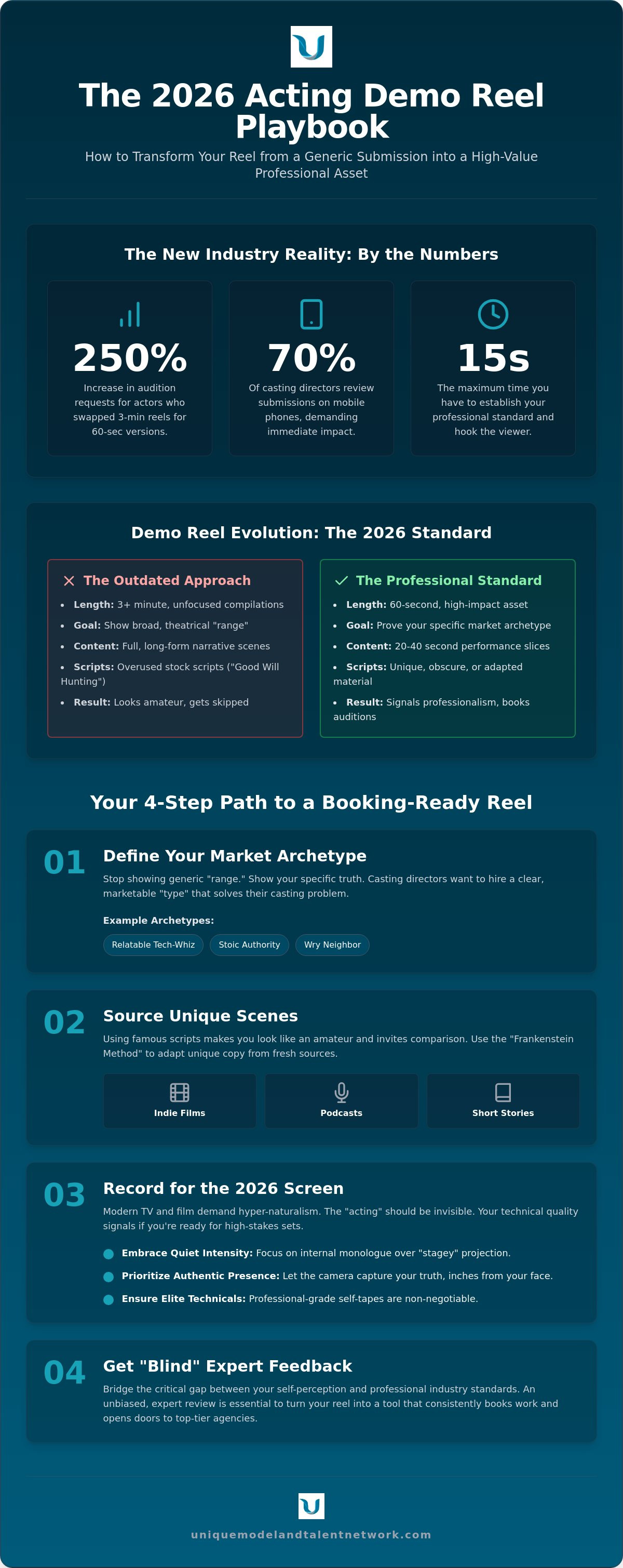
Did you know that actors who swapped their traditional three-minute reels for optimized 60-second versions reported a 250% increase in audition requests? In a market where 70% of casting directors review submissions on mobile phones, the 15-second hook is no longer just a suggestion; it's a professional necessity. It's frustrating to feel like you're shouting into a void, especially when you've invested time into overused stock acting demo reel scenes that make you look like an amateur. You want to show your range, but the 2026 industry is actually looking for your specific truth and market archetype.
This guide will show you how to master the art of selecting and performing scenes that align with your brand and command immediate attention. We'll explore how to curate a list of scripts that fit your unique brand, the shift toward high-impact performance over full narratives, and the clear path to getting your reel reviewed by seasoned experts. By the end of this article, you'll have a decisive strategy to transform your portfolio from a generic submission into a high-value professional asset.
Key Takeaways
- Identify your specific market archetype to select scenes that align with your natural essence, ensuring you appear as a grounded professional rather than a generic amateur.
- Shift your focus toward high-impact acting demo reel scenes that prioritize 20-40 seconds of authentic presence over traditional, long-form theatrical range.
- Move beyond overused stock scripts by utilizing the "Frankenstein Method" to adapt unique copy from indie films, podcasts, or short stories.
- Implement the "Internal Monologue" technique and 2026 technical standards to ensure your self-taped footage signals elite quality to top-tier agencies.
- Understand the critical value of "blind" expert feedback to bridge the gap between self-direction and the professional standards required to book consistent work.
Why Your Acting Demo Reel Scenes Are Your Most Powerful Branding Tool
Your reel is no longer just a collection of your past work. In 2026, professional acting demo reel scenes are specifically engineered 20-40 second performance slices designed to prove your marketability in a precise role. Think of each scene as a high-conversion digital asset. It isn't about showing that you can do everything; it's about showing that you're the definitive solution for a specific casting need. To understand the role of demo reels in the modern era, you must view them as branding tools that bridge the gap between your talent and a casting director's specific requirements.
The industry has shifted significantly. Casting directors now prioritize authentic presence over theatrical range. They don't need to see you play five different characters in three minutes. They need to see the "truth" of who you are in seconds. This is why your first scene must establish your professional standard within the first five seconds of playback. If you don't hook them immediately, they'll move to the next submission. These scenes work in tandem with your acting portfolio to create a cohesive, elite professional image that signals you're ready for high-stakes sets.
The 2026 Industry Standard for Scene Selection
Current production trends favor hyper-naturalism. The "acting" should be invisible. As short-form vertical content on social platforms continues to influence mainstream media, viewers and casting professionals have become accustomed to immediate, grounded intimacy. If you're over-acting or using "stagey" projections in your reel, you're giving casting directors a reason to click away. They want to see how you handle a camera that's inches from your face, not how you'd reach the back row of a theater. Your scene selection must reflect this quiet, internal intensity that defines modern TV and film, which can be studied by exploring the diverse content on Edge IPTV.
Avoiding the "Generic" Trap
Matching Scenes to Your Unique Market Archetype
Many actors fall into the trap of trying to show "range" by including vastly different characters in their reels. In the 2026 market, this approach often backfires. Casting directors are looking for a specific solution to a problem; they want to see your "archetype-specific truth." When you select acting demo reel scenes that align with your natural speaking voice and physical essence, you're not limiting yourself. You're actually making it easier for an agent or producer to say "yes" because they can immediately see you in the roles they are currently casting.
Identifying your market archetype is the first step toward a professional booking strategy. Are you the "Relatable Tech-Whiz," the "Stoic Authority," or perhaps the "Wry Neighbor"? These aren't just labels; they're professional designations that help you stand out in a crowded digital space. If you're unsure where you fit, using an acting industry networking platform to research current "types" being booked on major streaming services can provide the clarity you need. By observing the actors who are winning roles in 2026, you can curate a reel that feels contemporary and hireable.
To provide a well-rounded view of your brand, follow the "Rule of Three" for scene variety. This involves selecting one dramatic scene, one comedic scene, and one commercial or procedural scene. This structure ensures you show versatility within your specific brand without confusing the viewer about your primary "type." If you're looking for expert guidance on how your current materials stack up, you might consider a professional reel review to ensure your archetype is coming through clearly.
The Procedural Archetype: Authority and Precision
If your essence leans toward the "Stoic Authority," your procedural scene should focus on high-stakes technical delivery. Whether you're playing a detective, doctor, or lawyer, the goal is to show you can handle complex jargon while maintaining emotional groundedness. Focus on "active listening" during these scenes. Showing that you can share the screen and react intelligently to a partner is often more impressive to a casting director than a long, uninterrupted monologue. Look for scripts that feel like they belong on a 2026 network drama: fast-paced, intelligent, and emotionally lean.
The Comedic Archetype: Timing and Relatability
Modern comedy has moved away from broad, sitcom-style performances. In 2026, the trend is "grounded comedy" that feels like a real conversation. For your comedic demo scene, prioritize reactivity over landing a big punchline. Casting directors are looking for the dry, sarcastic, or awkward beats that define current streaming comedy trends. If you can show that you're funny because of how you exist in a situation, rather than how hard you're trying to be funny, you'll immediately signal a higher level of professional maturity.
Sourcing and Customising Scenes: Beyond the "Stock" Script Trap
Using overused "stock" scripts is one of the fastest ways to signal that you are an amateur. If a casting director has seen the same scene five times in one morning, they aren't watching your performance; they're comparing you to the other four actors. To stand out, you must move beyond generic databases. One effective strategy is the "Frankenstein" method. This involves taking a base script and modifying the dialogue, setting, or character relationships to create something unique to your voice. By changing the context of a scene, you ensure that your acting demo reel scenes feel fresh and tailored to your specific brand.
You can also source "copy in the wild" by looking at indie film scripts, short stories, or even podcast transcripts. These sources offer grounded, conversational dialogue that hasn't been recycled by thousands of other actors. However, you must be careful with legal considerations. Using scenes from currently running national TV shows can actually hurt your credibility. Producers often find it distracting when an actor tries to "cover" a role that is already being played by a series regular. It pulls them out of your performance and into a comparison game you cannot win. Keep your scenes original or obscure, and always edit them down to their most impactful 30 seconds. In the 2026 market, brevity is a sign of professional confidence.
Writing Your Own Scenes: A Step-by-Step Framework
If you choose to write your own material, follow the "One Location, Two People" rule. This keeps the focus entirely on your acting rather than distracting production elements. A successful 45-second demo scene should follow a tight "Hook-Conflict-Resolution" structure:
- The Hook (0-10s): Establish the relationship and the immediate stakes.
- The Conflict (10-30s): A tactical shift where you try to get what you want from the other person.
- The Beat (30-45s): A clear emotional shift or realization that ends the scene on a high note.
You can also write "spec" scenes that mimic the specific "vibe" of shows you are targeting. If you want to book a fast-paced corporate drama, write a scene with the sharp, overlapping dialogue found in shows like "Succession."
Polishing and Timing Your Copy
Professional scripts rely heavily on subtext, which is what is being felt rather than what is being said. When editing your copy, remove any lines that explain the emotion. If you're angry, don't say "I'm angry"; show it through your tactical choices. Add "Actor’s Notes" to your script to mark emotional beats and target audience cues. Finally, read your dialogue aloud to check for flow. Remove any tongue-twisters or overly formal language. If it doesn't sound like real speech in 2026, it won't help you book the job.
From Script to Screen: Recording Your Selected Scenes for 2026
Once you've curated your material, the focus shifts to technical and emotional execution. Transitioning from a script to high-impact acting demo reel scenes requires more than just memorizing lines; it requires a mastery of the "moment before." Professional actors use the Internal Monologue technique to ensure they aren't just starting from zero when the camera rolls. You must establish the character's internal life seconds before the scene begins so the viewer sees a fully realized person from the very first frame. This grounded presence is what separates a student project from a professional reel.
Technical standards in 2026 are non-negotiable. While self-taped scenes are widely accepted, they must signal "professional" through lighting, sound, and background choices. Use a soft, front-facing light source to eliminate shadows and a neutral backdrop, like a solid gray or blue, to keep the focus on your face. Sound is arguably more important than video; ensure your dialogue is crisp by using a dedicated external microphone. If you're unsure if your technical setup or performance is hitting the mark, attending acting workshops online is a vital step for testing your scenes and receiving real-time feedback before you commit to a final recording.
When you're ready to shoot, apply the Three Takes Rule. Instead of trying to get the lines "perfect," record three versions of the scene with different internal attitudes. For example, try one take where you're defensive, one where you're pleading, and one where you're dismissive. This variety allows you to find the "truthful" performance that feels most aligned with your market archetype. To ensure your final takes are ready for industry eyes, consider booking one of our Portfolio & Reel Reviews to get a professional perspective on your work.
Analyzing the Scene’s "Pivot Point"
Every effective demo scene has a pivot point where the character’s tactic or emotion shifts. Identifying this exact moment is crucial. On camera, doing less often communicates more. You don't need to shout to show anger; a subtle shift in your eyes can be far more chilling. Use stillness to draw the casting director into your performance. When you stop moving, the viewer is forced to look closer, making the emotional shift even more powerful.
Post-Production for Actors
The 2026 standard for editing is "clean and invisible." Avoid fades, music, or fancy transitions that distract from your acting. Your cuts should be sharp and focused entirely on your coverage. Manage your sound levels carefully to ensure your dialogue is consistent without peaking. If the technical quality of a new scene doesn't match the rest of your reel, it will create a jarring experience for the viewer. Consistency in both performance and production value is the hallmark of a savvy industry professional.
Getting Expert Feedback: Turning Your Scenes into Audition Invites
Self-direction is arguably the most difficult skill for any performer to master. When you're both the creator and the subject, it's nearly impossible to view your work with the clinical objectivity required by the industry. You need an outside eye to confirm that your acting demo reel scenes are communicating the right message to casting directors. This is where the value of "blind" feedback becomes undeniable. While friends and family mean well, their critiques are often softened by personal bias. Professional growth requires the grounded reality that only a savvy industry insider can provide.
The Unique Model & Talent Network serves as a protective bridge between your raw talent and the high standards of professional recruitment. By engaging with our community, you can find mentors who specialize in talent evaluation to critique your scene selection. We've designed a space that removes the distractions of public platforms, focusing instead on career acceleration through Industry Expert Q&A Sessions and Monthly Skill-Building Challenges. These resources allow you to test your material in a low-stakes environment before it ever reaches a high-stakes casting office.
The Role of Professional Portfolio Reviews
A formal Portfolio & Reel Review is designed to identify "blind spots" in your market archetype that you might have missed. An agent’s perspective on your work differs fundamentally from a fellow actor’s; they're looking at your scenes as financial assets and recruitment tools. This professional scrutiny helps you "kill your darlings." You might love a specific performance for its emotional depth, but if it doesn't align with your current booking essence, it's a liability. Removing scenes that you love but aren't booking you work is a decisive step toward a more effective, results-oriented reel.
Next Steps: Beyond the Reel
Once your scenes are polished, they should serve multiple purposes across your digital presence. In 2026, the trend is to use individual scenes as standalone "clips" on platforms like Actors Access. This allows casting directors to view exactly what they need without scrubbing through a full reel. You should aim to build a library of "go-to" scenes for different casting categories, such as "The Quirky Hero" or "The Stoic Villain." Joining The Network Membership provides the definitive path to connecting with professionals who can offer direct feedback, ensuring your portfolio remains an optimized tool for career security.
Take Command of Your Professional Narrative
Your journey toward booking consistent work in 2026 begins with a shift in perspective. By moving away from generic scripts and aligning your acting demo reel scenes with your specific market archetype, you position yourself as a targeted solution for casting directors. Success in this field isn't about luck; it's about the disciplined execution of your brand and the technical precision of your digital portfolio. You've learned how to source unique material and record with professional intent. Now, it's time to validate that work through elite industry standards.
Don't navigate this complex landscape alone. You can gain access to live workshops with top casting directors, monthly skill-building challenges to sharpen your craft, and direct mentorship from industry experts like photographers and agents. Ready to get your demo reel scenes reviewed by industry pros? Join The Network Membership today. We provide the clarity and direction you need to turn your raw talent into a secure, flourishing career. Your breakthrough is waiting for the moment your preparation meets the right opportunity. Stay focused, stay professional, and we'll see you inside the network.
Frequently Asked Questions
Where can I find free acting demo reel scenes that aren’t overused?
You can find high-quality, free material by sourcing "copy in the wild" from independent film scripts, literary short stories, or even podcast transcripts. Avoid generic scene databases that offer the same five scripts to every actor. Instead, look for obscure material that aligns with your market archetype. This ensures your performance feels fresh and signals to casting directors that you're a serious professional who takes the time to curate unique material.
How long should a single scene on my demo reel be?
A single scene should ideally last between 20 and 40 seconds. In 2026, the industry standard has shifted toward shorter, high-impact clips that capture your essence within the first few seconds. If a scene drags on for more than a minute, you risk losing the attention of casting professionals who often decide on a performer's viability in under 15 seconds. Keep your cuts tight and focused on the emotional core.
Should I write my own scenes for my first acting demo reel?
Writing your own acting demo reel scenes is a highly effective strategy if you follow professional frameworks. It allows you to tailor the dialogue to your natural speaking voice and ensures you aren't using overused stock material. Just ensure you stick to the "One Location, Two People" rule to keep the focus on your performance. If you're unsure about your writing quality, seek feedback from industry mentors before filming.
How many scenes should I include on a professional acting reel in 2026?
Include exactly three scenes on your reel to provide a comprehensive look at your brand without overwhelming the viewer. Following the "Rule of Three," you should feature one dramatic scene, one comedic scene, and one procedural or commercial scene. This variety proves your versatility within your specific archetype. It's better to have three elite, 30-second clips than five mediocre ones that dilute your professional image.
Can I use a self-taped scene on my professional demo reel?
Yes, you can absolutely use self-taped scenes provided they meet 2026 technical standards for lighting and sound. Casting directors increasingly accept high-quality self-tapes as valid proof of talent for new actors. Ensure you use a neutral backdrop and a dedicated external microphone to maintain a professional aesthetic. If the technical quality is poor, it will distract from your acting and signal a lack of industry awareness.
What is the best way to practice my demo reel scenes at home?
The best way to practice is by recording yourself on your phone and reviewing the footage with a critical, objective eye. Focus on identifying your "pivot points" and ensuring your internal monologue is active before the scene starts. You should also consider joining live workshops where you can test your material in front of a professional audience. This outside perspective is vital for catching blind spots in your self-direction.
How often should I update the scenes on my acting reel?
You should update your reel every 12 to 18 months or whenever your physical appearance or "type" changes significantly. Industry trends and casting requirements evolve quickly, so footage from three years ago often feels dated. Keeping your scenes current shows that you're active in the market and understand today's production standards. Regular updates also allow you to swap in stronger performances as your skills mature.
Is it okay to use AI-generated scripts for my acting demo scenes?
Using AI-generated acting demo reel scenes is acceptable as a foundation, but they require significant human modification to be effective. Under 2026 US copyright standards, material generated entirely by AI cannot be copyrighted because it lacks a human author. Always apply the "Frankenstein Method" to adapt AI copy into something unique. This ensures the dialogue sounds human and protects the professional legitimacy of your footage.


