
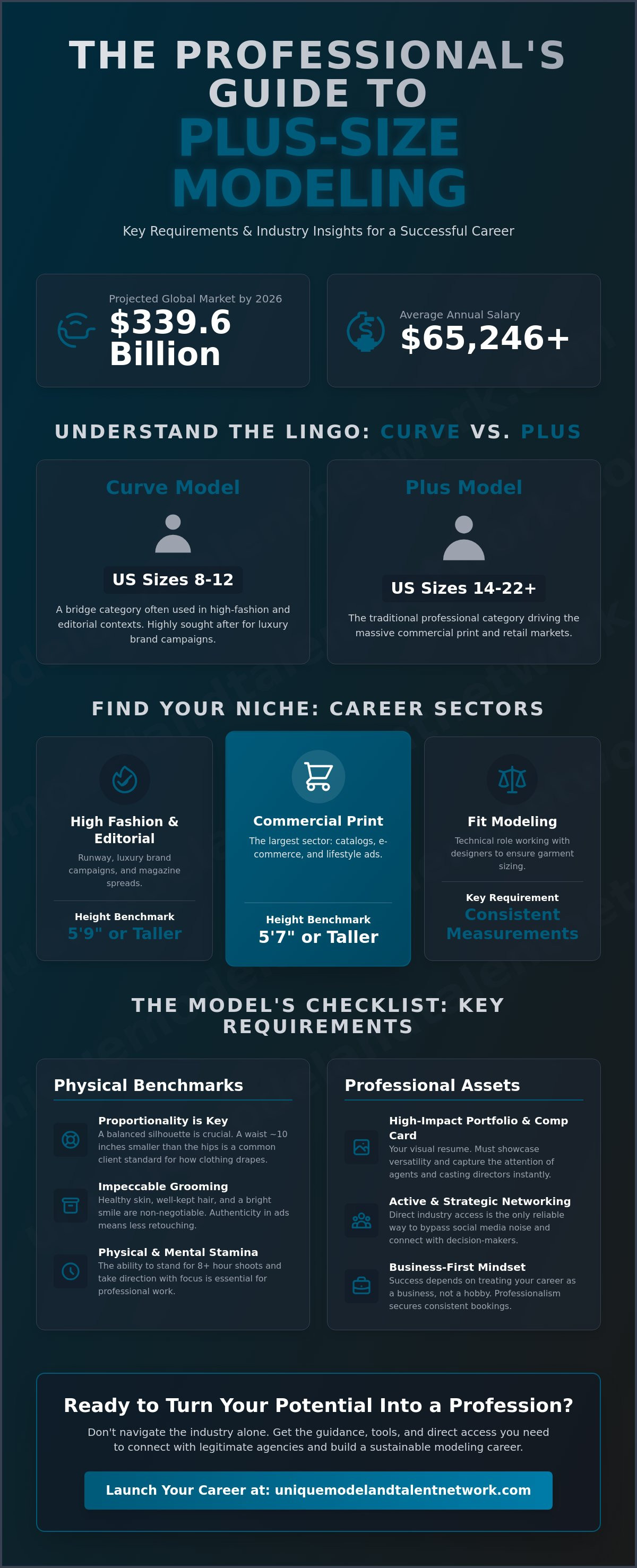
Did you know the global plus-size fashion market is projected to reach a staggering $339.6 billion by the end of 2026? This explosive growth has transformed the industry from a niche segment into a powerhouse of professional opportunity. Simply having a "curvy" look isn't enough to secure a contract with top-tier agencies. Understanding the specific plus size modeling requirements is the difference between a passing hobby and a lucrative career that averages over $65,246 annually.
You've likely felt the frustration of mixed signals regarding height, dress size, and the confusing line between "curvy" and "plus" labels. It's exhausting to filter through social media noise while trying to avoid predatory scams that target emerging talent. We're here to clear the fog. This guide provides the exact physical and professional benchmarks you need to meet. You'll gain a clear checklist for your portfolio, a roadmap for agency submissions, and the business strategies required to connect with legitimate industry decision-makers who are ready to hire.
Key Takeaways
- Understand the critical shift from "plus-size" to "curve" and "extended sizing" to position yourself accurately within the 2026 professional market.
- Master the specific plus size modeling requirements for both editorial and commercial niches, from height benchmarks to proportionality standards.
- Identify the core differences between high-fashion and commercial modeling to choose the career path that best fits your physical profile and professional goals.
- Learn how to build a high-impact digital portfolio and comp card that capture the attention of legitimate agency scouts and casting directors.
- Discover why active networking and direct industry access are the only reliable ways to bypass social media noise and secure consistent bookings.
What is Plus-Size Modeling in 2026? Defining the Landscape
In 2026, the modeling industry has moved past the era of simple visibility. It's now a mature, high-revenue sector where professional standards are as rigorous as any other business discipline. Plus-size modeling is defined as a professional category for individuals generally wearing a dress size 12 or larger. While the industry once viewed this as a niche market, it's now a primary driver of global fashion. Major agencies like IMG, Wilhelmina, and Ford have long established dedicated divisions to manage this talent, reflecting a permanent shift in how brands communicate with their audiences. Understanding the plus size modeling requirements of 2026 starts with recognizing that this isn't just about a dress size; it's about being a versatile professional in a $339.6 billion global market.
There are three primary sectors where you can build a career. High fashion or editorial modeling focuses on runway and luxury brand campaigns. Commercial print is the largest sector, covering everything from catalog work for retailers like ASOS and Torrid to lifestyle advertisements. Finally, fit modeling is a specialized, highly technical role where you work directly with designers to ensure garments are sized correctly for production. Each sector has its own specific plus size modeling requirements, making it essential to identify your niche early.
Plus Size vs. Curve: Understanding the Distinction
The industry uses specific terminology to segment talent. "Curve" is often used as a bridge category, typically representing sizes 8 to 12 in high-fashion contexts. This category is highly sought after for editorial work. In contrast, "Plus" refers to the traditional professional category of sizes 14 to 22 and beyond. Understanding the history and definition of plus-size modeling reveals how these labels have evolved to help talent target the right agencies. If you're a size 12, you might find more opportunities in a curve division; if you're a size 18, you'll focus on agencies with robust plus-size boards. Knowing your label isn't about restriction. It's about strategic targeting.
The Economic Rise of Inclusive Fashion
Market demand has reached a tipping point. In 2026, the 26 to 40 age group represents over 33% of the plus-size consumer segment. These buyers demand "real" body representation, forcing brands to prioritize models who offer both a professional look and a relatable personality. Brands no longer just look for a face. They look for professionals who understand their own brand and can engage an audience. This economic shift makes 2026 the most accessible year for diverse body types, provided you treat your career with a business-first mindset. Success now depends on your ability to network and access industry experts who can guide you through these evolving standards.
Physical and Professional Requirements: Beyond the Measuring Tape
Measurements are the essential starting point, but they don't tell the whole story of a successful career. In 2026, plus size modeling requirements have expanded to prioritize physical health, professional versatility, and consistent grooming. While high-fashion editorial work typically demands a height of 5'9" or taller, the commercial sector offers more flexibility, often accepting models starting at 5'7". Regardless of your height, proportionality is the key metric. Clients look for a balanced silhouette where the waist is often about 10 inches smaller than the hips. This ensures clothing hangs correctly for catalog work and digital commerce, which are the highest volume sectors for bookings.
Professional standards also include high-maintenance grooming as a baseline. Since many brands now favor unretouched or minimally edited imagery to meet consumer demands for authenticity, your natural canvas must be impeccable. This means maintaining healthy skin, well-kept hair, and a bright smile. You're expected to arrive at sets with a high level of natural grooming, as post-production is no longer used to "fix" basic presentation. Beyond aesthetics, you need the physical stamina to stand for eight hours and the mental focus to take direction from photographers without hesitation. If you're just starting, consulting a professional guide to becoming a model can help you organize these requirements into a daily routine.
Size Ranges and Industry Standards
The market distinguishes between "Curve" (sizes 12-14) and "Plus" (sizes 16-22+). If you're targeting fit modeling, stability is your most valuable asset. Brands use a "sample size", usually a 14 or 16, to build their entire collection. If your measurements fluctuate, you become unreliable for the production team. Success in this niche requires disciplined maintenance of your specific proportions to ensure the brand's sizing remains consistent for their customers.
The Mental Resilience Requirement
This industry moves fast and critiques can feel personal. Developing a "thick skin" is a non-negotiable part of the plus size modeling requirements in today's competitive landscape. You'll face frequent rejection, but it's rarely about your worth; it's about the specific vision for a single campaign. Many successful professionals utilize modeling career coaching to build the mental fortitude needed to handle these pressures. Learning to process feedback as a business data point rather than a personal failure will keep your momentum high. Joining a structured environment like the Network Membership provides the mentorship needed to refine these professional traits before you step onto your first major set.
High Fashion vs. Commercial: Where Do You Fit?
Choosing between editorial and commercial work isn't just about your personal style. It's a strategic business decision based on how your physical profile aligns with current market demands. While the industry has become more inclusive, the plus size modeling requirements for high fashion remain distinct from those in the commercial sector. You need to identify where your attributes will generate the highest return on your investment of time and resources. Success in 2026 depends on knowing whether you're a fit for the avant-garde runway or the high-volume world of retail e-commerce.
The "glamour" of editorial work often captures the most attention, but the "consistency" of commercial work builds the most sustainable bank accounts. In 2026, the female segment accounts for 60% of the plus-size market share. This means there is a massive, ongoing need for models who can represent the everyday consumer. If you're trying to decide where you fit, look at your height, your facial features, and your natural ability to connect with a camera lens. Your most profitable path is usually the one where your natural look matches the brand's target demographic.
The Editorial and Runway Path
Editorial and runway work is the "artistic" wing of the industry. If you're aiming for this niche, you generally need to be 5'10" or taller. Designers in this space prioritize high-concept movement and "edgy" or unique facial features that can carry a specific, often unconventional, artistic vision. This path almost always requires a top-tier mother agency to navigate the elite circles of high-end designers. While the prestige is high, the number of available roles is lower than in other sectors, making it a highly competitive environment for even the most qualified talent.
The Commercial and Catalog Path
Commercial and catalog modeling is the engine of the fashion industry. The plus size modeling requirements here are more flexible, often welcoming models between 5'7" and 5'9". Brands look for the "girl next door" or an "approachable professional" look. They want models who appear confident and relatable to the 26-40 age group that dominates current consumer spending. This sector offers a high volume of work in:
- E-commerce product pages for major retailers
- Lifestyle advertisements for health and beauty brands
- Social media campaigns for inclusive fashion labels
Building Your Professional Plus-Size Portfolio
Your portfolio is your primary business tool. It's the visual proof that you meet the plus size modeling requirements of 2026. While social media presence is helpful, professional agencies require a specific set of images known as "digitals" or "polas" to evaluate your potential. These shots must be clean, unedited, and taken in form-fitting clothing that clearly shows your silhouette. Agencies are increasingly wary of heavily filtered images; they need to see your natural skin texture, hair health, and body proportions without the distraction of post-production. If your images are over-processed, you'll likely be overlooked for talent who presents a more transparent professional baseline.
The "glamour shot" trap is a common pitfall for emerging models. These high-makeup, stylized photos might look great on a personal profile, but they often hide the very features casting directors need to see. Instead, focus on showing versatility. You need to demonstrate both a warm, commercial smile and a more composed, editorial look. This range proves you can handle different types of bookings, from friendly retail catalogs to high-concept fashion spreads. Getting professional portfolio reviews is a non-negotiable step to ensure your assets align with what decision-makers are actually seeking in 2026.
The 4 Essential Shots Every Plus Model Needs
To be taken seriously by top-tier agencies, your portfolio must include these four foundational images:
- The Clean Beauty Headshot: Shot with minimal makeup and pulled-back hair to show your facial structure.
- The Full-Body "Fit" Shot: Taken in simple, form-fitting attire like leggings and a tank top to show proportionality.
- The Movement Shot: A candid or action-oriented photo that demonstrates your comfort and fluidity in front of the camera.
- The Lifestyle Shot: An image that captures your personality and "approachable" commercial appeal.
Finding the Right Photographer
Not every photographer understands the nuances of plus-size lighting and posing. You must vet potential collaborators by looking at their previous work with diverse body types. While "Trade for Print" (TFP) sessions are a great way to start, investing in a paid shoot with an industry-standard photographer is often necessary for high-level agency submissions. Attending live industry workshops can help you practice your posing before you step into a paid session. This preparation ensures you don't waste time or money on shots that don't meet plus size modeling requirements. To get direct feedback on your current images, consider joining the Network Membership for professional guidance on your career development.
Beyond Requirements: Networking Your Way to Bookings
Meeting the physical plus size modeling requirements is your ticket into the stadium, but it isn't the game itself. Many aspiring models fall into the trap of the "discovery" myth, believing that a viral post or a lucky tag will launch their career. In reality, the industry in 2026 is far too saturated for passive strategies to work. Professional success is built on intentional networking and direct access to the decision-makers who control the bookings. If you want to move from the "aspiring" category into the "working" category, you must position yourself where casting directors and photographers are actually looking.
Social media platforms have become increasingly chaotic and filled with predatory scams. Relying on these open spaces for career growth often leads to more noise than results. A private, gated network removes these distractions and provides a concentrated environment for professional growth. By connecting with legitimate industry experts, you gain the clarity needed to navigate a field that often feels unorganized. This is about building professional bonds that lead to financial legitimacy and long-term career security. When you surround yourself with high-standard professionals, you naturally elevate your own brand to meet plus size modeling requirements at an elite level.
The Power of the Unique Model & Talent Network
The most efficient way to accelerate your career is through structured mentorship and community support. Within our community, you don't have to guess what agencies want. You can access live Q&A sessions with industry decision-makers who provide direct feedback on current market trends. Engaging in monthly skill-building challenges keeps your technique sharp and ensures you're always ready for a last-minute casting. This isn't just about information; it's about finding a supportive peer group that shares legitimate opportunities and holds you to a high professional standard.
Next Steps: Your Career Roadmap
Your transition to a working model requires a clear, 90-day strategy. First, evaluate your current materials against the standards we've discussed. If your portfolio lacks the four essential shots or your measurements aren't stable, address those gaps immediately. Second, set a specific networking goal, such as connecting with three new industry professionals each month. Finally, seek out an environment that prioritizes your growth over vanity. If you're ready to take your career seriously, Join The Network Membership to start booking real work today. This is your bridge between emerging talent and established industry professional status.
Take the Lead in Your Modeling Career
The landscape of the fashion industry has changed. Success in 2026 isn't about waiting to be discovered; it's about executing a precise business strategy. You now understand that mastering the plus size modeling requirements involves more than just hitting a specific measurement. It requires a deep knowledge of your niche, a commitment to professional grooming, and a portfolio that showcases your natural versatility without the crutch of digital filters. By focusing on these standards, you distance yourself from the amateur noise and position yourself as a high-value asset for major brands.
Building a sustainable career requires a bridge between your talent and the industry's gatekeepers. Our private community offers an exclusive space away from social media distractions where you can focus on tangible growth. You'll gain direct access to casting directors and photographers while participating in monthly skill-building challenges designed for all professional levels. Don't leave your success to chance. Join The Network and get your portfolio reviewed by pros! Your professional journey is waiting, and we're here to help you navigate every step with confidence.
Frequently Asked Questions
Do I have to be tall to be a plus-size model?
You don't necessarily need to be tall, as requirements vary by niche. High fashion and runway typically demand heights between 5'9" and 6'0", but commercial and fit modeling are more flexible. Fit models can often start at 5'5", while commercial roles prioritize an approachable look over extreme height. Your success depends on targeting the sector that best fits your specific physical profile.
What is the difference between a plus-size model and a curve model?
The distinction lies in the size range and market segment. Curve models generally fall between sizes 8 and 12, serving as a bridge between straight-size and plus-size categories. Plus-size modeling is the professional designation for sizes 14 to 22 and above. Knowing your category helps you target the specific agency divisions that represent your body type and professional goals.
Do plus-size models need a professional portfolio to get started?
You need a professional set of "digitals" to be considered by legitimate agencies. These aren't high-glamour shots; they're clean, unedited photos in form-fitting clothing that show your true silhouette. While you don't need a full editorial book immediately, having high-quality basics that meet plus size modeling requirements is essential for a serious agency submission in 2026.
Can I be a plus-size model if I am over 30 or 40?
Absolutely, as the 26-40 age group is the dominant consumer segment in the plus-size market. Brands prioritize models who look relatable to their customers. Mature models are highly sought after for commercial print, lifestyle advertisements, and luxury brands that cater to an established, professional demographic. Your life experience and confidence are often seen as significant business assets on set.
How much do plus-size models typically earn per shoot?
Earnings vary based on experience and the scale of the brand. Day rates can range from $200 for smaller projects to over $5,000 for major campaigns. Top-tier retailers like ASOS or Torrid often pay between $1,000 and $3,000 per day. According to June 2026 data, the average annual salary for a plus-size model in the U.S. is approximately $65,246.
Are there requirements for male plus-size models?
Yes, though they are often referred to as "Big and Tall" models. The primary requirement is generally a waist size over 34 inches. Like their female counterparts, male models need a well-proportioned build, healthy skin, and a professional portfolio to secure representation. The male segment is a growing part of the inclusive fashion market, offering new opportunities for diverse talent.
What should I wear to a plus-size modeling casting call?
Wear simple, form-fitting clothing that allows casting directors to see your natural body shape. A neutral-colored tank top or t-shirt paired with skinny jeans or leggings is the industry standard. Avoid heavy makeup, complicated hairstyles, or busy patterns. The goal is to present a clean, professional canvas that brands can easily envision in their own designs and campaigns.
How do I tell if a modeling agency is a scam?
Legitimate agencies earn money when you work, not before. Be wary of any agency that requires large upfront fees for registration or classes. Standard commissions are 15-20%. If an agency lacks a physical office, uses aggressive recruitment tactics, or has no verifiable client list, it's likely a predatory operation. Always research an agency's reputation within professional networks to ensure they meet legitimate plus size modeling requirements.


