
Your talent gets you the job, but your reputation on set is what secures the next ten. Many performers mistakenly believe the hard work ends once the contract is signed, yet mastering on-set etiquette for new actors is the most strategic business move you can make to protect your career. In an industry where casting directors and producers share feedback instantly, a single breach of protocol, such as violating a strict 2026 NDA by posting a "behind the scenes" photo, can derail your professional momentum before the project even wraps.
It is completely natural to feel a surge of anxiety about the complex hierarchy and technical terminology of a professional film set. You want to be seen as a disciplined collaborator, not a distraction to the crew. This guide provides the clarity you need to walk onto any production with total confidence. We will break down the essential chain of command, explain the latest 2026 standards for intimacy and safety, and show you how to turn every booking into a bridge to your next major opportunity.
Key Takeaways
- Understand the "feedback loop" and how your conduct with production assistants directly influences a casting director's decision to book you again.
- Identify your primary points of contact within the set hierarchy to ensure you maintain professional on-set etiquette for new actors.
- Master the essential rules of physical conduct, from maintaining absolute silence during takes to respecting the specialized equipment of every department.
- Safeguard your career by navigating the legal complexities of modern NDAs and strict behind-the-scenes social media policies.
- Discover how to simulate these high-stakes environments and refine your professional habits before you ever step onto a major production.
The Professional Mindset: Why Etiquette is Your Best Marketing Tool
Your performance might secure the initial contract, but your behavior ensures you are invited back for the sequel. Professional on-set etiquette for new actors isn't just about being polite; it's a critical standard of conduct designed to protect the efficiency of the filmmaking process. Every minute on a professional set represents a massive financial investment. When you master the unspoken rules of the environment, you position yourself as a low-risk, high-reward asset for producers. Directors and producers frequently rank "ease of collaboration" higher than raw talent when making repeat-hiring decisions. If you are difficult to manage, your talent becomes a liability rather than an asset.
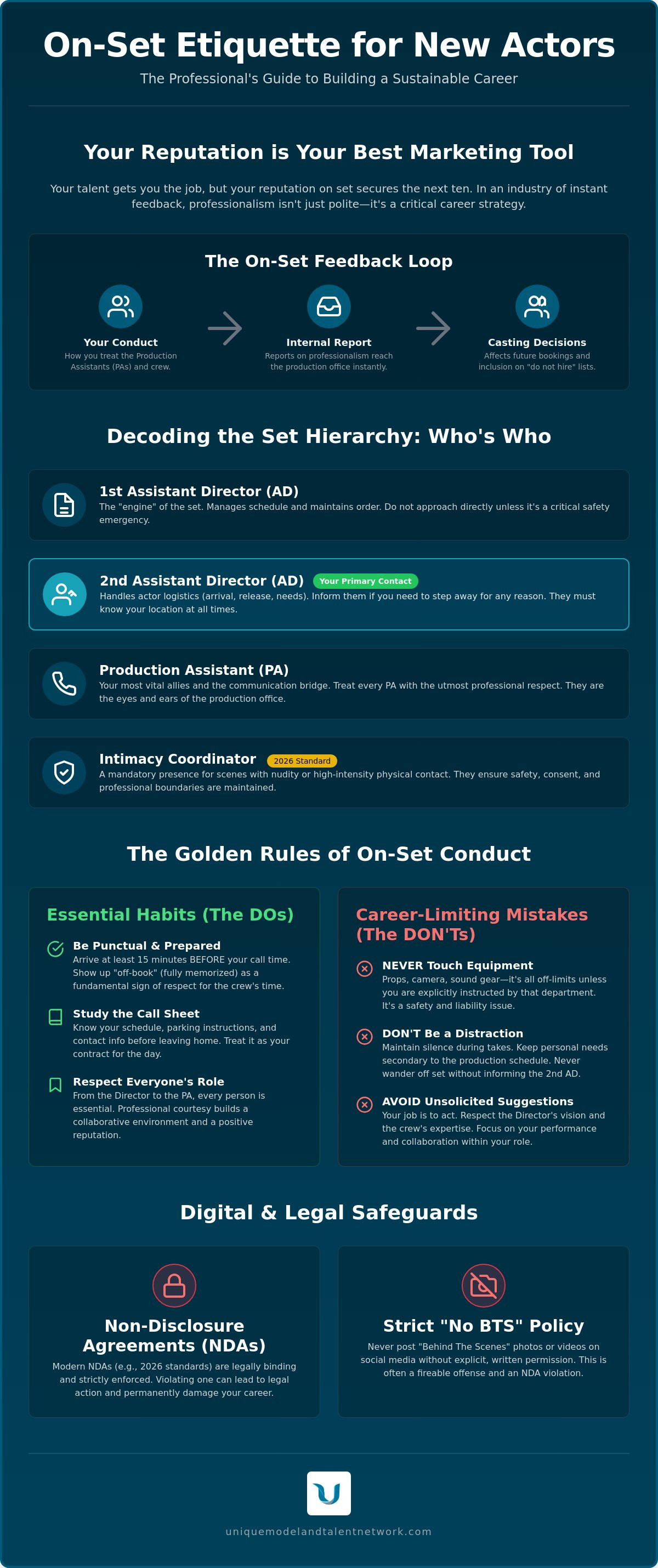
You must understand the "Feedback Loop" to appreciate the stakes. Information travels with incredible speed in this industry. If you are disrespectful to a Production Assistant (PA), that report can reach the Casting Director’s office before the lunch break ends. PAs often move into casting or production roles later in their careers, and they remember who treated them with professional respect. In a world of digital notes and internal industry databases, your conduct on day one determines your access to day one hundred.
The Long-Term Value of a Professional Reputation
Your reputation is a portable business asset that precedes you into every audition room. A minor lapse in judgment on a small independent project can impact your chances at a major studio years later. Industry professionals maintain informal "do not hire" lists based on reliability and attitude. To thrive, you must develop a "set-ready" persona. This persona balances the confidence required to perform with the humility required to be a disciplined member of a massive team. You are a professional business partner, not just a performer.
Preparation as the First Act of Etiquette
Respect for the crew begins long before you arrive on location. Showing up "off-book" and fully memorized is the most fundamental sign of respect you can show for the crew's time. It allows the director and director of photography to focus on their technical craft rather than waiting for you to find your lines. You must also treat the call sheet as a binding contract. Call Time is the moment you are physically present, through hair and makeup, and ready to step onto your marks for work, not the moment you park your car.
- Study the Call Sheet: Know your parking instructions and the nearest hospital location before you leave your house.
- Prioritize Punctuality: Aim to be on-site at least 15 minutes before your official call time to account for check-in procedures.
- Minimize Distractions: Keep your personal needs secondary to the needs of the production schedule.
Decoding the Set Hierarchy: Who is Who and How to Interact
Stepping onto a professional set for the first time feels like entering a high-stakes ecosystem where every person has a precise, time-sensitive function. Understanding the hierarchy isn't about ego; it's about production safety and efficiency. If you don't know who to talk to, you risk disrupting a workflow that costs thousands of dollars per hour. Mastering on-set etiquette for new actors begins with identifying the chain of command so you can solve problems without becoming one.
The 1st Assistant Director (AD) is the engine of the set. They manage the schedule and maintain order. Unless it's an immediate safety emergency, you'll rarely speak directly to the 1st AD. Instead, your primary point of contact is the 2nd AD or the 2nd 2nd AD. They are responsible for your logistics, from your arrival to your release. If you need to step away for a moment, they must know where you are at all times. Never just wander off.
Production Assistants (PAs) might be the most junior members of the crew, but they are your most vital allies. They are the communication bridge between you and the rest of the production. Treat every PA with the same level of professional respect you would offer a producer. They are the ones who notice your discipline, and they are often the first to report unprofessional behavior to the production office. Practicing on-set etiquette for new actors involves respecting the physical boundaries and time of every department, from Hair and Makeup to Sound.
In 2026, the set hierarchy also includes the mandatory presence of an Intimacy Coordinator for any scene involving nudity or high-intensity physical contact. Respect their role as a safety professional. They are your advocate, and their instructions regarding the physical boundaries of a scene are as binding as the Director's creative notes.
The Chain of Command for Actors
Distinguish between creative needs and logistical needs. If you have a question about a line change, that is a conversation for the Director, though you should wait for a natural break or consult the AD first. If you need a bathroom break, tell the PA assigned to you or the 2nd AD. Be equally mindful of the Sound department. Assume every microphone is a "hot mic" and keep your private conversations professional. Finally, stay away from the Video Village, the monitor area for directors and producers, unless specifically invited. It is their workspace, not a viewing lounge.
Role-Specific Conduct: Background vs. Principal
Your etiquette should adapt to your role. Background talent must remain in the designated "holding" area and follow the Background PA’s instructions without hesitation. If you're a Day Player, your goal is to integrate into an existing team. Observe the rhythm of the series regulars and match their professionalism. If you're a Principal, you set the emotional temperature of the set. Leading by example through punctuality and focus builds a culture of respect that crew members will remember. To refine these skills in a safe environment, consider joining Live Industry Workshops that simulate these exact dynamics.
The Golden Rules of Set Conduct: From 'Quiet on Set' to Crafty
The physical environment of a film set is a complex network of expensive technology and meticulously placed props. Once you understand the hierarchy, you must master the physical discipline required to occupy that space. High-level on-set etiquette for new actors demands a heightened sense of spatial awareness. You aren't just there to act. You are there to fit into a professional machine where every movement is calculated.
Total silence is the baseline expectation. When you hear "Picture's up" or see the red light, even a whisper is too loud. Modern microphones are incredibly sensitive. The sound of a heavy footstep or the rustle of a nylon jacket can necessitate an expensive retake. Similarly, you must adhere to the "Touch Nothing" rule. The equipment used by the Grip and Electric (G&E) teams is specialized and precisely balanced. Moving a light or adjusting a C-stand to make room for yourself can ruin hours of technical setup; it can also create a safety hazard. If something is in your way, ask a PA or a member of that department to assist you.
Professionalism extends to the lunch line as well. Production catering and "crafty" (craft services) follow a specific social contract. Generally, the crew eats first to ensure they can get back to setting up the next shot. If you're a day player or background talent, wait for the AD to release your group to the catering area. When you're on camera, "staying on your mark" is your primary technical responsibility. Missing a piece of tape on the floor by even a few inches can pull you out of the focal plane or the lighting sweet spot. This forces the entire team to repeat the work.
Spatial Awareness and Safety
Always identify a "Hot Set" before you enter a room. This means the props and furniture have been locked for continuity. Moving a coffee cup or sitting on a piece of furniture can break the visual logic of the scene. Be mindful of "Crossing" as well. If you must walk behind the camera, announce "Crossing" so the operator knows why the viewfinder might go dark. If you spot a potential hazard, such as an unsecured cable or wobbly rigging, report it quietly to a PA or the 2nd AD immediately.
In instances where a filming location is compromised by more significant safety issues like water damage or mold, production management typically relies on specialized experts such as Floodsafe Restoration LLC to restore the environment for the crew's safety.
The Emotional Etiquette of 'Hurry Up and Wait'
Film production involves long periods of downtime followed by bursts of intense activity. Managing your energy during these gaps is a skill in itself. Use your time in the trailer or holding area to review the next scene or stay focused on your character. Avoid the temptation to engage in set gossip or complain about the schedule. Productions are stressful. Staying neutral in any internal drama is a career-saving move. Maintaining on-set etiquette for new actors means being a professional solution, not a distraction.
Digital and Legal Etiquette: NDAs, BTS, and Social Media
In 2026, the digital border of a film set is just as strictly guarded as the physical one. While you may be excited to share your success with your followers, on-set etiquette for new actors requires a disciplined approach to technology. Your phone is not a personal accessory on set; it's a potential liability. Productions today are increasingly aggressive about protecting their intellectual property, and a single unauthorized post can terminate your contract and your professional reputation simultaneously.
The Non-Disclosure Agreement (NDA) is a binding legal contract, not a set of suggestions. Major streaming platforms in 2026 employ dedicated teams to monitor social media for leaks. If you capture a photo that reveals a plot point, a set location, or a guest star, you risk a lawsuit for damages that can far exceed your session fee. Always assume that everything you see, hear, or wear on set is confidential until the project's official release date. If you're unsure about the rules, consult your The Network Membership resources to review standard contract language before you sign.
Digital etiquette also extends to your physical likeness. Under the 2026 SAG-AFTRA agreements, you have specific rights regarding digital scanning and AI usage. If you're asked to step into a scanning booth, you must be provided with clear documentation regarding how that data will be used. Professionalism means knowing your rights while cooperating with the technical needs of the Visual Effects (VFX) department. Being "difficult" about necessary technical captures is unprofessional, but being uninformed is a business risk.
Phone Etiquette on a Working Set
Your phone should remain in "Airplane Mode" the moment you arrive. Cellular signals can interfere with sensitive wireless audio equipment, creating a technical nightmare for the sound department. Phones are strictly prohibited near the monitors, in the makeup chair, or anywhere sensitive costume designs are visible. Remember that leaking a costume design before a trailer release is a breach of contract that casting directors never forget. Keep your device in your bag or your trailer to ensure your focus remains on the work.
Managing Your Digital Footprint
When the production finally allows behind-the-scenes (BTS) content, always ask for permission before posting a photo that includes a co-star or crew member. Respect the "embargo" date, which is the specific day the production allows talent to announce their involvement. You can support the project professionally by resharing official posts from the studio rather than leaking unapproved content. Using your platform to celebrate the crew's hard work, rather than centering only on yourself, demonstrates the savvy insider mindset that leads to repeat bookings.
Elevating Your Career Through Professionalism: The Unique Model & Talent Network Edge
Professionalism is the invisible engine that drives a sustainable career in the entertainment industry. While your craft gets you through the door, your reputation is what keeps that door open for future opportunities. Mastering on-set etiquette for new actors is a continuous process of refinement that separates the hobbyists from the elite. Unique Model & Talent Network serves as the definitive educational bridge for this transition. By providing a moderated environment to practice high-stakes interactions, we ensure you arrive on set as a vetted professional rather than an anxious novice.
Our acting industry networking platform is specifically designed to remove the distractions of general social media and focus on professional business development. Within The Network Membership, you gain direct access to industry experts who provide honest feedback on conduct and protocol. This peer-to-peer mentorship allows you to learn from the real-world experiences of seasoned pros, helping you avoid common pitfalls without risking your own reputation on a live production.
Preparation is your greatest shield against accidental unprofessionalism. We've integrated specific modules on set hierarchy and technical conduct into our acting workshops online. These sessions simulate the fast-paced environment of a professional set. You'll learn how to manage the "hurry up and wait" rhythm and interact with various departments long before your first call time, giving you a competitive edge in any production environment.
Turning Every Job Into a Networking Opportunity
A wrap party isn't the end of your professional responsibility. Savvy actors use the days following a shoot to solidify their professional bonds. Reach out to the crew members you collaborated with on LinkedIn or other professional platforms to express your gratitude for their hard work. Sending a brief, professional "thank you" note to the casting office can also distinguish you as a class act. When you update your acting portfolio, you aren't just adding a credit; you are showcasing that you are a reliable, "set-ready" professional who understands the nuances of on-set etiquette for new actors.
Your Next Steps as a Savvy Actor
For your next booking, set a goal to achieve one specific "etiquette win." This could be arriving perfectly prepared for a technical mark or maintaining absolute discipline during set silence. Join the Unique Model & Talent Network today to stay informed on the latest industry shifts, from 2026 safety protocols to evolving digital likeness rights. Your talent is the spark, but your professionalism is the foundation that allows that talent to shine consistently. We are here to help you build that foundation with clarity and confidence.
Step Onto Your Next Set With Total Authority
Mastering the unspoken rules of a professional production is more than just a matter of good manners; it is a strategic business decision. By respecting the established chain of command and maintaining technical discipline during critical moments, you prove you are a reliable asset to any production team. You now understand that your conduct on a modern set, from adhering to strict 2026 NDA protocols to hitting your marks with precision, is what transforms a single job into a lasting reputation. Mastering on-set etiquette for new actors is the foundation that allows your creative talent to be seen and valued by those who hold the power to hire you again.
To truly refine these habits before your next call time, you need a professional environment to practice. Join Unique Model & Talent Network and get the professional edge you need to book your next role. Our elite membership provides direct access to live industry workshops with casting directors and monthly skill-building challenges to sharpen your professional conduct. You will also find a private community hosted on Mighty Networks for real-time industry advice and peer support. Take control of your professional narrative and step onto your next set with the confidence of a seasoned pro.
Frequently Asked Questions
What should I do if I’m going to be late to a film set?
Call the 2nd AD or the production office number listed on your call sheet immediately. Don't rely on a text to a fellow actor or a junior PA; you must ensure the message reaches the people managing the schedule. Honesty about your ETA allows the production to shift scenes and save valuable time. Failing to communicate a delay is a major breach of on-set etiquette for new actors that can lead to immediate replacement.
Can I bring a guest or a friend with me to the set?
No, you cannot bring guests to a professional film set. Productions are high-liability environments with strict insurance regulations and confidentiality requirements. Bringing an unauthorized person creates a security risk and signals that you aren't focused on your professional duties. Unless a guest is specifically cleared by the producers in writing before you arrive, you should always show up alone and ready to work.
Is it okay to ask the director for a photo or an autograph?
It is generally inappropriate to ask a director for a photo or autograph while you are working on set. The director is responsible for hundreds of technical and creative decisions; your job is to be a disciplined collaborator, not a fan. Save your personal requests for the wrap party or a professional follow-up after the project has been released. Maintaining this boundary shows you respect the workspace and the director's time.
What does 'checking the gate' or 'moving on' mean for an actor?
"Checking the gate" refers to the camera assistant verifying that the lens and sensor are free of debris before finishing a scene. "Moving on" is the official command that the director is satisfied and the crew is transitioning to the next setup. You should stay near your marks and remain in character until you hear "moving on" to ensure you don't disrupt a potential technical retake or a last-minute adjustment.
How should I handle a safety concern I notice on set?
Report any immediate safety hazards promptly to the 2nd AD or a Production Assistant. If the concern involves an intimate scene or physical boundaries, you should speak directly with the Intimacy Coordinator. Under 2026 industry standards, your safety is a priority, and professional sets value talent who are observant and proactive about the well-being of the entire cast and crew. Don't hesitate to speak up if something feels genuinely unsafe.
What is the proper etiquette for eating at craft services?
Always allow the technical crew to eat first if they are in a rush to set up the next shot. Practice discipline at the "crafty" table by taking only what you need and avoiding lingering to socialize in high-traffic areas. Remember that craft services is for quick energy between scenes, while catering is for full meals. Follow the AD's instructions on when your specific group is released to head to the catering area.
Can I post a picture of my trailer or dressing room on Instagram?
You shouldn't post photos of your trailer or dressing room if they reveal the project's name, location, or your costume. Even a seemingly safe interior shot can violate a strict 2026 NDA if it contains sensitive production documents or schedules in the background. To protect your professional reputation, wait for the production's official social media "ok" before sharing any behind-the-scenes content. When in doubt, keep the phone tucked away.
What happens if I accidentally break a prop or piece of equipment?
Inform the Prop Master or the 2nd AD immediately if you accidentally damage any production property. Accidents happen on busy sets, but hiding a broken item can delay the entire production when the cameras start rolling. Taking immediate responsibility is a hallmark of proper on-set etiquette for new actors. It demonstrates the integrity and professional maturity that directors and producers look for when they are deciding who to book again for future projects.


