

Did you know that the most common age for actors to land the majority of their roles is actually between 30 and 39? If you've spent nights wondering if you missed your window because you didn't start in your teens, you aren't alone. Many aspiring performers frequently ask: is it too late to start acting at 30? It's a valid concern in an industry that often celebrates youth, but the professional reality of 2026 tells a much more encouraging story.
You might feel like you're behind or fear being the oldest person in the audition room. We understand that pressure. However, starting at 30 is a strategic advantage. You bring a level of professional reliability and emotional depth that casting directors often find lacking in younger talent. This article will show you exactly how to leverage your maturity to build a sustainable career.
We'll provide a clear roadmap for building a competitive portfolio, mastering the digital self-tape standards of 2026, and securing legitimate industry connections. It's time to stop questioning your timeline and start focusing on the unique value you bring to the screen.
Key Takeaways
- Understand why the demand for authentic, mature talent in 2026 makes this the ideal time to enter the industry.
- Leverage your life experience to offer the emotional depth and professional reliability that casting directors actively seek.
- Learn why the answer to is it too late to start acting at 30 is a definitive no, provided you build a professional foundation with high-quality materials.
- Master the art of digital networking and learn how to bypass common industry scams by focusing on gated, professional communities.
- Discover how live workshops and expert portfolio reviews can give you the insider access typically reserved for veteran performers.
Debunking the 'Age 30' Deadline in the Entertainment Industry
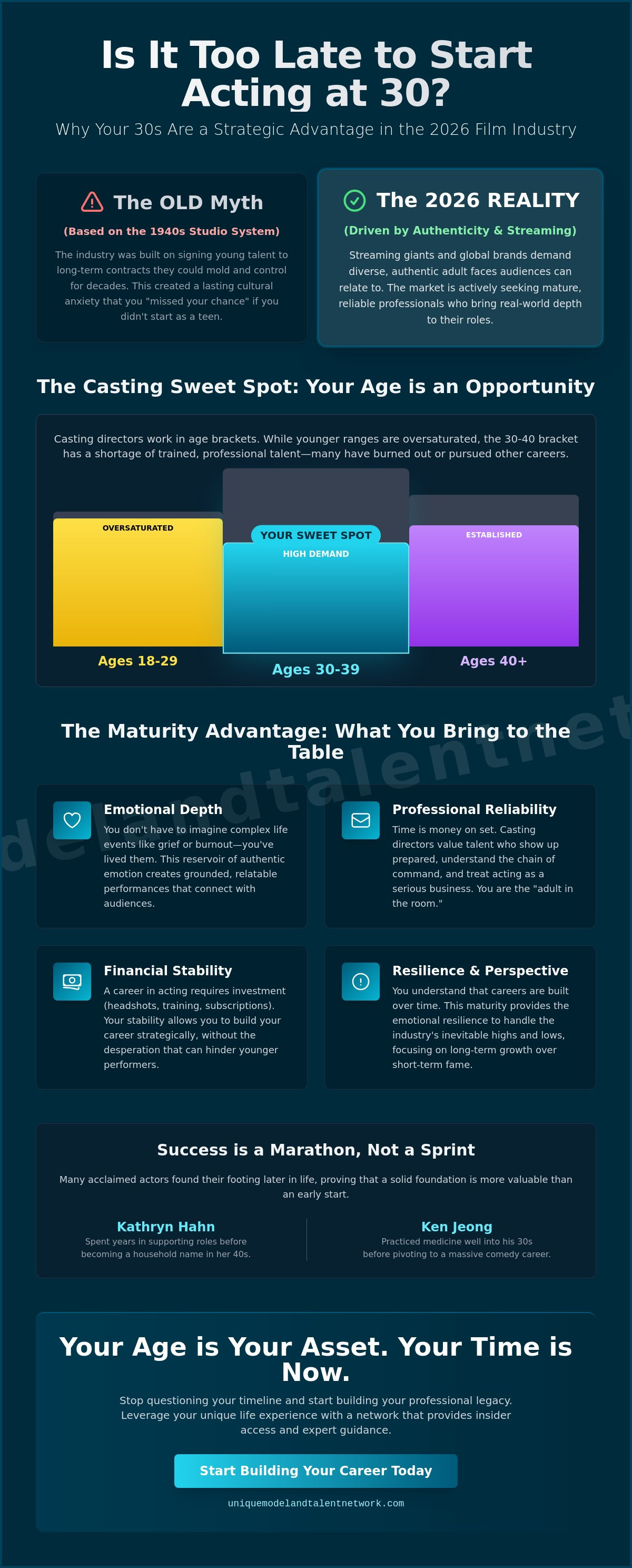
The "30-year-old deadline" is a ghost from the 1940s studio system. During that era, studios signed actors to long-term contracts, preferring young talent they could mold and profit from for forty years. This created a lasting cultural anxiety that persists today. Many people still ask: is it too late to start acting at 30? The short answer is no. In fact, the 2026 market has shifted heavily toward authenticity. Streaming giants and global brands are moving away from the polished, "perfect" look of the past. They now demand diverse, authentic adult faces that audiences can actually relate to.
While younger demographics are often oversaturated with aspiring talent, the 30-plus category is frequently underserved. This is your sweet spot. By this age, many who started in their teens have burned out and left the industry. This leaves a gap for mature professionals who understand the craft of acting and possess the discipline to treat it as a business rather than a dream. Success in 2026 isn't about being "discovered" at a mall. It's about professional career development and strategic positioning.
The Reality of Casting Brackets
Casting directors work in specific age ranges, typically 25-35 or 30-40. When you are 30, you can effectively play both sides of that line. There is a frequent shortage of trained actors in these brackets because life often gets in the way for people in their late twenties. Many aspiring performers quit to pursue more stable paths just as they reach their prime casting years. Being 30 on camera brings a specific weight and presence that a younger actor simply cannot replicate with makeup. It's the difference between "looking" the part and "inhabiting" the life experience required for the role. Producers in 2026 value this efficiency; they want actors who can step onto a set and deliver a grounded performance without the need for extensive coaching.
Success Stories: Actors Who Started After 30
Longevity is the hallmark of a career built on maturity. Consider Kathryn Hahn, who spent years in supporting roles before becoming a household name in her 40s. Or Ken Jeong, who practiced medicine well into his thirties before pivoting to a massive comedy career. These aren't just "overnight success" stories. They are "slow burn" trajectories that prove starting later provides a sturdier foundation. Starting at 30 means you likely have the financial stability and emotional resilience to handle the industry's highs and lows. You aren't just looking for fame; you're building a professional legacy. If you're still asking is it too late to start acting at 30, look at the data: the market is actively seeking the reliability you offer.
The Maturity Advantage: Why Casting Directors Need 30-Something Talent
Casting directors often experience a sense of relief when a 30-something professional walks into the audition room. While younger talent might bring energy, they frequently lack the logistical discipline that comes with a decade of real-world work experience. If you're still questioning if is it too late to start acting at 30, look at the production side of the industry. Time on set is incredibly expensive. Producers value actors who possess the "adult in the room" factor. You show up prepared, you understand the chain of command, and you treat every call time with the same respect as a high-stakes corporate meeting.
Your life experience serves as a shortcut to emotional depth. A 22-year-old actor often has to rely on imagination to portray complex grief, professional burnout, or the nuances of a long-term relationship. You've lived these moments. This reservoir of authentic emotion allows you to deliver grounded performances that resonate with modern audiences. Many industry experts agree that starting an acting career later in life provides a unique competitive edge in dramatic roles. You don't need to "find" the character's pain; you already understand the human condition.
Financial stability is another overlooked advantage. Treating acting as a business requires capital for high-quality headshots, ongoing training, and industry subscriptions. Because you likely have a primary career or savings, you can afford to invest in your craft without the desperation that often plagues younger performers. This lack of desperation is palpable in the room. It allows you to walk into auditions with a sense of confidence and ease that casting directors find incredibly appealing. You aren't begging for a job; you're offering a professional service.
Transferable Skills from Your First Career
Your professional background isn't a distraction. It's your training ground. The discipline required to manage projects or lead teams translates directly to audition preparation and character research. You know how to communicate effectively with directors and take adjustments without letting your ego interfere. Professionalism on set is a 30+ actor's greatest asset, ensuring you're the talent that producers want to hire again. If you're ready to refine these skills, joining The Network Membership can help you align your professional history with industry expectations.
Marketability: The 30-45 Demographic
The 30-45 age bracket is one of the most lucrative "types" in the industry. Brands targeting adults with disposable income want to see actors who look like their peers. Whether it's the "Young Professional," the "Modern Parent," or the "Tech Innovator," these roles require a look that conveys both aspiration and relatability. Identifying your specific "type" at 30 allows you to market yourself effectively to casting directors who are struggling to find reliable talent for these high-demand niches. You aren't just an actor; you're a solution to a casting problem.
Building Your Professional Foundation: Training and Materials
Transitioning from curiosity to action requires a shift in mindset. If you've spent years asking is it too late to start acting at 30, the best way to quiet that doubt is through concrete preparation. In 2026, the industry doesn't expect you to have a decade of credits, but it does expect a high level of professional polish from day one. You need an "Adult Starter Kit" that signals you are a serious contender, not a hobbyist. This foundation begins with high-quality headshots that reflect your actual age and casting "type." In major hubs like Los Angeles, a professional session typically ranges from $300 to $800, and investing in this quality is non-negotiable for the 30-plus demographic.
Your maturity allows you to bypass the experimental phase that younger actors often endure. Instead of taking general theory classes, prioritize strategic, on-camera training that focuses on the technical demands of modern sets. You should seek out modeling career coaching and acting mentorship that emphasizes business development. This approach ensures your marketing materials, from your casting profiles to your resume, align with current market demands for authentic adult performers. You aren't just learning to act; you're learning to manage a professional brand.
The Essential Acting Portfolio
A professional acting portfolio in 2026 is a digital-first asset. If you have zero professional credits, don't panic. You can build a compelling demo reel using high-quality self-taped scenes or footage from student films. Casting directors prioritize your ability to inhabit a character over the size of the production. Ensure your portfolio includes "digitals"—clean, unedited photos that show your natural look—to provide an honest representation of how you appear on camera today. This transparency builds trust with casting offices and helps you secure roles that fit your specific look.
Accelerating Growth Through Workshops
Since time is your most valuable resource, acting workshops online offer a streamlined path to professional-grade skills. These sessions allow you to bridge the experience gap quickly while maintaining a full-time job. You can receive real-time feedback from casting directors and industry experts who specialize in the 30-something market. By setting a disciplined 12-month training schedule, you can transform from a beginner into a market-ready professional. The goal is to move past the question of "if" it's too late and focus entirely on the quality of the work you're putting on tape.
Navigating the Business: Networking Without the Noise
If you still worry that is it too late to start acting at 30 because you don't live in a major entertainment hub, you are operating on an outdated industry map. By 2026, physical proximity to Los Angeles or New York has become secondary to your digital accessibility and the quality of your acting industry networking platform. The industry has moved into gated, professional digital spaces where your reputation is built on reliability and craft rather than social media followers. This shift is a massive win for the mature professional who values efficiency over the chaos of public forums.
Protecting your career from "hobbyist" traps is essential at this stage. Predatory scams often target newer actors with promises of "guaranteed fame" or require upfront fees for representation. As a savvy insider, you must recognize that legitimate opportunities are built on professional standards and verified results. You don't need to wait for an agent to begin building relationships with casting directors. Direct communication, when handled with professional etiquette, allows you to position yourself as a reliable solution for their specific casting needs. If you want to bypass the distractions of external platforms, focusing on a private, moderated community ensures your networking efforts yield tangible career growth.
Strategic Use of Casting Websites
Success in the modern market requires you to maximize your visibility on the casting websites that industry pros actually use to find new faces. The self-tape revolution has leveled the playing field, allowing you to audition for international productions from your own home studio. When you submit a tape that demonstrates both technical proficiency and the emotional depth of a 30-something, you immediately stand out from the sea of less-experienced performers. Casting directors are actively looking for fresh, mature talent who can deliver a grounded performance without the need for extensive hand-holding on set.
Networking as a Mature Professional
Your networking strategy should mirror your professional background. Approach industry pros with a peer-to-peer mindset rather than a fan-based perspective. Use professional platforms like LinkedIn to research production companies and connect with casting associates in a disciplined, organized manner. Surrounding yourself with a supportive community of like-minded professionals is critical for managing the emotional "no" that is part of the business. This collective resilience keeps you focused on long-term career acceleration rather than short-term vanity. Ready to connect with a community that values your professional standards? Join The Network Membership and start building high-value industry connections today.
Accelerating Your 30+ Career with the Unique Model & Talent Network
Starting a career at 30 requires a surgical approach to professional development. You don't have the luxury of wandering through unorganized social media groups or falling for predatory scams that promise fame without substance. The Unique Model & Talent Network serves as a protective bridge, providing the clarity and direction needed to move from a curious beginner to a market-ready professional. If you have been asking is it too late to start acting at 30, the answer is found in the speed at which you can access internal industry perspectives. By joining a gated community, you remove external distractions and focus entirely on the high standards required to secure professional recognition.
When you participate in our Live Industry Workshops, you aren't just learning; you're being evaluated by professionals who value reliability and discipline. This positions you as "vetted talent" in a market where casting directors are desperate for actors who possess the maturity to handle a high-stakes set. Our Portfolio & Reel Reviews ensure your marketing materials meet the elite standards of 2026, removing the guesswork that often leads to wasted time and missed opportunities. You aren't just an applicant; you're a member of a community that values career security and professional growth over vanity.
Direct Access to Decision-Makers
Our Industry Expert Q&A Sessions provide a rare opportunity to speak directly with those who book talent daily. You receive direct mentorship that would normally take years of trial and error to acquire. By getting your reel reviewed by active casting directors, you gain an immediate understanding of how you are perceived in the current recruitment landscape. This direct feedback loop is the ultimate career accelerator for the 30-something performer. It allows you to refine your "type" and your performance based on actual market demand rather than theory. If you are serious about your craft, this level of access is the most efficient way to bridge the experience gap.
Joining a Community of Like-Minded Creatives
Peer support is the hidden engine of career longevity for adult actors. Within The Network Membership, you connect with other serious professionals who share your dedication to excellence. Our Monthly Skill-Building Challenges keep your tools sharp and your resume growing, ensuring you maintain momentum even between auditions. This organized environment transforms the "aspiring" mindset into a "working" reality. You gain a sense of community belonging that is often missing in this competitive field. Through these collective efforts, you can transition from someone questioning their timeline to a professional who is fully optimized for the 2026 industry. Is it too late to start acting at 30? Not when you have a roadmap designed for your specific professional needs.
Your Professional Pivot Starts Now
The entertainment industry in 2026 has evolved to prioritize the authenticity and reliability you naturally possess. By now, it's clear that the answer to is it too late to start acting at 30 is a resounding no. Your life experience acts as a shortcut to emotional depth, and your professional background ensures you are the "adult in the room" that production teams desperately need. You aren't just starting; you're arriving with a competitive edge that younger talent hasn't yet developed.
True success requires moving beyond the noise of general social media and into a gated environment where your craft remains the primary focus. You deserve a roadmap that respects your time and protects your career from industry predators. By choosing a path centered on high-value training and legitimate connections, you position yourself as a market-ready professional ready for recruitment.
Are you ready to stop questioning your timeline and start building your legacy? Join the Unique Model & Talent Network and start your professional journey today. You'll gain direct access to active casting directors, expert-led workshops, and a private, moderated community dedicated to your growth. Your most significant roles are still waiting to be cast.
Frequently Asked Questions
Is 30 too old to get an acting agent?
No, 30 is actually a prime age for many talent agencies. Agents are constantly looking for performers in the 30-45 demographic because it represents a high-volume casting bracket for commercials, streaming series, and industrial films. If you present yourself with professional-grade headshots and a clear understanding of your "type," you are seen as a marketable business asset rather than a beginner.
Do I need a drama degree to start acting at 30?
You don't need a formal drama degree to build a successful career. While prestigious programs like the David Geffen School of Drama at Yale have strict application deadlines (January 2, 2026, for the Fall 2026 term), many working professionals prefer the efficiency of specialized workshops. Focusing on on-camera technique and portfolio development is often more effective for adults than committing to a multi-year academic program.
How do I balance a 9-5 job with an acting career?
The self-tape revolution has made it possible to balance a traditional career with professional acting. Most initial auditions in 2026 are conducted via digital submissions, allowing you to record your scenes in the evening or on weekends. By using a private networking platform, you can manage your submissions and training without the need for constant travel or mid-day absences from your primary job.
What are the best types of roles for actors starting at 30?
The most lucrative roles for this age group are often "relatable" characters like the young professional, the modern parent, or the tech-savvy entrepreneur. These roles are in high demand for national commercial campaigns and ensemble-driven streaming content. When people ask is it too late to start acting at 30, they often overlook these high-paying niches that require the maturity and life experience only an adult performer can provide.
Can I start acting at 30 with no experience?
You can start with no experience, but you must prioritize high-level training to remain competitive. Casting directors value craft over a long resume, so your first step should be joining a skill-building community. Gain your initial credits through student films and non-union projects to build a demo reel that proves you can handle the technical requirements of a professional set.
How much does it cost to start an acting career in 2026?
Initial costs involve essential marketing materials and industry access. In 2026, a professional headshot session in Los Angeles typically ranges from $300 to $800 for a standard session. An annual subscription to a major casting site like Backstage costs $199.99. Once you qualify for union entry, the national SAG-AFTRA initiation fee is $3,000, which is a one-time investment in your professional status.
Do I have to move to Los Angeles or New York to be an actor?
You don't have to move to a major hub to begin booking work. Digital casting dominance means your location matters less than your ability to deliver a high-quality self-tape. Many actors build impressive resumes in regional markets or through international productions before ever stepping foot in a traditional entertainment capital. Focus on your digital presence and professional networking first.
How long does it take to book your first paid acting job?
The timeline varies based on your preparation and the quality of your materials. Some actors book non-union commercial work within their first few months of training, while others may spend a year refining their craft and building a reel. Consistency is your greatest ally. By engaging in monthly challenges and expert reviews, you can significantly shorten the learning curve and move toward your first paycheck faster.


