

What if the weeks between bookings could strengthen your craft instead of putting it on pause? If you’ve wondered how to stay creative between acting jobs, you’re not alone. When a project ends, momentum can fade, and open days may feel more stressful than freeing. It’s easy to fill them with self-promotion and audition prep, even when what you need is a more meaningful connection to acting.
Staying creatively engaged doesn’t mean treating every day like an audition. A sustainable routine can help you keep your skills active, explore new ideas, and make room for rest without losing your sense of direction. The goal is steady practice, not constant productivity.
This guide shares practical ways to build that rhythm, from focused scene work and low-pressure creative experiments to structured workshops, skill-building challenges, and supportive peer connection. You’ll learn how to use downtime to grow at a manageable pace, so you can return to auditions and projects feeling prepared, engaged, and connected to the work you love.
Key Takeaways
- Define creative practice by exploration and reflection, not by how much work you produce or promote.
- Build a flexible routine around one clear focus, a manageable practice session, and a brief check-in afterward.
- Choose activities that match your goal, whether you want to sharpen technique, spark imagination, or work with others.
- Learn how to stay creative between acting jobs without making every exercise audition material or pushing through signs of burnout.
- Use workshops, skill-building challenges, and peer perspectives to add structure and fresh insight between projects.
Why Staying Creative Between Acting Jobs Matters
Finishing a project can change your routine overnight. The structure, shared focus, and daily demands of rehearsals or production fall away, while the next opportunity may not arrive on a predictable schedule. If your momentum dips or unstructured time feels unsettling, that doesn’t mean you’ve lost your connection to acting. It means the rhythm of the work has changed.
Staying creative isn’t about keeping busy every day or turning downtime into a nonstop audition campaign. Creative practice between acting jobs is deliberate time spent exploring your craft, following your curiosity, and reflecting on what you learn, without making each session prove your career value.
Regular, manageable practice can keep skills engaged and help you identify what you want to explore next. It can’t guarantee auditions, paid roles, or a particular career outcome, and it doesn’t need to produce submission material to count. A scene study that helps you listen more closely, or an improvisation that lets you take a different kind of risk, can be worthwhile for its own sake.
Separate creative growth from booking pressure
Booking a role is an outcome you can’t fully control. Your choices within a practice session are more firmly in your hands. Set a process goal, such as trying a new tactic, staying present through a scene, or exploring a character’s point of view. This gives the session direction without making its value depend on whether you can turn it into a reel clip or audition piece.
That distinction can make practice feel safer and more useful. Work on a monologue privately, read a scene without recording it, or revisit a moment from a past performance to understand what felt truthful. If the exercise produces material you later choose to use, treat that as a bonus, not a requirement.
Notice what kind of creative energy you need
There isn’t one routine that suits every actor or every stretch between jobs. Before choosing an activity, ask what would serve you now: play, structure, collaboration, or rest. Think back to your last project. Which moments gave you energy, and which left you wanting a different pace or kind of challenge?
Use your answer to choose a small, useful next step. If you miss structure, explore a technique or focused scene study. If you miss working with others, choose a collaborative practice. If you feel depleted, let rest come first. For independent study, Stanislavski's system of acting offers a framework for exploring craft outside audition preparation. A practice that fits your energy can help you stay connected without turning every open day into a performance test.
How to Build a Sustainable Acting Practice Between Jobs
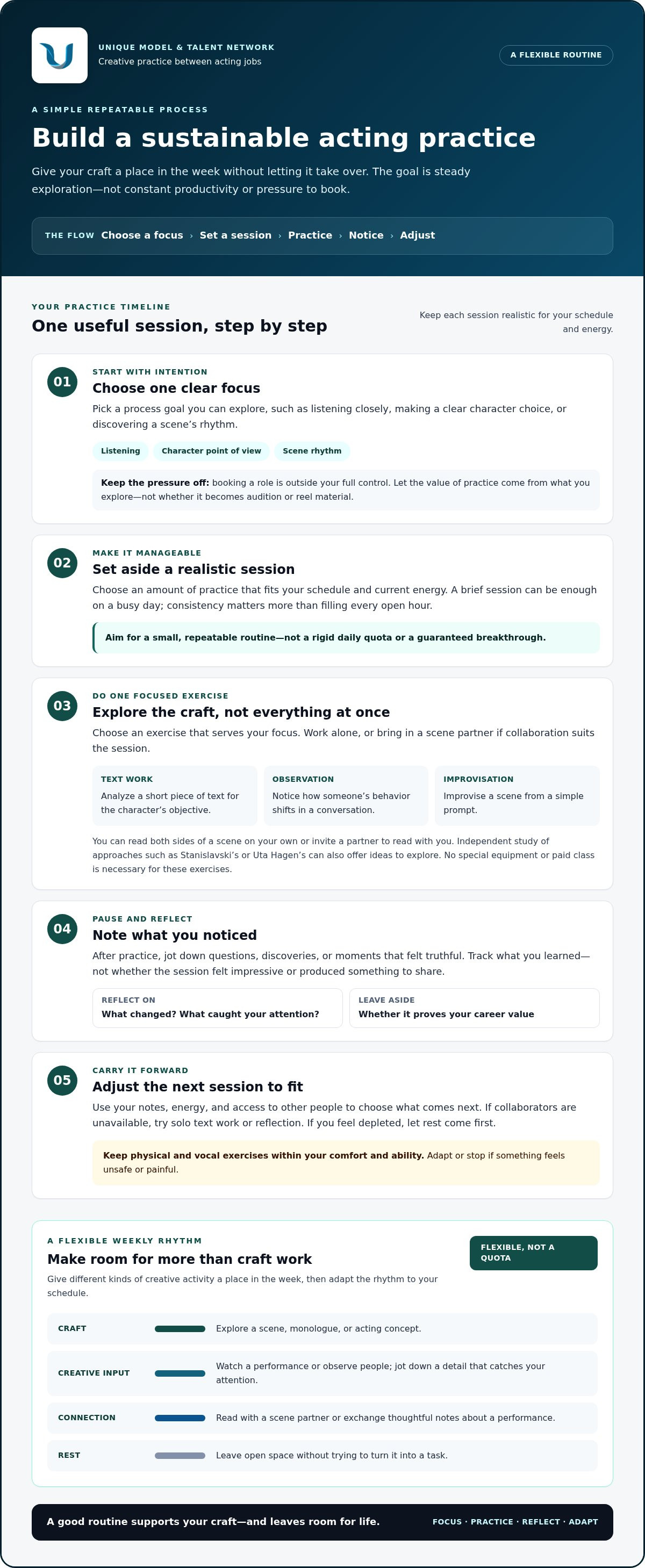
A routine works best when it gives your craft a place in the week without taking over the week. Use a simple sequence: choose one focus, set aside a manageable session, practice, note what you noticed, then adjust next time. Your focus might be listening, making a clear character choice, or exploring a scene’s rhythm. Keep the session realistic for your schedule and energy. Consistency matters more than filling every open hour.
A small, repeatable routine keeps your craft within reach without asking every session to deliver a breakthrough. If you’re figuring out how to stay creative between acting jobs, start with the time, energy, and people available to you now.
Use short exercises to keep your instrument active
Choose one focused exercise rather than trying to work on everything at once. Analyze a short piece of text for the character’s objective, observe how someone’s behavior shifts in a conversation, or improvise a scene from a simple prompt. You can work alone by reading both sides of a scene, or invite a partner to read with you. No special equipment or paid class is necessary.
Acting approaches such as Stanislavski’s or Uta Hagen’s can offer ideas to explore through independent study. Keep physical and vocal exercises within your comfort and ability. Adapt or stop if something feels unsafe or painful.
Create a weekly rhythm that leaves room for life
Instead of setting a rigid daily quota, give different kinds of creative activity a place in your week. For example:
- Craft: Explore a scene, monologue, or acting concept.
- Creative input: Watch a performance or observe people in a public place, then jot down a detail that caught your attention.
- Connection: Read with a scene partner or exchange thoughtful notes about a performance.
- Rest: Leave open space without trying to turn it into a task.
Adapt the rhythm to your schedule. A brief session may be enough on a busy day. When energy or access to collaborators is limited, choose solo text work or reflection. Track questions and discoveries, not whether each practice felt impressive. The University of Southern California’s School of Dramatic Arts describes professional development opportunities that include mentorship and visiting artists, illustrating how learning and connection can complement individual practice.
If guided structure or peer connection would help you follow through, The Network’s live workshops and monthly skill-building challenges offer focused ways to keep developing between projects.
Which Creative Activities Help Actors Grow Between Roles?
The best activity depends on what you want to explore. Solo study can sharpen technique; improvisation can loosen your imagination; scene practice can build connection; writing can deepen your understanding of character. Observing people and performances can offer fresh material, but watching alone won’t replace actively practicing the craft.
Use this comparison to choose an activity based on your goal and what you have available. Most options need little more than a script, a notebook, or a willing scene partner.
| Activity | Best use | Resource needs |
|---|---|---|
| Monologue or text study | Technique and close attention to language | A script and a quiet space |
| Scene practice | Listening, relationship, and collaboration | A scene partner, in person or remotely |
| Improvisation | Imagination, spontaneity, and play | A prompt; a partner is optional |
| Character writing | Backstory, point of view, and inner life | A notebook or document |
| Observing people or performances | Fresh perspective on behavior and choices | Attention and a way to record observations |
When solo practice is the right fit
Solo work suits days when you want to focus at your own pace. Study a monologue, keep a character journal, or self-tape a short scene to explore one specific intention, such as making a clear choice about what the character wants. If you review a recording, watch it once with one question in mind, such as whether your reactions felt connected. Treat what you notice as information, not a verdict.
Watching a performance can also prompt questions about timing, physical choices, or how an actor handles silence. Bring one of those questions into an exercise of your own. Inspiration is useful, but active experimentation is where you engage directly with the craft.
When collaboration can unlock new ideas
A scene exchange, peer reading, or brief improvisation can reveal choices you might not find alone. Agree on a simple focus and a clear stopping point so the session stays manageable. Meisner-based repetition can be a reference for practicing attention and responsiveness, but it isn’t a shortcut to strong acting. Treat it as one possible exercise, adapted to your experience and goals.
If guided group practice would help, explore the professional guide to acting workshops online for ideas about learning with others. When deciding how to stay creative between acting jobs, choose an activity for the skill or curiosity it serves, not simply because it might produce audition material.
How to Stay Creative Without Burning Out or Turning Everything Into Audition Prep
Creative practice can start to feel like another audition when every scene must become a reel clip, every exercise must improve your casting chances, and every quiet day becomes a reason to post or scroll. Professional preparation has its place, but your creative life doesn’t need to produce proof of progress each time you engage with it.
Notice when practice is turning into pressure: you dread starting, compare your work constantly with others, or finish feeling depleted rather than engaged. Those feelings aren’t a verdict on your commitment. They’re useful information. Adjust the exercise, change the goal, or step away for a while.
- Structured practice: It offers focus and a clear way to develop a skill, but can feel like a chore if every session has to meet a rigid target.
- Open-ended play: It can invite surprise and experimentation, but may feel unfocused if you’re looking for a specific technical challenge.
Neither approach has to carry the whole routine. Let your needs determine the balance.
Make room for rest and creative play
Rest isn’t a failure to be ambitious. It gives you room to replenish the attention and curiosity that acting draws on. Read for pleasure, take a walk and notice how people move, cook something new, or listen closely to music without turning the experience into character research. These activities can feed your imagination without becoming assignments.
If an exercise consistently drains you, pause it or try a different approach. Switch from recording a scene to reading it aloud, or trade a technique drill for an improvisation with no planned outcome. The aim is not to avoid challenge; it’s to keep challenge distinct from punishment.
Keep audition preparation in its proper place
Give audition tasks their own time block. Use it to review the brief, prepare sides, record a self-tape, or handle submissions. In a separate craft session, explore a scene or acting choice without asking whether the result is ready to send. Boundaries help protect both kinds of work.
You can also set limits around job-search and social media time. Decide when you’ll check casting updates or share professional news, then step away when that block ends. This keeps career tasks from crowding out creative practice and recovery. For a focused approach to audition preparation, read this professional guide to film industry auditions.
If structured guidance would help you explore craft without making every session about an audition, join a live industry workshop for creative development.
Turn Between-Job Creativity Into Your Next Sustainable Step
You don’t need to redesign your entire schedule to make creative progress. Choose one practice for this week, such as exploring a short scene, observing a character trait in everyday life, or writing from a character’s point of view. Afterward, ask: What felt engaging, and what would I like to explore next? That reflection turns one session into useful information for your next step.
Make a simple four-week creative plan
Think of a month as a chance to test and adjust a routine, not a deadline for a breakthrough. Keep the plan flexible enough to fit your energy and commitments:
- Week one: Choose one craft focus and a realistic practice rhythm.
- Week two: Repeat an exercise and note what changed in your choices, attention, or comfort with the material.
- Week three: Add collaboration or feedback, such as a peer reading or a fresh perspective on your work.
- Week four: Reflect on what supported your practice, then keep, change, or drop parts of the routine.
At the end of the month, review progress without using bookings as the only measure. Did you return to the craft? Did you discover an area you want to develop? Did your routine leave room for rest? Those answers can help you decide what to carry forward. This is a practical way to approach how to stay creative between acting jobs: build a rhythm you can revisit, then adapt it as your circumstances change.
Find structure, feedback, and creative peers
Independent practice can be valuable, but outside perspectives can add focus when you want them. Live industry workshops offer guided learning, while portfolio and reel reviews provide feedback on professional materials. Monthly skill-building challenges give you a defined prompt, and industry expert Q&A sessions create opportunities to learn from experienced voices.
Peer connection can also make creative development feel less solitary. In a private, moderated community, actors can share learning and professional perspectives with others who understand the demands of the industry. These resources support development; they don’t promise representation or bookings.
If you’d like ongoing learning, structured opportunities, and connection with industry professionals and peers, explore The Network Membership.
Keep Your Craft Moving Between Bookings
Learning how to stay creative between acting jobs starts with a manageable practice, not a packed schedule. Choose an activity that keeps you curious, set a realistic rhythm, and give yourself permission to rest. Progress can show up in sharper choices, renewed energy, or a deeper connection to the work, even when it doesn’t create audition material.
When you’d benefit from structure or a fresh perspective, creative development doesn’t have to be solitary. The Network offers live workshops led by guest casting directors and photographers, portfolio and reel reviews, monthly skill-building challenges, and industry expert Q&A sessions in a private community. These opportunities support learning and professional connection without promising representation or bookings.
Keep building your craft and connecting with industry peers between projects. Explore The Network Membership and keep building your craft between jobs. A small, sustainable step today can help you return to your next project feeling engaged and ready to grow.
Frequently Asked Questions
How do actors stay motivated between jobs?
Actors can stay motivated by setting small, controllable craft goals and choosing practice that fits their energy. Pick one focus, such as listening closely in a scene or exploring a character’s point of view, then reflect on what you noticed. Motivation can fluctuate, so don’t treat every low-energy day as a failure. Rest, creative play, and connection with other actors can all help you maintain a sustainable relationship with your craft.
What creative exercises can actors do on their own?
Solo exercises include studying a monologue, analyzing a scene’s objectives, writing a character journal, or improvising from a simple prompt. You could also observe a real conversation and note a detail about how people listen or shift their behavior. Choose one intention before you begin, then review what you learned without judging the exercise by whether it produced audition material. A notebook or script is often enough to get started.
Can actors improve their craft when they are not working?
Yes. Actors can develop their craft between roles through focused practice, reflection, and creative exploration, even without a current production. Revisit a scene, test a new acting choice, or work with a peer to strengthen your listening and responsiveness. Progress may not show up as a booking right away, and it doesn’t have to. Consistent learning can keep your skills engaged and help you return to future projects with fresh curiosity.
How much should an actor practice between jobs?
There’s no single practice schedule that fits every actor. Choose a rhythm that works with your time, energy, and access to collaborators, then adjust it as your circumstances change. A short, focused session can be more sustainable than a demanding daily quota. For example, you might plan craft practice, creative input, collaboration, and rest across your week. Review whether the rhythm feels useful, rather than measuring success by hours logged.
What happens if I feel uninspired between acting jobs?
Feeling uninspired can be a cue to change your approach, not proof that you’ve lost your ability or ambition. Step back from an exercise that feels draining, take time to rest, or try a different source of creative input, such as reading, music, or observing everyday behavior. If structure or connection would help, consider a guided workshop or peer practice. Start small and let curiosity return at its own pace.
Should actors use downtime to prepare for auditions?
Actors can use some downtime for audition preparation, but it doesn’t need to fill every creative session. Set aside a specific block to review a brief, learn sides, record a self-tape, or handle submissions when an audition calls for it. Keep other craft practice open to exploration, without requiring it to become a reel clip or audition piece. Separating these activities helps you prepare professionally while protecting space for creativity and rest.
Are acting workshops useful between jobs?
Acting workshops can offer structure, guided practice, and perspectives from industry professionals while you’re between projects. They may be especially useful if you want to focus on a particular craft area or learn alongside other actors. Unique Model & Talent Network offers live industry workshops led by guest casting directors and photographers, along with skill-building challenges and industry expert Q&A sessions. These support learning and professional connection, not guaranteed bookings or representation.


