

What if the most critical factor in booking your next role isn't your reel, but the three sentences you write before clicking submit? In a 2026 landscape where digital submissions are the absolute standard, learning how to write a cover letter for an audition is the difference between being seen and being skipped. Casting professionals are sifting through hundreds of profiles on subscription platforms; they simply don't have time for fluff. They need to see that you're a disciplined professional who understands the specific needs of their production and can deliver results immediately.
It's exhausting to feel like your hard work is disappearing into a digital void. You want to stand out, yet you worry about sounding unprofessional or sharing too much personal detail in a space as small as a 500-character notes box. We're going to replace that uncertainty with a professional framework designed to grab attention and accelerate your career. This guide provides a clear template to help you master the art of the audition pitch. We will explore how to craft concise, solution-oriented notes that respect a casting director's time and significantly increase your audition invite rates.
Key Takeaways
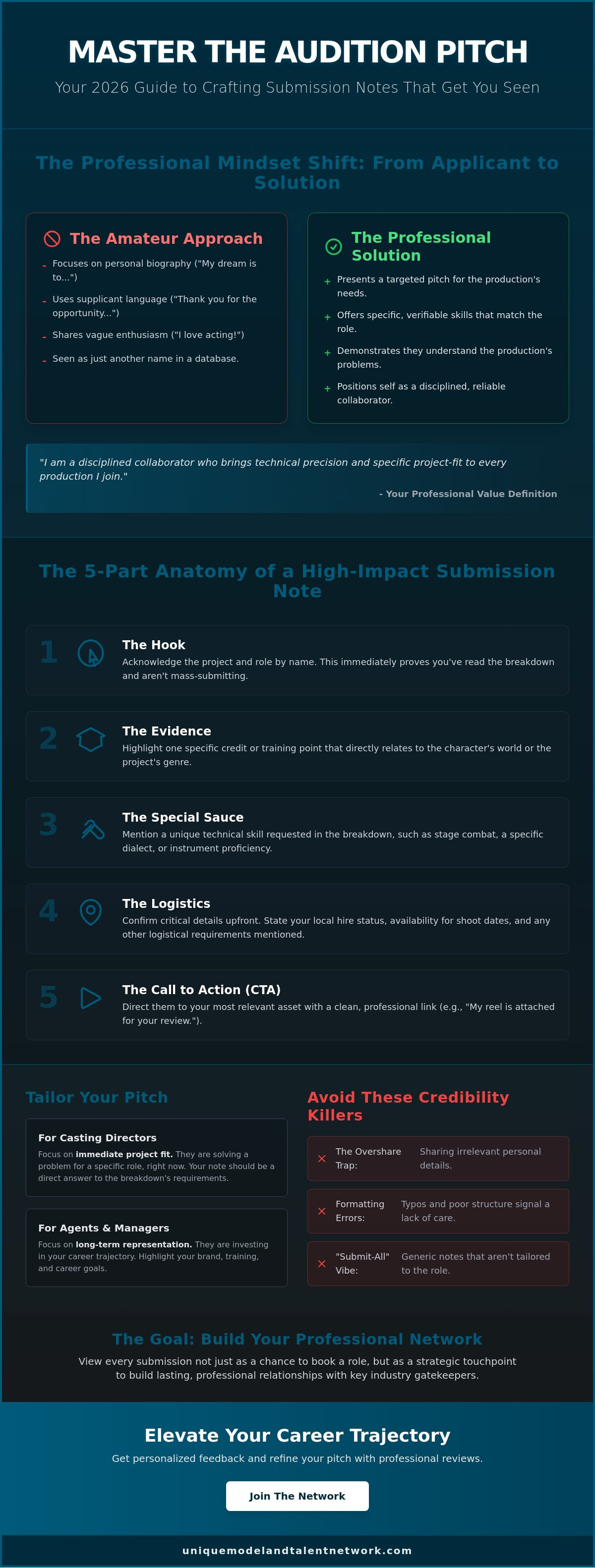
- Shift your perspective from personal biography to professional solution by treating every submission as a targeted pitch for the production’s specific needs.
- Master how to write a cover letter for an audition by using a high-impact hook that immediately aligns your training with the requirements of the role.
- Learn to differentiate your communication strategy when pitching to agents for long-term representation versus casting directors for immediate project fit.
- Protect your professional credibility by avoiding common pitfalls like the overshare trap and formatting errors that can signal a lack of industry experience.
- Elevate your career trajectory by viewing every submission as a strategic touchpoint to build lasting, professional relationships with key industry gatekeepers.
The Evolution of the Audition Cover Letter in 2026
The traditional paper cover letter is a relic of a slower industry. In 2026, casting portals have replaced physical mail with "submission notes," transforming the way talent communicates with gatekeepers. This isn't just a technical shift; it's a strategic one. You need to know how to write a cover letter for an audition that functions as a high-speed, professional pitch. Casting directors are vetting hundreds of profiles in minutes. If your note is "me-focused," detailing your childhood dreams or general love for the craft, it will likely be skipped. A project-driven industry demands that you lead with specific, verifiable skills rather than vague enthusiasm.
When you organize your professional submission documents, the cover letter acts as the essential bridge between your past credits and the production's future needs. It's your opportunity to prove that you aren't just another name in a database, but a prepared professional who understands the specific requirements of the breakdown. In a landscape where digital noise is constant, brevity and precision have become the new standards for elite talent.
Why Casting Directors Still Care About What You Write
Casting directors use submission notes to filter for professional compliance. A well-crafted note proves you've actually read the breakdown instructions, which immediately sets you apart from the automated "submit-all" crowd. It also allows you to break the "fourth wall" of a static digital profile by addressing logistical needs. For example, confirming your "local hire" status for a shoot in a specific city solves a primary casting problem before it even arises. This small detail demonstrates that you're thinking like a producer, not just a performer.
The "Solution-First" Mindset for Talent
To succeed in 2026, you must position yourself as the answer to the casting director’s specific search. Amateurs often fall into the "thank you for this opportunity" trap, which frames the interaction as a favor being granted. Professional talent avoids this supplicant language. Instead, focus on how your specific training or unique physical skills align with the role's demands. If the production needs an actor who can handle complex choreography or a specific dialect, state your proficiency clearly and confidently. You're not asking for a chance; you're offering a solution.
Professional Value Definition: I am a disciplined collaborator who brings technical precision and specific project-fit to every production I join.
The Anatomy of a High-Impact Submission Note
Mastering the structure of a submission note is the most efficient way to prove your professional standards. In 2026, casting directors view your note as a preview of your performance; if it's disorganized, they'll assume your work on set will be too. Understanding how to write a cover letter for an audition requires a shift toward a modular, five-part framework that values the reader's time. This structure ensures you provide exactly what is needed to move your profile from the "maybe" pile to the "invite" list.
- The Hook: Acknowledge the project and role by name immediately to prove you aren't mass-submitting.
- The Evidence: Highlight one specific credit or training point that directly relates to the character's world.
- The Special Sauce: Mention a technical skill requested in the breakdown, such as stage combat or a specific dialect.
- The Logistics: Confirm your local hire status and absolute availability for the shoot dates.
- The Call to Action: Direct the viewer to your reel or digital assets with a clean, professional link.
Providing this information in a segmented format respects the fast-paced nature of digital vetting. When you consider an agent's perspective on submissions, you realize that clarity always beats cleverness. If you're looking for personalized feedback on your pitch, The Network Membership offers professional reviews to help you refine this five-part structure.
Crafting a Compelling Hook
The hook is your first impression. If you're submitting for a commercial, your hook should focus on your brand alignment and "vibe." For theatrical roles, connect your look to the character description professionally. Avoid saying "I've always wanted to play a doctor." Instead, try: "As a performer with a grounded, authoritative presence, I am submitting for the role of Dr. Aris in [Project Name]." This shows you've analyzed the breakdown and understand where you fit in the market.
Linking to Your Digital Assets
Your submission note is the gatekeeper to your media. Ensure you include a direct link to your acting portfolio so casting directors don't have to hunt for your reel. Never use password-protected links or files that require a download; these are immediate deal-breakers in a high-volume environment. Mention your reel naturally by saying, "My latest dramatic reel, which features work similar to this role, is available at the link below." This keeps the focus on the work rather than the technology.
Tailoring Your Pitch: Agents vs. Casting Directors vs. Models
Pitching is not a one-size-fits-all endeavor. The strategies for how to write a cover letter for an audition change significantly depending on who is opening the digital file. Casting directors are looking for a reliable, immediate solution for a specific shoot date. Agents are searching for a long-term business asset who fills a specific gap in their current roster. Models are often vetted based on physical data and brand compatibility. You must adjust your tone from "artistic collaborator" to "business-professional partner" to match these distinct professional expectations.
Understanding these nuances prevents you from sounding desperate or unprofessional. When you approach a casting office, your submission note should be a fast-paced confirmation of your fit for a single role. When you approach an agency, the narrative shifts toward your marketability and your potential for consistent revenue generation. This disciplined approach ensures your communication is always aligned with the recipient's primary business goals.
Writing to Talent Agents for Representation
When you approach an agency, your pitch must emphasize marketability. Agents don't just want talent; they want talent that is easy to sell to their existing client base. Highlight your Unique Selling Point (USP) and your current career momentum. If you have been active on an acting industry networking platform, mention any recent connections or referrals you've secured. This demonstrates that you are proactive and already integrated into the industry ecosystem. Address the "Representation Gap" by explaining how your specific look or skill set complements their existing talent list without creating direct competition with their current top-tier performers.
Modeling Submission Notes: Short and Punchy
Commercial modeling submissions require a different level of technical precision. While actors focus on character and training, models must prioritize data and brand alignment. Your note should be a concise list of your current measurements, height, and any recent high-profile bookings that prove your professional experience. Mention your specific experience with the brand’s aesthetic to show you've done your research. In 2026, your social media handles often serve as a secondary cover letter. Include them clearly, but only if they reflect a professional brand image that aligns with the agency's elite standards.
Shifting your tone is essential for career acceleration. When writing to a casting director, keep your language focused on the immediate project and your reliability on set. When writing to an agent, use language centered on career growth and financial legitimacy. This organized method positions you as a savvy industry insider who respects the unique professional pressures each gatekeeper faces.
Common Pitfalls and the "Industry Standards" Checklist
Even the most talented performers can sabotage their chances with a single formatting error or a tone that signals desperation. When you are refining how to write a cover letter for an audition, you must understand that casting directors value technical precision as much as creative potential. A submission note is a business document, not a personal diary. If your communication feels unorganized, a producer will worry that your performance on set will be equally chaotic. Professionalism is your primary shield against being ignored.
The "Overshare" trap is one of the most frequent mistakes made by emerging talent. While your personal journey is valid, casting directors don't need to hear about your childhood dreams or the financial struggles you've faced. They need to know if you can hit your marks and deliver the lines. Keep your personal life stories out of your professional notes. Similarly, formatting nightmares like weird fonts or excessive emojis kill your credibility instantly. Most digital casting portals strip custom formatting, which can turn your carefully designed note into a series of broken characters. Stick to clean, standard text to ensure your message remains readable.
A "begging" tone is another silent killer. Phrases like "I would do anything for this chance" or "I'm just waiting for my big break" signal a lack of confidence. Even if this is your first professional audition, you must speak as a peer. Confidence comes from knowing your value and being prepared. If you want to ensure your materials meet these high standards, join The Network Membership for expert portfolio and reel reviews that can give you that necessary competitive edge.
How to Address a Lack of Credits
If your resume is currently light on professional credits, pivot your focus toward your technical training. Mentioning your recent participation in acting workshops online proves that you are actively refining your craft and staying updated on 2026 industry standards. Highlight transferable skills such as stage combat, fluency in multiple languages, or high-level athletic abilities. If you've produced your own work or participated in high-quality passion projects, use those to demonstrate your initiative and on-camera comfort. Initiative often speaks louder than a background role on a major production.
The 2026 Submission Checklist
Before you hit send, you must perform a final technical audit of your submission. Precision is non-negotiable in an elite professional environment.
- Verify Character Details: Is the character name and project title spelled correctly?
- Test All Links: Are your reel and portfolio links working, and are they free of password protection?
- Check Grammar: Have you removed all typos that could suggest a lack of attention to detail?
A single minute of rigorous proofreading ensures that your first impression is defined by your talent rather than a preventable clerical error.
Beyond the Letter: Building Long-Term Industry Relationships
Professional follow-up etiquette is where many talent lose their competitive edge. If you've submitted a high-impact note and haven't received an immediate response, the urge to check in can be overwhelming. However, in a high-volume digital environment, silence is the standard response. You should only follow up if there has been a significant change in your professional status, such as booking a major union project or a shift in your local hire availability. Staying silent is often the most professional choice you can make. It respects the casting director's workflow and proves you understand the rhythm of a high-level production office.
Leveraging Managed Talent Communities
Transitioning from a solo submitter to a member of a professional community provides a distinct advantage in a crowded market. Accessing modeling career coaching allows you to refine your pitch with the help of seasoned insiders who know what gatekeepers are currently seeking. Peer reviews of your submission notes ensure that your "Evidence" and "Special Sauce" points are landing with the intended impact. Private, gated networks also provide "warm" leads, where the casting director is already familiar with the high standards of the community, allowing you to bypass the distractions of unorganized social media platforms.
From Submission to Success
Ready to get your materials in front of the right people? Join the Unique Model & Talent Network today.
Accelerate Your Audition Success in 2026
Mastering the technical nuances of your pitch is the fastest way to transition from an aspiring performer to a working professional. By shifting your focus from personal biography to project-specific solutions, you prove that you understand the high-speed demands of modern casting. You now have the framework for how to write a cover letter for an audition that respects a casting director's time while highlighting your unique technical value. This disciplined approach ensures that your digital materials aren't just seen; they're remembered by the industry gatekeepers who matter most.
True career security comes from moving beyond cold submissions and into a space defined by professional standards and direct industry access. Our network provides a private, moderated environment where you can engage in monthly skill-building challenges and gain direct access to casting directors and photographers. Master your industry pitch and join our private talent community today. Your journey toward consistent bookings starts with the decision to treat your craft like the elite business it is. We're here to help you open those doors with confidence and integrity. Keep pushing forward; your next great role is waiting for the professional version of you.
Frequently Asked Questions
Should I include a cover letter if the casting site says it is optional?
Yes, you should always provide a submission note even if the platform lists it as optional. This is your primary opportunity to confirm you meet the specific requirements of the breakdown, such as local hire status or a technical skill. If you skip this step, you're relying solely on your headshot and resume to do the work. A professional note bridges the gap between your general profile and the specific needs of the project.
How long should an acting cover letter be in 2026?
Your acting cover letter should be extremely concise, typically between two and four sentences. In 2026, casting directors prioritize speed and efficiency above all else. Some major casting platforms even enforce a 500-character limit for submission notes. When you are learning how to write a cover letter for an audition, focus on a high-impact hook and one piece of relevant evidence. If your note requires scrolling, it's likely too long.
Can I use a template for my audition submission notes?
You can use a professional framework, but you must avoid copy-pasting the exact same text for every role. Casting directors can easily spot generic messages that don't reference the project or character. Instead, adapt your structure to highlight the specific training or credits that align with the breakdown. Mastering how to write a cover letter for an audition involves balancing a consistent professional structure with project-specific details that prove you've read the instructions.
What should I say if I have no professional acting credits yet?
If you lack professional credits, focus your note on your technical training and specific skill sets. Mention high-level workshops or specific techniques you've mastered that apply to the character's world. If the role requires a specific dialect or physical ability, lead with your proficiency in those areas. This approach shifts the focus from your resume's length to your immediate ability to deliver a professional performance on set.
Is it professional to mention my social media following in a cover letter?
You should only mention your social media following if it's directly relevant to the production's marketing goals or brand alignment. For commercial modeling or influencer-led campaigns, high engagement numbers can be a secondary asset. However, for theatrical roles, your craft and training are much more important. If you choose to include handles, ensure your profiles reflect the high professional standards expected within an elite talent community.
How do I address a casting director if I don’t know their name?
If you cannot find a specific name, use a professional collective greeting such as "Dear Casting Team" or "To the [Project Name] Casting Office." Avoid overly informal greetings like "Hey" or outdated phrases like "To Whom It May Concern." This professional approach shows respect for the office's hierarchy while maintaining a business-appropriate tone. It's always better to be slightly formal than to risk sounding unprofessional or overly familiar.
Should I mention that I am willing to work as a local hire if I live elsewhere?
Yes, confirming your local hire status is one of the most effective ways to use a submission note. If you have housing and transportation secured in the shoot's location, state this clearly in the first two sentences. This removes a major logistical hurdle and financial concern for the production. By addressing this problem immediately, you position yourself as a low-risk, high-reward solution for the casting director's immediate needs.


