
Did you know that 75% of casting calls in 2026 now require your social media handles before you even step into a room? The industry has shifted from a simple beauty pageant into a high-stakes business where your digital footprint is just as vital as your look. Learning how to start a modeling career requires more than just a smartphone and a dream. If you've felt the frustration of dodging predatory "modeling schools" or the uncertainty of physical requirements, you aren't alone. It's exhausting to feel like the door is locked by gatekeepers you can't reach. This guide provides the exact roadmap you need to transition from aspiring talent to a booked professional by mastering the business side of the industry. We will break down how to build an agency-ready toolkit, manage standard 15% to 20% commission structures, and network directly with the decision-makers who actually sign checks. It's time to stop guessing and start building a legitimate career with the clarity and professional security you deserve.
Key Takeaways
- Shift your mindset from chasing fame to building a professional business where your unique image is a high-value marketing asset.
- Learn how to start a modeling career by mastering the art of the "digital" submission, which is the only industry-standard way to catch an agent's eye.
- Identify your specific market niche to ensure you're pitching your look to the casting directors who are actually looking for your demographic.
- Bypass the "black hole" of online submission forms by using vetted networking strategies that put your materials directly in front of decision-makers.
- Protect your career from predatory scams by understanding the financial legitimacy of commission-based agencies and spotting red flags in seconds.
Treating Your Modeling Career Like a Professional Business
Many people believe that learning how to start a modeling career begins with a lucky break or a viral post. In reality, professional modeling is the business of marketing your unique image to specific clients who need to sell a product. You aren't a passive participant in this industry; you're the CEO of your own brand. Fame is a byproduct of success, not the goal. If you focus on being "famous," you'll miss the actual objective: booking paid work and building a sustainable income. This mindset shift is what separates hobbyists from professionals.
Think of yourself as an entrepreneur. Your face and body are your inventory. Your portfolio is your marketing deck. When you approach the industry with this level of professional authority, you demand respect from the start. One of the biggest misconceptions is that an agency is your "boss." They aren't. They're your business partners. They provide the infrastructure and connections, but you're the one who delivers the service. If you don't treat your career like a business, neither will they.
Shifting from Aspirational to Professional
Waiting to be "discovered" while walking down the street is a failed strategy in 2026. Successful models don't wait; they execute. Professional discipline is your greatest asset. This means being ten minutes early to every casting, communicating within minutes of receiving a booker's email, and maintaining a reputation for total reliability. In your first 12 months, set realistic milestones. Focus on securing your first five sets of high-quality digitals and building a list of twenty local commercial clients. These tangible goals keep you grounded in reality while others are chasing ghosts.
Why an Agency Isn’t Your Only Path to Success
While a top-tier agency is a powerful tool, it's not the only way to earn a living. The rise of the direct-to-client market has changed the game. Brands now book talent directly for social media campaigns, e-commerce, and specialized types of modeling like fit or parts work. You can build a robust resume through professional networks before you ever sign a contract. Remember, being "signed" is just a status. Being "successful" means you're actually working. Use this time to master how to start a modeling career by diversifying your income streams and building a professional reputation that precedes you. This proactive approach ensures you're never dependent on a single gatekeeper for your livelihood.
Building Your Professional Modeling Starter Kit
Your modeling starter kit is more than a collection of images; it is your professional business card. In an industry that evaluates talent in seconds, your materials must meet exact Model Alliance industry standards to be taken seriously. Many beginners make the mistake of over-investing in high-glamour, heavily edited photoshoots before they understand what agencies actually need to see. If your goal is to master how to start a modeling career, your first step is to strip away the distractions and present your raw potential.
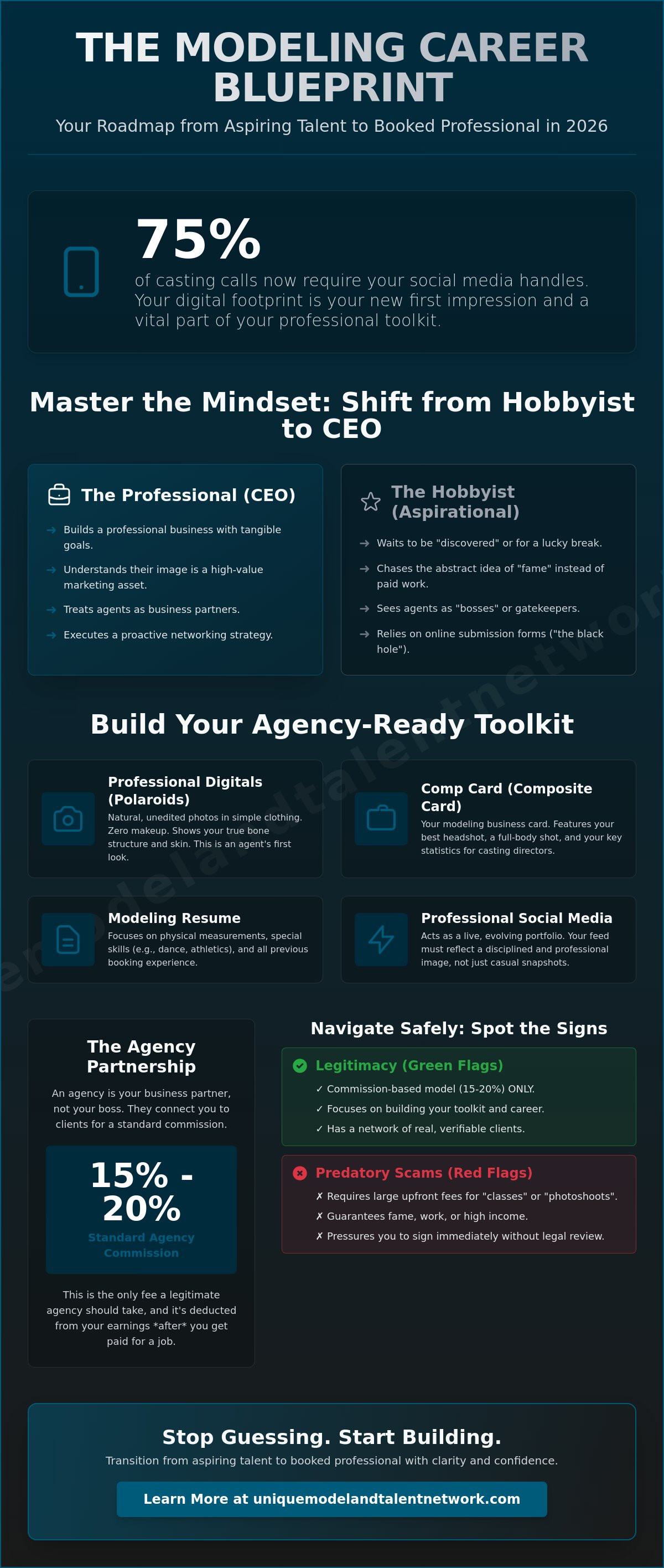
Step one is capturing professional "digitals," also known as polaroids. These are natural, unedited photos taken in simple clothing like a form-fitting t-shirt and jeans. You should wear zero makeup and have your hair styled away from your face. Agencies use these to see your true bone structure and skin texture without the interference of professional lighting or retouching. Once your digitals are secure, you will need a Comp Card (Composite Card). This is a single-sided or double-sided card that features your best headshot, a full-body shot, and your vital statistics. It acts as a quick-reference guide for casting directors during busy call sessions.
A professional modeling resume is also essential. Unlike a corporate CV, this document focuses on your physical measurements, special skills like dance or athletics, and any previous booking experience. Finally, you must establish a professional social media presence. In 2026, your Instagram or TikTok acts as a live portfolio. 75% of casting calls now require social media handles, so ensure your feed reflects a disciplined, professional image rather than just casual snapshots. If you need a second pair of eyes on your materials, our team offers comprehensive portfolio and reel reviews to ensure you're meeting the highest industry benchmarks.
Digitals vs. Professional Portfolios
Digitals are your "raw" state, showing agencies exactly what they are working with on day one. A professional portfolio, or "book," is a curated collection of stylized images that show your range as a performer. While agencies prefer simple digitals for initial submissions, they will eventually want to see how you move and take direction. Test shoots are collaborative sessions with photographers where you both work for free to build your respective books and practice new concepts.
The Anatomy of a High-Converting Comp Card
A high-converting comp card requires a striking headshot on the front and 3 to 4 varied shots on the back. It must include clear measurements: height, bust, waist, and hips. Never include your age on a professional comp card; casting directors prefer to decide if you "look the part" without being biased by a number. This strategic approach to your visual marketing is similar to the ultimate guide to building an acting portfolio that books in 2026, where clarity and professional standards always outweigh superficial filters.
Identifying Your Market and Modeling Niche
Finding your niche is the most critical strategic decision you'll make when learning how to start a modeling career. Your physical "look" isn't a measure of your worth; it's a specific aesthetic that fits into a particular market segment. In 2026, the industry is highly segmented into Editorial, Commercial, Fit, and Parts modeling. If you're 5’7” with a relatable smile, you won't find success pitching yourself to high-fashion houses that require a 5’10” runway frame. Conversely, an editorial look might be too "edgy" for a regional bank’s commercial print ad. Success comes from aligning your aesthetic with the clients who are actually spending money on talent like you.
To truly master the business of modeling, you must understand that agencies look for "market fit" above all else. They aren't just looking for beauty; they're looking for a product they can sell to their existing client base. Research which niche is most active in your specific geographic region by looking at local ad campaigns and agency rosters. For those eyeing international expansion or emerging markets, staying updated on regional trends through publications like The Rio Times can provide a competitive edge. If your local market is dominated by healthcare and insurance companies, a commercial portfolio will serve you better than a collection of high-fashion poses.
Editorial vs. Commercial: Where Do You Fit?
Editorial modeling is high fashion and avant-garde. It often requires strict height and measurement requirements, though diversity is increasing. Racial diversity on major runways reached an all-time high of 48% in the Spring 2024 season, showing that the "standard" look is evolving. Commercial modeling focuses on relatable beauty for print ads, catalogs, and TV. It's the most accessible and lucrative path for most models, including high-demand sectors like maternity modeling, where studying the content of established outlets like Pregnancy Magazine can provide essential insight into the look and feel brands desire. You must pivot your portfolio based on your target. A commercial book needs smiles and warmth, while an editorial book requires dramatic angles and high-concept styling.
Navigating Local vs. Major Markets
Starting in a secondary market like Minneapolis, Miami, or Atlanta is often smarter than moving to New York City immediately. These hubs offer plenty of commercial work and less competition, allowing you to build a professional resume. The rise of virtual castings also means you can often book work from anywhere before committing to a move. If you're unsure how to position yourself, Modeling Career Coaching: The Professional’s Guide provides deeper insights into navigating these geographic choices. Research which brands are headquartered near you and see which agencies they use for their local campaigns to find your best entry point.
The Networking Strategy: Bypassing the Cold Submission
If you think the path to success is paved with online submission forms, you're likely heading for a dead end. Most agency portals are digital "Black Holes" where 99% of applications are never reviewed by a human. Agencies receive thousands of submissions every week. Most are deleted before they're even opened. Learning how to start a modeling career in 2026 requires a more sophisticated approach than just clicking "send" and hoping for the best. You need a strategy that puts you in the same room as the people who make the actual booking decisions.
Vetted networking is the professional shortcut. It's about building relationships in environments where your talent is actually seen and evaluated. This isn't about random social media interactions or "DMing" every photographer you find. It's about entering spaces where industry professionals are already looking for new faces. Peer networking within these circles also serves as a critical safety net. It allows you to find out which photographers are legitimate and which ones should be avoided based on the real-world experiences of other models. This community-led protection is essential for anyone serious about their career security.
Why Networking Beats Cold Emails
Cold emails are easily ignored; warm introductions are not. The psychology of casting is simple. Directors prefer to book people they recognize and trust. When a casting director sees your face in a live workshop, you transition from an anonymous digital file to a recognizable professional. This familiarity significantly increases your success rate. For a deeper look at how to position yourself on these sites, read The Ultimate Acting Industry Networking Platform Guide. Building these bonds early prevents you from wasting months in an empty inbox.
Leveraging Private Talent Communities
Private, moderated environments like Unique Model & Talent Network offer a level of access that public social media cannot match. Here, you can engage in live workshops and Q&A sessions with industry experts, replacing the need for expensive and often unvetted "model camps." Our Monthly Skill-Building Challenges provide a structured way to generate high-quality content that builds a resume-ready portfolio while you refine your craft. These challenges ensure you're always producing fresh material that meets current market demands. Join our network today to stop shouting into the void and start building the connections that lead to real bookings.
Navigating the Industry Safely: Red Flags and Standards
Protecting your future is just as vital as building your portfolio. A savvy insider understands that predatory behavior often hides behind the shiny promise of a "big break." When you're figuring out how to start a modeling career, your first line of defense is a sharp business mind. A legitimate agency is your partner, and in this partnership, they only profit when you book work. They typically take a commission between 15% and 20% from your earnings. If an entity asks for significant cash before they've even found you a job, they aren't an agent; they're a salesperson selling a dream they can't deliver.
The "Golden Rule" of industry safety is absolute: never attend a casting or a photoshoot in a private hotel room or a residential home. Professional castings occur in commercial offices, studios, or vetted public spaces. If an individual claims to be a high-end scout but refuses to meet in a professional setting, walk away immediately. You must also distinguish between predatory "scam schools" that sell useless certificates and legitimate career coaching or networking memberships. Professional coaching provides you with the business tools to succeed, while scam schools focus on draining your bank account through high-pressure tactics.
Red Flags of Predatory Agencies
- Mandatory Upfront Fees: Legitimate agencies don't charge for "classes," "listings," or "mandatory" in-house photography as a condition of representation.
- High-Pressure Sales: Be wary of anyone who tells you that you must sign "right now" or the opportunity will vanish. Professional decisions take time.
- Vague Success Stories: If an agency cannot point to real, recent bookings for their talent, they aren't active in the market.
Use your professional network to vet any agency before you sign. Ask other models about their experiences and check for a history of timely payments. This due diligence is part of your role as a model-entrepreneur.
Establishing Your Professional Boundaries
You always have the right to bring a "plus one" or a chaperone to initial shoots, especially when working with new photographers. If a professional refuses this request, it's a major red flag. You must also understand "Usage Rights" and "Buyouts." These terms dictate where your image can be used and for how long. Without this knowledge, you risk being underpaid for a campaign that runs for years. Having a professional mentor to review your first few contracts provides the career security you need to focus on your craft. Mastering how to start a modeling career means knowing your worth and protecting your rights at every turn.
Launch Your Professional Future Today
Success in this industry isn't about luck; it's about the disciplined application of professional standards. You've learned that your image is a high-value business asset and that your starter kit must prioritize raw authenticity over superficial filters. By identifying your specific market niche and bypassing the digital black hole of cold submissions through vetted networking, you are already positioned ahead of the average aspiring talent. Mastering how to start a modeling career requires consistent effort and a protective community that filters out the noise of predatory scams.
To accelerate your progress, you need direct access to the decision-makers who can move the needle for your brand. Join the Unique Model & Talent Network to connect with industry experts and accelerate your career. Our members gain exclusive access to live workshops with Casting Directors, professional Portfolio and Reel Reviews, and a private, moderated community of industry insiders. These tools provide the clarity and career security you need to transition from an enthusiast to a booked professional. Your career is too valuable to leave to chance. Take the next step with the confidence of a professional who knows exactly where they're going.
Frequently Asked Questions
Do I need to go to modeling school to start my career?
No. Most professional agencies view modeling schools as unnecessary and often predatory. They prefer to train talent themselves to match their specific client needs. Focus your resources on high-quality digitals and strategic networking rather than paying for a certificate that the industry doesn't recognize. Legit agencies make money from commissions, not from selling you classes. This ensures they're invested in your actual booking success rather than just your tuition.
How much does it actually cost to start modeling?
You can start for the cost of a smartphone photo. Initial agency submissions require simple digitals which are free to take. Once you're signed, you might invest in professional test shoots. These range from $150 for beginners to $1,500 for high-end, agency-approved photographers. Avoid any agency that demands large upfront fees for "listing" or "mandatory" training before you've booked a single job. Professional growth should be funded by your earnings.
Can I start a modeling career at 25 or older?
Yes, the commercial market is highly active for models aged 25 and older. While editorial and runway often skew younger, brands in the healthcare, lifestyle, and luxury sectors specifically seek mature talent. Your look determines your niche. If you are starting later, focus on professional business development and building a commercial portfolio. This reflects your current demographic and the life experience that commercial clients find relatable and valuable.
What is the minimum height requirement for models in 2026?
Height requirements depend entirely on your niche. Runway and high-fashion editorial still favor women 5’9” to 6’0” and men 6’0” to 6’3”. However, the commercial, fit, and parts markets are much more flexible. With racial diversity on runways reaching 48% in 2024, the industry is prioritizing unique character and marketability. Many sectors outside of traditional high fashion now value personality and specific "types" over rigid physical measurements.
How do I know if a modeling agency is legitimate?
A legitimate agency only makes money when you make money. They take a 15% to 20% commission from your earnings. Red flags include high-pressure sales tactics, "limited time" offers, or requiring you to use their specific, expensive photographers. Check if they're bonded and licensed in their state. Always research their current roster to see if their models are actually booking work with recognizable brands before signing any legal contract.
Do I need a professional portfolio before I apply to an agency?
No, agencies actually prefer to see your natural state first. A professional portfolio can be expensive and might not align with the specific look an agency wants to market. Simple, unretouched digitals taken against a plain wall are the industry standard for initial submissions. Once signed, your agent will guide you on building a book. This ensures your professional images target the right clients for your specific market and demographic.
What are modeling digitals and how do I take them?
Digitals are simple, unedited photos that show your true bone structure and proportions. To take them, wear form-fitting clothing and zero makeup. Stand against a plain, neutral background in natural light. You'll need a clear headshot, a profile shot, and a full-body shot. These photos are the most important tool for anyone learning how to start a modeling career because they show your raw potential to scouts without the distraction of styling.
Is it possible to be a model if I live in a small town?
Yes, virtual castings and social media have made it possible to start from anywhere. 75% of casting calls now require social media handles, allowing you to showcase your talent to global agencies without moving. You can build your initial experience in local markets or through freelance bookings. Many models eventually travel to major hubs like New York or Miami once they've secured representation or consistent work through their digital presence.


