

What if the strongest slate is the moment you stop trying to perform? Learning how to slate for a commercial audition is less about adding extra personality and more about giving casting a clear, confident introduction before your audition. It’s easy to second-guess what to say, how to sound natural, and whether to film a full-body shot or slate in character.
Those details matter, but the audition notice is your guide. A polished slate is brief, professional, and tailored to the instructions. It isn’t a memorized pitch or another scene. You’ll learn what information to include, how to deliver it warmly without sounding stiff or over-rehearsed, and how to handle different slate formats.
This guide also gives you a repeatable checklist for recorded and in-person auditions. We’ll cover framing, delivery, and common instruction-specific requests, so you can prepare with purpose, follow the brief, and start your audition feeling composed.
Key Takeaways
- Learn how to slate for a commercial audition by treating your slate as a clear introduction, not another performance.
- Use a simple template for your name, then add details such as height or location only when the casting brief requests them.
- Keep your delivery warm and clear with a steady pace, natural expression, and no character performance unless instructed.
- Prepare your recording setup with stable framing, a clean lens, even light, a simple background, and quiet surroundings.
- Use a final checklist to review the brief, details, delivery, framing, and playback before submitting.
What Is a Slate for a Commercial Audition and Its Purpose?
A slate is a brief introduction to camera or to the casting team. It identifies you and gives casting the details requested for the role. It is separate from your commercial audition performance.
Think of it as a clear handoff, not an extra chance to act. Casting teams use the slate to connect a face and voice to a submission and gather any information they need to review it. You might slate in person or record one for a self-tape. A brief may ask for a simple introduction or specific additional details. For a general overview of what an audition is and the formats it can take, see What is an Audition?
Follow the individual casting notice. One commercial brief may ask only for your name; another may request your height, location, or other relevant information. Don’t assume that details you gave for another audition belong here. If instructions specify where the slate goes in the recording, how to frame it, or whether to include a full-body view, follow those directions. If a detail isn’t requested, leave it out.
What Casting Teams Need From a Commercial Slate
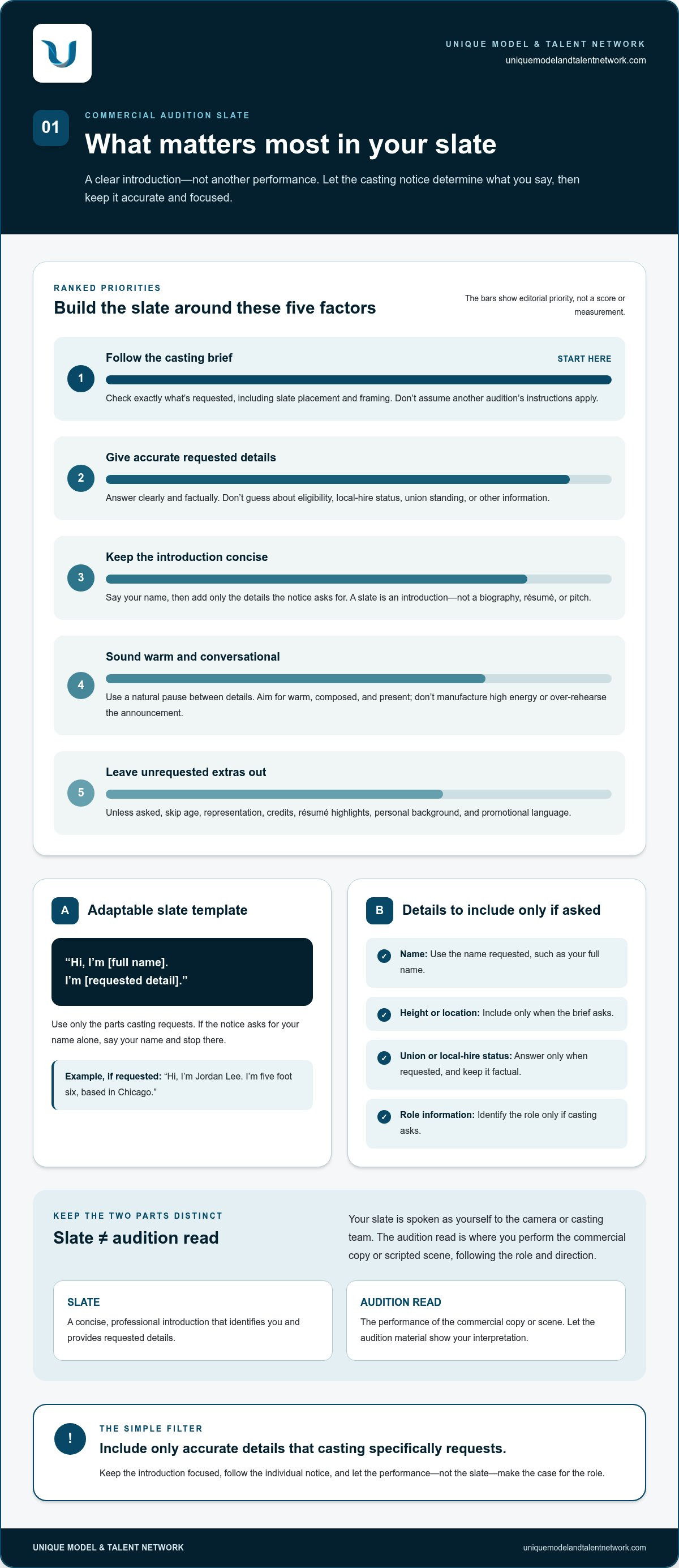
A slate gives casting a concise, professional way to identify you and check the details requested for that particular role. It isn’t a biography or a pitch. Keep your introduction focused, and let the audition material show your interpretation of the script. Read the brief before deciding what to say.
Example template: “Hi, I’m [full name]. I’m [height], based in [location].” Use only the parts the casting team asks for. If the notice requests your name alone, say your name and stop there. This is a flexible example, not a universal script.
How a Slate Differs From the Audition Read
Your slate is spoken directly to the camera or casting team as yourself. The audition read is where you perform the commercial copy or scripted scene, following the role and direction. A slate is an introduction, not a performance. You can be open and engaging without inventing a character, adding a sales pitch, or demonstrating the scene’s emotional range before it begins.
Once the slate is complete, shift to the scene’s eyeline and performance setup. In a self-tape, that may mean looking toward the reader’s position rather than directly into the lens; in person, follow the room’s direction. Some briefs place the slate after the scene or specify a particular framing sequence, so don’t assume every audition follows the same order.
Knowing the slate’s purpose makes preparation simpler: check what casting needs, keep your introduction accurate, and separate it from the role. Next, use the brief to decide exactly what to say and how to prepare your slate.
What to Say in a Commercial Audition Slate
Build your slate from the details the casting brief actually requests. There isn’t one script for every commercial audition. A casting team may ask for your name alone, or request details such as height, location, union status, local-hire status, or information related to the role. Answer clearly and accurately rather than filling every possible category.
A Simple Commercial Slate Script to Adapt
Use this as a template, not a universal script:
“Hi, I’m [full name]. I’m [requested detail].”
If the brief asks for your height and location, you might say, “Hi, I’m Jordan Lee. I’m five foot six, based in Chicago.” If it asks only for your name, remove the second sentence. Keep the wording conversational, with a small natural pause between details instead of delivering them like a memorized announcement.
Before recording, scan the instructions for each specific request. If casting asks you to identify a role, use the role name in the brief. If it asks whether you’re a local hire, answer based on your actual ability to meet that requirement. Only state union or nonunion status if requested, and describe your status accurately.
Which Details Should You Leave Out?
Extra information can distract from the details casting needs to assess and organize your submission. Unless requested, skip your age, representation, résumé highlights, credits, personal background, and promotional language. Don’t use the slate to explain why you’re right for the part; that belongs in the audition performance.
Accuracy matters as much as brevity. Don’t guess about eligibility, local-hire status, union standing, or any other fact. If the instructions use a term you don’t understand, review the breakdown and your own circumstances before recording. An inaccurate detail can create confusion.
- Name: Give the name requested, such as your full name.
- Height or location: Include these only if the brief asks.
- Union or local-hire status: Answer only when requested, and keep it factual.
- Role information: Identify the role only if casting asks you to.
Rule to remember: include only accurate details that casting specifically requests. That simple filter keeps your slate focused and helps prevent oversharing when nerves make silence feel uncomfortable. For structured practice, the industry workshops and expert Q&A sessions offer opportunities to build audition skills.
How to Deliver Your Slate Naturally Without Overacting
Knowing how to slate for a commercial audition involves more than choosing the right words. Your delivery should help casting hear and see you clearly, without turning a simple introduction into a sales pitch or a miniature performance. Aim for warm, composed, and present. You don’t need to manufacture high energy; an attentive, genuine delivery usually feels more confident than trying too hard to impress.
Should You Slate in Character or as Yourself?
Unless the casting team asks for a character slate, introduce yourself as yourself. Keep the slate’s tone distinct from the choices you’ll make in the commercial read. If a brief requests a character-specific slate, follow its direction without adding extra gestures, dialogue, or backstory. The slate sets up your audition; it doesn’t need to preview every acting choice.
For a recorded slate, look into the camera lens unless the instructions direct you elsewhere. In an in-person audition, address the casting professional or follow the room’s stated eyeline. Keep your posture easy and let your expression suit the brief. A natural smile can fit an upbeat commercial, while a neutral, friendly expression may suit a more understated tone.
How to Manage Nerves and Keep Your Delivery Grounded
Before you begin, take a comfortable breath, release tension in your jaw, and pause briefly. Speak at a pace that gives each requested detail room to land. Clear articulation matters more than sounding extra polished. A short pause between your name and another detail can help prevent a rushed delivery.
Rehearse for familiarity, not perfection. You want to know what you’re saying, not recite it with the same rigid rhythm every time. If nerves make your words unclear or your pace too fast, reset and record another take. A focused retake is more useful than pushing through while distracted.
Try this short practice exercise before submitting:
- Speak once. Deliver the slate in your normal conversational voice, following the requested details.
- Review once. Listen for clarity, pace, and whether your expression feels natural. Don’t search for tiny flaws.
- Adjust one thing. If you rushed, slow down slightly. If you sounded stiff, relax your jaw and speak to the lens as if greeting one person.
Then record again and compare the two takes. Keep the version that feels clear and grounded, not necessarily the one with the most energy. This practice gives you a repeatable way to check your delivery without over-rehearsing. Once your slate feels natural, check that the camera setup and framing support the same professional impression.
How to Frame and Record a Commercial Audition Slate
A clear recording helps casting focus on your introduction rather than distractions in the frame or sound. There’s no single camera angle or orientation for every audition. Use the casting brief as your recording plan before adjusting your setup.
A Quick Setup Check Before You Record
Work through this pre-take sequence in order. It keeps your setup simple and helps you catch a mismatch before recording.
- Start with the casting brief. Confirm the requested orientation, slate placement, framing, and any full-body requirement. Follow the specified format rather than assuming every audition should be filmed the same way.
- Stabilize and position the camera. Set it at a height that captures you as directed, then check focus. Keep the device steady so the image doesn’t shift while you speak.
- Check the lens and background. Clean the lens and choose a simple, uncluttered setting. Remove visual distractions that compete with your face or make the shot feel untidy.
- Check light and sound. Use even light that lets casting see your face clearly, and reduce nearby noise where possible. Make sure your voice can be heard without competing sounds.
- Match the frame to the request. Review the shot for the specified head-and-shoulders or full-body composition. Include a full-body view only when requested, and make sure you remain clearly visible within the frame.
Give extra attention to framing when a full-body view is requested. Check that the camera captures you from head to toe without cutting off your feet or placing you so far away that your face becomes difficult to see. If the instructions call for a close-up slate followed by a wider view, follow that sequence. Don’t add a framing change the brief doesn’t ask for.
What to Check in the Playback
After recording, watch or listen to the slate once before submitting. Confirm that you’re audible, in focus, and framed as requested. Check that the spoken details match the brief and that you haven’t added anything unintentionally. If the notice specifies a file order or submission format, preserve it rather than adding unnecessary edits or extra takes.
For how to slate for a commercial audition, treat playback as a final quality check, not an invitation to overwork a clean take. If the image, sound, framing, and requested information are clear, you’re ready to move on. Live industry workshops offer a way to keep practicing audition skills with professional guidance.
Your Final Commercial Slate Checklist, and Where to Keep Building
You’ve prepared your words, delivery, and recording setup. Before submitting, take a brief final pass. A reliable review catches small mismatches without turning a straightforward slate into a prolonged retake session. The aim is simple: follow the casting request, keep every detail accurate, and let the slate do its job.
The 30-Second Slate Review
Use this checklist before you send your audition. If each item meets the brief, you can submit with confidence.
- Brief: Have you followed the requested slate order, format, and placement?
- Details: Does what you say match the request, with no inaccurate or unrequested additions?
- Delivery: Is your voice clear and natural, with the slate distinct from your audition performance?
- Framing: Does the composition match the instructions, including any requested full-body view?
- Playback: Is the recording audible and in focus, and does the file follow the submission directions?
That’s the core of how to slate for a commercial audition: follow the request, stay accurate, and keep your introduction focused. If something is off, correct that specific issue. If everything checks out, resist the urge to keep changing a solid take.
How Continued Practice Can Strengthen Your Audition Skills
Introductions can feel awkward until they become familiar. Deliberate practice helps you focus on the person you’re speaking to, rather than worrying about every word or expression. Rehearse reading a brief, preparing the requested details, and delivering them naturally. Keep the practice flexible so you can adapt to new instructions instead of relying on one fixed script.
For broader film industry audition preparation, build the same habit of reading directions closely and making choices that fit the specific audition. You can also develop your acting portfolio by giving thoughtful attention to the materials that represent your work.
Structured learning provides opportunities to keep refining your skills. Unique Model & Talent Network offers live industry workshops, expert Q&A sessions, and monthly skill-building challenges for continued practice and professional development.
Ongoing guidance and a professional learning community can support your development as you continue to practice, respond to each brief, and bring a clear, grounded approach to your next audition.
Make Your Next Audition a Confident One
A slate is a small moment you can make your own through preparation and practice. Keep building the habit of showing up focused, responsive, and ready to connect, whether you’re recording a self-tape or stepping into a casting room. That steady approach can support more than one audition by helping you develop confidence in how you present yourself professionally.
The Unique Model & Talent Network offers workshops led by industry professionals, portfolio and reel reviews, skill-building challenges, and expert Q&A sessions. These resources provide opportunities to keep developing your craft and learning from industry professionals.
Put what you’ve learned about how to slate for a commercial audition into practice, then keep strengthening your skills through structured learning. Explore the Unique Model & Talent Network.
Frequently Asked Questions
Is a slate required for every commercial audition?
No. Include a slate when the casting instructions request one; some projects specify a spoken introduction, while others may request a different format. Read the audition email and breakdown before preparing your file or arriving at an in-person audition. If there’s no slate instruction, don’t add one automatically. For example, if a submission asks for a scene take only, adding an unrequested slate may not follow the requested format.
How long should a commercial audition slate be?
Keep it only as long as needed to deliver the requested information clearly. There isn’t one duration that fits every project, since the details and format can differ. Avoid turning the introduction into a personal pitch or résumé summary. If you’re recording the slate and scene together, leave a brief natural pause between them so the shift is clear, without adding a long explanation or extra background.
Can I redo a slate if I stumble over my words?
For a self-tape, you can usually record another take if the submission instructions allow it. Choose one that’s clear and natural, rather than repeating takes until your delivery sounds overly polished. If you stumble during an in-person audition, pause, reset calmly, and continue unless the casting team directs you otherwise. There’s no need to explain the mistake at length; that can draw attention away from the audition.
Should I include my age in a commercial audition slate?
Include your age only if casting specifically asks for it. A request for an age range or another age-related detail isn’t automatically the same as asking you to state your exact age, so follow the wording in the brief. Don’t volunteer personal information as a substitute for something you’re unsure about. If a detail is requested but unclear, avoid guessing and use the stated submission instructions to guide your response.
Can I use the same slate for every commercial audition?
You can develop a consistent, natural way of speaking, but tailor the details and format to each project. One brief may request your name, while another may ask for additional information or a specific slate order. A dependable approach to how to slate for a commercial audition starts with treating each breakdown as its own set of directions. Recheck the current brief before submitting, even if you’ve recently recorded another audition.
What should I do if the slate instructions conflict with general advice?
Follow the project’s explicit instructions. General tips are starting points, not a replacement for directions about what to say, how to frame the shot, or where the slate belongs in the file. For example, if a brief requests a particular orientation that differs from your usual setup, use the requested orientation. Before submitting, compare the finished recording with the breakdown so your choices match this audition rather than a general rule.


