

What if the "gatekeepers" you're trying to impress are actually waiting for you to take the lead? Many actors spend years feeling invisible on casting sites, wondering why their profiles never seem to trigger an audition. You don't need a signed contract with a top-tier agency to start landing professional work. Learning how to self-submit for acting roles is the most effective way to take control of your career trajectory in 2026. It's about moving beyond the "post and pray" method and treating your craft like a high-level business operation.
We understand the frustration of seeing questionable casting calls or paying for memberships that don't yield results. It's exhausting to feel like you're shouting into a void without any feedback. This guide will show you how to master the strategic art of self-submission so you can bypass traditional barriers and book professional work on your own terms. We'll provide a clear daily workflow to improve your audition-to-submission ratio and help you access higher-quality, paid roles. By refining your digital presence and understanding the specific requirements of 2026's top platforms, you'll turn your profile into a consistent booking machine.
Key Takeaways
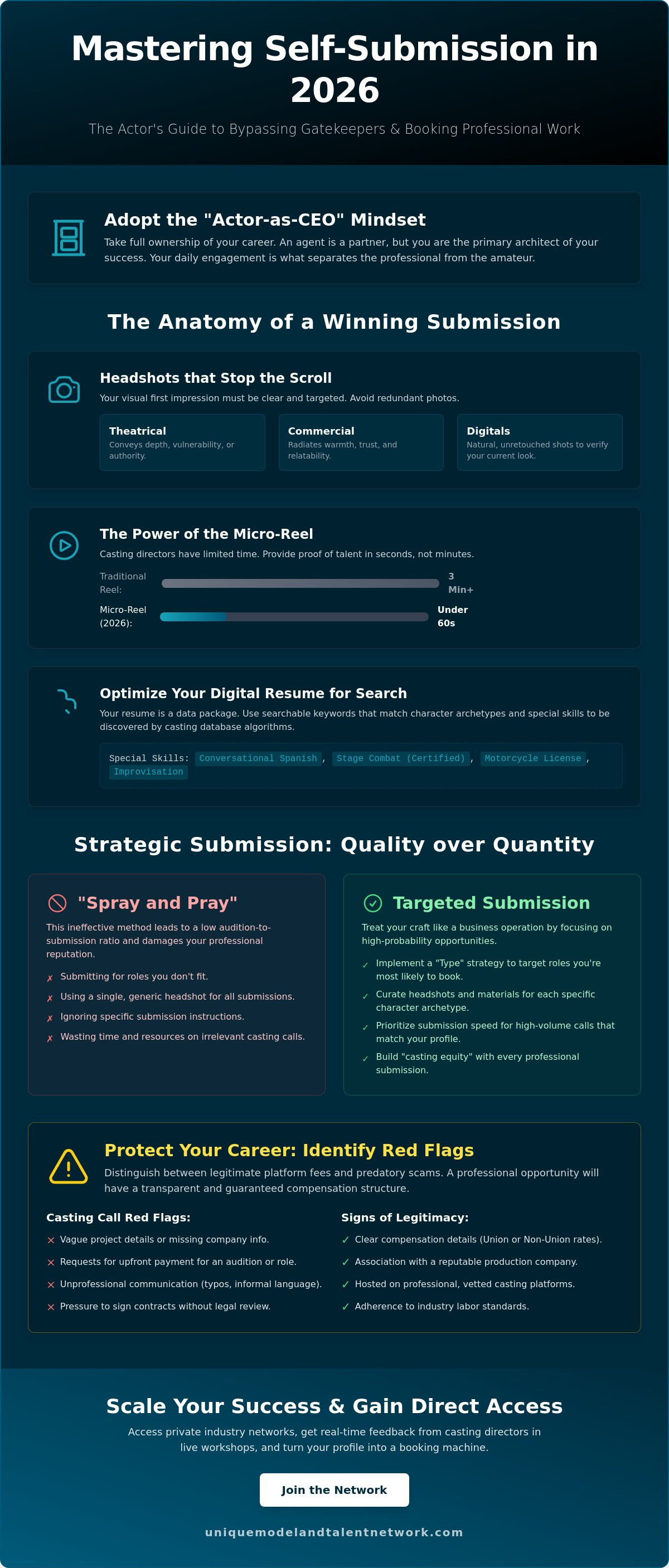
- Adopt an "Actor-as-CEO" mindset to take full ownership of your career development and professional visibility.
- Master how to self-submit for acting roles by curating headshots that match specific character archetypes and optimizing your digital resume with searchable keywords.
- Implement a "Type" strategy to target the roles you're most likely to book while prioritizing submission speed for high-volume calls.
- Protect your professional reputation by identifying red flags in casting calls and distinguishing between legitimate platform fees and predatory scams.
- Access private industry networks and live workshops to gain direct exposure to casting directors and receive real-time feedback on your materials.
What is Self-Submission and Why is it Essential in 2026?
Self-submission is the proactive process of actors applying for roles directly through casting platforms or industry networks. In 2026, the professional landscape has shifted away from passive waiting. To succeed, you must adopt an "Actor-as-CEO" mindset. This means you are your own primary publicist, managing both your digital presence and professional marketing collateral. For actors who require high-end physical portfolios or branded assets, Linemark provides commercial-grade printing and communication solutions. Even after you sign with an agent, you remain the chief architect of your career momentum. An agent is a valuable partner, but they cannot be everywhere at once. Your daily engagement with your own career development is what separates the working professional from the hopeful amateur.
The 2026 landscape is digital-first. This environment has leveled the playing field for unrepresented talent. When you master how to self-submit for acting roles, you are building "casting equity." Every submission serves as a professional touchpoint with a decision-maker. You are getting your face and your talent in front of recruiters repeatedly, proving your range and your reliability. Understanding the casting process helps you realize that casting directors are often looking for specific archetypes or fresh talent that their standard agency rosters might not currently reflect. By submitting yourself, you ensure you're always in the room where decisions are made.
The Myth of the "Agent-Only" Casting Call
The Financial Legitimacy of Self-Submitted Roles
It's a mistake to confuse self-submission with "hobbyist" projects. While low-budget calls exist, a significant amount of professional, paid union and non-union work is available directly to talent. You should use the best casting websites to identify high-value opportunities that meet your professional standards. Financial legitimacy in professional acting is defined as a contract that provides transparent, guaranteed compensation and adheres to established industry labor standards. By targeting these legitimate roles, you ensure your career is built on a foundation of professional business development rather than amateur distractions.
The Anatomy of a Winning Self-Submission
Once you've embraced the "Actor-as-CEO" mindset, your focus must shift to the technical quality of your digital assets. A professional submission is a data package that needs to be optimized for both human eyes and casting database algorithms. Mastering the technical side of how to self-submit for acting roles ensures that when a decision-maker finally clicks your profile, they find a polished, ready-to-work professional. To truly understand what happens on the other side of the table, you must realize that your materials are often viewed on a grid of hundreds of other performers. Your goal is to provide clarity and proof of talent in under five seconds.
Headshots That Stop the Scroll
In a digital-first environment, your theatrical and commercial headshots must be distinct. A theatrical shot should convey depth, vulnerability, or authority; meanwhile, a commercial shot needs to radiate warmth and relatability. Avoid the "redundancy trap" where every photo in your gallery looks like a slightly different version of the same shirt. Casting directors also require "Digitals," which are natural, unretouched shots taken against a plain wall. These serve as a secondary verification that you actually look like your professional headshots in real life. If you are unsure if your current images meet these standards, a Portfolio & Reel Review can provide the professional clarity you need.
The Power of the Micro-Reel
The traditional three-minute acting reel is essentially dead in 2026. Casting directors no longer have the time to sit through montages or slow-burn transitions. Instead, you should utilize "Micro-Reels." These are 15 to 30-second clips of specific performance types. If you're submitting for a procedural drama, attach a 20-second clip of you playing a professional. If it's a sitcom, attach a comedy clip. For a deeper dive into asset creation, refer to the ultimate guide to building an acting portfolio. Matching your clip directly to the role you are submitting for significantly increases your audition-to-submission ratio.
- Optimize your resume: Use searchable keywords like "local hire," "valid passport," or specific dialects to help casting filters find you.
- Verified credits: Ensure your credits are formatted correctly with the project title, role type (Lead, Supporting, etc.), and production company.
- The Submission Note: Keep it concise. A simple, "Local hire in Chicago with current passport and police procedural experience," adds more value than a paragraph of fluff.
- Updated Digitals: Refresh your natural shots every six months or whenever your look changes significantly.
Refining your workflow for how to self-submit for acting roles involves constant maintenance of these assets. When your contact information, sizes, and location are always updated to 2026 standards, you remove the friction that prevents casting directors from booking you. Efficiency is the hallmark of a savvy industry insider.
Strategic Submission: Moving Beyond "Spray and Pray"
Many actors fall into the trap of submitting for every role that vaguely matches their age range. This "spray and pray" method is inefficient and can damage your professional reputation. If you want to master how to self-submit for acting roles, you must narrow your focus to the 3-5 character archetypes you are most likely to book right now. This is your "Type" strategy. By specializing, you become a clear solution for casting directors rather than a generic option they have to filter out. When you present yourself as a specialist, you build trust with casting offices that value precision and professional self-awareness.
Timing is a critical factor in your daily workflow. For high-volume calls, being in the first 50 submissions often determines whether your materials are even seen. Casting directors frequently stop reviewing new profiles once they've found a sufficient pool of talent for the first round of auditions. You should also track your engagement data. Use a simple log to record which headshots or micro-reels trigger profile views. If a specific "look" consistently gets clicked, that is your market telling you exactly what your most bankable asset is. Don't guess what the industry wants; let the data guide your asset selection.
Character Matching and Archetypes
Analyze every breakdown like a detective to find the subtext of what the casting director truly needs. If a role description mentions "quiet intensity," don't attach a clip of a high-energy comedic performance. You can often "warm up" a submission by briefly referencing a previous workshop or a professional connection you share with the office. However, you must avoid the danger of over-submitting. Sending your materials for roles you are clearly not right for signals to casting directors that you don't understand your own brand. This lack of discipline can lead to your profile being ignored in the future, even when you are a perfect fit.
Professional Submission Etiquette
The savvy insider approach to communication is brief, professional, and results-oriented. If a role requires specific disclosures, such as comfort with explicit content or specialized stunt experience, provide these details clearly and without emotion. If you have nothing specific to add that isn't already on your resume, it's often better to leave the submission note blank. A professional submission note should be structured as a concise statement of fact that pairs your current location with a specific skill or credential directly requested in the breakdown. This approach respects the casting director's time and reinforces your status as a disciplined professional who understands how to self-submit for acting roles at the highest level.
Avoiding the "Submission Black Hole" and Industry Scams
The entertainment industry is unfortunately a magnet for predatory behavior and data-mining schemes. When you are learning how to self-submit for acting roles, you must develop a "Protective Mentor" checklist to ensure your personal data and professional reputation remain secure. The "Submission Black Hole" occurs when actors send their materials to unverified casting calls that serve no purpose other than collecting contact information. If a project asks for sensitive identification or personal financial details before a formal audition, it is a clear red flag. Legitimate casting directors focus on your talent and professional credentials, not your social security number.
A common point of confusion is the "pay-to-play" debate. You must distinguish between legitimate casting sites that charge a transparent subscription fee for platform access and predatory services that demand "consultation fees" or "guaranteed booking" charges. Legitimate platforms provide a service by aggregating verified breakdowns; they never take a commission from your paycheck. Additionally, while background work can provide supplemental income, it should rarely appear on your professional submission resume. Cluttering your credits with "Extra" work signals to decision-makers that you are a hobbyist rather than a principal performer. Focus your energy on projects that build your bankable credits.
Vetting the Production
Before you hit send, use industry databases like IMDbPro to verify the track record of the casting director and the production company. Professional union breakdowns under SAG-AFTRA come with specific legal protections and payment guarantees that non-union projects may lack. If you are submitting for non-union work, look for transparency regarding the shooting schedule and the "financial legitimacy" we discussed in previous sections. A managed community acts as a vital safety seal for unrepresented talent by pre-vetting opportunities and removing the noise of unorganized social media groups. To ensure you are only seeing high-quality, verified calls, consider joining The Network Membership for a more secure career environment.
Overcoming the "No-Agent" Objection
You may encounter a situation where a casting director asks for your representation during a callback for a self-submitted role. The best response is honest and business-oriented: "I'm currently self-representing and managing my own bookings." This answer demonstrates the "Actor-as-CEO" mindset and shows that you are disciplined enough to handle your own professional affairs. You can eventually use your self-submission success to accelerate your acting career by presenting your booking data to potential agents. Showing a future representative that you already know how to self-submit for acting roles and land work makes you a much more attractive, low-risk signing.
- IMDbPro Check: Verify the casting director has a history of completed, professional projects.
- Contract Transparency: Ensure the breakdown clearly states the pay rate and usage terms.
- Data Security: Never provide sensitive ID documents until you have signed a formal contract.
- Resume Discipline: Keep background work off your principal acting resume to maintain a professional image.
Scaling Your Success with the Unique Model & Talent Network
Mastering the mechanics of how to self-submit for acting roles is only the first phase of your career acceleration. The second phase involves moving from the isolation of public casting sites into a private, moderated environment where professional standards are the baseline. The Network Membership provides this essential transition. By joining a gated community, you remove the noise of social media and the risk of predatory "casting calls" found on unorganized platforms. This is where you gain direct access to industry experts and casting directors who value the accreditation and high standards that our members represent.
A significant advantage of this community is the shift from "cold" submissions to "warm" networking. Our Live Industry Workshops allow you to receive real-time feedback on your submission materials from the very people who hire talent. Instead of wondering why your profile isn't getting views, you get direct answers on how to optimize your assets. We also host Monthly Skill-Building Challenges designed to keep your portfolio and micro-reels current. These prompts ensure you always have fresh, competitive material that reflects the character archetypes you are currently targeting.
From Submission to Booking: The Network Advantage
Understanding acting workshops online is critical for bridging the gap between simply "submitting" and actually "performing" in an audition. These sessions provide the craft development necessary to back up your professional digital presence. We've seen numerous case studies where members booked major roles by applying the specific submission strategies taught within our network. Our Portfolio & Reel Reviews act as an elite filter, ensuring your headshots and clips meet the precise requirements of top-tier casting offices. When your assets are vetted by insiders, your confidence in how to self-submit for acting roles grows exponentially.
Join a Community That Values Your Craft
Isolation is the enemy of professional growth in the entertainment industry. A supportive network of peers provides advocacy and shared knowledge that social media groups simply cannot replicate. You can participate in Industry Expert Q&A Sessions to refine your submission strategy and clarify any uncertainties regarding the 2026 landscape. We emphasize the financial legitimacy of every opportunity, acting as a reliable bridge between emerging talent and established professionals. This disciplined approach ensures you are spending your time on work that builds your career security rather than chasing vanity metrics.
- Direct Access: Connect with casting directors in a secure, private environment.
- Expert Feedback: Participate in live workshops to polish your submission assets.
- Consistent Growth: Engage in monthly challenges to keep your reel competitive.
- Professional Advocacy: Benefit from a community that prioritizes integrity and efficiency.
Ready to stop shouting into the void? Join The Network today and submit like a pro.
Take Command of Your Casting Journey in 2026
The transition from a struggling actor to a working professional requires more than just talent; it demands a disciplined, business-oriented strategy. By adopting the "Actor-as-CEO" mindset and optimizing your digital assets for the modern landscape, you remove the barriers between your craft and the decision-makers who hire. Mastering how to self-submit for acting roles ensures you are never dependent on a gatekeeper to move your career forward. You now have the tools to identify high-value opportunities, vet productions for financial legitimacy, and present your materials with the precision of an industry veteran.
Success in this field is rarely a solo endeavor. While self-reliance is essential, joining a gated community provides the security and high-level networking necessary to scale your results. Our private community on Mighty Networks offers direct access to live workshops with Casting Directors and Professional Portfolio & Reel Reviews to ensure your assets stay competitive. It's time to leave the uncertainty of public social media groups behind and step into a professional environment built for your success. Join the Unique Model & Talent Network and start booking work today. You have the talent and the strategy; now it's time to take the stage.
Frequently Asked Questions
Do I really need an agent to get professional acting roles in 2026?
No, you don't need an agent to access professional roles. The 2026 industry relies heavily on direct-to-talent platforms that allow unrepresented performers to compete for high-level projects. By mastering how to self-submit for acting roles, you establish yourself as a proactive professional. Many casting directors actually prefer the direct access that self-submission provides when looking for fresh faces outside of the standard agency rosters.
Which casting websites are the best for self-submitting?
The industry standard sites remain Actors Access, Casting Frontier, and Backstage. New AI-powered platforms like P3RSON are also gaining traction by matching talent directly with brands and creators. Each site has a specific focus. Backstage is excellent for theater and indie film, while Casting Frontier is a primary hub for commercial work. Diversifying your presence across these platforms ensures you don't miss high-value opportunities.
How much should I spend on casting site subscriptions each month?
You should budget approximately $30 to $60 per month for your primary subscriptions. As of 2026, Actors Access Plus is $9.99 per month, while Casting Frontier Premium Plus is $20.99. Backstage subscriptions start around $20.00. Focus your investment on the platforms most relevant to your specific character archetypes to maintain a high-level professional presence without overextending your budget.
Can I self-submit for SAG-AFTRA roles if I am non-union?
Yes, you can submit for union roles even if you are currently non-union. Casting directors have the authority to Taft-Hartley a non-union actor if they are the most authentic fit for the project. This process effectively grants you union eligibility based on your performance. Proactive self-submission is one of the most common ways emerging talent breaks into the SAG-AFTRA ecosystem and secures professional, union-protected contracts.
What should I include in the "notes" section of a self-submission?
Your submission notes should only contain factual, high-value information that isn't already obvious on your profile. Mention your "local hire" status for specific cities or highlight a specialized skill like fluency in a second language or advanced stage combat. A concise note like "Local hire in Atlanta with current passport and valid driver's license" is much more effective than a generic plea for an audition. Professionalism is defined by brevity.
How many headshots should I have on my casting profile?
You should maintain a gallery of 2 to 4 high-impact headshots. This should include one theatrical shot, one commercial shot, and one or two character-specific "look" variations. Avoid the redundancy trap of uploading twelve nearly identical photos. Casting directors need to see your range and your professional "type" quickly. Quality always outweighs quantity when you are learning how to self-submit for acting roles effectively.
Is it okay to submit for the same casting director multiple times?
It is absolutely acceptable to submit to the same casting office multiple times for different projects. Every professional submission builds your "casting equity" by keeping your face in front of decision-makers. As long as you are genuinely right for the specific role you are applying for, you are demonstrating your reliability and interest. Consistent, high-quality submissions eventually turn you into a familiar, trusted name in the casting database.
What happens if I get a callback from a self-submission but don’t have an agent to negotiate?
If you receive a callback without representation, you can manage the initial negotiation yourself. Most professional contracts follow standard industry rates; you can always consult an entertainment lawyer for a flat fee if the contract is complex. Successfully booking a role on your own terms is a powerful credential. You can eventually use this data to attract an agent by proving you already have a bankable track record.


