
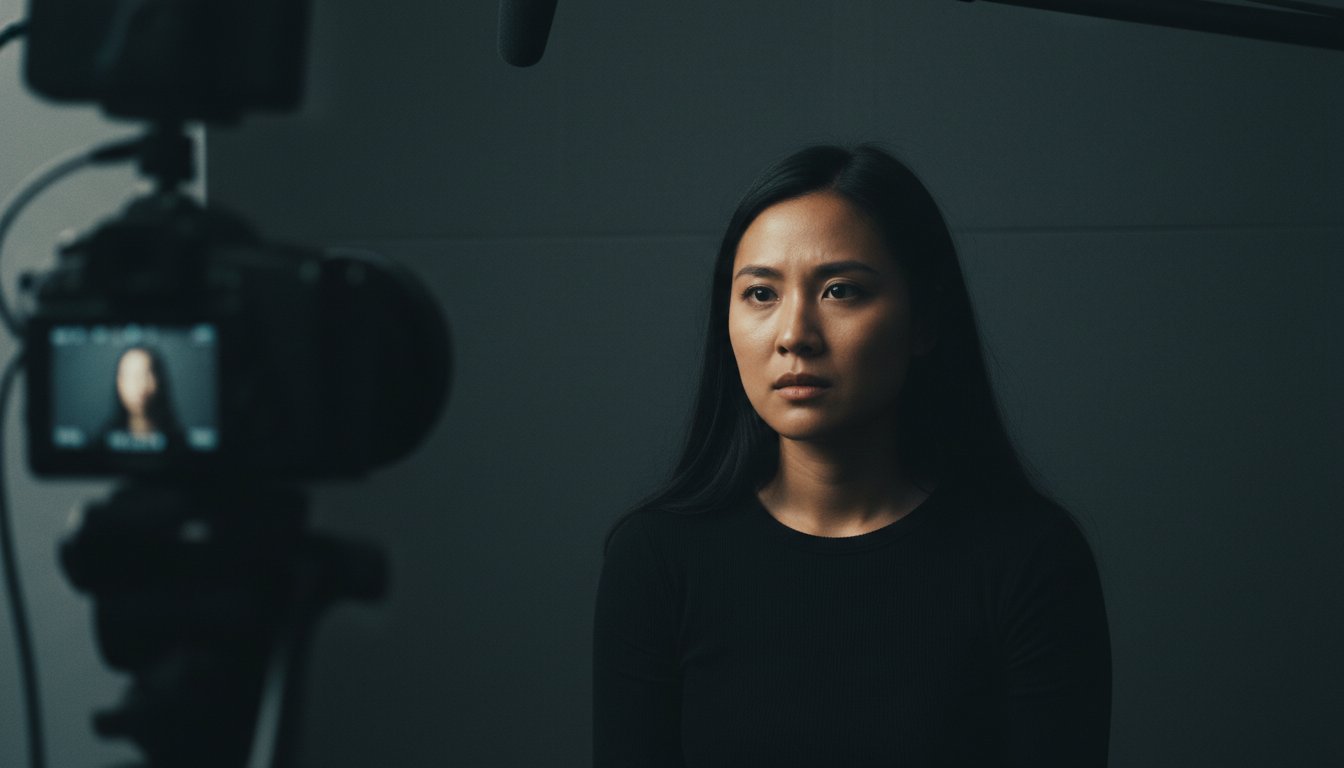
What if the most transformative performance of your career happens in an empty room with nobody watching? Many actors believe they're just spinning their wheels without a scene partner or a director's immediate feedback. You might feel that learning how to practice acting by yourself is a poor substitute for a real rehearsal, but the reality is quite different. Solo practice is the professional gym where you build the muscle memory required to execute under the pressure of a high-stakes set.
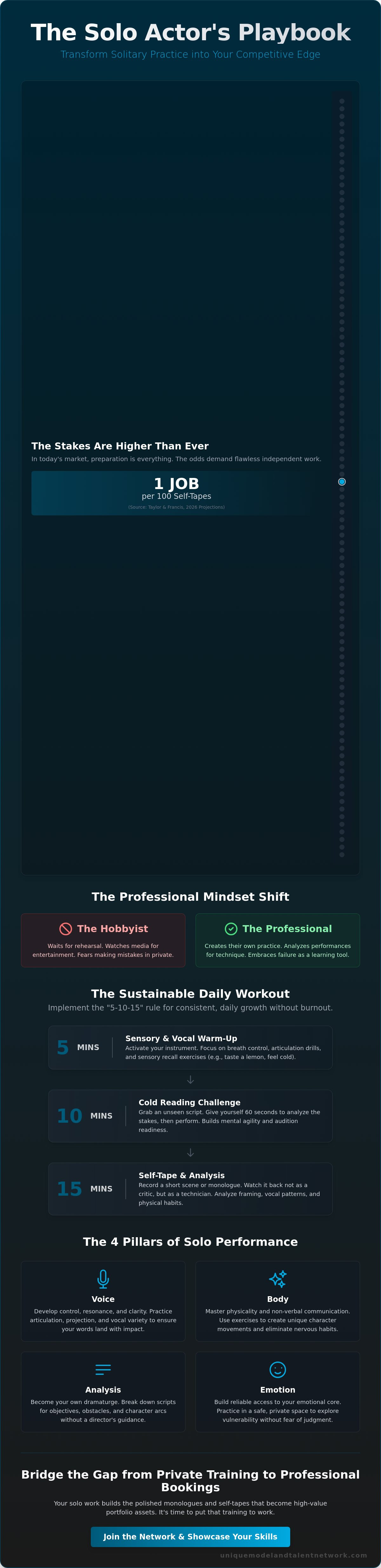
It's understandable to feel uncertain about whether your solo drills are actually effective, especially when the industry has become so competitive. In 2026, research from Taylor and Francis indicates that actors now average closer to one job for every one hundred self-tapes submitted. This shift means your independent preparation must be flawless. This guide will show you how to transform your solitary hours into a professional training regimen that catches the eye of casting directors. You'll gain a structured daily routine to improve your self-tape quality and build the confidence to deliver a natural, conversational performance the moment your next audition arrives.
Key Takeaways
- Reframe solo practice as a competitive advantage that builds the professional stamina and muscle memory required for high-pressure sets.
- Master the core pillars of performance by learning how to practice acting by yourself through daily sensory drills and cold reading challenges.
- Utilize your camera as a diagnostic tool rather than a mirror to objectively evaluate your technical naturalism and self-tape framing.
- Implement the "5-10-15" rule to establish a sustainable 30-minute daily workout that prevents performance staleness and ensures consistent growth.
- Bridge the gap between private training and professional representation by using polished solo monologues as high-value portfolio assets.
Mastering the Solo Actor’s Paradox: Why Private Practice is Your Competitive Edge
Many actors believe that performance is a team sport that only exists when a scene partner is present. This is a fundamental misunderstanding of professional development. Rehearsal is for the production, but practice is for the performer. When you learn how to practice acting by yourself, you aren't just running lines; you're building a foundation of intentional skill-building that remains invisible until the moment the red light on the camera blinks. If you treat your living room like a professional studio, your brain will respond with professional-grade focus.
Professionals understand that solo work builds "unconscious competence." This is the ability to perform complex emotional and physical tasks without overthinking. In high-stakes auditions, your brain is often flooded with adrenaline. If your technique hasn't been drilled in private, it will crumble under pressure. By exploring a comprehensive list of acting techniques in your own time, you develop a personalized toolkit that belongs to you, not your director. This self-reliance is the hallmark of a serious industry professional who doesn't wait for permission to grow.
The Psychology of the Private Rehearsal Space
Your home should be more than just a place to sleep; it's your laboratory. The "sacred space" of a private room allows for deeper emotional exploration because the fear of judgment is removed. You can fail spectacularly without consequences. To make this effective, you must overcome the "feeling silly" barrier. Talking to a wall or an imaginary friend feels absurd at first, but this is exactly where the breakthrough happens. Set physical boundaries in your living space. Designate a specific corner as "the set" and treat it with the same respect you'd give a professional soundstage. This mental shift ensures that when you step into that space, your creative instincts are immediately activated.
From Hobbyist to Pro: The Shift in Mindset
The difference between a hobbyist and a professional often comes down to how they consume media. A hobbyist watches a film to be entertained; a pro watches to analyze the beats, the breath, and the physical choices. This active observation is a core component of how to practice acting by yourself. Casting directors have a sixth sense for actors who "stay in the gym." They can see the technical precision and the vocal control that only comes from daily discipline. In an industry defined by unpredictable cycles and long gaps between bookings, your solo routine is the only thing you truly control. It's your career security and your bridge to the next major booking.
Essential Solo Acting Exercises: From Script Analysis to Sensory Drills
Building a professional-grade performance requires more than just passion; it demands a technical foundation. If you want to master how to practice acting by yourself, you must focus on the four pillars of solo practice: Voice, Body, Analysis, and Emotion. These aren't isolated skills. They're interconnected muscles that need daily resistance training. While some beginners make the mistake of practicing in front of a mirror, professionals know that mirror work creates a vanity loop that kills spontaneity. Instead, focus on exercises that force you to look inward or react to an imaginary environment.
One of the most effective ways to build mental agility is the "Cold Reading" challenge. Grab a script you've never seen, give yourself sixty seconds to identify the stakes, and perform it immediately. This mimics the fast-paced reality of a producer session where adjustments are expected on the fly. For physical development, the "Animal Exercise" remains a staple. Choose an animal, study its movements, and slowly integrate those physical traits into a human character. This prevents generic acting and gives your character a unique physical center that casting directors will notice. If you're looking for more structured ways to test these skills, participating in Monthly Skill-Building Challenges can provide the external pressure needed to grow.
Deep Script Analysis Without a Director
Professional acting begins on the page. When you're working alone, you must become your own dramaturge. Break down your sides using the objective and tactic framework. Ask yourself: "What do I want in this moment, and what am I willing to do to get it?" Don't stop at the lines. Write a character biography to fill in the gaps the writer left behind. Identifying the inciting incident in a single-page monologue is crucial. It's the moment that changes everything. If you miss it, your performance will feel flat and aimless.
Sensory and Emotional Memory Drills
To ground your performance in reality, use Stanislavsky's "Sense Memory" technique. Practice recreating the physical sensations of an environment, like the bite of cold wind or the smell of a hospital room. These acting exercises for performers help you build a believable world without needing expensive sets. Learning how to practice acting by yourself ensures that your emotional triggers are sharp and ready for any scenario. Move into "Personalization" by connecting your own history to the character’s stakes. This isn't about wallowing in your past; it's about finding a parallel emotional truth. Finally, develop a vocal warm-up routine that projects professional authority. A thin, unsupported voice can undermine even the most brilliant emotional work.
Leveraging Technology: How to Use Self-Taping as Your Personal Acting Coach
Technology has bridged the gap between the isolated rehearsal room and the professional casting office. While the previous sections focused on internal preparation, this is where you turn your practice into a tangible asset. The most effective way to understand how to practice acting by yourself is to treat your camera as your most honest coach. A mirror is a deceptive partner because it encourages you to "watch" yourself while you perform, leading to a self-conscious and superficial result. The camera, however, captures the truth of your transitions and the clarity of your intentions without the vanity loop.
To maximize this, you should adopt the "Three-Take Method" for every solo session. Your first take is purely instinctual. Your second take is a technical adjustment where you focus on a specific note, perhaps incorporating different acting warmups and techniques to shift your energy. The third take is the integration of both, where you let go of the technicality and trust your preparation. This diagnostic approach allows you to see exactly where your performance loses steam or where your physical choices become repetitive.
Setting up a professional-grade "Self-Tape Corner" doesn't require a massive investment. In 2026, casting directors expect a clean, neutral background and soft, three-point lighting. You can achieve this with a simple ring light and a solid-colored wall or a portable pop-up backdrop. The goal is to remove all technical distractions so the viewer can focus entirely on your performance. If your lighting is uneven or your audio is echoey, it suggests a lack of professional standards that can overshadow even the most brilliant acting.
The Objective Critique: Reviewing Your Own Work
The hardest part of learning how to practice acting by yourself is the review process. You must learn to watch your footage like a talent scout, not a critic. Look for "dead eyes," which happen when you stop thinking the character's thoughts between lines. Identify physical tics, such as unnecessary head nodding or shifting weight, that pull focus from the story. If you find yourself cringing, stop. Shift your focus to vocal clarity and the smoothness of your emotional transitions. This objective analysis is the only way to close the feedback loop without a director present.
Mastering the Self-Tape Technical Standard
Your technical proficiency is now a non-negotiable part of your craft. Beyond the lighting, your "slate" is a critical component of your professional presentation. It's often the first thing a casting director sees, and it serves as a gauge for your personality and professionalism. Ensure your framing is correct, typically a medium close-up, and that your eyes are clear and well-lit. Once you've mastered these technical requirements and produced a tape that meets your high standards, it becomes a high-value asset for your acting portfolio. This is where your solo practice finally transforms into a career-building tool.
Building Your Professional Training Schedule: The 30-Minute Daily Actor Workout
Inspiration is for amateurs; professionals rely on a schedule. While a 10-minute "hack" might help you find a specific emotion, it won't build a sustainable career. To truly master how to practice acting by yourself, you need a holistic routine that balances technical skill with industry literacy. The "5-10-15" Rule is designed to fit into a busy life while ensuring no part of your craft atrophies. By dedicating 30 minutes every day, you move from a passive dreamer to an active participant in your own professional growth.
This daily workout is divided into three distinct phases. First, spend five minutes on physical and vocal readiness. Next, dedicate ten minutes to deep script analysis or character development. Finally, spend fifteen minutes on active performance, preferably recorded as discussed in the previous section. To keep your work from becoming stale, rotate your monologues every two weeks. This forces you to apply your skills to new challenges rather than just repeating a memorized pattern. To ensure you're applying these skills to the right opportunities, consider joining The Network Membership to access high-level professional resources and community support.
Morning Routine for Vocal and Physical Readiness
Your day should begin with a focus on your primary instruments: your body and voice. Start with articulator drills and resonance placement exercises to ensure your speech is clear and supported. Integrate yoga or "Neutral Body" stretches to release any physical tension that might block your emotional flow. Finish with a stream-of-consciousness character writing session. This is the actor’s version of "Morning Pages." Write as your character for five minutes without stopping. This bridges the gap between your personal identity and the character's psyche before you ever pick up a script.
The Evening Review: Analyzing Industry Trends
The final part of your daily discipline involves the business of acting. Spend 10 minutes on casting websites to study current breakdowns. This helps you understand what types of roles are actually being cast in 2026 and allows you to tailor your practice accordingly. Watch one scene from a "Top 10" film and reverse-engineer the performance. Ask why the actor made specific choices. End your night by preparing your "sides" for the next morning’s session. Tracking this progress in a "Performance Journal" allows you to spot patterns and celebrate technical breakthroughs that would otherwise go unnoticed. This is how to practice acting by yourself with the precision of an elite athlete.
Beyond the Bedroom: Transitioning Solo Skills into Professional Bookings
Solo work is the engine of your career, but even the most powerful engine needs a road to drive on. While you've mastered how to practice acting by yourself through technical drills and self-tape analysis, these skills must eventually survive the "stress test" of professional scrutiny. The transition from private rehearsal to a paid set is where many talented performers falter. They become comfortable in the safety of their own space but lose their edge when faced with the high-stakes environment of a casting director’s office or a live production. To avoid this, you must bridge the gap between solitary skill-building and industry-standard performance.
There is a distinct danger in what professionals call "hermit acting." If you only perform for your own camera, you risk developing blind spots that only an external eye can detect. Acting is, at its core, an act of communication. Without a recipient for your performance, your choices can become self-indulgent or repetitive. Your polished solo monologues shouldn't just live on your hard drive. They are your primary tools for attracting representation and proving your technical naturalism to elite agencies. In an era where actors submit nearly one hundred self-tapes for every single booking, your independent work must be refined by professional standards to stand out in a saturated market.
Closing the Feedback Loop with Industry Experts
The most effective way to validate your progress is through a structured feedback loop. While you've learned to critique your own footage, acting workshops online provide the "director’s eye" that is impossible to replicate alone. These sessions allow you to test your solo-developed characters in a live, virtual environment. Participating in Monthly Skill-Building Challenges also allows you to benchmark your progress against other serious professionals. Within a private network, you can have your tapes reviewed by real casting directors, ensuring your technical setup and emotional transitions meet 2026 industry requirements.
Your Gateway to the Real Industry
Transitioning from a solo practitioner to a working professional requires a shift in environment. Moving your career to a dedicated acting industry networking platform removes the distractions of general social media and places you in a managed talent community. This professional ecosystem is designed to vet opportunities and protect you from the unorganized communication typical of hobbyist groups. It provides the clarity and direction needed to turn your daily 30-minute workout into a sequence of professional bookings. If you're ready to stop practicing in a vacuum and start building a verified career, join the Unique Model & Talent Network today. This is your professional home, where your solo discipline finally meets the high-value opportunities you've been training for.
Elevate Your Craft from the Living Room to the Global Stage
You've established that mastering how to practice acting by yourself is a matter of professional discipline rather than creative isolation. By integrating rigorous script analysis with a structured 30-minute daily schedule, you build the "unconscious competence" that casting directors demand. Leveraging self-tape technology as a diagnostic tool ensures your work remains grounded, technically precise, and conversational. These solitary hours are the foundation of your professional identity, providing the stamina required for high-stakes environments.
However, even the most disciplined solo routine eventually requires the "stress test" of expert feedback to truly accelerate your career. Our gated community provides the clarity and direction you need to move beyond the rehearsal room and into the professional market. Join the Unique Model & Talent Network to get professional feedback on your craft. You'll gain exclusive access to live workshops with casting directors, monthly skill-building challenges, and a private, moderated professional community designed for serious talent.
Your commitment to the gym is what separates a hobbyist from a professional. If you're ready to turn your solo preparation into a verified career, we're ready to open the door for you. Start building your legacy today.
Frequently Asked Questions
Can I really learn acting by myself without a teacher?
You can build a significant technical foundation by yourself, but acting is ultimately a collaborative art. While you can master how to practice acting by yourself to develop muscle memory and script analysis skills, you eventually need professional feedback to validate your instincts. Think of solo work as the gym and workshops as the game. Both are necessary to succeed in a competitive industry.
How often should I practice acting if I don’t have an audition coming up?
Daily practice is the industry standard for serious performers regardless of their current audition schedule. A consistent 30-minute routine keeps your vocal and physical instruments sharp. This discipline ensures that when a high-stakes opportunity finally arrives, you aren't starting from zero. Consistency is the primary factor that separates working professionals from hobbyists.
What are the best monologues for solo acting practice?
The most effective monologues are contemporary pieces that fit your current casting type and age range. Avoid overused "classical" pieces unless you are specifically targeting theater roles. Rotating your material every two weeks prevents your performance from becoming mechanical. It also forces you to apply your skills to fresh character objectives and varied emotional stakes.
Is it better to practice in front of a mirror or a camera?
The camera is always the superior choice for professional development. Mirrors encourage you to watch your facial expressions, which leads to superficial and self-conscious acting. A camera allows you to review your work objectively after the performance is over. This helps you identify physical tics or "dead eyes" without breaking your concentration during the scene.
How do I know if my acting is actually getting better?
Progress is measured through the clarity of your intentions and the consistency of your technical execution. Use a Performance Journal to track your daily sessions and compare self-tapes from several months ago to your current work. You'll know you're improving when your transitions feel smoother and your physical choices become more specific and grounded in the text.
What tools do I need for a home acting studio?
A professional home setup requires a smartphone with a high-quality camera, a solid-colored neutral backdrop, and a basic three-point lighting kit. Audio is equally important; ensure your space is free of echo or external noise. These tools are now non-negotiable for meeting 2026 self-tape standards and demonstrating your professional legitimacy to casting directors.
How can I get professional feedback on my solo work?
You can obtain professional critiques by joining managed talent communities that offer Portfolio & Reel Reviews. These private environments connect you with industry experts who provide the "director's eye" you lack during solo practice. This closes the feedback loop and ensures your independent training aligns with current market expectations and recruitment standards.
Can solo practice help me get an acting agent?
High-quality self-tapes produced during solo practice are essential assets for attracting professional representation. Agents look for actors who demonstrate technical naturalism and a disciplined work ethic. Your polished monologues serve as a proof of concept, showing that you are ready to be submitted for major bookings and can handle the technical demands of a professional set.


