
Most actors think networking is about "selling" themselves to casting directors, but the reality is that the most successful professionals in 2026 are the ones who act as low-risk assets rather than high-pressure salespeople. Learning how to network in the film industry isn't about breaking into an exclusive club; it's about establishing the professional standards that make you an obvious choice for the 2.01 million jobs currently supported by the American film and television industry. You've likely felt the frustration of shouting into the void of social media or feared that reaching out to a busy producer would come across as "bothering" them. It's a common anxiety in an industry that can often feel like it's gated by invisible walls.
This guide will show you how to dismantle those barriers by mastering a clear, professional strategy for relationship building that unlocks the hidden job market and accelerates your career. You'll learn exactly how to approach decision-makers with confidence and purpose. We'll explore specific frameworks for high-value outreach, the shift toward vetted professional communities, and how to position your craft as a vital human element in an era of increasing AI integration.
Key Takeaways
- Understand why industry decision-makers prioritize vetted talent to mitigate risk and how you can position yourself as a high-value, low-risk professional asset.
- Master the "Give-First" framework to learn how to network in the film industry by offering professional currency and reliability before seeking favors.
- Discover why private, gated networks provide a safer and more efficient alternative to the noise and potential scams of public social media platforms.
- Follow a tactical 2026 checklist to audit your portfolio for market readiness and identify target professionals who align with your specific brand and look.
- Learn how to leverage expert-led workshops and portfolio reviews to build the confidence required for successful outreach to casting directors and agents.
Why Networking is the 'Hidden' Job Market of the Film Industry
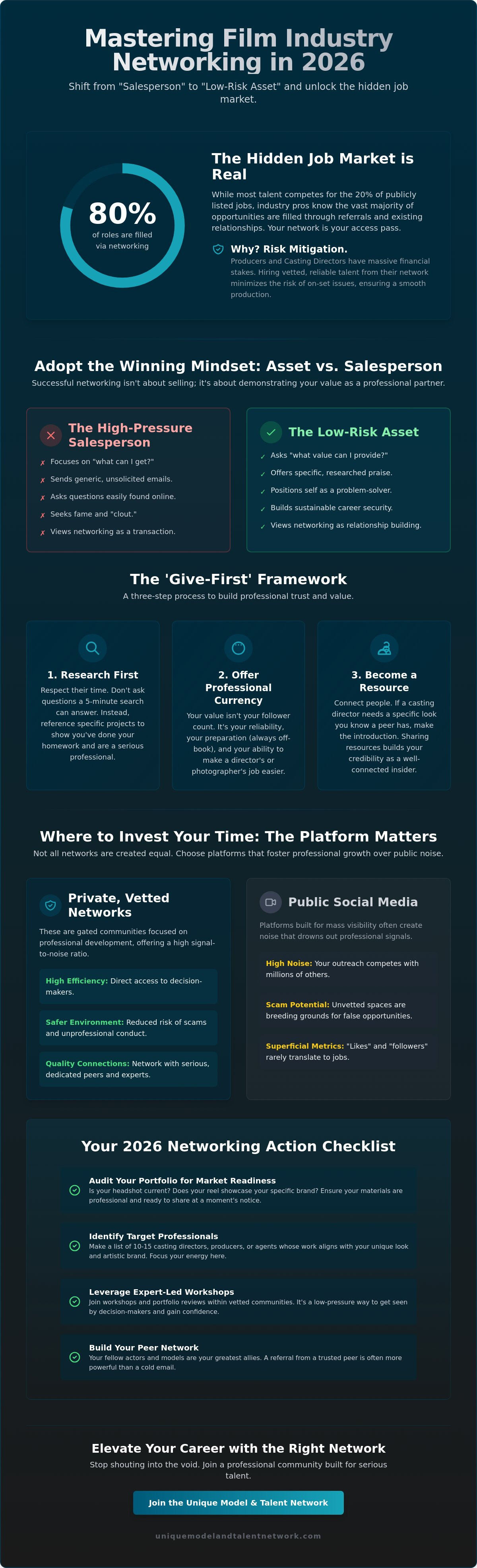
Networking in this field isn't about collecting business cards or chasing fame; it's a strategic process of building professional trust before a contract is ever signed. While many newcomers spend their days refreshing casting sites, seasoned pros know that most opportunities never make it to a public board. This is the "hidden" job market. Industry standards consistently suggest that 70% to 80% of roles are filled through existing relationships, internal databases, or direct referrals. If you aren't in those databases or on those shortlists, you're competing for a tiny fraction of the available work.
The reason for this reliance on referrals is simple: risk mitigation. Producing a film or a commercial campaign involves massive financial stakes. A casting director's primary job is to provide the production with reliable, high-standard talent. When they hire someone they've already met or someone a trusted colleague has vouched for, they're reducing the risk of a "no-show" or an unprofessional personality on set. Learning how to network in the film industry is essentially the art of proving you're a low-risk, high-reward professional long before you step into the audition room.
It's vital to distinguish between social networking and professional networking. Social networking is often focused on visibility for the sake of ego or "clout." Professional networking is about career building; it's the disciplined pursuit of connections that lead to sustainable work and professional growth. It moves away from the superficiality of "likes" and toward the security of professional bonds.
The Shift from Luck to Strategy
Waiting for an agent to discover you isn't a viable strategy in 2026. The most successful talent takes ownership of their own business development. You must position yourself as a professional peer rather than a fan. This means showing up in professional spaces, having a sharp portfolio ready, and maintaining consistent visibility. Casting directors need to see your face and your work multiple times before you become a "known quantity" in their mental database. Consistency builds a sense of career security for both you and the people hiring you.
Identifying Your High-Value Connections
Focus your energy on the people who actually move the needle. This includes casting directors, producers, and professional photographers who frequently work with high-level clients. However, don't overlook your peers. Peer networking is just as crucial as "networking up." Your fellow actors and models are often the first to hear about a role that isn't right for them but fits your brand perfectly. The power of the second-degree connection is the backbone of the entertainment world; a recommendation from a friend to a director is often more powerful than any cold email.
The 'Give-First' Framework: How to Build Value
When you master the 'Give-First' framework, you transform from a talent seeker into a professional partner. This shift is essential for anyone learning how to network in the film industry effectively. Your 'Professional Currency' isn't measured by your follower count; it's measured by your ability to solve problems for decision-makers. For an actor, this means being the person who is always off-book, always on time, and always brings a unique, prepared perspective to the room. For a model, it's about being the professional who understands lighting and movement so well that the photographer's job becomes effortless. Learning how to network in the film industry as a talent requires you to think like a producer, always looking for ways to add value to the production.
Before you send an email, apply the 'Research First' rule. If a question can be answered by a five-minute search, don't ask it. Busy professionals appreciate when you respect their time. Instead of asking generic questions, focus on specificity. Generic praise like "I love your work" feels like noise. A value-added outreach mentions a specific project or a choice the professional made that resonated with your own artistic brand. This level of detail proves you are a serious student of the craft, not just another fan seeking a shortcut.
Becoming a Resource, Not a Requester
Position yourself as a solution to a casting director's specific needs. If you know they're struggling to find a niche skill or a specific look that a peer of yours possesses, make the introduction. Sharing resources and industry news with your network builds your authority as a savvy insider. When you vouch for others, you're actually building your own credibility; it shows you have an eye for talent and a high standard for professionalism. This collaborative mindset is exactly what we cultivate in our Live Industry Workshops, where talent learns to engage as peers rather than competitors.
Mastering the Art of the Follow-Up
Staying on a professional's radar requires a delicate balance. Use the 'Three-Touch' rule to maintain visibility without becoming a nuisance. Your first touch is the initial meeting. The second should be a value-add, perhaps sharing an article or a resource relevant to a project they're working on. The third touch should be a 'Career Win' update, such as a new reel or a booking that aligns with their casting style. A professional follow-up is a brief, benefit-oriented update.
Social Media vs. Vetted Networks: Where to Invest Your Time
Public social media platforms like Instagram and X have become increasingly ineffective for professional talent in 2026. The "Noise Problem" is a significant barrier; your professional message is often buried under a mountain of lifestyle content, viral trends, and bot activity. When you're trying to figure out how to network in the film industry, relying on unmoderated spaces exposes you to risks like scams and predatory "pay-to-play" schemes. These environments lack the professional standards required to build legitimate career security, making it difficult to distinguish between a hobbyist and a serious professional.
Gated communities offer a necessary alternative by providing direct access to moderated environments filled with high-standard peers. These spaces act as a filter, removing the distractions that plague public platforms. By choosing a focused environment, you signal to industry decision-makers that you value professional growth over superficial fame. This shift toward private networks is about moving away from the chaos of the public square and into a space designed for tangible success.
The Pitfalls of Informal Networking
Reaching out via DMs is often the least professional way to contact a Casting Director or Producer. It lacks the formal structure and boundaries that industry pros respect in their daily operations. There is a profound psychological difference between a public forum and a private professional network. In a gated community, the expectation of business development is already established. Choosing the right digital space protects your professional image and ensures your outreach is perceived as a legitimate business inquiry rather than an intrusion.
Leveraging Managed Communities for Fast-Track Growth
Industry pros look for professionals in professional spaces. Utilizing a managed acting industry networking platform eliminates the distractions of general social media and focuses entirely on recruitment and talent evaluation. Curated networks provide "warm" introductions, where your membership itself acts as a badge of quality and commitment. These platforms facilitate real-time rapport through Live Industry Workshops and Expert Q&A Sessions, allowing you to bypass the uncertainty of "cold" calling. When you're learning how to network in the film industry, being in a space that prioritizes accreditation and internal industry perspectives gives you a decisive advantage over those stuck in the noise of external platforms.
Tactical Steps: Your 2026 Networking Checklist
Moving from theory to execution requires a disciplined approach. If you're serious about learning how to network in the film industry, you need a repeatable system that moves you closer to decision-makers every week. This isn't about luck; it's about preparation and targeted outreach. Follow this professional checklist to ensure your efforts result in tangible career growth rather than wasted time.
- Step 1: Audit your acting portfolio for market readiness. Ensure your materials meet 2026 standards before you begin outreach.
- Step 2: Identify 10 "Target" professionals whose current work or casting style aligns with your specific "look" or brand identity.
- Step 3: Engage with casting websites and professional databases to keep your profile active and searchable.
- Step 4: Attend live industry workshops. These provide the face-to-face time necessary to move from a digital profile to a remembered professional.
- Step 5: Document every interaction in a simple Relationship Manager (CRM) or spreadsheet. Track when you last spoke, what you discussed, and when it's time for a professional follow-up.
By organizing your outreach, you remove the anxiety of "bothering" people and replace it with a structured business development plan. You can start building these connections today by joining The Network Membership, where we provide the tools and community to execute this strategy effectively.
Maximizing Live Workshops and Q&As
When you attend a session, your goal is to be remembered for your professionalism. Ask a memorable question that showcases your understanding of industry standards rather than asking for a job. For example, inquire about a casting director's specific process for evaluating reel updates in the current market. The "Post-Workshop" protocol is just as vital; send a brief, specific thank-you note that references a point they made. Real-time feedback in acting workshops online is a powerful way to refine your approach and build rapport without the logistical barriers of travel.
Portfolio Readiness: The Networking Secret Weapon
In 2026, your headshots and reel function as your digital business cards. They must be sharp, current, and professional. If there's a disconnect between your materials and your actual skill level, you create "networking friction" that stops a connection before it starts. A professional review ensures your materials are optimized for recruitment. A networking-ready portfolio is one that answers a Casting Director's questions before they are asked.
Elevating Your Career with the Unique Model & Talent Network
The final step in mastering how to network in the film industry is choosing an environment that actively advocates for your success. While individual strategy is vital, the most significant career shifts happen within curated spaces where the barriers between talent and decision-makers are intentionally removed. We provide that bridge by hosting a private, gated community that prioritizes professional standards over social media metrics. This creates a protective environment where you can focus on business development without the predatory or disorganized feel of public forums. You're no longer shouting into the void; you're engaging in a space designed for tangible results.
Membership offers more than just a digital profile. It provides a structured path to career security through Portfolio & Reel Reviews and Monthly Skill-Building Challenges designed to keep your craft sharp. You're joining a community of high-standard peers who understand that the "hidden" job market is built on mutual respect and professional advocacy. When one member succeeds, it reinforces the reputation of the entire network. This creates a rising tide for all serious professionals involved, moving the focus away from superficial competition and toward collective career acceleration.
Direct Access to Decision-Makers
Access is the most valuable currency in entertainment. Our platform facilitates this through moderated Industry Expert Q&A Sessions with guest Casting Directors and Photographers. These aren't just lectures; they are opportunities to build "warm" connections in a professional environment that respects everyone's time. Unlike a standard subscription, this is a career investment. It moves you away from the uncertainty of cold submissions and places you directly in front of the people who manage recruitment and talent evaluation. You gain the internal industry perspectives necessary to navigate a field that increasingly values human artistry and professional accreditation.
Your Next Move: Joining the Network
As we move through 2026, the era of the "Private Network" has arrived. The noise of external platforms has made it harder than ever to stand out, making exclusive, vetted spaces the primary hubs for legitimate opportunities. Whether you're an emerging actor auditing your first portfolio or a seasoned model looking for high-level workshops, the immediate benefits of membership scale with your experience level. You don't have to guess how to network in the film industry when you have a roadmap and a community already in place to support your growth.
Join the Unique Model & Talent Network and start building your professional future today.
Secure Your Place in the Professional Film Community
Success in the entertainment world is no longer a matter of being in the right place at the right time; it's a matter of being the right professional in the right space. You've seen how the hidden job market relies on trust and risk mitigation. By adopting a give-first framework and auditing your materials for market readiness, you move from an outsider to a peer. Understanding how to network in the film industry effectively means moving away from the noise of public social media and into curated environments where your craft is recognized by decision-makers.
The transition from aspiring talent to established professional requires more than just persistence; it requires legitimate access. We've built a gated environment where you can bypass the chaos and connect with vetted industry experts who are looking for talent like you. It's time to replace uncertainty with a clear strategy and a supportive community of high-standard peers.
Join the Professional Community Built for Your Success and gain direct access to casting directors within our private moderated community. Your career acceleration starts with the decision to invest in your professional development today. We are ready to help you navigate this path with confidence.
Frequently Asked Questions
How do I network in the film industry if I have no experience?
Start by building professional bonds with your peers. Emerging actors and models are often your best sources for independent project leads and shared resources. If you focus on being a reliable resource for others at your level, you'll naturally grow as they do. This lateral networking creates a foundation of trust that is essential when learning how to network in the film industry from scratch.
Is it okay to message casting directors on Instagram?
Messaging casting directors on Instagram is generally considered unprofessional and intrusive. Most decision-makers prefer to keep their personal social media separate from their recruitment process. If you want to be taken seriously, use official email channels or private, moderated networks where professional outreach is expected. This protects your image and ensures your message is viewed in a business context rather than as noise.
What should I say when reaching out to an industry professional for the first time?
Lead with a specific, brief reference to their recent work. Avoid generic praise and never ask for a job or representation in your first message. A professional outreach should be concise; mention a project of theirs that resonated with you and express your interest in their casting style. This proves you've done your research and respect their time as a busy industry professional.
How can introverts network effectively in such a loud industry?
Introverts can thrive by leveraging digital platforms and written communication. You don't have to be the loudest person in the room to make an impact. Focus on one-on-one connections and moderated online spaces where you can contribute thoughtfully. These environments allow you to showcase your professional standards and build rapport without the exhaustion of high-pressure, in-person mixers.
Do I need an agent before I start networking with casting directors?
You don't need an agent to begin building professional bonds with casting directors. In fact, establishing your own presence and reputation can make you more attractive to future representation. Many talent pros value the initiative it takes to manage your own business development. Learning how to network in the film industry independently ensures you aren't solely reliant on a third party for your career growth.
How do I find film industry networking events near me?
Major film festivals like Sundance, TIFF, and the Miami Film Festival are primary hubs for networking. In 2026, these events offer various pass levels, such as the Miami Film Festival's Social Pass for networking access. You can also check with your local film commission or join a private digital network to find vetted workshops and Q&A sessions that happen regardless of your physical location.
What is the best way to follow up after an audition or workshop?
Send a brief, benefit-oriented update within 24 to 48 hours. A simple thank-you note that mentions a specific piece of feedback you received is highly effective. If you've recently updated your reel or portfolio, use that as a professional excuse to check in. Keep the communication focused on how you are continuing to grow as a low-risk asset for their future productions.
How do I know if a networking opportunity or talent network is a scam?
Look for transparency and a focus on skill building rather than empty promises of fame. Legitimate networks will never guarantee bookings or direct representation in exchange for a fee. Check for an emphasis on financial legitimacy and professional standards. If a group feels disorganized or uses high-pressure sales tactics, it's likely a distraction from your actual career goals.


