

Earning your SAG card is often treated like a secret society initiation, but in reality, it's a calculated business transition that requires more than just luck. You've likely felt the frustration of the voucher system or the paralyzing fear that joining too early might cost you valuable non-union work. It's a common crossroads where emerging talent often feels stuck without a clear map, wondering if they're ready for the professional standards of the big leagues. This guide provides the definitive professional roadmap for how to get a SAG card in 2026, offering the clarity you need to move from eligible to member with absolute confidence.
We'll break down the $3,000 initiation fee, the three-voucher background path, and the precise strategic timing that ensures your union status accelerates your career. You'll gain a clear checklist for eligibility, an understanding of the financial commitment, and a strategy for finding union-covered jobs that respect your craft. This isn't about chasing fame; it's about securing your professional future and joining a community of 160,000 media professionals who value excellence and career security. We're here to help you move past the noise and toward a sustainable, protected career in the industry.
Key Takeaways
- Identify the most efficient route for your career by mastering the distinction between the Principal Performer path and the three-voucher background system.
- Understand the strategic advantage of "SAG-Eligible" status, which allows you to build a competitive resume before the "Must Join" rule requires full membership.
- Learn the precise steps for how to get a SAG card, including how to secure a Taft-Hartley agreement and the specific documentation required for verification.
- Take control of your career by leveraging Ultra Low Budget (ULB) contracts and specialized casting platforms to find union-covered work without an agent.
- Accelerate your professional development through live industry workshops and expert Q&A sessions that connect you with the standards of the union community.
Understanding SAG-AFTRA: Why the 'Card' is a Career Milestone
SAG-AFTRA stands as the primary labor union for approximately 160,000 media professionals in 2026, acting as the bedrock of professional standards in the entertainment industry. Understanding SAG-AFTRA is essential for any actor who wants to move beyond the hobbyist stage and into a legitimate, protected career. The "card" functions as more than a membership ID; it's a signal to producers and casting directors that you're a vetted professional who understands the business of acting. It represents a transition from being a "talent" to being a "professional partner" on a production.
Membership unlocks a suite of elite protections that non-union performers simply don't have. You'll benefit from standardized onset safety protocols, comprehensive health and pension plans, and the long-term financial security of residual payments. Despite these perks, the industry often presents a "Catch-22" for emerging talent. You need the card to access the most lucrative, high-profile roles, yet you need those very roles to qualify for membership. Navigating the question of how to get a SAG card requires a tactical approach to bridge this gap without losing your career momentum or your financial stability.
The Reality of Union vs. Non-Union Work
The gap between union and non-union sets is wider than most realize. Union productions operate under strict contracts that guarantee minimum pay scales, regulated meal breaks, and mandatory overtime pay. On a non-union set, you're often at the mercy of the production's fluctuating budget and ethics. Once you join the union, Global Rule One takes effect. This rule mandates that you only work on union-signatory productions. While this exclusivity preserves your professional value, it also means you must be ready to compete at the highest level. Casting directors view union status as a mark of reliability and experience, which immediately elevates your standing in competitive markets.
Is 2026 the Right Year for You to Join?
The entertainment landscape in 2026 has shifted following recent industry-wide contract negotiations, creating a more stable and lucrative environment for professional performers. If you're based in a major hub like Los Angeles, New York, or Atlanta, union status is often the baseline for entry into the rooms where major casting decisions are made. You must evaluate your current bookability before making the leap. If you've reached a plateau in the non-union space, it's likely time to move into the union pool. This transition is a significant business decision, but for those serious about their craft, it's the only way to access elite opportunities and long-term career security.
The Three Proven Paths to SAG-AFTRA Eligibility
The roadmap for how to get a SAG card is built on three distinct pillars of professional entry. While the industry often feels like a closed door, these established protocols ensure that talent with the right combination of skill and persistence can earn their place. Understanding these entry points allows you to stop wishing for a breakthrough and start executing a calculated business strategy. There are no shortcuts, but there are definitely smarter ways to manage the system.
The Principal Path (Taft-Hartley)
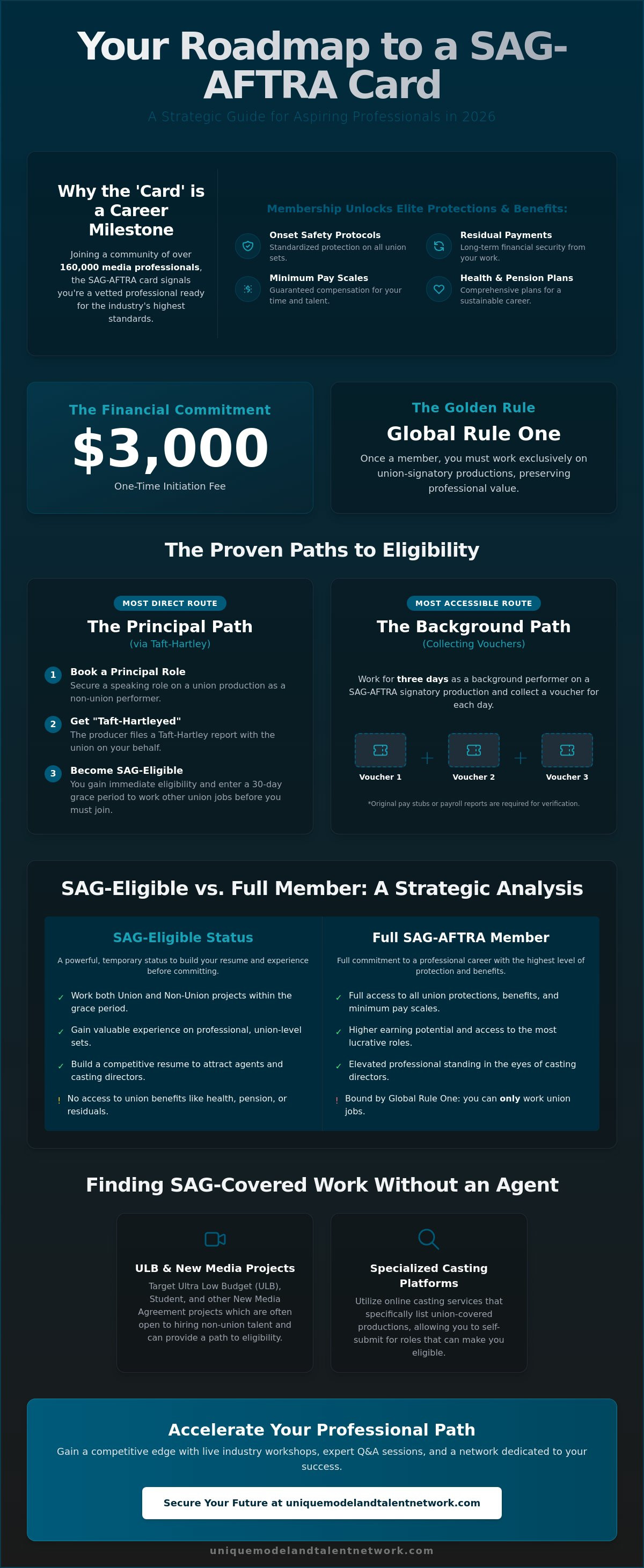
Booking a principal role on a union production is the most direct route to membership. Under the Taft-Hartley Act, a producer can hire a non-union performer if they possess a specific skill, look, or quality that union members cannot provide. Once you're hired for a principal role, you're "Taft-Hartleyed." The production submits a waiver to the union, and you become SAG-eligible immediately. This status gives you a 30-day window to work on other union projects before you're required to join. It's a high-stakes entry that demands you're ready to perform at an elite level from day one.
The Background Path: Vouchers and Persistence
For many, the background performer route is the most accessible way to gain eligibility. You must work for three days as a background performer on a production under a SAG-AFTRA contract. Each day earns you a "union voucher." While non-union actors are often hired for background, union vouchers are only distributed when the union's daily quota for members isn't met. You can sometimes earn a "bump up" to a union voucher if you're asked to perform a specific task, such as driving a car or providing a specialty skill. Remember that the union requires original pay stubs or payroll reports for verification; copies of vouchers are not accepted. To sharpen the skills that get you noticed for these upgrades, consider participating in Live Industry Workshops where you can learn the nuances of professional set etiquette.
Sister Unions and Reciprocity
If you're already a member of an affiliated performers' union like Actors' Equity Association (AEA) or ACTRA, you may have a streamlined path. In 2026, the reciprocity rule generally requires you to be a member in good standing for at least one year and have worked at least once as a principal performer under that union’s contract. This "one year and one job" rule recognizes your professional standing in theatre or international markets and allows you to bypass the voucher system entirely. It's a strategic way to leverage your existing professional bonds to expand your market reach.
The New Media and ULB Strategic Entry
Independent productions using SAG-AFTRA Ultra Low Budget (ULB) or New Media contracts offer a tactical entry for emerging talent. These contracts are designed to help smaller productions hire professional talent, and they often provide a more accessible path to getting Taft-Hartleyed. Producers on these sets are frequently more open to hiring non-union actors who bring high value to the project. This allows you to secure your eligibility on a smaller, more collaborative set before stepping onto a massive studio production.
SAG-Eligible vs. SAG-Member: A Strategic Analysis
Understanding the distinction between being eligible and being a card-carrying member is the most critical business decision you'll face. Once you've secured your first principal role or third background voucher, you've essentially figured out how to get a SAG card, but you haven't actually bought it yet. This period of "SAG-Eligibility" is often the most profitable phase for an emerging actor. You're seen as professional enough to work union jobs, yet you're still legally allowed to book non-union commercials and independent films that provide your "bread and butter" income. It's a strategic sweet spot that allows you to build your resume while keeping all doors open.
The union's "Must Join" rule eventually ends this dual-market access. After your first SAG-covered principal role, you have a 30-day grace period to work on other union projects as a non-member. Once that window closes, you are required to join the union to work on any subsequent union production. This is why timing is everything. If you jump into membership too soon, you lose the ability to work non-union jobs under Global Rule One. This can significantly impact your cash flow if you aren't yet booking union roles consistently enough to sustain your lifestyle.
Joining is a major financial commitment. In 2026, the national initiation fee is $3,000, though it can reach $3,121 depending on your local branch. Beyond this one-time cost, you'll pay annual base dues of $246.14, split into two installments on May 1 and November 1. You'll also contribute 1.575% of your covered earnings as work dues. It's a professional investment that requires a solid savings plan. These costs are non-negotiable for anyone serious about their career longevity and access to the union's pension and health plans.
The Benefits of Staying 'Eligible'
Marketing yourself as "SAG-E" on your resume tells casting directors you're ready for the big leagues without the legal restrictions of full membership. Use this time to refine your craft and build a professional acting portfolio that stands up to union-level scrutiny. This status allows you to gain experience on high-quality sets while still keeping your options open for lucrative non-union commercial work. It is the perfect time to experiment with different markets and find your niche.
When to Pull the Trigger and Join
You should consider joining when your union callbacks become frequent and you've established a strong relationship with a talent agent who focuses on union breakdowns. Look at your income objectively. When the potential for union residuals and higher day rates outweighs your non-union earnings, the ROI on membership becomes clear. Saving for your initiation fee well in advance ensures that when the "Must Join" letter arrives, it's a celebration of your professional growth rather than a financial crisis.
How to Find SAG-Covered Work Without an Agent
Waiting for a talent agent to hand you a career is a common mistake that stalls many promising actors. In 2026, the most proactive performers are taking the lead by identifying union-covered opportunities on their own. If you're wondering how to get a SAG card without representation, the answer lies in your ability to master the digital and social architecture of the industry. You must become your own scout, researcher, and advocate until your resume demands the attention of top-tier agencies.
Maximizing Casting Platforms
Start by optimizing your presence on the best casting websites available today. Use professional portals like Actors Access to set specific filters for SAG-AFTRA projects, ensuring you only spend your energy on roles that offer a path to eligibility. When you submit, your note should be concise and professional. Explicitly state your "SAG-Eligible" status; this tells the casting director that hiring you for a union role is a seamless process without administrative hurdles. You can also leverage acting industry networking tools to find unlisted breakdowns and build relationships with the decision-makers who frequent these spaces.
The Indie Film Strategy
The most effective way to secure a Taft-Hartley waiver is through the independent film circuit. Projects operating under SAG-AFTRA Ultra Low Budget (ULB) or Short Project agreements are often looking for fresh faces who bring authenticity to the role. Use IMDbPro to research directors and producers who consistently work under union contracts. By offering value on these sets, you build the professional bonds that lead to principal roles. Student films from top-tier universities are also fertile ground; these directors often go on to produce union-signatory work and remember the actors who were reliable and professional on their early sets. Mastering these independent strategies is the most reliable way to learn how to get a SAG card while maintaining control of your professional narrative.
Don't overlook the power of direct networking with casting directors who are known for discovering new talent. Attend workshops where you can demonstrate your skill in a professional environment. For those pursuing the background path, registering with agencies like Central Casting remains a foundational step. Self-submitting for union background spots requires daily diligence, but it is a proven method for securing the vouchers mentioned in previous sections. If you're ready to accelerate this process and stop guessing, join The Network Membership today to connect with industry experts and peers who are actively booking union work.
Accelerating Your Path via the Unique Model & Talent Network
The journey toward union membership often feels like a solitary climb, but the most successful performers understand that professional growth happens within a community of peers and mentors. While the mechanics of how to get a SAG card are governed by vouchers and contracts, your ability to secure those opportunities depends on your professional preparation. The Unique Model & Talent Network acts as a bridge, transforming the uncertainty of the industry into a structured roadmap. We provide a moderated, distraction-free environment where serious talent can focus on the business of their careers without the noise of general social media platforms.
Direct Access to Decision Makers
One of the most significant hurdles for emerging actors is getting their work in front of the right people. Our members participate in acting workshops online that offer real-time feedback from union-vetted experts and casting directors. These sessions allow you to prepare your SAG strategy and ask specific questions about the nuances of union contracts during our monthly Q&A sessions. When you understand exactly what a casting director looks for in a Taft-Hartley candidate, you can tailor your performance and your professional approach to meet those high standards.
Professional Development and Community Support
Success at the union level requires a level of polish that goes beyond basic acting skills. Our monthly skill-building challenges push you to sharpen the technical aspects of your craft, from self-tape excellence to cold reading. Interestingly, many of the techniques used in modeling career coaching can help actors book high-paying union commercials by improving their physical awareness and on-camera presence. Within the Network, you'll also find a peer group currently navigating the voucher system. This community support is invaluable for tracking which productions are currently hiring and which casting offices are most active in your specific market.
Ready to Go Pro?
The professional roadmap for how to get a SAG card is clear: prioritize your education, secure your eligibility through strategic bookings, and then make the calculated move to full membership. The Unique Model & Talent Network is designed to protect you from the industry scams and predatory pay-to-play schemes that often target those who are eager to join the union. We focus on legitimate, professional-grade opportunities and verifiable career growth. If you're serious about moving past the hobbyist stage and into a sustainable career, it's time to invest in a community that values your integrity and your talent. Join us and start building the professional bonds that define a lifelong career in the entertainment industry.
Step Into Your Professional Future
Mastering the strategy of how to get a SAG card is about more than just checking boxes. It's a calculated transition from being a talent to becoming a professional business partner in the entertainment industry. You now understand that while vouchers and principal roles provide the entry, your strategic timing determines your financial stability. By leveraging the SAG-Eligible sweet spot and targeting independent productions, you can build a resume that commands respect and opens doors to elite opportunities.
Don't navigate this complex landscape alone. The industry is often chaotic, but your focus should remain on tangible results and professional standards. Our private community on Mighty Networks offers the direct mentorship you need to thrive. You'll gain access to SAG-AFTRA casting directors and receive portfolio reviews by industry pros who know exactly what works in the current market. This is about more than just membership; it's about career security and community belonging.
Ready to accelerate your journey to SAG-AFTRA? Join the Unique Model & Talent Network today.
Your professional milestone is within reach. Take the next step with confidence and clarity.
Frequently Asked Questions
Can I get a SAG card without an agent?
Yes, you can absolutely secure eligibility without an agent by being proactive on professional casting platforms. Many performers learn how to get a SAG card by self-submitting for independent films or student projects that use union contracts. By networking directly with directors and maintaining a high-quality portfolio, you create your own opportunities rather than waiting for a representative to find them for you.
How much does it cost to join SAG-AFTRA in 2026?
In 2026, the national initiation fee is $3,000, though it can vary slightly by location, reaching up to $3,121 in some branches. You'll also be responsible for annual base dues of $246.14, paid in two installments on May 1 and November 1. Additionally, members pay 1.575% of their covered earnings as work dues. These costs are a necessary investment for those seeking long-term career security and professional benefits.
What does it mean to be 'SAG-Eligible'?
Being "SAG-Eligible" means you've completed the work requirements for the union but haven't yet paid the initiation fee. This status is often considered the "sweet spot" for emerging talent. It allows you to build a competitive resume on union sets while still booking non-union jobs that provide consistent income. It's a strategic period to refine your craft before committing to the restrictions of full membership.
How many vouchers do I need to get a SAG card?
You need three original union vouchers to become eligible via background work. These vouchers are earned on productions under a SAG-AFTRA contract when the union quota isn't met by existing members. It's crucial to keep your original pay stubs as proof; the union doesn't accept copies of vouchers. This path requires persistence and a high level of professional set etiquette to get noticed by casting directors.
Does background work count toward my SAG card?
Yes, background work is a legitimate and proven path to union membership. Working three days on a union-signatory production as a background performer qualifies you for eligibility. While these vouchers can be difficult to obtain as a non-union actor, they represent a clear, actionable roadmap for how to get a SAG card. This method allows you to gain invaluable onset experience while building your professional credentials.
Can I work non-union jobs once I have my SAG card?
No, once you become a full member, you must adhere to Global Rule One. This rule strictly prohibits members from working on any production that hasn't signed a SAG-AFTRA contract. Joining too early can be a financial risk if you still rely on non-union commercial work for your primary income. You should only join when your union booking rate is high enough to sustain your professional life.
What is a Taft-Hartley waiver in acting?
A Taft-Hartley waiver is a document a producer files when they hire a non-union actor for a principal role on a union production. This typically happens when the actor has a specific skill or look that isn't available within the current union pool. Once the waiver is processed, the actor becomes SAG-eligible. It's the most direct way to enter the union and usually signals a significant career transition.
Is it worth getting a SAG card for commercial acting?
It's worth it if you're consistently booking national or regional spots that offer residuals. Union commercial contracts provide long-term financial benefits and health contributions that non-union buyouts simply don't offer. However, the non-union commercial market is vast; you must ensure your union bookability is high before closing the door on non-union opportunities. It's a business decision that should be based on your current booking data.


