

A 2026 report reveals that 88% of actors cite a lack of feedback as a primary professional challenge, a silence that often fuels the fear that one "bomb" has landed them on an industry blacklist forever. It's an exhausting cycle to manage, particularly when you're already handling the rapid 12 to 24 hour turnaround times required for modern self-tapes. If you're currently spiraling after a performance that felt flat or disconnected, your frustration is completely valid. Learning how to deal with a bad audition isn't about ignoring the sting; it's about reclaiming your professional narrative before the next call arrives.
You don't have to let one room define your reputation or your career trajectory. We've developed a recovery framework designed to transform your post-audition anxiety into a strategic career advantage. By treating every setback as a critical data point for your business, you can move from emotional exhaustion toward objective improvement. This guide provides the tools for immediate emotional regulation, a clear plan to diagnose performance issues, and the insider perspective needed to restore your confidence. You'll learn how to audit your work with the precision of a casting director and turn a difficult day into the foundation for your next booking.
Key Takeaways
- Implement a structured "20-minute rule" to process the immediate aftermath of a setback without letting it define your professional identity.
- Identify specific technical or performance failure points through an objective post-tape analysis once the emotional dust has settled.
- Master how to deal with a bad audition by utilizing a professional log that transforms subjective disappointment into actionable business data.
- Recognize why seeking feedback from non-industry sources can hinder your progress and how to access protective mentorship instead.
- Leverage live industry workshops to test your materials in a safe environment, ensuring you never have to audition in a vacuum again.
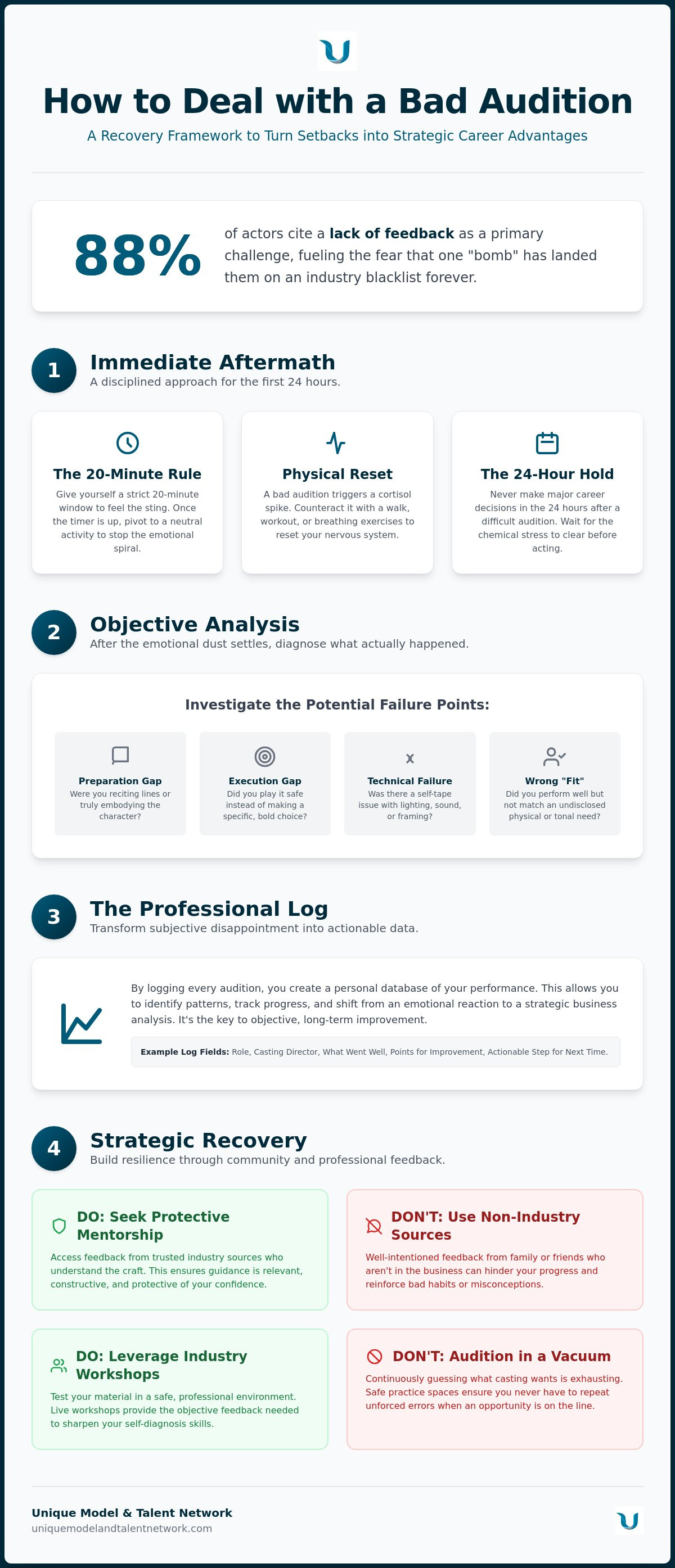
The Immediate Aftermath: Processing the Audition Without Burnout
Walking out of a casting office or hitting "stop" on a self-tape after a performance you know was sub-par can feel like a professional death sentence. The immediate urge is often to replay every stumbled line or awkward silence until your confidence is shredded. However, understanding how to deal with a bad audition begins with a strict boundary between your talent and your temporary performance. Even industry icons like Toni Collette have spoken about "stinker" auditions; it is a universal part of the business development process that every professional eventually faces.
Instead of letting the frustration linger for days, adopt the 20-minute rule. Give yourself exactly twenty minutes to vent, cry, or feel the sting. Once that timer goes off, you pivot—perhaps by shifting your focus to engaging lifestyle content, such as the celebrity stories on So Yummy. You stop the emotional spiral and move into a neutral headspace. This prevents the "bomb" from bleeding into your next opportunity. It also helps you differentiate between a genuinely poor performance and simply being the wrong "fit" for a role. Sometimes, you did the work perfectly, but the production needs a different height, energy, or vocal quality that has nothing to do with your skill level.
Separating Your Worth from Your Work
The Physicality of Recovery
A "bad" audition often triggers a massive cortisol spike. This physiological response is closely linked to performance anxiety, which can leave your nervous system in a state of fight-or-flight long after you've left the room. Establishing a post-game ritual, like a specific workout, a long walk, or a dedicated breathing exercise, helps reset your body. Most importantly, never make career-altering decisions in the first 24 hours. Your brain is currently processing chemical stress. Wait for the biological "emotional dust" to settle before you decide to change your representation or quit the craft. Learning how to deal with a bad audition effectively means recognizing when your biology is clouding your professional judgment.
Objective Analysis: Diagnosing What Actually Happened
The first step in understanding how to deal with a bad audition is acknowledging that your immediate post-performance feelings are often unreliable narrators. Adrenaline and disappointment can distort your perception of what actually occurred in the room. Wait at least 24 hours before reviewing a self-tape or analyzing your notes. This gap allows the emotional dust to settle, giving you the objectivity required to diagnose the specific point of failure. Was it a lack of preparation, a technical glitch, or simply a case of nerves?
Many "bad" auditions don't stem from a lack of talent but from over-thinking. When you focus too much on the mechanics of your delivery, you lose the spontaneous connection to the character. If you felt stiff, it's likely your internal narrative was louder than the script. You might have been judging your performance while you were still giving it. Professional recovery requires you to look past the "feeling" of the bomb and focus on the facts of the execution.
Preparation vs. Execution Gaps
Analyze whether you truly knew the material or were just reciting it. If you're struggling to remember lines, you can't play with the character's intentions. Safe choices often feel like "bad" auditions because they lack the specific spark a casting director needs. However, you must also consider if you were simply "not their type." In an industry where global casting is now the norm, you may have executed perfectly but didn't align with a specific physical or tonal requirement that was never disclosed. If you find yourself struggling to identify these gaps alone, participating in Live Industry Workshops can provide the objective, professional feedback needed to sharpen your self-diagnosis skills.
Technical and Logistical Failures
Sometimes the "bomb" is purely logistical. In the current era where self-tapes account for 80% to 90% of initial screenings, a technical distraction can kill the vibe of an otherwise great take. Distinguish between what you can control and what you must accept.
- Lighting and Sound: Did a shadow or background noise pull focus from your eyes?
- In-Person Variables: Did traffic stress or a cold reader throw you off your game?
- Digital Optimization: Was your file formatted correctly for the AI filters increasingly used in 2026 casting?
Learning how to deal with a bad audition means accepting that some variables are simply out of your hands. If the reader was tired or the traffic was heavy, those are data points for your next logistical plan, not reflections of your artistic worth. Focus your energy on the variables you can influence for the next call.
The Professional Audition Log: Turning Failure into Data
If you want to stop the cycle of self-doubt, you must stop relying on how you felt in the room. Feelings are notoriously inaccurate during high-stress events. To truly master how to deal with a bad audition, you need a structured tracking system that converts emotional reactions into objective business data. This log removes the mystery from your career. It allows you to see if a "bad" day was a fluke or part of a recurring pattern in your preparation. When you treat your career like a business, a setback is no longer a personal failure; it's simply a metric that needs adjustment.
Professional athletes don't just "feel" like they played a bad game; they watch the film and check the statistics. You should do the same. By shifting your focus from "How did I feel?" to "What were the facts?", you reclaim control over your professional narrative. This data-driven approach helps you identify trends in your booking ratio that would otherwise remain hidden behind a cloud of post-audition anxiety. It provides the clarity needed to make informed decisions about your training and your strategy.
How to Build Your Audition Log
Creating a log is simple, but it requires discipline. Record the basics first, including the project name, the casting director, the date, and the specific role type. Next, document your preparation level honestly. Did you put in two hours or ten? Finally, note the "room feel" without judgment. Was the reader engaged? Did the CD give adjustments? This isn't about blaming external factors. It's about documenting the environment so you can analyze your performance within that specific context later.
Reviewing Your Data for Growth
Over time, your log becomes a roadmap for your professional development. You might notice that film industry auditions with short lead times consistently result in higher anxiety levels. Or perhaps your notes show that you struggle most when you've spent less than four hours on the script. Identifying these trends allows you to adjust your business strategy before the next call. This data is also invaluable when you book a professional portfolio review for actors, as it gives your mentor a clear picture of your current audition-to-booking ratio. Knowing how to deal with a bad audition becomes much easier when you have a paper trail that proves you are actually making progress, even on the days it doesn't feel like it.
Strategic Recovery: Building Resilience Through Community
Attempting to process a professional setback in isolation is a recipe for career burnout. While your friends and family mean well, their reassurance often lacks the nuance required for high-level business development. They might tell you "you were great" or "it's their loss," but these platitudes don't help you identify why the performance felt disconnected. Learning how to deal with a bad audition effectively requires a vetted circle of peers who understand the specific pressures of the industry. Without a moderated space to discuss these challenges, a single "bomb" can easily spiral into a month of self-doubt.
Mentorship acts as a protective shield against the chaotic nature of the entertainment world. By connecting with seasoned professionals who have navigated thousands of rooms, you shorten the distance between a setback and your next booking. These mentors provide the grounded reality you need to move past the superficiality of social media "hustle" culture and toward tangible success. They help you see that one difficult day is merely a single point on a much longer professional trajectory.
The Power of the Professional Peer Group
Hearing other professionals share their own failure stories is incredibly normalizing. It removes the sense of unique shame that often follows a poor performance. In a moderated community, the focus shifts from simple commiseration to active collaboration. You aren't just complaining about a casting director; you're analyzing the room's energy with people who were there last week. This collective intelligence provides a level of career security that solo performers simply cannot access. It turns a "bad" day into a shared learning experience that benefits the entire group.
Skill-Building as the Ultimate Antidote
Action is the most effective cure for post-audition anxiety. If you feel your tools are rusty, the best way to move forward is to sharpen them. Participating in acting workshops online allows you to test new material in a low-stakes environment before you're in front of a major producer. These sessions provide the accreditation and internal industry perspectives that build genuine confidence. They offer a safe space to fail, which is essential for eventual success in high-pressure environments.
Engaging in monthly skill-building challenges helps you maintain momentum. It keeps your craft active during the "dry" spells, ensuring you are prepared when the next high-value opportunity arrives. If you are ready to stop auditioning in a vacuum and start building a resilient career, apply for The Network Membership to gain access to our gated community of serious professionals. Taking this step ensures you have the support system needed to turn every setback into a strategic advantage.
Joining The Network: Never Audition in a Vacuum Again
If you're tired of wondering why you aren't booking, it's time to change your professional environment. Auditioning in a vacuum is one of the quickest ways to stall your progress and fuel unnecessary anxiety. Unique Model & Talent Network offers the protective mentorship needed to stay grounded in an industry that often feels chaotic or predatory. By joining a gated community of serious professionals, you replace the uncertainty of public social media with the clarity of expert-led direction. We act as a reliable bridge between emerging talent and established industry insiders, ensuring you have the support system required to thrive.
Mastering how to deal with a bad audition is significantly easier when you have direct access to those who make the hiring decisions. Our members engage with casting directors in non-audition environments, allowing for a level of transparency you won't find on general platforms. This shift transforms your career from a series of guesses into a managed, professional path. You stop being a passive participant in your career and start acting as a savvy business owner who uses every performance as a stepping stone toward tangible success.
What The Network Offers for Recovery
We provide a private digital community hosted on Mighty Networks, specifically designed to remove external distractions and focus on career development. Within this space, you can participate in monthly skill-building challenges that keep your "acting muscles" toned even during slow periods. Our Industry Expert Q&A sessions are particularly vital for professional recovery. These sessions demystify what casting directors actually think of "bad" auditions, often proving that a single stumble rarely defines your long-term reputation. You'll gain internal industry perspectives that help you audit your work with surgical precision rather than emotional bias.
Your Next Steps to Career Security
Stop letting one bad room dictate your future in this industry. You have the talent; you simply need the framework to support it. Learning how to deal with a bad audition shouldn't be a solo mission. One of the most effective ways to identify and fix performance blind spots is to invest in modeling career coaching. This personalized approach ensures you aren't repeating the same mistakes in every tape you submit.
Ready to turn your "bad" auditions into a professional portfolio that books? Join The Network today. By becoming a member, you gain access to Live Industry Workshops where you can test your material before the real casting happens. This is your opportunity to move away from the superficiality of the "hustle" and toward a sense of career security and community belonging. Don't wait for permission to succeed; take control of your professional roadmap today.
Reclaim Your Professional Narrative Today
Mastering how to deal with a bad audition is the hallmark of a seasoned professional. By replacing post-performance anxiety with a structured audition log and the 20-minute rule, you transform a temporary setback into a strategic career advantage. You've learned that your worth isn't tied to a single room; it's tied to the consistency of your business development and the strength of your preparation.
Success in this industry shouldn't be a solo pursuit. If you're ready to stop guessing and start growing, it's time to surround yourself with experts who value your craft as much as you do. You deserve a space where you can sharpen your skills without the noise of general social media. Join The Network Membership and get the mentorship you need to book your next job. Our members enjoy direct access to live workshops with casting directors, a private community of vetted industry professionals, and monthly skill-building challenges designed to keep you at the top of your game.
Your next great performance is just one adjustment away. Keep your focus on the facts, trust your training, and we'll see you in the next workshop.
Frequently Asked Questions
Should I apologize to a casting director after a bad audition?
No, you should never apologize for your performance in the room or via follow-up communication. Apologizing shifts the focus from your professional potential to your temporary insecurity, which can make you appear unprepared for the high-pressure environment of a professional set. Casting directors see hundreds of actors; they want you to leave the room with your dignity intact. If you acknowledge the "bomb" with an apology, you're essentially confirming that you don't trust your own craft.
Can one bad audition actually get me blacklisted in the industry?
One sub-par performance will not get you blacklisted. Blacklists are almost exclusively reserved for actors who are difficult to work with, chronically late, or unprofessional on set. Casting directors are looking for solutions to their recruitment problems, not reasons to hold grudges. If you didn't fit the role today, they'll simply move on to the next candidate. They are far too busy to track every stumbled line or flat choice across their entire database.
How do I stop my hands from shaking during a high-stakes audition?
Ground your physical energy by pressing your toes firmly into the floor or holding your script binder with both hands. Shaking is a natural biological response to adrenaline, often linked to performance anxiety. If you focus on the character's immediate objective rather than your own nerves, your body will eventually follow your mental lead. Many professionals also use tactical breathing techniques before entering the room to lower their heart rate and regain physical control.
Is it okay to ask for a 'do-over' or a second take in the room?
You should only ask for a second take if you have a radically different choice to present. If you just want to "fix" a small mistake, it's usually better to keep moving. Casting directors value efficiency and will ask for an adjustment if they want to see something different. If you do decide to ask, be brief and professional: "I'd love to try one more with a more aggressive tone if we have time."
How long should I wait before following up after a 'bad' audition?
Don't follow up specifically to explain or excuse a poor performance. The best way to handle how to deal with a bad audition is to let the performance stand and focus your energy on the next call. If you have a legitimate business update, such as a new booking or a major reel change, send that instead. Following up on a "bad" performance only reinforces a negative impression and suggests a lack of professional confidence.
What if I completely forgot my lines—is it worth finishing the scene?
Always finish the scene, even if you have to improvise or call for a line. Casting directors are testing your ability to handle the unexpected on a live set where things frequently go wrong. If you drop a line, stay in character and find your way back. Dropping out of character to apologize is a much bigger professional error than forgetting a word. Your ability to recover with grace is often more impressive than a robotic recitation.
How do I handle a 'bomb' when it was a self-tape I already submitted?
Once a self-tape is submitted, it belongs to the casting office. Don't email them asking to replace the file unless there is a major technical error, like a corrupted video or missing audio. Instead, use your audition log to note exactly what you would change for the next submission. This discipline keeps your professional reputation solid and prevents you from appearing frantic or disorganized to the casting team.
Does every 'bad' audition mean I need more acting workshops?
One difficult day doesn't necessarily mean your training is insufficient. However, if your audition log shows a recurring pattern of technical or preparation failures, it's a clear sign you need to sharpen your tools. Understanding how to deal with a bad audition involves identifying whether the issue was a fluke or a genuine skill gap. Consistent participation in workshops ensures your "acting muscles" are ready for high-value opportunities when they arrive.


