

Your acting resume isn't a historical archive of your past; it's a strategic marketing asset designed to open doors within a professional ecosystem. If you're worried about looking like an amateur or feel you have "nothing" to list, you aren't alone. Learning how to build an acting resume that meets 2026 professional standards is the first step toward being taken seriously by top-tier casting directors. It's about clarity, technical precision, and understanding exactly what recruiters are looking for when they scan your digital profile.
You deserve a career built on legitimate opportunities rather than guesswork. We'll show you how to master high-impact formatting, identify the special skills that actually move the needle, and implement strategies to build your credits fast. This guide provides a clear roadmap to transform your experience into a professional presentation. By the time you finish reading, you'll have the confidence to submit your materials to the industry's most influential gatekeepers with a clean, industry-standard portfolio that demands attention.
Key Takeaways
- Define your resume as a high-impact professional snapshot that works in tandem with your headshot and portfolio.
- Navigate standard formatting requirements, from listing union status correctly to providing physical stats without compromising your personal data.
- Implement a strategic two-step plan for how to build an acting resume even if you're starting with zero professional credits.
- Use digital optimization techniques like casting site keywords and QR codes to bridge the gap between your paper resume and your demo reel.
- Learn why a stand-alone resume isn't enough and how professional portfolio reviews can help you secure your spot in the room.
The Strategic Purpose of a Modern Acting Resume in 2026
In the fast-paced entertainment industry of 2026, your acting resume serves as a high-impact, one-page professional snapshot. It isn't a detailed memoir of every creative endeavor you've ever pursued. Instead, it's a lean, tactical document designed to tell a casting director exactly where you fit in their current production. Understanding how to build an acting resume involves recognizing that casting directors often follow a 6-second rule. They don't read every line; they scan for specific markers of professionalism and experience. If your layout is cluttered or your credits are confusing, you've lost your chance before the audition even begins. Brevity and clarity are your strongest allies in this digital-first environment.
Successful actors have shifted their mindset from creating an "experience list" to building a "marketability map." This document needs to signal your specific "type" and brand before you ever speak a word in the room. When you present a resume that follows strict industry standards, you're communicating that you understand the business side of show business. It proves you're a disciplined professional who can be trusted on a high-stakes set. For those looking to bolster their professional organization, The CEO Creative provides the essential office supplies and branding tools needed to manage a successful career. This strategic approach ensures that every piece of information on the page serves a single goal: proving you are the solution to the casting director's problem.
Resume vs. Portfolio: Knowing the Difference
Think of your resume as the index to your broader professional presence. While your acting portfolio provides the depth and visual proof of your talent through reels and production stills, the resume provides the hard facts. A critical rule of thumb is to never include photos directly on the resume page itself. That space is strictly for technical data and credits. Your visual identity is handled by your actor's headshot, which should be a separate, high-quality file. In professional networking circles, a clean, text-based resume signals that you're a pro who respects the traditional protocols of the industry.
The 'Marketing Asset' Mindset
Your acting resume is a foundational tool for building industry trust and establishing your professional reputation. It tells the story of your career growth and your commitment to the craft. Professional standards in font choice, margin size, and layout are non-negotiable if you want to be viewed with legitimacy. Using a standard, legible font isn't just about aesthetics; it's about ensuring your data is easily digestible for both human eyes and the AI scanning systems used by major agencies. When you focus on how to build an acting resume with this level of precision, you move away from the noise of social media and toward a sense of career security and community belonging.
Standard Formatting: The Anatomy of a Casting-Ready Resume
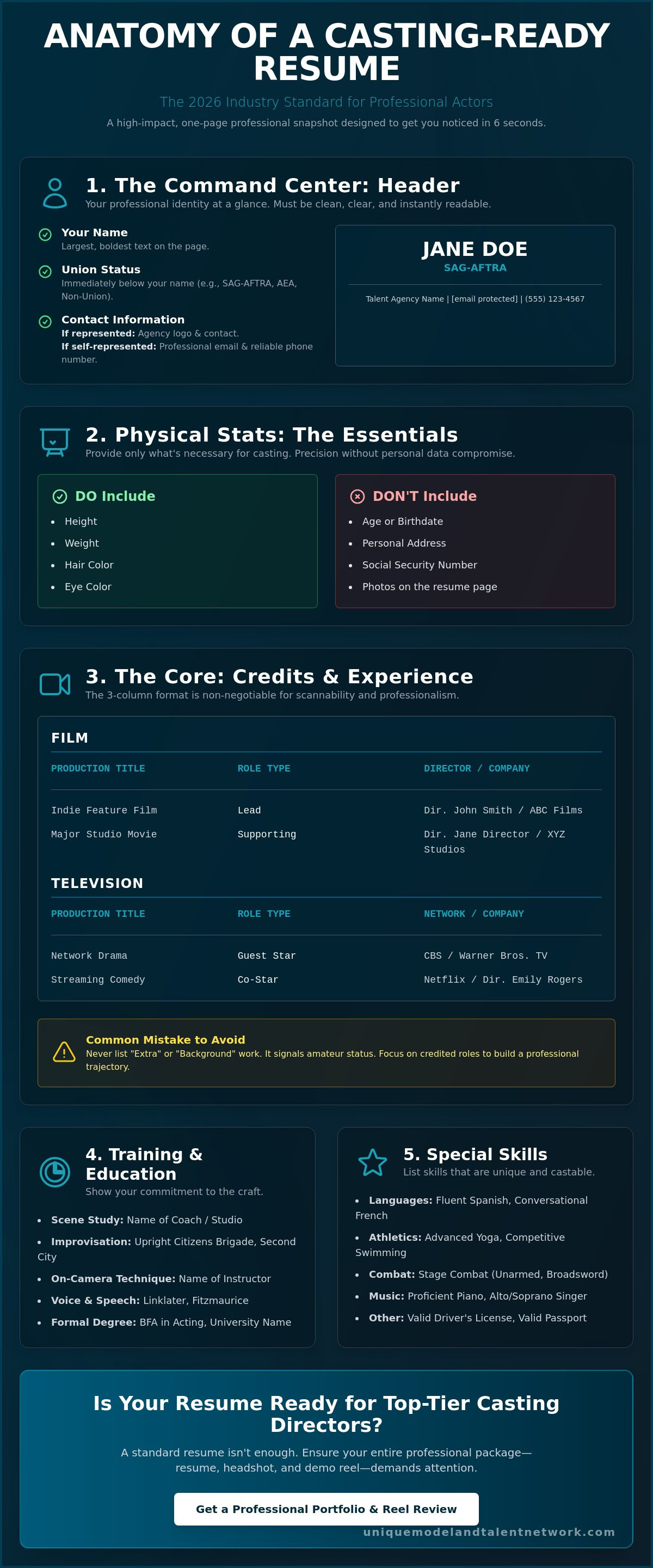
Your header is the command center of your professional identity. It must feature your name in a bold, legible font, followed immediately by your union status, such as SAG-AFTRA, AEA, or Non-Union. If you have representation, include your agency's logo and contact information; otherwise, provide your professional email and a reliable phone number. Learning how to build an acting resume with professional precision ensures you aren't overlooked for technical errors. Below the header, list your physical stats. Focus on height, weight, hair color, and eye color. Never include your age or birthdate on the page. Casting directors use these stats to see if you fit the physical requirements of a role, and providing unnecessary personal data can lead to unintended bias.
The core of the document consists of three clear columns for your credits. The left column lists the production title, the center column identifies your role type, and the right column names the production company and director. This clean hierarchy allows a reader to grasp your career trajectory in seconds. If you are unsure about the strength of your current layout, getting a professional Portfolio & Reel Review can provide the clarity needed to ensure your materials meet elite industry standards.
Categorizing Your Credits Correctly
Group your experience by medium to help casting directors find relevant work quickly. Standard categories include Film, Television, Theater, and Commercials. In the role type column, use specific industry terms. For television, distinguish between Co-Star, Guest Star, and Series Regular. For film, use Lead or Supporting. A common amateur mistake is listing "Extra" or "Background" work. Unless you are just starting and have zero other credits, leave background work off your professional resume to signal that you are a principal performer.
The Special Skills Section: What Actually Gets You Booked
The special skills section is often the secret weapon that secures an audition. Use this space to list verifiable abilities such as fluency in foreign languages, stage combat certification, or high-level athletic skills like horse riding. Readability is paramount here, so use a simple, comma-separated list. Honesty is your best policy; never list a skill you cannot perform on camera immediately if asked. If you claim to be a proficient dialect speaker, be prepared to demonstrate that accent during your first meeting. High-value skills like these often act as the final tie-breaker when a casting director is choosing between two equally talented actors. Mastering how to build an acting resume means treating this section with as much weight as your credits.
Building Your Resume from Scratch (Even Without an Agent)
Every professional actor started with a blank page. If you're staring at a white screen wondering how to build an acting resume without a single credit to your name, you must shift your focus toward the things you can control. You don't need a talent agent to begin establishing your professional identity. Instead, you need a disciplined strategy to acquire "proof of talent" through high-quality training and independent projects. This phase of your career is about building a foundation of legitimacy that signals to the industry you are serious, reliable, and ready for the room.
Start by prioritizing your education. When you lack production credits, your training section becomes the primary indicator of your skill level. Seek out reputable coaches and participate in Monthly Skill-Building Challenges to keep your craft sharp and your resume active. Once you have a base of training, look for local community theater productions. Theater is a respected medium that demonstrates your range, vocal discipline, and ability to handle a rigorous rehearsal schedule. These early steps transform your resume from a list of aspirations into a record of professional development.
Training as a Credit Substitute
A common mistake for beginners is prioritizing low-quality independent films over high-quality education. Listing a workshop with a respected industry professional or completing specialized acting workshops online often carries more weight than a credit from a production that lacks professional standards. High-tier training shows casting directors that you've been vetted by experts. It also provides you with the technical vocabulary needed to succeed on a professional set. Treat your training as a career investment rather than a placeholder.
The Power of Independent and Student Films
Student films from major universities are excellent resources for building your initial credits. These programs often have access to professional-grade equipment and high production values, ensuring your resulting reel footage looks legitimate. When you're learning how to build an acting resume, aim for the "Rule of Three." Secure three solid Lead or Supporting credits in well-produced independent shorts before you begin approaching talent agents. This shows you have on-camera experience and can carry a narrative. Always vet independent projects by asking about the director's previous work and the intended distribution plan. Proactive actors also create their own opportunities by producing web series or short-form content, which demonstrates the level of proactivity that modern casting directors admire.
Professional Optimization: Tailoring for Casting Directors and AI
In 2026, the gatekeepers of the industry are no longer just human casting directors; they are sophisticated algorithms and database filters. Learning how to build an acting resume that satisfies both the human eye and the machine is the hallmark of a savvy professional. When a casting office is looking for a specific skill or physical attribute, they don't manually browse thousands of files. They use search terms. If your resume isn't optimized with the correct keywords, you remain invisible regardless of your talent level. This technical precision is what separates the elite from the hobbyist.
Your digital presence on high-traffic casting websites requires more than just uploading a generic document. You must use industry-specific terminology that allows your profile to surface during a filtered search. Beyond the text, you should implement a "digital handshake" by integrating a small, clean QR code at the top of your resume. This allows a director to scan your paper resume with their phone and immediately view your demo reel. It creates a seamless bridge between your physical and digital assets, showing that you value the casting director's time and efficiency.
Tailoring your resume for specific auditions is another non-negotiable strategy. If you're auditioning for a multi-cam sitcom, prioritize your comedic theater and improv credits at the top of your medium lists. If the project is a gritty procedural drama, swap those out for your dramatic film shorts. Additionally, pay close attention to your file naming conventions. A document titled "Resume_Final_2.pdf" is a missed branding opportunity and an amateur move. Use a standardized format like "Firstname_Lastname_Resume_SAG.pdf" to ensure your materials are organized and professional when they land in a production's local folder.
Modern Digital Integration
A professional resume must be a clickable PDF where your contact information and professional links are active. If a casting director wants to see your work, they should be able to click a link directly on the document to reach your professional talent network profile. Keeping this digital version updated in real-time is essential; never let a major credit or a new high-value skill go unlisted for more than twenty-four hours. If you want to ensure your technical formatting is flawless, consider booking one of our Portfolio & Reel Reviews to get direct feedback from industry insiders who know exactly what works.
AI and Casting Databases
Casting databases use AI to parse text and categorize talent based on specific attributes. To stay competitive, you must ensure your resume text is "selectable" and not saved as a flattened image or a non-searchable scan. If the system can't read your text, you effectively don't exist in the database. Standardize your credits by using common industry headers and role descriptions. This uniformity ensures that when an AI system searches for a "Guest Star" with "Combat Training," your name appears at the top of the list. Mastering how to build an acting resume in this era means being as disciplined with your data as you are with your craft.
Accelerating Your Career Through the Unique Model & Talent Network
Learning how to build an acting resume that stands out is a vital professional skill, but a document in isolation has limited power. To truly move from "aspiring" to "professional," you must place that resume within a professional ecosystem that provides direct access to decision-makers. The entertainment industry is often perceived as chaotic or predatory, which is why serious talent seeks the protection and clarity of a vetted community. Our members don't just submit documents; they build professional bonds that lead to career security and long-term success. When you align yourself with a network that values integrity and efficiency, you're no longer shouting into the void of the internet.
Within our network, you can participate in Monthly Skill-Building Challenges that force you to keep your credits active and your skills sharp. These challenges ensure your resume remains a living document that reflects your current growth and dedication. When you surround yourself with high standards and financial legitimacy, you naturally elevate your own professional status. It's about moving away from the superficiality of general social media and toward a sense of community belonging where your success is the primary focus. This disciplined approach is what turns a hobby into a sustainable business.
The Power of Expert Feedback
Even a perfectly formatted resume can have blind spots that only an industry insider would notice. Our members benefit from a professional portfolio review for actors, where real casting directors provide direct feedback on your presentation. You can also attend Industry Expert Q&A Sessions to ask specific questions about your training or the hierarchy of your credits. This direct line of communication removes the guesswork. It allows you to correct common mistakes before they cost you a spot in the room, ensuring your materials always meet elite industry standards.
Joining the Elite: The Network Membership
The acting industry networking platform we provide is a gated, private space designed for those who are serious about their craft. Unlike unmoderated social media groups filled with distractions and misinformation, our network focuses on tangible results and professional business development. We act as a reliable bridge between emerging talent and established professionals, offering a disciplined environment where you can grow without external noise. Mastering how to build an acting resume is a great start, but joining The Network Membership is how you sustain a lifelong career. Join us today to start building your professional future within a community that advocates for your success.
Take Command of Your Career Trajectory
You now possess the technical blueprint for how to build an acting resume that commands respect in 2026. By prioritizing clean formatting, digital optimization, and high-value training, you've moved beyond the common mistakes that keep talent on the sidelines. Your resume is a dynamic marketing tool, not a static list of credits. It's the first impression that signals your readiness for elite opportunities and professional standards. When you treat your materials with this level of discipline, you're telling the industry that you're a serious professional who is ready to work.
Even the most polished resume needs the right environment to flourish. You can accelerate your growth by surrounding yourself with a vetted community of industry professionals who value integrity and excellence. Our platform offers direct access to casting directors and live monthly skill-building challenges designed to keep your craft at its peak. This focused approach removes the distractions of public platforms and provides a clear path to career security.
Build your professional future with the Unique Model & Talent Network membership today. Your journey from aspiring talent to a recognized professional starts with the standards you set for yourself. We're here to open the door and advocate for your success every step of the way.
Frequently Asked Questions
Should I include my home address on my acting resume?
No, you should never include your home address on your acting resume for safety and professional reasons. Casting directors only need to know your current city and state to determine your local hire status. If you have an agent, their office address is the only physical location that needs to appear. Providing your personal address is an amateur mistake that can compromise your privacy in a digital-first industry.
Can I list background or 'extra' work on a professional resume?
You should generally avoid listing background or extra work on a professional resume. Including these credits can signal to casting directors that you are not yet a principal performer. If you are just starting, you can use one or two entries to show you've been on a professional set, but you must remove them as soon as you secure your first student film or independent credit.
How long should an acting resume be for a beginner?
An acting resume should always be exactly one page, regardless of your experience level. It is traditionally trimmed to fit the back of an 8x10 headshot. For a beginner, this means using a clean layout with generous white space rather than trying to fill the page with irrelevant information. Focus on high-quality training and special skills to demonstrate your potential when you are first learning how to build an acting resume.
Do I need to include my age or date of birth for casting?
You don't need to include your specific age or date of birth on your resume. Industry standards and labor laws protect actors from age-based discrimination during the initial casting phase. If you are a minor or are over 18 but look younger, you can include "Legal 18" or "Permit Player" to clarify your employment status. Otherwise, let your headshot and your age range in your digital profile speak for themselves.
What should I do if I have no professional acting credits yet?
If you have no professional credits yet, prioritize your education and special skills sections. Listing reputable workshops and intensive classes shows you are disciplined and prepared for the rigors of a set. You can also participate in community theater or student films to gain your first Lead or Supporting credits. Joining a professional network for peer support and industry workshops is the fastest way to bridge the gap between aspiring and professional.
How do I list specialized training or workshops correctly?
List your specialized training by identifying the studio or coach followed by the specific technique or class title. For example, instead of just writing "Acting Class," specify "Meisner Technique" or "Advanced On-Camera Study." This level of detail helps casting directors understand your specific methodology and skill level. Grouping your workshops by category, such as Voiceover or Stage Combat, makes your resume significantly more scannable for recruiters.
Should I include my social media handles on my resume?
You should only include your social media handles if they are professional and directly relevant to your acting brand. If you have a significant following or use your platform to showcase your craft, a clean link to your professional Instagram or TikTok can be a benefit. However, don't include personal accounts that feature non-professional content. A clickable link to your professional talent profile is always more valuable than a link to a private social account.
Is it okay to lie about a skill like horseback riding or a dialect?
It is never okay to lie about a skill on your resume. The industry is small, and your reputation is your most valuable asset. If you claim to speak a dialect or ride a horse, you must be able to perform that skill at a professional level on camera that same day. Lying is a fast way to get blacklisted by casting offices. If you want to add a skill, invest time in training rather than taking a shortcut that could ruin your career.


