

In 2026, a massive social media following is no substitute for a professional book that speaks the language of a casting director. You've likely felt the pressure to keep up with digital trends while worrying about predatory scouts or the high cost of professional photography. It's a valid concern because the line between "influencer" and "industry professional" has never been sharper. If you're serious about your craft, you deserve a roadmap for how to build a modeling portfolio that prioritizes your career security over vanity.
This guide reveals exactly how to build a modeling portfolio that captures the attention of elite agencies and legitimate brands. You'll learn which shots are non-negotiable, why unretouched "digitals" are your most powerful tool, and how to avoid the expensive mistakes that sideline most beginners. We're moving past the noise of public platforms to focus on the business of modeling. From understanding current pay scales to mastering the "Trade for Print" strategy, you're about to gain the insider clarity needed to turn your ambition into a vetted professional reality.
Key Takeaways
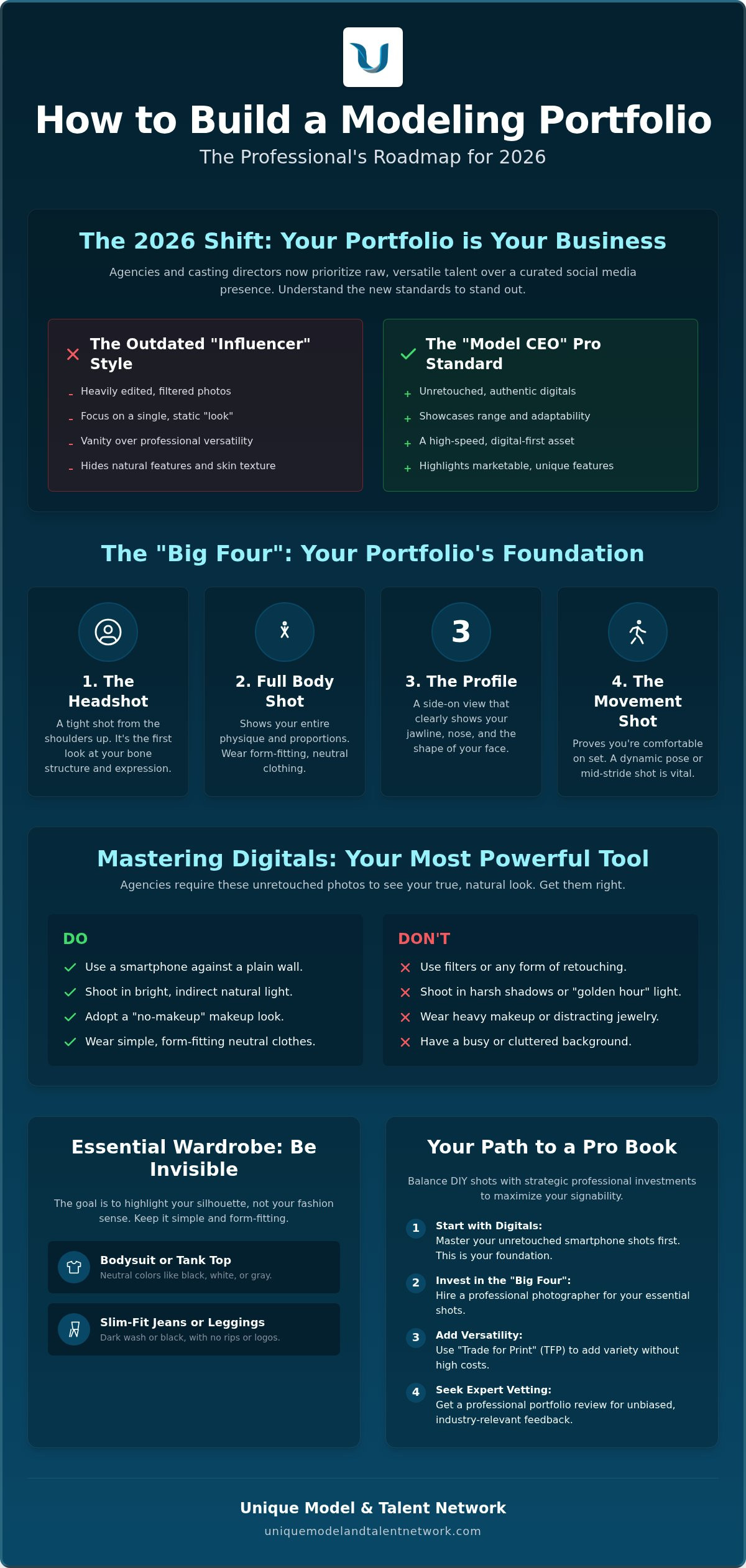
- Define your portfolio as a professional marketing tool that prioritizes raw versatility over heavy editing to meet 2026 industry standards.
- Master the "Big Four" non-negotiable shots, including headshot, full body, profile, and movement, to ensure your book is agency-ready from day one.
- Prioritize unretouched smartphone digitals as your most critical asset, as casting directors now value natural authenticity over high-fashion polish.
- Discover exactly how to build a modeling portfolio that balances strategic DIY shots with professional investments to maximize your signability threshold.
- Leverage professional portfolio reviews to identify marketable gaps in your look and avoid the career-stalling traps of informal or family-led feedback.
Understanding the Purpose of a Modeling Portfolio in 2026
Your modeling portfolio is far more than a collection of aesthetic photos; it's the primary marketing tool for your professional talent brand. In the 2026 market, casting directors aren't looking for a passive subject. They're looking for a business partner who understands their market value. When you approach the question of how to build a modeling portfolio, you must start with a CEO mindset. You're responsible for the quality control, the strategic direction, and the financial legitimacy of your career.
The industry has moved away from the hyper-curated, "Instagram famous" aesthetic that dominated the early 2020s. Today, professional standards demand raw versatility. Agencies need to see that you can transform to meet a client's specific vision, not just replicate a single social media filter. While influencers sell a static lifestyle, models sell the ability to adapt. Learning how to build a modeling portfolio that meets these high standards is what separates the serious talent from the crowd.
The Shift from Print to Digital-First Portfolios
Physical books have become a secondary requirement in a world that moves at the speed of a digital upload. Your portfolio must be a high-speed, digital-first asset that lives on a mobile-optimized gallery. Casting directors often review talent on the fly between shoots, so your work needs to load instantly and display perfectly on a smartphone screen. A digital-first approach also allows you to update your book the moment your look evolves, ensuring you never miss a booking because of outdated hair color or measurements.
The Role of Authenticity in Modern Casting
Authentic casting is the practice of selecting talent based on their natural, unretouched features to create a genuine connection with the consumer. In 2026, what were once considered "flaws" are now marketable features that set you apart from the AI-generated perfection seen on public platforms. Agencies actively reject the over-filtered Instagram style because it hides the very details a client needs to see. If a casting director can't see your skin texture or your true proportions, they can't trust you for a high-value commercial booking. Utilizing professional Portfolio & Reel Reviews is often the best way to ensure your book strikes the right balance between polished professional and raw authenticity.
The Essential Shots: What Every Agency-Ready Portfolio Needs
The "Big Four" shots are the foundation of any professional book. You need a tight headshot, a full-body shot, a profile view, and a movement shot. These four images tell an agency exactly what they need to know about your proportions, bone structure, and physical comfort. While some beginners believe they need a dozen high-fashion editorial looks, the reality is that agencies prioritize raw potential over complex styling. When learning how to build a modeling portfolio, you must prioritize range. Showing a commercial smile for lifestyle clients and a high-fashion serious expression for editorial work proves you're a versatile asset worth the investment.
Wardrobe choices should be invisible. Stick to form-fitting, neutral clothing like a black bodysuit, slim-fit jeans, or a simple tank top. The goal is to highlight your silhouette, not your fashion sense. If the clothes are the focus, the model becomes secondary, which is a mistake that can stall your progress before you even land a casting.
Mastering the "Clean Look" for Digitals
Digitals, often called polaroids, are currently the most important assets in your career. Most agencies now expect these to be taken with a smartphone against a plain white or grey wall. Avoid the "golden hour" for these specific shots; high-noon or indirect indoor light is better because it doesn't hide your features with warm, flattering shadows. The industry standard is the "no-makeup" makeup look, which means grooming your skin and hair to look polished but entirely natural. If you're unsure if your current shots meet these standards, getting Portfolio & Reel Reviews can prevent you from submitting subpar work that agencies will likely ignore.
Adding Versatility with Lifestyle and Commercial Shots
Once the basics are covered, add shots that showcase your personality. Commercial clients look for relatability, so a genuine laugh or a relaxed pose can be the difference between a booking and a pass. Movement is also vital; static images are no longer enough in 2026. Include shots that show you in mid-stride or captured during a dynamic pose to prove you're comfortable on a fast-paced set. If you have special skills like dance, fitness, or sports, integrate them here. These aren't just hobbies; they are marketable items for your visual resume that increase your value to specific athletic or lifestyle brands. Understanding how to build a modeling portfolio with this level of strategic variety ensures you're ready for any casting call that comes your way.
DIY vs. Professional Shoots: Strategic Planning for Beginners
Deciding where to allocate your financial resources is a critical business decision for any emerging talent. Many beginners struggle with the choice between a DIY approach and a high-cost professional production. High-quality smartphone digitals are the best way to start because they provide the raw, unedited look agencies currently demand. If you have a modern phone and a plain wall, you have the tools to begin. However, once you reach the "signability" threshold, you'll need to invest in professional assets. This threshold occurs when your basic look is proven, but you need "proof of concept" photos to show agencies you can handle a high-pressure commercial or editorial set. Learning how to build a modeling portfolio involves knowing when to save your money and when to spend it on elite expertise.
Vetting photographers requires more than just scrolling through an Instagram feed. Look for social proof, such as tagged models and agency credits, to verify their industry reputation. In an industry where predatory behavior exists, your safety is non-negotiable. Always check if a photographer has a history of working with reputable agencies or established networks before booking a session. This protective approach ensures your investment goes toward career growth rather than a potentially dangerous or unprofessional experience.
Building Your Portfolio Through Safe TFP Collaborations
Trade for Print (TFP) is a strategic way to build your book without upfront costs. It’s a mutual exchange where both the model and photographer provide their services for free to create high-value images for their respective portfolios. To approach a photographer for TFP without sounding like an amateur, present a clear concept or a "mood board" that shows you've done your research. To keep these collaborations professional, always request a call sheet and bring a chaperone to the set. Use these sessions specifically to target the "missing" looks in your book, such as a high-movement athletic shot or a relatable commercial laugh, to ensure you are efficiently learning how to build a modeling portfolio that covers all marketable bases.
The Investment Mindset: Budgeting for Your Career
Legitimate career development involves costs, but you must distinguish between production fees and "pay-to-play" scams. A legitimate agency will never charge you an upfront fee to sign or represent you. However, paying a top-tier fashion photographer for a test shoot is often a necessary business expense. One high-quality shoot that captures your marketability is infinitely more valuable than five mediocre sessions that clutter your book with amateur mistakes. If you find yourself overwhelmed by these choices, our modeling career coaching guide provides a deeper dive into making informed financial decisions as you navigate the early stages of your career.
Beyond the Photos: Comp Cards and Digital Submissions
A comp card is the professional business card of the modeling world. While physical cards are still used at in-person castings, your digital comp card is now your primary leave-behind. It distills your entire talent brand into a single, high-impact document. When you're learning how to build a modeling portfolio, you must understand that your photos are only half of the equation. The other half is how you present your data. Your card must include your height, measurements, hair and eye color, and professional contact information. In 2026, casting directors expect these details to be accurate to the centimeter; outdated stats are a quick way to lose professional trust.
Organization is a hallmark of a disciplined professional. When submitting your work digitally, use clear naming conventions like "FirstName_LastName_FullBody.jpg" instead of generic camera file names. This simple step makes you a favorite among casting directors who manage thousands of files daily. It demonstrates that you value their efficiency, which is a trait of a savvy industry insider.
Designing a High-Impact Comp Card
Your layout should feature one "Hero Image" on the front and a "Supportive Grid" of three to four varied shots on the back. This structure allows you to show your range in a single glance. For your safety, never include your home address or personal phone number on your card. Instead, use a professional email address or link your digital card to a secure profile within a gated community. This protects your privacy while keeping you accessible to legitimate recruiters. If you want to ensure your layout meets current agency standards, joining The Network Membership provides the direct expert feedback needed to refine your presentation.
Navigating Casting Websites and Online Profiles
Your digital presence must be dynamic. Keeping your online portfolio updated is essential, but doing so without annoying casting directors requires a strategic approach. Only upload new assets when they represent a significant improvement or a change in your physical look. There is a powerful synergy between your private portfolio and your public profiles on the best casting websites. Profile optimization is the process of completing every data field and tag within a talent database to ensure your profile appears in specific, filtered searches by casting directors. Mastering this ensures that your hard work in learning how to build a modeling portfolio actually results in visibility and bookings.
The Vetting Advantage: Why Expert Portfolio Reviews Matter
Taking the photos is only the first half of the journey. The second, and often more difficult, stage is objective evaluation. Many aspiring models fall into the trap of relying on "Mom-approved" photos. While your family wants the best for you, their feedback lacks the clinical, results-oriented perspective of a casting director. When you are learning how to build a modeling portfolio, subjective praise is a career bottleneck. You need an expert to identify marketable gaps in your presentation. Perhaps you have great editorial shots but lack the approachable commercial smile that lands high-paying e-commerce jobs. A professional review identifies these holes before you waste time on dead-end submissions.
Real-time feedback from industry veterans can completely pivot your career trajectory. Instead of guessing why you aren't getting called back, an expert critique provides the clarity needed to adjust your posing, your wardrobe, or your shot selection. This disciplined approach moves you away from the vanity of social media and toward the grounded reality of professional business development.
Integrating Your Portfolio into a Managed Talent Network
Moving your professional development away from the chaos of public social media is a strategic move for your career security. A private digital community, like our space on Mighty Networks, provides a moderated environment where you can share work without the distractions of external noise or predatory "scouts." Within this gated network, you can participate in Monthly Skill-Building Challenges. These aren't just exercises; they're designed to help you generate new, high-quality portfolio content organically while receiving real-time feedback from industry veterans. It's a protective authority that ensures you're growing in a space that values integrity over vanity.
Your 30-Day Portfolio Action Plan
Success in this industry requires a disciplined, organized approach. This week, focus on shooting your basic digitals as discussed earlier. Once you have your "Big Four" shots, don't just sit on them. Seeking a professional review is the next non-negotiable step. You can leverage the Unique Model & Talent Network to receive your first eyes-on critique from people who understand current commercial standards. If you're serious about your craft, follow this 30-day roadmap to ensure you know how to build a modeling portfolio that actually converts:
- Week 1: Shoot your clean look digitals using natural, indirect light against a plain wall.
- Week 2: Organize your files with professional naming conventions and draft your digital comp card.
- Week 3: Submit your book for a Portfolio & Reel Review within the network to identify marketable gaps.
- Week 4: Plan your first TFP shoot or professional session to target specific missing looks identified in your review.
Join the Unique Model & Talent Network to get your portfolio reviewed by experts today.
Take Control of Your Professional Talent Brand
Success in the modeling industry requires a strategic commitment to professional business standards. You now understand that your portfolio is a high-value marketing tool designed to showcase raw versatility and natural authenticity. By prioritizing unretouched digitals and mastering the essential shots, you've already moved ahead of the hobbyist crowd. The final step in learning how to build a modeling portfolio is ensuring your work passes the scrutiny of the industry's most disciplined gatekeepers.
Don't leave your career trajectory to chance or amateur feedback. You need a safe, moderated environment where your professional growth is the priority. Our community provides direct access to vetted industry experts and professional portfolio reviews by photographers and casting directors who know exactly what the 2026 market demands. Elevate your career. Join the Unique Model & Talent Network today to secure your place in a private, scam-free community for serious talent. Your ambition deserves a protected path to success; we're ready to help you turn that vision into a verified reality.
Frequently Asked Questions
How do I start modeling with no experience?
Start by taking high-quality "digitals" with a smartphone against a plain wall. You don't need a professional shoot yet. Research legitimate agencies and submit these unretouched photos through their official websites. Joining a private network for workshops and expert Q&As helps you learn the business side of the industry without falling for common scams targeting beginners. Focus on building your skills and understanding your unique marketability first.
Do I need an agent to get modeling jobs in 2026?
While you can find freelance work via social media or casting websites, a reputable agent is essential for high-value commercial and editorial bookings. Agencies provide professional vetting, negotiate contracts, and ensure you receive industry-standard pay. They typically take a 20% commission from your earnings. In 2026, many models use a hybrid approach, maintaining their own brand presence while relying on an agent for elite representation and career security.
How much does it cost to build a modeling portfolio?
A professional modeling portfolio can cost anywhere from $0 to $800. Beginners often start for free by utilizing Trade for Print (TFP) shoots, where the model and photographer exchange services. If you choose to invest in a paid test shoot with an established professional, expect to pay between $150 and $400 per session. High-quality digitals taken at home cost $0 but are arguably the most important part of your initial submission.
What is the difference between digitals and editorial photos?
Digitals are unretouched, natural photos taken in simple clothing to show your true proportions and skin texture. Editorial photos are stylized, high-concept images that showcase your ability to tell a story or sell a brand's vision. When learning how to build a modeling portfolio, prioritize digitals for agency submissions. Editorial shots are added later to demonstrate your versatility and comfort on a professional set under specific creative direction.
How can I tell if a modeling photographer is a scam?
Legitimate photographers have a verified portfolio, clear social proof, and professional industry reputations. Be wary of anyone who demands upfront fees as a condition of "guaranteed" agency representation or uses high-pressure sales tactics. Always check for tagged models in their work and ask for references. A protective mentor will tell you that if a deal feels informal or secretive, it's likely a scam designed to exploit newcomers who lack industry guidance.
What should be in a beginner modeling portfolio?
A beginner's book must include the "Big Four" non-negotiables: a clean headshot, a full-body shot, a profile view, and a movement shot. Focus on unretouched digitals in form-fitting, neutral clothing. As you learn how to build a modeling portfolio, you can add a few commercial lifestyle shots showing a natural smile. Avoid over-styled or heavily edited images, as agencies in 2026 value your raw, natural potential over artificial polish.
How many photos should be in a model portfolio?
Aim for a concise selection of 6 to 12 high-quality images. Quality always beats quantity in a professional book. Including too many mediocre shots can dilute the impact of your best work and signal a lack of industry awareness. A savvy model keeps their portfolio tight and relevant, only adding new photos when they represent a significant improvement or a specific marketable gap identified during a professional portfolio review.
How do I get my portfolio noticed by casting directors?
Optimize your online profiles on reputable talent databases and ensure your digital comp card is easily accessible. Use professional naming conventions for your files and keep your measurements up to date. Direct access to casting directors often comes through private networks or live industry workshops rather than public social media. By presenting an organized, agency-ready book, you demonstrate the disciplined mindset that high-level casting directors look for in professional talent.


