

Most aspiring performers wait to be "discovered" like it’s a lottery, but in 2026, the industry belongs to those who treat their craft like a professional business. You’re likely feeling overwhelmed by the noise of social media or worried about falling for predatory scams that promise fame but deliver nothing. It’s isolating to feel like an outsider without the right connections. Learning how to become an actor with no experience doesn't require a Hollywood zip code or a lucky break anymore. You simply need a clear strategy and a safe haven to grow.
We believe your career deserves a foundation of integrity and real, paying jobs. This guide provides a vetted, BS-free roadmap to help you secure your first professional credits and finally stop guessing about your next move. We will break down the exact costs of essentials like the $3,121 SAG-AFTRA initiation fee, how to master the $68-a-year casting platforms, and the specific steps to building a professional resume from absolute zero. By the end of this roadmap, you’ll have the confidence to submit for your first role and the tools to be seen by the right people.
Key Takeaways
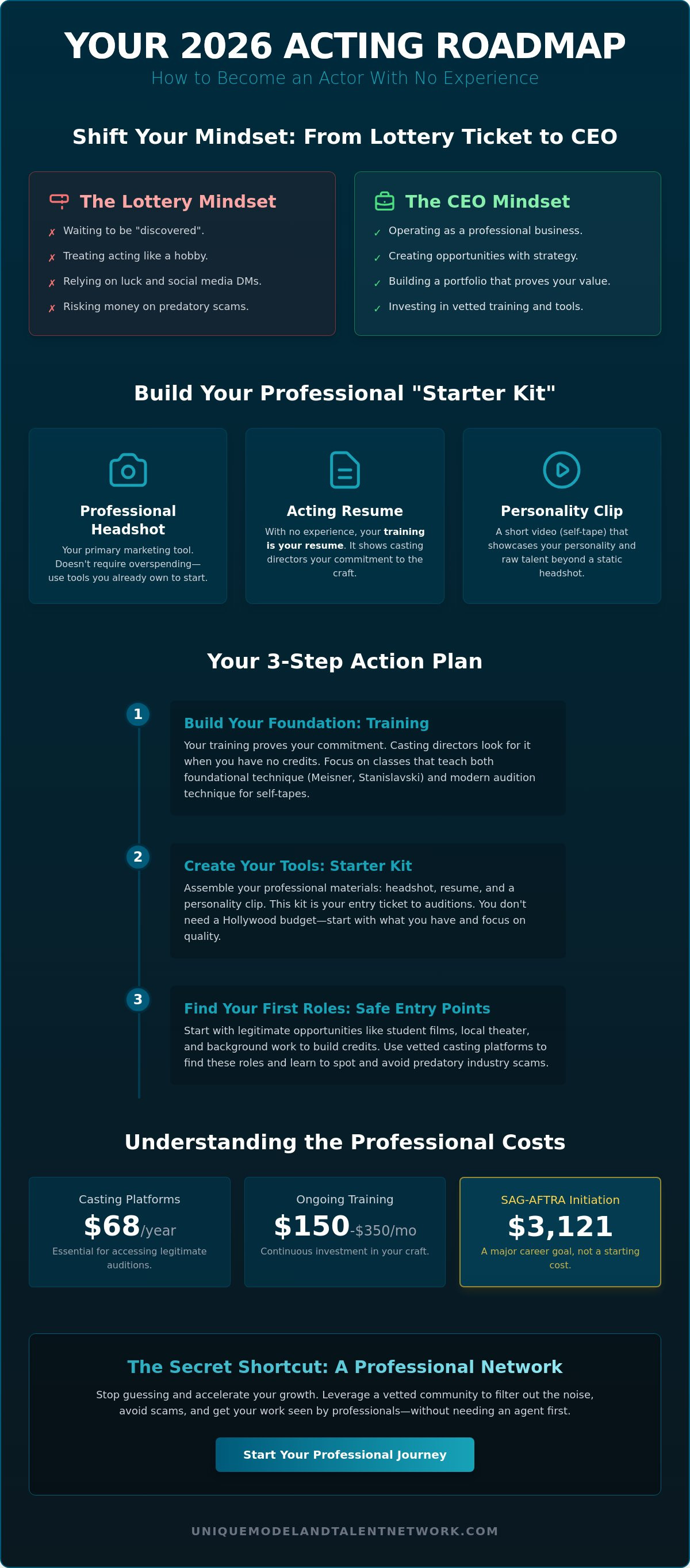
- Shift your mindset from waiting to be discovered to operating as the CEO of your own professional acting business.
- Discover how to become an actor with no experience by using high-quality training as your initial resume to prove your craft to casting directors.
- Build a professional "Starter Kit" with a headshot, resume, and personality clip using tools you already own without overspending on production.
- Identify safe, legitimate entry points like student films and local theater while navigating casting platforms to avoid predatory industry scams.
- Stop guessing and accelerate your growth by leveraging vetted community access to get your work seen by professionals without needing an agent first.
The Reality Check: What It Really Takes to Start Acting in 2026
If you want to treat your career like a serious endeavor, you must first accept that you are a business. You are the CEO making the executive decisions, the product being sold to productions, and the marketing department finding the buyers. Many beginners fail before they even start because they treat this journey like a casual hobby. Understanding how to become an actor with no experience starts with acknowledging that the industry isn't waiting to discover you. It's waiting for professionals who know how to solve a casting director's problem with skill and reliability.
The 2026 landscape has permanently changed the rules of geography. Remote auditions and self-tapes are now the global standard. This shift has leveled the playing field for actors living outside of traditional hubs like Los Angeles or New York City. You can now book real, paying jobs from a home studio in a regional market. However, this increased digital accessibility also means more noise. You need a safe haven to filter out predatory scouts and messy DMs that promise overnight fame but lead to empty bank accounts. Professionalism is your best defense against the chaos of the open market.
Dispelling the 'Discovery' Myth
The idea of being discovered while sitting in a coffee shop is a relic of the past. In reality, being in the right place at the right time is simply the result of preparation meeting opportunity. If you have a lottery mindset, you're relying on luck. If you have a career mindset, you're relying on strategy. Professional acting is a lifelong commitment to the craft of acting and consistent business development. You don't wait for permission to be an actor; you create the conditions where your talent is undeniable.
The Business Mindset: You Are a Startup
Every successful startup requires an initial investment of time, training, and professional tools. You must prioritize high-quality instruction over get rich quick schemes or expensive, unvetted workshops. When you decide to stop guessing about your next move, you save thousands of dollars in potential mistakes. Vetting every person and opportunity is your primary defense. A serious actor knows that their reputation is their most valuable currency. Focus on these three business pillars:
- Prioritize vetted casting calls over random social media posts.
- Avoid anyone asking for upfront representation fees or commissions before you book work.
- Focus on building a portfolio that proves your value to producers.
This disciplined approach is the most effective way to learn how to become an actor with no experience while maintaining your integrity and professional standards. By focusing on the business of your craft, you move away from the superficiality of the industry and toward a sense of legitimate career security.
Step 1: Building Your Foundation Through Training and Technique
When you are figuring out how to become an actor with no experience, your training section is your only resume. Casting directors don't expect a beginner to have a long list of credits, but they do expect proof that you have put in the work. Training isn't just about learning lines. It's about developing a reliable process that allows you to deliver a consistent performance under the pressure of a professional set. While formal acting training through a university is one path, many successful pros start with specialized studios and workshops that focus on the practical business of the craft.
You must understand the vital difference between "performing" and "acting." Performing is often about seeking the audience's approval or showing off. Acting is the art of living truthfully under imaginary circumstances. Casting directors are looking for the latter. They want to see a raw, honest connection to the material, not a polished caricature. High-quality instruction helps you strip away bad habits and find your unique voice in a safe, professional environment.
Choosing the Right Acting Classes
In 2026, group acting classes average between $25 and $40 per hour, while ongoing monthly sessions typically range from $150 to $350. You should look for classes that offer a balance of foundational technique, such as Meisner or Stanislavski, and audition technique. Technique gives you the tools to build a character, while audition classes teach you the business of booking the job. Always vet your coaches by looking for active industry ties and verified student success stories. If you’re ready to accelerate your growth without the noise of unvetted local options, exploring acting workshops online provides a streamlined way to connect with experts from any location.
Developing Your Daily Practice Routine
You don't need to be in a classroom to work on your craft. A disciplined daily routine is what separates the serious talent from the hobbyists. Focus on these three areas at home:
- Script Analysis: Take a scene from a recent film and break down the character's objectives and obstacles.
- Voice and Movement: Spend 15 minutes daily on vocal resonance and physical awareness to ensure you are "camera ready."
- The Self-Tape Challenge: Record yourself performing a one-minute monologue every day. Reviewing your own footage is the fastest way to spot technical issues and improve your on-camera presence.
Consistency is your greatest asset when learning how to become an actor with no experience. Participating in monthly skill-building challenges can help you stay motivated when you aren't yet booking roles. If you want to stop guessing about your progress, joining a Network Membership can provide the professional feedback and community support necessary to maintain your momentum.
Step 2: Creating Your Professional 'Starter Kit' Without Breaking the Bank
Launching your career requires a professional "Starter Kit" that effectively markets your brand to casting directors. You don't need a massive budget to look like a pro. In 2026, the three pillars of your toolkit are the headshot, the resume, and the personality clip. While a high-end headshot session in a major market like Los Angeles or New York City averages between $295 and $450, you can start much smaller. Learning how to become an actor with no experience is about being resourceful while maintaining the high standards of a "vetted" talent.
Avoid the "glamour shot" trap at all costs. Casting directors want to see the real you, not a heavily filtered version of a character you think they want. They are looking for a "clean canvas" they can cast in multiple roles. Your goal is to provide a clear, honest representation of your current look. This builds trust before you even walk into the room or join a Zoom audition. When you stop guessing what they want and show them who you are, you accelerate your career growth immediately.
Headshots and Digitals for Beginners
Casting agencies today often rely on "digitals" to see your true physical proportions and skin texture. Digitals are raw, unedited photos taken against a plain wall. If you're using a smartphone, find natural, indirect sunlight and wear simple, solid-colored clothing. Focus on "the eyes" by projecting a specific thought or emotion through your gaze. This creates a magnetic connection that a static, "pretty" photo cannot replicate. For a deeper dive into the technical specs required for 2026, check out our acting portfolio guide.
Drafting Your First Resume and Demo Reel
Your first resume should emphasize your training and specific physical or technical abilities. If you speak a second language, play a musical instrument, or have high-level athletic skills, list them under "Special Skills." These details are often the deciding factor when finding your first roles because they make you a versatile candidate for niche productions. If you lack professional footage, film a "Personality Clip." This is a 30 to 60-second video where you speak naturally about a hobby or passion. It’s often more effective for beginners than a low-quality reel of student film clips. A professional 30-second "Slate"—stating your name, height, and location—is your first impression, so keep it clean and confident.
By focusing on these foundational elements, you move closer to being "really seen" by the industry. This organized approach ensures you aren't lost in the noise of unvetted platforms. You are building a legitimate career bridge that connects your current lack of experience to your first paying job.
Step 3: Finding Your First Roles and Navigating Casting Sites
Once your professional kit is ready, you need to put it to work. You don't need an agent to land your first job. In 2026, the digital shift means your first audition will almost certainly be a self-tape. Mastering this technical skill is the most important step in learning how to become an actor with no experience. You must be able to produce high-quality video and audio from home to even be considered for non-union commercials or student productions. This technical literacy is what separates the serious talent from the hobbyists who are still waiting for a lucky break.
Identifying safe starting points is crucial for building your resume without getting exploited. Student films, local theater, and non-union commercials are the most accessible entry points. These roles allow you to gain on-set experience and build a network of emerging directors who will grow with you. However, you must be vigilant. If a casting call seems too good to be true or asks for sensitive personal information via a DM, it's likely a scam. A legitimate professional will never ask you to pay a fee just to view a job opportunity.
Leveraging Student Films and Background Work
Student films are the gold standard for beginners because they provide the high-quality footage you need for your reel. These projects allow you to practice set etiquette in a lower-pressure environment. Background work is another option, though it carries pros and cons. While it's a great way to see how a major production operates, don't get stuck in the "extra" loop for years. Use it to learn the language of the set, then pivot quickly to speaking roles. Arriving 15 minutes early and staying focused on your work ensures you're the first person a director remembers when casting their next project.
Mastering Casting Websites and Avoiding the Noise
Navigating the hierarchy of casting platforms is essential to avoid the noise of traditional social media. Reliable platforms like Actors Access PLUS cost $68 per year for unlimited submissions, while a Backstage subscription is priced at $199.95 annually. You can compare these in detail using the best casting websites guide to see which fits your current goals. To stay ahead of the competition, set up custom alerts for "no experience" roles so you are among the first to submit your materials. You never have to pay a commission to a website just to see a casting call.
If you want to stop guessing about which opportunities are legitimate, you should join a vetted talent network that prioritizes your safety and career growth. This structured environment provides the clarity you need to move from a beginner to a working professional with confidence.
The Secret Shortcut: Why a Professional Network Beats Going It Alone
The "Lone Wolf" myth is one of the most dangerous traps for new talent. Most beginners believe they must grind in total isolation until they are "worthy" of a network. The reality is that the "Lone Wolf" actor rarely survives their first 12 months in the business. When you are trying to figure out how to become an actor with no experience, the lack of a support system leads to burnout, confusion, and expensive mistakes. A professional network acts as a protective shield. It filters out the noise of traditional social media and redirects your energy toward real, paying jobs and meaningful relationships.
Vetted access is the most powerful tool in your business arsenal. It allows you to get your work in front of casting directors and industry pros without the typical gatekeepers. In an industry that can feel predatory, a private hub provides the legitimate career security you need to thrive. If you want to know how to become an actor with no experience while staying safe from scams, a curated community is your best asset. This transition moves you from a state of constant guessing to a place of professional clarity.
Transitioning from Solo Actor to Connected Professional
Acting operates on a referral economy. It's a small world where actors help other actors book work by recommending peers for roles or sharing behind-the-scenes insights. Mentorship from seasoned pros helps you avoid the common pitfalls that drain your bank account in your first year. You don't have to navigate this alone. For a complete strategy on building these connections, see the ultimate acting industry networking platform guide for 2026.
Inside the Unique Model & Talent Network
We designed this network to be a safe haven for talent who are serious about their professional development. Instead of searching through messy DMs, our members focus on live industry workshops and monthly skill-building challenges. You receive practical guidance through portfolio reviews and reel critiques from people who actually hire. This isn't about vanity; it's about professional growth. Our community provides several tangible benefits:
- Direct access to industry expert Q&A sessions to answer your specific career questions.
- Portfolio and reel reviews that ensure your materials meet 2026 professional standards.
- A streamlined hub that connects you with real, paying opportunities without the noise.
Becoming a Founding Member gives you VIP access to a streamlined hub where you are really seen. It's time to move away from the superficiality of unvetted platforms and toward a sense of community belonging. Join the Network and stop guessing your way through your career.
Take Command of Your Acting Career Today
You've now seen that the path to success isn't about luck. It's about treating your craft like the professional business it is. By building a solid foundation through training and assembling a streamlined starter kit, you've already bypassed the most common amateur mistakes. Learning how to become an actor with no experience is a marathon; you don't have to run it in isolation. The industry in 2026 moves fast. The difference between those who book and those who wait is the quality of their network.
It's time to stop guessing and start growing within a safe haven that prioritizes your integrity. You deserve a space where you can focus on your development without the noise of traditional social media. Start your professional acting journey with the Unique Model & Talent Network today. Our community provides direct access to vetted casting directors and monthly skill-building challenges designed to keep you sharp. Join a private, noise-free community focused on real, paying jobs and take the first step toward the career you've always envisioned. Your future self will thank you for choosing a path of clarity and professional standards.
Frequently Asked Questions
Can I really become an actor with no experience at 30 or 40?
Yes, you can absolutely start your career at any age. The entertainment industry requires actors of all life stages to fill diverse roles in streaming content, television, and commercials. Character actors often find more consistent work in their 30s and 40s because there's often less competition than in the younger demographics. If you have a professional mindset, your life experience becomes a unique selling point that casting directors value.
Do I need to move to Los Angeles or New York to start acting?
You don't need to move to a major hub to launch your career in 2026. Remote casting is the global standard, allowing you to submit self-taped auditions from any location. Many regional markets have seen a 25% increase in local production over the last few years. Focus on building your skills and resume in your current area before considering a move to a high-cost city.
How much money does it cost to start an acting career from scratch?
Starting costs vary, but you should budget for essential professional tools. Group classes average $25 to $40 per hour, while a professional headshot session typically ranges from $295 to $450. Annual subscriptions to platforms like Actors Access PLUS cost $68. When you are learning how to become an actor with no experience, investing in these foundational elements is better than spending thousands on unvetted star-making packages.
Is it possible to get an acting agent without any professional credits?
It's possible but rare to secure an agent without any credits. Most reputable agents want to see a proven track record of training and at least a few student film or community theater credits. Instead of chasing representation immediately, focus on self-submitting for real, paying jobs through vetted platforms. Once you have three to five solid credits, you'll be a much more attractive candidate for professional representation.
What is a self-tape and why does every beginner need to master it?
A self-tape is a digital audition you record at home and submit electronically. It's the primary way casting directors screen talent in 2026. Mastering this skill allows you to compete for roles globally without the expense of travel. You need a clean background, good lighting, and clear audio to ensure you look like a vetted professional rather than an amateur. This technical literacy is a non-negotiable requirement today.
How can I tell if a casting call or talent scout is a scam?
Legitimate casting calls never ask for money upfront. If a scout asks for a registration fee or insists you use their expensive photographer, it's a major red flag. Professional agencies only earn a commission after you book a job. Avoid messy DMs from unvetted sources and stick to private, gated communities that prioritize talent safety and career security to ensure you are seeing real opportunities.
Should I work for free on student films when I'm starting out?
You should work on student films if the production provides high-quality footage for your reel. While these roles are often unpaid, the professional video you receive is worth more than a small paycheck at the start. It’s the most efficient way to learn how to become an actor with no experience while building a resume that proves you can handle the demands of a working set and collaborate with directors.
What should I put on my acting resume if I've never been in a show?
Focus on your training, workshops, and special skills. List the specific techniques you've studied, such as Meisner or Stanislavski, and the names of your highly accredited coaches. Include unique abilities like fluency in a second language, musical instruments, or advanced athletic skills. These details help casting directors see your potential value and versatility even before you've booked your first major television or film credit.


