

What if the reason you aren't booking isn't your look or your voice, but the way you read the page? Most actors treat a script as a set of instructions to follow, yet the industry demands a collaborator who can bring a unique, professional perspective to the material. Learning how to analyze a script is not just an academic exercise; it is the strategic business plan for your performance.
We understand the frustration of feeling stiff or failing to take direction because your initial preparation was too shallow. It's common to focus so much on memorization that the actual character work gets lost in the shuffle. You want to walk into the audition room feeling grounded and specific, not like you're just reciting ink on a page. When your analysis is deep, your performance becomes bulletproof.
This guide will master the essential framework for script analysis to transform your preparation process. We will provide a clear roadmap for scene work that ensures you stay flexible and ready for any adjustment a casting director throws your way. By the end, you will have the tools to turn every audition into a compelling, job-winning performance that feels both authentic and professional.
Key Takeaways
- Move beyond the surface level by learning to differentiate between reading for plot and reading for performance.
- Discover how to analyze a script using Stanislavski’s given circumstances to establish a solid foundation for every character you play.
- Identify the specific objectives and tactics that turn a static scene into a dynamic, active pursuit of a professional-grade performance.
- Use subtext and the "moment before" to create a layered performance that feels authentic and grounded from the very first frame.
- Transform your technical analysis into bold, job-winning choices for self-tapes and high-pressure cold read auditions.
Decoding the Page: What is Script Analysis and Why It Matters
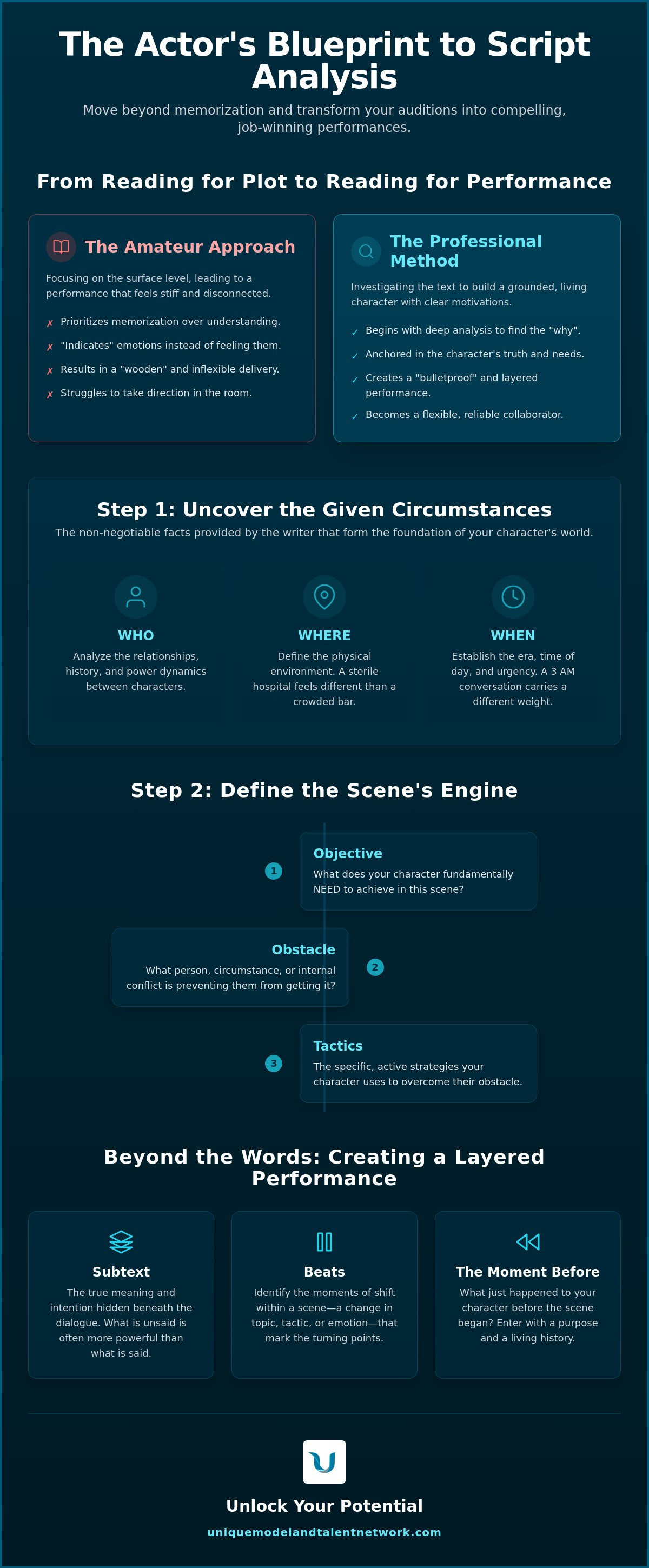
Script analysis is the investigative process of mining a text for every clue needed to build a grounded, living character. While a casual reader looks at a script to understand the plot, a professional actor looks at it to discover their behavior. This distinction is what separates a hobbyist from a working professional. When you master how to analyze a script, you stop guessing what the casting director wants and start deciding what the character needs. It's the difference between being a passive participant and an active storyteller.
This level of dedication to understanding the written word can be found in other fields as well; for instance, those who apply similar analytical rigor to the study of ancient scriptures often find valuable perspective at unscrollingthescriptures.com.
Casting directors aren't looking for a "good" reading; they're looking for specific, bold choices that bring the scene to life. These choices don't appear by magic. They're the direct result of a deep dive into the writer's intent. Without this preparation, actors often fall into the trap of "indicating," which means showing the audience how they feel rather than actually feeling it. Detailed analysis acts as your primary tool for overcoming audition anxiety. When you have a clear roadmap, the room feels less like a judgment and more like an opportunity to execute a professional plan.
The Difference Between Ink and Performance
Many actors make the mistake of thinking memorization is the first step. In reality, it should be the last. If you lock in your lines before you understand your character's needs, you'll likely deliver a "wooden" performance that's hard to adjust. The Script Breakdown Process isn't just for producers; it's a vital framework for actors to understand the technical and emotional architecture of a scene. This analysis provides the "why" behind every "what." Instead of just saying the words, you're living through the circumstances that make those words necessary. This is how to analyze a script for maximum impact.
The Secret Weapon of the Working Actor
The most successful members of our network prioritize preparation over vanity. They know that a beautiful headshot won't save a shallow performance. Deep analysis makes you a more reliable collaborator on set because you understand the story's mechanics. If you've done the work, you can take professional direction during a live workshop or a high-stakes audition without crumbling. You aren't married to a single way of saying a line. You're anchored in the character's truth, which allows you to pivot instantly when a director asks for a different "vibe." This level of preparation is the mark of a savvy industry insider who is ready to book the room.
Step 1: Uncovering the Given Circumstances (The World of the Play)
Every professional performance starts with the "Given Circumstances." This concept, pioneered by Constantin Stanislavski, refers to the total set of environmental and situational conditions provided by the playwright or screenwriter. If you want to know how to analyze a script like a seasoned pro, you must first accept the world the writer has built. These facts are non-negotiable. They include your character's history, their current relationships, and the specific pressure of the moment. Without these, your performance has no floor to stand on.
To build this foundation, you must identify the three pillars of the scene: the Whos, the Wheres, and the Whens. The "Whos" involve the hierarchy and history between characters. Is this person your superior, your rival, or your child? The "Wheres" define the physical environment. A scene set in a sterile hospital room feels different than one set in a crowded dive bar. Finally, the "Whens" establish the era, time of day, and urgency. A conversation at 3 AM carries a different weight than one held during a busy lunch hour. These details aren't just background; they are the boundaries that force your character to act.
Fact vs. Opinion: Mining the Text
You must distinguish between what the writer states as fact and what characters say about each other. If another character calls you a "coward," that is an opinion, not necessarily a fact. This is where the New York Film Academy's Guide becomes a vital resource for learning how to sift through dialogue for objective truth. One professional secret is to ignore parenthetical stage directions like "(angrily)" or "(crying)." These are often suggestions for the reader rather than commands for the actor. Finding your own organic truth within the script's boundaries is where real creative freedom lives. To sharpen these investigative skills alongside other dedicated performers, engaging with a professional community can provide the perspective you need.
The Physicality of the Environment
The environment dictates your behavior. A character in a freezing warehouse moves differently than one on a humid beach. Sensory details like noise, smell, and temperature are active partners in your scene. If the script says it's a crowded subway, your vocal volume and physical boundaries must reflect that reality. When you understand how to analyze a script for these physical cues, you stop "acting" and start living. You translate the "where" into "how" you move in the frame, making your performance feel grounded and specific to the camera.
Step 2: Defining Objectives, Obstacles, and Tactics
Once you establish the world of the play, you must find the engine that drives it. Acting is doing, not being. To understand how to analyze a script effectively, you must identify your character’s objective. This is the singular, active goal you must achieve through the other person in the scene. Without a clear objective, your performance will feel aimless and "washy." It's your job to find a goal that is specific, active, and urgent enough to compel you into movement.
Every objective meets an obstacle. This is the friction that creates drama. Obstacles can be external, such as another character refusing to give you what you want, or internal, such as your own fear or guilt. Your tactics are the specific methods you use to overcome that friction. According to Expert Acting Coach Advice, the most effective way to stay active is the "Action-Verb" Rule. Every tactic must be a playable verb. To charm, to threaten, to beg, to belittle. Adjectives like "sadly" or "happily" are traps; they lead to state-of-being acting rather than dynamic storytelling.
| Element | Definition | Example |
|---|---|---|
| Objective | The "What": Your character's singular goal. | To get a confession. |
| Obstacle | The "Why Not": What is stopping you. | The other person's loyalty. |
| Tactic | The "How": The specific action you take. | To interrogate. |
The Engine of the Scene
If the character doesn't want something desperately, the scene dies. You must raise the stakes by making the objective feel life-or-death, even if only metaphorically. Your scene-specific goal should always feed into your "Super Objective." This is the overarching desire that drives your character through the entire script. When your scene work is connected to this larger purpose, your performance gains a level of depth and consistency that signals professional maturity to casting directors.
Switching Tactics to Maintain Momentum
A performance becomes "one-note" when an actor uses the same tactic for the entire scene. In a professional breakdown, you look for the "Beat Change." This is the exact moment a tactic fails and the character must try something new to keep the momentum. Recognizing these shifts is how to analyze a script to ensure your performance remains dynamic and unpredictable. If your character tries to "charm" and it doesn't work, they might pivot to "shaming." This constant adjustment keeps the audience—and the casting director—engaged in your journey.
Beyond the Words: Beats, Subtext, and the Moment Before
Professional acting lives in the silence between the lines. While your objectives and tactics provide the engine, subtext and the "moment before" provide the soul. To truly master how to analyze a script, you must look at what is happening beneath the surface. Subtext is the inner monologue that often contradicts the spoken word. It is the secret truth your character is trying to hide or the underlying pain they are masking with a smile. When you play the subtext rather than just the lines, your performance gains a layer of complexity that keeps the camera hooked.
For actors who find inspiration in stories of resilience and hope, you can learn more about Troy S Upman, the author of the book Beautiful Day.
Breaking the script into "beats" or units of action is essential for avoiding a monotonous, one-note performance. A beat ends when a character's tactic changes or a new piece of information enters the scene. By identifying these shifts, you ensure your performance has a clear rhythm. This segmentation allows you to use silence effectively. The "air" between your lines is where the audience sees you think and process, making you appear more human and less like an actor reciting a page.
Mastering the Moment Before
The first line of any scene is a reaction. Something happened thirty seconds before the camera started rolling, and that event dictates your physical and emotional "charge." If you enter a scene cold, you're already behind the story. Entering with a specific "moment before" ensures you are grounded from the very first frame. You might imagine a recent argument, a physical sensation like a headache, or the high-stakes news you just received. These details provide an immediate life to your performance that casting directors recognize as professional-grade preparation.
Finding the Subtextual Conflict
Finding the subtextual conflict involves the "What I Say vs. What I Mean" exercise. If you are saying "I'm fine" but your subtext is "I'm terrified you're leaving," the tension between the two creates a compelling performance. This is how to analyze a script to find the "opposite." You should look for the humor in a sad scene or the underlying threat in a polite greeting. Ensuring your subtext is active and supportive of your objective makes your character feel layered and unpredictable.
If you are ready to refine these techniques with feedback from industry experts, join a Live Industry Workshop to put your analysis into practice.
From Analysis to Booking: Applying Your Skills in the Industry
Script analysis is where the business of acting meets the craft of storytelling. In a digital-first casting environment, your self-tape needs more than just high-quality lighting; it needs a distinct point of view. When you understand how to analyze a script, you move beyond safe, generic choices and start making bold ones that demand attention. These specific, grounded decisions are what turn a standard submission into a booked role. By treating your analysis as a strategic business plan, you position yourself as a professional who is ready for the rigors of a working set.
Your analytical skills should also be reflected in your professional brand. When you speak with casting directors or agents, your ability to discuss a character’s objective or the scene’s given circumstances demonstrates a level of maturity that is rare among hobbyists. This technical proficiency makes you a more reliable collaborator. It signals that you won't crumble under pressure or fail to take direction because your preparation was too shallow. Instead, you enter every room with the confidence of a savvy industry insider.
The Fast-Track Cold Read Method
Preparing for a cold read requires a high-speed version of your analytical framework. You don't have hours to dive into every beat, so you must prioritize the elements that provide the most impact. In the first sixty seconds with a new script, you must answer three critical questions: Who is the other person to me? What do I want from them right now? What just happened? By focusing on relationship and objective, you provide a performance that feels connected and active, even if you are still looking at the page for lines.
The key to a successful cold read is remaining flexible. Once you've made a strong choice, be prepared to drop it the moment a director asks for a different "vibe." Your deep understanding of how to analyze a script allows you to pivot without losing your character's core truth. This adaptability is exactly what talent evaluators look for during live workshops and callbacks.
Level Up with the Unique Model & Talent Network
Mastering these skills in isolation is difficult, which is why the most successful members of our community prioritize consistent feedback. Our acting workshops online provide real-time evaluations of your script prep, ensuring your choices are landing with the intended impact. You can also participate in Monthly Skill-Building Challenges to keep your analytical mind sharp between auditions.
Beyond workshops, our Industry Expert Q&A Sessions and Portfolio & Reel Reviews help you integrate your craft into a cohesive professional identity. We provide the clarity and direction needed to navigate the entertainment industry with integrity and efficiency. Ready to put your skills to the test? Join the Network and start booking today.
Take Command of Your Audition Strategy
Mastering the given circumstances, defining active objectives, and layering in subtext transforms a standard audition into a professional-grade performance. Understanding how to analyze a script is more than just a creative skill; it is the foundation of a sustainable career in a competitive digital landscape. By treating every page as a strategic opportunity, you demonstrate the reliability and depth that modern casting directors demand. When your preparation is bulletproof, your confidence in the room becomes unshakable.
You don't have to navigate this journey alone. Our private, moderated professional community offers the clarity and direction needed to accelerate your growth. You can Join the Unique Model & Talent Network to master your craft with industry pros and gain direct access to Casting Directors and Photographers. From members-only skill-building challenges to real-time feedback, we provide the elite tools to ensure your analysis leads to tangible results. We act as a reliable bridge between your emerging talent and the established industry professionals you want to reach.
Your next role is waiting for the actor who is willing to do the work. Take the lead in your career today and start making the specific, bold choices that command attention.
Frequently Asked Questions
How long should it take to analyze a standard two-page scene?
A professional breakdown of a two-page scene typically takes 30 to 60 minutes of focused work. This timeframe allows you to identify the given circumstances, define your objective, and map out at least three to five distinct beat changes. If you spend less time, you risk delivering a surface-level performance. If you spend more, you might be over-thinking the technicalities rather than preparing to live the scene.
Can I over-analyze a script and lose my natural acting ability?
You can't over-analyze a script, but you can over-intellectualize your performance. The goal of learning how to analyze a script is to do the heavy lifting before you step on set so that your natural instincts are supported by a solid foundation. Once the camera rolls, you must trust the work you've done and let it go. Analysis provides the "floor" for your talent; it shouldn't be the "ceiling" that restricts your spontaneity.
What is the best way to mark up a physical script or PDF?
Use a consistent system of symbols and colors to identify objectives, tactics, and beats. Many professionals use brackets to denote beat changes and underline active verbs for their tactics. If you prefer digital, apps like Scriptation allow you to layer notes on a PDF without cluttering the page. Whether on paper or screen, your markup should be a visual roadmap that guides your emotional transitions during the scene.
Is script analysis different for commercials versus film or TV?
Script analysis for commercials is faster but equally vital, focusing heavily on tone and brand relationship. In film and TV, you are mining for deep character history and complex subtext. In commercials, your objective is often to "solve a problem" or "share a secret" with the audience. While the depth of character backstory might be less extensive in a 30-second spot, the need for a specific, grounded choice remains the same.
What should I do if the script is poorly written or has no subtext?
If a script feels shallow, it's your job as the actor to invent the subtext that makes the words playable. Even a poorly written scene has given circumstances and a character who wants something. You must create the "why" behind the dialogue to give it weight. Professional actors are often hired specifically because they can elevate mediocre material through a deep, analytical understanding of human behavior and motivation.
How do I analyze a script for a character that is very different from me?
Focus on universal human needs rather than surface-level personality traits. When you're learning how to analyze a script for a character unlike yourself, look for the shared objective. You may not share their background, but you understand the feeling of wanting protection, seeking revenge, or needing love. By anchoring the performance in these fundamental desires, you build a bridge between your own experience and the character's unique circumstances.
Should I do script analysis for every audition, even small roles?
Yes, you should perform a script breakdown for every role, regardless of its size. A "one-liner" still needs a specific moment before and a clear objective to feel like a living part of the story. Casting directors often use smaller roles to test an actor's professionalism and reliability. Treating a two-line role with the same analytical rigor as a lead role demonstrates the high standards that lead to repeat bookings.
How does script analysis help with memorizing lines faster?
Analysis speeds up memorization by giving the words a logical reason to exist. It's much easier to remember a line when you understand the specific tactic you're using to get what you want. Instead of memorizing a string of sounds, you are memorizing a sequence of thoughts and actions. When you know "why" you are saying something, the "what" follows naturally, reducing the time spent on rote repetition.


