

Most modeling coaches are selling you a glossy dream, but very few are selling you a sustainable career. You’ve likely seen the high-pressure ads for expensive "model camps" that promise stardom while ignoring the grounded reality of professional business development. It’s exhausting to navigate an industry that often feels chaotic and predatory, especially when you’re ready to trade the superficiality of social media for legitimate, paid industry work.
We agree that the lack of transparency around industry standards makes it difficult to know who to trust. That’s why understanding exactly what to look for in a modeling coach is your most important career move this year. A true mentor doesn't just teach you how to pose. They act as a protective authority, helping you build a professional portfolio and providing direct access to vetted casting directors and photographers who actually hire talent.
In this 2026 professional guide, you'll learn how to identify legitimate mentors who prioritize your financial security and career acceleration. We will preview the essential red flags to avoid, the impact of new regulations like the New York Fashion Workers Act, and how to find a coach who understands the business side of booking work.
Key Takeaways
- Learn why a modern modeling coach acts as a skill-building mentor rather than a booking agent, focusing on the specific commercial and digital demands of the 2026 market.
- Discover exactly what to look for in a modeling coach by vetting their track record with elite agencies and their mastery of current standards like digital portfolios and self-tapes.
- Master the "Business of You" through a curriculum that balances technical posing skills with professional branding and essential on-set etiquette.
- Identify and avoid common industry scams, such as "guaranteed" agency signings or predatory photographer referrals that drain your budget without adding value.
- Understand why a managed talent community provides superior career security by offering diverse expert perspectives and peer feedback compared to traditional 1-on-1 coaching.
Defining the Role: What Does a Modeling Coach Actually Do?
Modeling isn't just about standing still; it's a high-stakes business performance. A modeling coach acts as your strategist and technical instructor. They ensure you understand the mechanics of what a professional model does before you step into a high-pressure casting environment. In 2026, this role has shifted significantly. While old-school runway walks still matter, the modern industry demands expertise in commercial movement and digital-first presence. Understanding what to look for in a modeling coach starts with recognizing they are your mentor, not your manager.
The Difference Between a Coach and an Agent
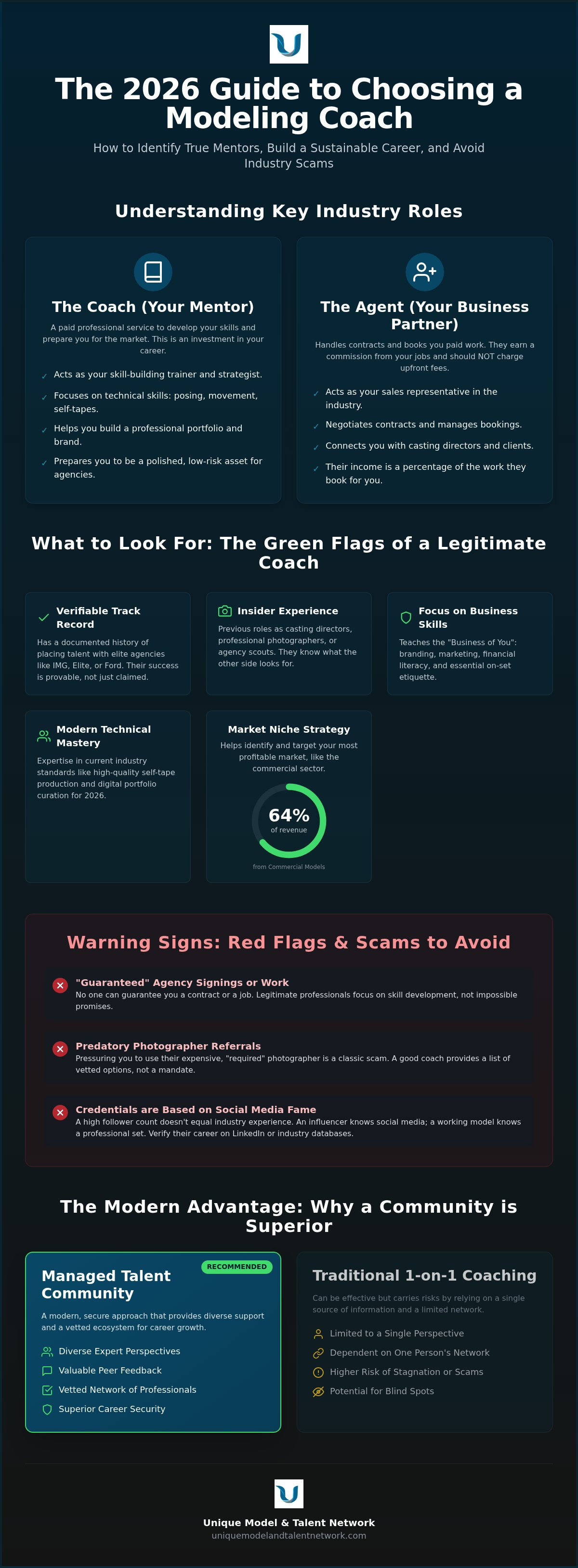
Agents are your business partners. They handle the contracts and book the work. Coaches are your trainers. You should never pay an agency an upfront fee for representation, as their income comes from commissions on your bookings. Conversely, a coach provides a professional service. Paying for their time is a standard investment in your skill set. A coach helps you perfect your digital submissions and open call etiquette. They make sure that when you finally meet an agent, you're a polished, low-risk asset. They prepare you to be bookable, while the agent handles the actual booking.
Technical Skills vs. Career Strategy
Technical coaching focuses on the "how" of the job. It’s about angles, lighting, and fluid movement for the lens. However, a comprehensive approach includes modeling career coaching to address the "why" and "where" of your career path. This involves:
- Identifying your specific market niche, such as commercial, editorial, or fitness.
- Building a personal brand that resonates with 2026 casting directors.
- Establishing financial legitimacy by focusing on paid industry work rather than vanity projects.
A career-focused coach prepares you for the business reality where commercial models account for roughly 64% of industry revenue. They help you pivot from being a hobbyist to a professional who understands set etiquette and marketing strategy. Knowing what to look for in a modeling coach means finding someone who balances these technical demands with a clear roadmap for your professional growth. They shouldn't just tell you that you look good; they should show you how to turn that look into a sustainable business.
Evaluating Credentials: How to Vet Industry Experience
Credentials in the modeling industry are often shrouded in vague claims of stardom and potential. To protect your career, you must demand verifiable evidence of success. When considering what to look for in a modeling coach, your first step is auditing their professional network. A legitimate mentor should have a documented history of working with or placing talent at top-tier agencies like IMG, Elite, or Ford. They should also demonstrate a deep understanding of 2026's technical requirements, such as high-quality self-tape production and the nuances of digital portfolio curation.
Vetting these claims is your first line of defense against predatory practices. It's vital to cross-reference a coach’s promises with FTC advice on modeling scams to ensure you aren't being led into a high-priced trap that offers no real industry return. Prioritize coaches who have held roles as casting directors or professional photographers. These insiders understand the "other side" of the table and can provide the specific feedback you need to actually book paid work.
The 'Social Media Fame' Trap
Don't let a high follower count cloud your judgment. There is a massive difference between an influencer and a working model. An influencer knows how to curate an aesthetic feed, but a working model knows how to navigate a complex commercial set and hit their marks under pressure. Use LinkedIn and industry-specific databases to verify a coach's professional history. If their experience doesn't exist outside of Instagram or TikTok, they likely lack the technical expertise required to help you succeed in a professional casting room. Accessing a vetted talent network can help you bypass these superficial metrics and connect with professionals who have real skin in the game.
Portfolio and Client List Verification
A coach’s personal portfolio should be your next stop. Review their work for quality and relevance to your specific niche, whether that’s commercial, fit, or high fashion. Look for "tear sheets"—actual published work—from the last 2-3 years. The industry evolves rapidly, and advice from someone who hasn't been on a professional set since 2020 is often obsolete. A coach with diverse experience across multiple markets offers the most value. They can help you pivot your strategy as the market shifts, ensuring your look remains competitive and your branding stays sharp. Always ask for specific student success stories. If they can't name models they've helped get signed or jobs they've helped talent book, their "expertise" is likely just theory.
The Essential Curriculum: What Your Coach Should Teach
A legitimate coach provides more than just a critical eye on your runway walk. In 2026, technical mastery of your movement must be paired with digital literacy and a deep understanding of set etiquette. When evaluating what to look for in a modeling coach, prioritize those who teach you how to manage your career as a business. This includes mastering the nuances of light and angles to ensure you always give the photographer "the shot" while maintaining the professional stamina required for long production days.
Your education should also cover the defensive side of the industry. A mentor who values your career security will teach you how to avoid modeling scams by identifying the red flags in predatory contracts or "pay-to-play" casting calls. They should guide you through the technical setup of your profiles on professional casting websites, ensuring your digital presence is optimized for search by recruiters and directors.
Mastering the Digital Submission
Agencies today rely on "digitals" or "polas" to see your natural state. Your coach must show you how to take these images without professional lighting or heavy retouching. They should also help you perfect the self-taped slate, which is a personality video where you introduce yourself to casting teams. These 30-second clips are often the deciding factor in whether you get called in for a live audition. A coach should also help you optimize your profile on platforms like Actors Access or other major industry portals to ensure you aren't overlooked by automated filters.
Developing a 'Bookable' Portfolio
A vanity-driven portfolio is a career killer. Instead, your coach should help you curate images that demonstrate range, showing you can transition from commercial "neighbor" looks to high-fashion editorial. Central to this is your comp card. A comp card is a model's professional business card containing stats and top images. It serves as your primary marketing tool during go-sees and networking events, and your coach should ensure yours meets current 2026 industry standards.
The Business of Booking
The most valuable coaches demystify the financial side of the industry. Understanding usage rights and contract terms is a core part of what to look for in a modeling coach who actually wants you to succeed. You need to understand the difference between day rates and usage buyouts to ensure you’re being paid fairly for your work. Professional set behavior determines whether you get booked a second time. Finally, a mentor should emphasize financial organization, helping you track expenses and invoices as an independent contractor.
Spotting the Red Flags: How to Avoid Industry Scams
The modeling industry is unfortunately rife with individuals looking to profit from your ambition. Knowing what to look for in a modeling coach means knowing how to spot the difference between a legitimate professional investment and a predatory scam. A protective mentor focuses on your long-term career security. They never use high-pressure sales tactics to push you into expensive "modeling camps" that lack a clear, written curriculum. If a coach uses aspirational language about "stardom" but cannot provide a syllabus or clear session goals, they are likely selling a dream rather than a skill set.
One of the most common lies is the promise of "guaranteed" agency signings. No legitimate coach can promise this. Agency rosters are curated by scouting teams based on specific market needs and current trends. If a coach claims they have a "backdoor" into an elite agency that guarantees you a contract, they are being dishonest. Their job is to make you bookable and prepared for the room, but the final decision always rests with the agency. Another critical element of what to look for in a modeling coach is a history of professional integrity. Avoid coaches who profit from "pay-to-play" fashion shows. These events require models to pay fees or sell tickets to participate and offer zero value to your professional portfolio.
The 'In-House Photographer' Conflict
A legitimate mentor should act as a gatekeeper to quality, not a salesperson for a specific studio. If a coach insists you must use their "in-house" photographer at an inflated price, you are likely caught in a kickback scheme. Professional coaches provide a diverse list of recommended photographers across various price points and styles. This transparency allows you to build a portfolio that actually fits your specific market niche. In 2026, a fair price for a starter portfolio shoot should be based on the photographer's published rates and the number of retouched images provided, not a hidden fee bundled into a coaching package.
Vague Promises vs. Tangible Skills
Scams often hide behind the superficiality of social media fame. Be wary of coaches who focus on "influencer" metrics rather than technical casting room requirements. A professional coach emphasizes becoming "working talent" and focuses on your financial legitimacy as an independent contractor. They should encourage you to seek outside advice and join vetted professional networks rather than trying to isolate you. Isolation is a major red flag. If a coach discourages you from speaking to other industry professionals or checking outside resources, they are trying to maintain control over your career path and your wallet. True mentorship is about empowering you with the tools to navigate the industry independently.
Beyond 1-on-1: Why a Managed Talent Community is the Modern Choice
While private sessions offer individual attention, they often lack the breadth of perspective required for a competitive edge in 2026. When evaluating what to look for in a modeling coach, you must consider whether that mentor provides a bridge to a wider professional ecosystem. A single coach's advice is limited by their personal bias and past experiences. In contrast, a diverse acting industry networking platform offers a collective intelligence that a lone professional simply cannot match. Unique Model & Talent Network functions as a curated, gated space that removes the noise of general social media, allowing you to focus on tangible career success.
Access to Multiple Experts
The industry is subjective. What one casting director loves, another might overlook. This is why the Network Membership prioritizes Live Industry Workshops with a rotating roster of guest experts. Hearing from five different casting directors provides a more accurate picture of current market demands than relying on a single coach's opinion. Monthly skill-building challenges keep your craft sharp by forcing you to adapt to different creative briefs. These internal Q&A sessions offer the "unfiltered" truth about recruitment and talent evaluation, providing you with a roadmap for professional financial legitimacy.
The Power of a Vetted Peer Network
Isolation is the enemy of professional growth. By joining a managed community, you gain the ability to learn from the successes and mistakes of other working models. This environment provides a "Protective Mentor" atmosphere where you can discuss industry trends and safety concerns without the fear of predatory behavior. A gated community on Mighty Networks ensures that every member is serious about their craft, creating a safe, moderated space for professional development. This collective approach offers several benefits:
- Finding reliable collaborators for "test shoots" to build your portfolio without the risks of public forums.
- Receiving objective peer feedback on your digital submissions and self-tapes.
- Sharing intelligence on reputable photographers and agencies to avoid the scams mentioned in previous sections.
Ultimately, what to look for in a modeling coach in 2026 is no longer just a person; it is a system of support. A managed talent community provides the career security and elite status needed to transition from an aspiring talent to a working professional. It acts as a reliable bridge between your current skill level and the high standards of established industry professionals, ensuring you aren't just another face in a chaotic digital landscape.
Your Path to Professional Financial Legitimacy
Navigating the modeling industry requires more than just a dream; it requires a strategic roadmap and a protective circle of experts. You now understand that what to look for in a modeling coach goes far beyond a runway walk. It’s about finding a mentor who prioritizes your digital literacy, business acumen, and career security. By avoiding the common traps of predatory modeling camps and unvetted social media advice, you position yourself as a serious, bookable professional in the 2026 market.
Instead of relying on a single perspective, you can access an entire ecosystem of industry leaders. Join the Unique Model & Talent Network and get direct access to industry experts today. Our members benefit from live workshops with casting directors, portfolio reviews by professional photographers, and monthly skill-building challenges designed to accelerate your career. You have the talent and the ambition. Now, it’s time to give yourself the professional foundation you deserve.
Frequently Asked Questions
Is it worth paying for a modeling coach if I don't have an agent yet?
It's absolutely worth paying for a coach before seeking an agent. Agents expect you to arrive as a polished professional who understands set etiquette and movement. A coach helps you refine these skills so you don't waste your one chance at an agency open call. Investing in your craft early ensures you have a competitive digital portfolio and the confidence to handle professional casting environments.
What is the average cost of a modeling coaching session in 2026?
Industry rates for coaching vary based on the market and the instructor’s professional background. While some seasoned experts in major fashion hubs charge premium rates for private sessions, many emerging models find success through monthly membership platforms. These communities often provide more value than a single session by offering continuous access to multiple experts. Always prioritize a technical curriculum over the lowest price point when deciding on your professional development.
Can a modeling coach help me get signed by a top agency?
A coach cannot guarantee a contract, but they significantly improve your chances by making you a low-risk asset to a scouting team. They help you understand what to look for in a modeling coach who has actual ties to elite agencies. By refining your digitals and self-tape technique, a mentor ensures your submission stands out to recruiters who receive thousands of applications every month.
What is the difference between a modeling camp and a modeling coach?
Modeling camps are typically short, intensive events that often focus on aspirational dreams and high-pressure sales. A modeling coach provides ongoing mentorship and a structured curriculum tailored to your specific market niche. While camps might offer a glossy experience, a dedicated coach or a managed talent network focuses on the grounded reality of building a sustainable, financially legitimate career through repeatable skill development and industry networking.
How do I know if a modeling workshop is a scam?
You can identify a scam by looking for pay-to-play models or guarantees of fame and work. Legitimate workshops never promise a job in exchange for a fee. If a program insists you use their expensive in-house photographer or discourages you from checking outside resources, it's a red flag. Always verify the credentials of the guest speakers and cross-reference their names with reputable industry databases before making any financial commitment.
Do I need a coach if I only want to do commercial or 'real people' modeling?
Yes, because commercial modeling accounts for a dominant share of industry revenue and requires specific acting and movement skills. Commercial work isn't just about your look; it's about your ability to take direction and maintain professional behavior on a busy set. A coach helps you master the Business of You, ensuring you can market yourself effectively to brands looking for authentic, relatable talent that knows how to work.
Can online modeling coaching be as effective as in-person sessions?
Online coaching is highly effective, particularly for mastering the digital-first requirements of 2026. Since most initial castings now happen via self-tapes and digital portfolios, learning these skills in a digital environment is actually an advantage. Virtual platforms also allow you to connect with experts in major markets without the high cost of travel, providing a more accessible path to elite industry knowledge and professional feedback.
What questions should I ask a modeling coach before hiring them?
You should ask about their specific student success stories and which agencies their talent have successfully joined. Inquire about their curriculum: does it cover digital literacy and contract basics? Understanding what to look for in a modeling coach means ensuring they have a verifiable history as a casting director, photographer, or working model. Finally, ask if they provide a written syllabus so you know exactly what technical skills you will be developing.


