

The difference between a hobbyist and a professional talent isn't just luck; it's the depth of their preparation. In a 2026 market that prioritizes hyper-naturalism and subtle on-camera delivery, casting directors can spot a surface-level performance in seconds. If you've ever worried that your characters all sound the same or felt that nagging anxiety about being "found out" as an amateur, you're facing a common professional hurdle. To move beyond the generic, you need a structured set of character development exercises for actors that turn creative guesswork into a repeatable, high-stakes system.
You deserve to walk into every audition, whether it's a self-tape or a live session, with the confidence of a seasoned insider. We're going to master the advanced techniques that help you find "the hook" in a script quickly and effectively. This guide provides a professional toolkit designed to deepen your craft, secure more bookings, and earn the recognition of industry pros who value disciplined talent. We'll explore the specific methods you can use to bridge the gap between basic exploration and the elite performance standards required for SAG-AFTRA level work.
Key Takeaways
- Understand why the 2026 casting landscape prioritizes hyper-specific, authentic character choices over generic archetypes to increase your booking frequency.
- Learn to use the "Three Perspectives" diagnostic tool to excavate the unnegotiable truths buried within any professional script.
- Discover how somatic techniques like "Animal Work" and vocal resonance placement can physically anchor your performance for high-stakes on-camera roles.
- Implement professional character development exercises for actors, such as "Hot Seating" and pre-script journaling, to build a repeatable and reliable immersion system.
- Adapt your character-building process for the self-tape era by optimizing your choices for digital frames and leveraging expert feedback loops.
The Professional Stakes of Character Development in 2026
In the high-stakes environment of 2026, casting directors are moving away from the "polished" audition. They've seen thousands of technically perfect reads that lack a pulse. What they're searching for is a "lived-in" quality, a performance that suggests a life existed before the first line and will continue after the final cut. This shift toward hyper-specificity means that generic archetypes no longer secure bookings. If you want to be more than just a face in a database, you must treat your craft as a serious business investment. Deepening your character work isn't an artistic indulgence; it's the foundation that reduces audition anxiety and allows you to deliver with authority. When you know exactly who the person is, the fear of "getting it wrong" disappears.
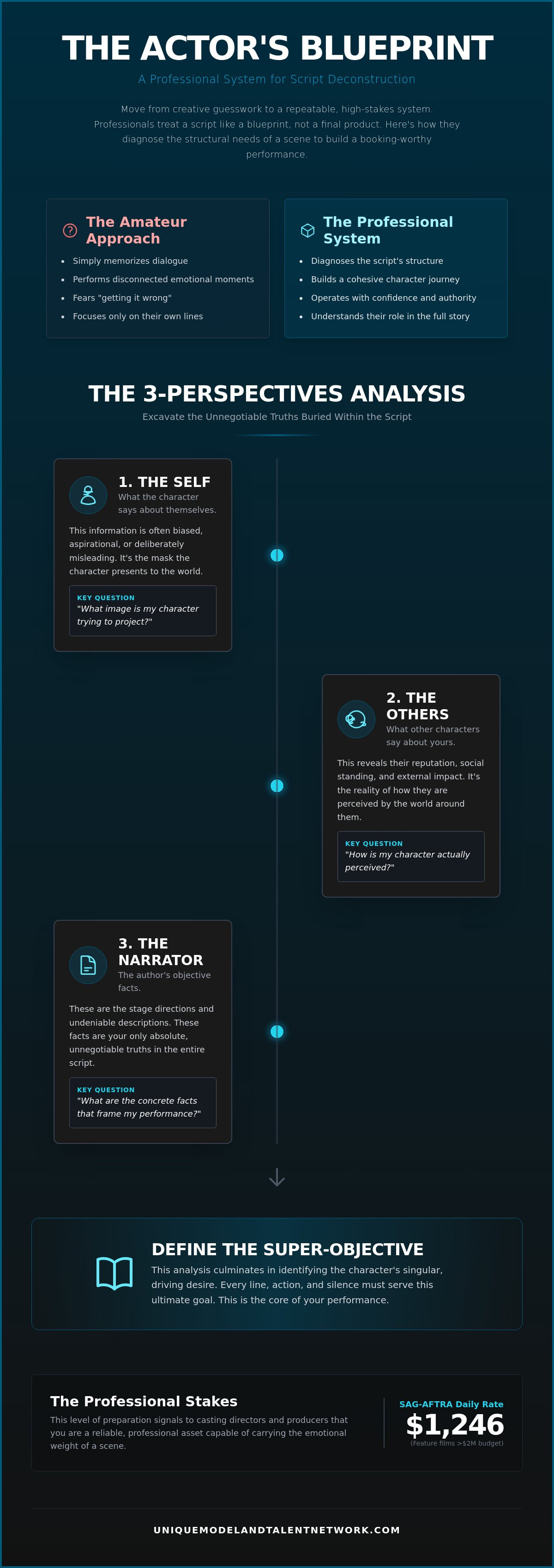
While the SAG-AFTRA daily rate for films with budgets over $2 million is $1,246, the actors who consistently secure these roles are those who bring more than just a memorized script. Developing a repeatable system through character development exercises for actors allows you to bypass the "hook" struggle and jump straight into the emotional core of the story. This level of preparation is what distinguishes the talent who get called back from those who are forgotten. It's an investment in your own professional legitimacy that pays dividends in the form of higher-tier bookings and industry respect.
Beyond the Script: Why Depth Matters to Decision-Makers
Decision-makers are often working against tight deadlines and shrinking budgets. When you present a character with evident depth, you're essentially making their job easier. You provide the "X-factor" that vetted talent brings to the table, proving you can handle the nuances of a complex production. Character depth is the definitive bridge between a cold script and a confirmed booking. It signals to producers that you're a reliable asset who can carry the emotional weight of a scene without constant hand-holding from the director.
The Difference Between Acting and 'Being' in a Private Network
The modern industry is cluttered with superficial trends from social media that prioritize vanity over technique. Serious professionals distinguish themselves by focusing on the grounded reality of the work. Within a gated community like the Unique Model & Talent Network, the emphasis remains on high standards and career longevity. By utilizing specialized Method acting techniques and consistent character development exercises for actors, you move from "performing" to simply "being." This distinction is what separates the elite tier of performers from the hobbyists. It's about building professional bonds and a reputation for excellence that industry experts recognize. If you're serious about your craft, you prioritize these rigorous standards over temporary social media fame. This commitment to excellence ensures that you're not just looking for a job, but building a sustainable career with the security of a professional community behind you.
Script-Based Diagnostic Exercises: The Foundation of Prep
Professionals treat a script like a blueprint rather than a final product. While an amateur might simply memorize dialogue, a seasoned performer uses specific character development exercises for actors to diagnose the structural needs of the scene. This diagnostic phase is where you identify the unnegotiable truths of the story. You're looking for the "given circumstances," the facts provided by the writer that cannot be ignored. These facts provide the boundaries within which your creativity can play. Without this foundation, your performance risks becoming a series of disconnected emotional moments rather than a cohesive journey.
One of the most effective ways to begin this excavation is through the "Three Perspectives" analysis. This system forces you to look beyond your own lines to see how the character fits into the larger narrative machinery. You must analyze three distinct sources of information:
- The Self: What the character says about themselves. This is often biased or aspirational.
- The Others: What every other character in the script says about you. This reveals your reputation and external impact.
- The Narrator: The stage directions and objective facts provided by the author. These are your only absolute truths.
Once you've established these perspectives, you can identify the "Super-Objective." This is the singular, driving desire that your character pursues throughout the entire script. Every line and every silence should serve this goal. To keep your performance active, use the "Action Verb" method. Instead of playing an emotion like "sadness," choose a playable verb like "to plead," "to interrogate," or "to defy." If you're looking for a professional environment to sharpen these diagnostic skills, joining the Unique Model & Talent Network provides access to the high-level workshops where these techniques are mastered.
The 'Fact vs. Opinion' Script Excavation
Differentiating between what a character says and what they actually do is where the subtext lives. Characters, like people, often lie to themselves and others. To find the character's secrets, try this exercise: grab two highlighters. Mark every factual statement about your character in blue. Mark every opinion in yellow. The distance between the two colors is where you'll find the character's insecurities and hidden motives. Integrating these character development exercises for actors into your prep ensures you aren't just reciting words; you're revealing a human soul.
Mapping the Character’s Emotional Arc
Every scene requires a clearly defined "Before" and "After." If your character ends a scene in the same emotional state they began, you've missed the opportunity for a turning point. Professionals map these shifts to ensure consistency across a full episodic or feature-length journey. You need to identify the exact moment where your character's tactics change. This level of detail is what creates a "lived-in" performance that casting directors trust for high-budget productions.
Somatic and Vocal Embodiment: Characterizing the External
While script analysis provides the map, your body is the vehicle. Professional character development exercises for actors must bridge the gap between intellectual understanding and physical reality. If your body doesn't reflect the character's history, the performance remains "heady" and detached from the scene's stakes. Casting directors in 2026 are looking for a visceral connection to the role, where every movement feels organic rather than rehearsed. This requires a systematic approach to somatic work that bypasses your own physical habits and replaces them with the character's unique essence.
One of the most potent tools in this category is the "Animal Work" technique. By observing a specific animal's movement and energy, you can find a physical essence that feels entirely separate from your own. It's not about "playing a dog" or a "cat" on screen. Instead, you're looking for the predatory stillness of a wolf or the nervous, high-frequency alertness of a bird. This essence informs how you enter a room, how you listen, and how you react under pressure. To refine this further, identify your character's "Lead Center." Does this person lead from the head, suggesting a cerebral or calculating nature? Do they lead from the heart, indicating emotional vulnerability, or from the pelvis, suggesting a grounded, primal drive? Once you've found this center, develop a singular "Character Gesture." This is a small, repeatable movement, like adjusting a ring or smoothing a collar, that anchors you into the role instantly before the camera rolls.
The Physicality of Status
Status in a scene isn't just about social class; it's about how much space you dare to occupy. High-status characters move with economy and stillness, while low-status characters often exhibit "leaky" energy through fidgeting or shrinking their frame. You can practice this using the "Invisible String" exercise. Imagine a string pulling you upward from the crown of your head to find an effortless, high-status presence without looking stiff. Remember that your physical choices communicate a character's history and internal state to the camera far more effectively than dialogue ever could.
Vocal Rhythm and Tempo Exercises
Your natural speech patterns are often your biggest hurdle in character work. To break these habits, you must find the character's specific tempo and vocal resonance. Does their voice sit in the nasal cavity, the throat, or deep in the diaphragm? A character's tempo often conflicts with the rhythm of the scene, creating necessary dramatic tension. Try the "Punctuation Trap" exercise: intentionally ignore the writer's periods and commas during early rehearsals to find unexpected emotional breaths and rhythms. If you're looking for specialized coaching to master these nuances, The Professional Guide to Acting Workshops Online in 2026 offers excellent resources for finding vocal experts who understand the demands of modern performance.
Psychological Immersion and 'Off-Book' Exploration
Professional talent doesn't wait for the director to yell "Action" to inhabit a role. They understand that psychological immersion is a full-time commitment during the preparation phase. By utilizing specific character development exercises for actors, you ensure that your character has a fully realized life that exists outside the margins of the script. This "off-book" exploration is what prevents your performance from feeling like a series of rehearsed lines and instead makes it feel like a lived experience.
The "Hot Seating" exercise is a favorite among savvy industry insiders for testing character readiness. Have a coach or peer pepper you with rapid-fire questions while you remain in character. If you can't answer immediately about your character's deepest regret or their favorite childhood meal, your foundation is still too thin. Complement this with character journaling, specifically writing about the "Day Before" the script begins. This clarifies the character's immediate needs and emotional state as they enter the first scene. You should also explore the "Private Moment" exercise. Discover what your character does when they believe no one is watching. Do they pace? Do they obsessively clean? These private habits build a layer of authenticity that a camera captures with startling clarity.
To make the script's history feel earned, improvise the "Unseen Scenes" mentioned in the dialogue. If two characters reference a past betrayal, don't just imagine it. Play it. This turns a line of dialogue into a visceral memory, allowing you to react with genuine history rather than manufactured emotion. This level of preparation is what distinguishes the elite talent from the hobbyists.
The 'Five Senses' Backstory Method
Generic backstories often fail because they lack sensory detail. To create instant emotional depth on camera, assign a specific smell, sound, or taste to a pivotal childhood memory. These sensory triggers act as a shortcut to your character's emotional core. Try spending 10 minutes "living" as your character in your own home. Perform mundane tasks like folding laundry or making coffee while maintaining the character's lead center and internal rhythm. This practice bridges the gap between the rehearsal room and the reality of a busy set.
Developing the Character’s Inner Monologue
The most common critique of amateur self-tapes is "dead eyes" during the other person's lines. You can fix this by developing a rigorous inner monologue. You must know exactly what your character is thinking while their partner is talking. Use the "Subtext Translation" exercise by writing out what your character actually means under every line of dialogue. This ensures your eyes remain active and your reactions stay grounded in the character's objective. If you're ready to test these techniques in a professional setting, apply for The Network Membership to connect with mentors who can refine your psychological approach.
Refining Your Process for the Modern Industry
Mastering your craft in private is only half the battle. To secure more bookings in 2026, you must translate your internal character work into a format that casting directors recognize instantly through a screen. The shift toward digital-first performance means that your character development exercises for actors need to be optimized for the lens. A performance that feels "lived-in" on stage might appear over-the-top in a medium-close shot. Professional talent understands that the final stage of character building is refinement through presentation and expert scrutiny.
Presenting your character choices effectively in a professional portfolio or reel is a business necessity. If your reel only shows one "type," you're limiting your marketability. Use the depth you've cultivated to showcase range, ensuring that every clip feels like a distinct, fully realized human being. Joining a managed community allows you to pressure-test these choices before they ever reach a casting office. This environment provides the career security and professional standards that hobbyist groups simply cannot offer. It's about moving away from the superficiality of general social media and toward a disciplined, results-oriented development path.
Character Exercises for Self-Tapes and Digital Auditions
In the self-tape era, the "Moment Before" exercise is your most valuable tool for the camera frame. You don't have the luxury of a slow build on screen. Your character's history must be visible in your eyes the second the recording starts. Practice entering the frame with a specific physical and emotional "hook" that is readable even in a tight medium-close shot. If you find your choices aren't translating well to video, consult The Ultimate Guide to Building an Acting Portfolio That Books in 2026 to ensure your technical presentation matches your artistic depth.
Leveraging Expert Feedback in the Unique Model & Talent Network
Peer review from other emerging actors isn't enough to reach the elite level of the industry. You need the perspective of vetted experts who understand the current recruitment and talent evaluation standards. Within the Unique Model & Talent Network, you can participate in Monthly Skill-Building Challenges designed to sharpen your preparation under professional pressure. These challenges move you beyond the "acting games" found on informal forums and into a structured system of craft. Membership provides direct access to industry expert Q&A sessions and portfolio reviews, offering real-time critique on your character work. This feedback loop is the definitive solution for actors who want to remove external distractions and focus on tangible career acceleration.
Elevate Your Professional Standards for 2026
You've explored how a systematic approach to script analysis, somatic embodiment, and psychological immersion can transform your performances from generic to "lived-in." By integrating these character development exercises for actors into your daily routine, you move beyond the superficial trends of social media and align yourself with the high standards of elite performers. This disciplined preparation is your most effective business tool for reducing audition anxiety and securing consistent bookings in a competitive market.
Real growth happens when you move from solo practice to professional evaluation. You can join a vetted community of professional talent where you'll participate in monthly skill-building challenges and attend live workshops with real casting directors. Ready to have your character work reviewed by industry experts? Join The Network Membership today.
Your craft is your career. Take the next step with the clarity and support of a network that values your professional success as much as you do.
Frequently Asked Questions
What are the best character development exercises for beginners?
Beginners should start with the "Five W’s" (Who, What, Where, When, Why) to establish a logical baseline for any role. These foundational character development exercises for actors help you move past surface-level imitation and toward authentic behavior. It's about grounding yourself in the objective facts of the story before you attempt to add complex emotional layers or stylized physical choices.
How do I develop a character backstory that actually helps my acting?
A backstory only helps if it informs your character’s immediate tactics and needs within the scene. Focus on "Given Circumstances" that create specific obstacles for you right now. If a childhood memory doesn't change how you pursue your objective in the script, it's creative fluff. Professional talent uses backstory to justify their character's current worldview and emotional triggers.
Can I do character development exercises without a script?
You can practice character development exercises for actors through active observation and "people watching" in public spaces. Pick a stranger and try to identify their "Lead Center" or imagine their "Private Moment" based on their posture and gait. This keeps your diagnostic muscles sharp and builds a library of physical traits you can use for future professional roles.
How long should I spend on character development before an audition?
Professionals often have less than 48 hours for a self-tape, so you must prioritize efficiency over exhaustive research. Spend roughly 30 minutes on script diagnostics to find the "Super-Objective" and another 30 minutes on a somatic "Lead Center" to anchor the performance. Speed is a professional requirement; the ability to find depth quickly is what distinguishes elite talent from hobbyists.
What is the 'Animal Work' acting technique and how do I use it?
How do I make my character choices stand out in a self-tape?
Make your choices stand out by committing to a rigorous internal monologue that continues even when you aren't speaking. Focus on the "Moment Before" so that you enter the digital frame already in the middle of a specific thought process. This prevents "dead eyes" in close-ups and ensures your performance feels active, specific, and ready for a professional evaluation.
Is it possible to over-develop a character and become stiff?
You can become stiff if you prioritize a "correct" result over the spontaneous process of the scene. Over-development happens when you plan your reactions instead of your objectives. Stay flexible by focusing on your scene partner and your goal. Let your character work provide the floor you stand on, not a rigid ceiling that limits your natural impulses.
How can joining a talent network improve my character work?
Joining a managed network provides the expert feedback loop that solo practice lacks. You get access to live workshops and portfolio reviews where industry pros can identify if your character choices are actually reading on camera. This professional accountability ensures you’re meeting the high standards required for SAG-AFTRA level opportunities and helps you build vital industry bonds.


