

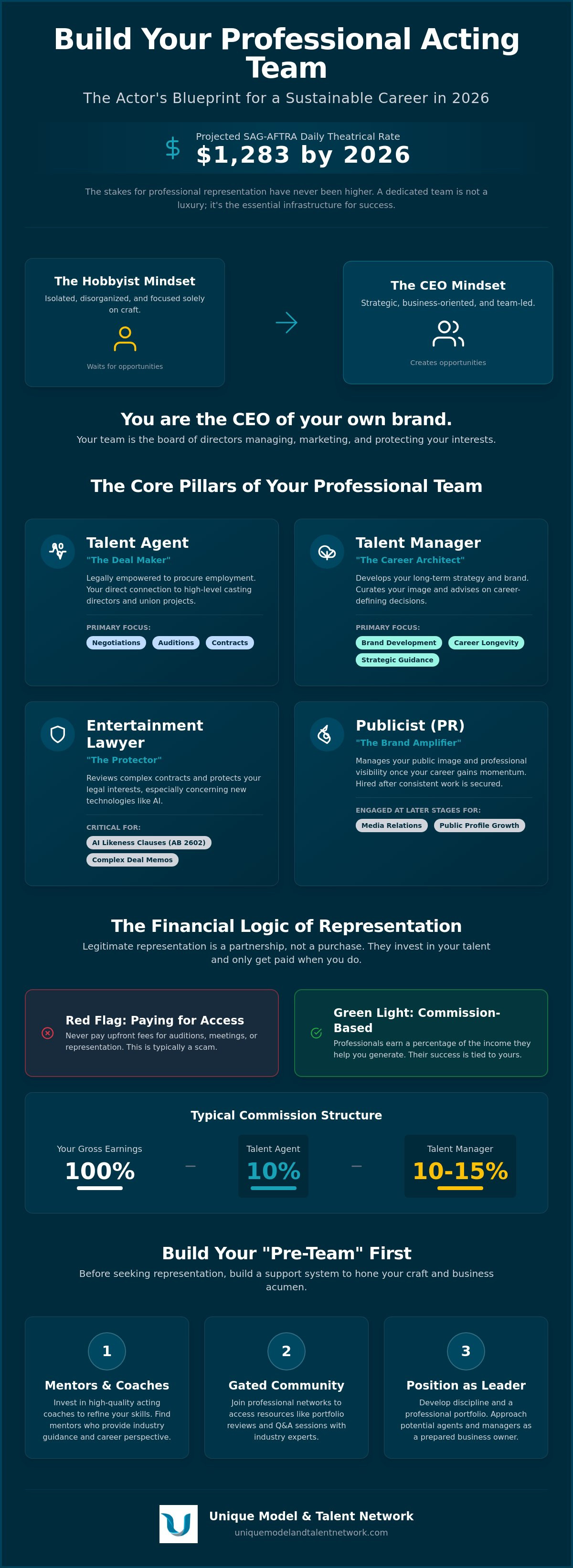
A professional acting team isn't a reward for your success; it's the essential infrastructure required to create it. You likely feel isolated in an industry that often feels predatory or disorganized, but the truth is that the most successful performers don't work alone. If you're tired of shouting into the digital void, it's time to stop guessing how to connect with casting directors and start building a gated network of advocates who understand your value. With SAG-AFTRA daily theatrical rates reaching $1,283 in 2026, the stakes for professional representation have never been higher.
We understand that navigating the shift toward virtual auditions and new AI protections like California’s AB 2602 can feel overwhelming. You deserve a clear roadmap that distinguishes between an agent's hustle and a manager's long-term vision. This article provides a professional strategy for 2026, teaching you how to assemble a high-standard team that transforms your acting craft into a sustainable, profitable business. We will break down exactly who you need on your side, when to hire them, and how to find a mentor-led community that prioritizes your career security over social media vanity.
Key Takeaways
- Define the shift from a hobbyist mindset to a professional business structure by understanding how a specialized team manages, markets, and protects your craft.
- Distinguish between the immediate negotiation power of a talent agent and the long-term strategic brand development provided by a talent manager.
- Learn the professional strategy for how to connect with casting directors by building a pre-team of mentors and acting coaches before seeking formal representation.
- Position yourself as the disciplined leader of your professional circle to ensure efficient communication and maintain high industry standards.
- Discover how resources like Portfolio & Reel Reviews and Industry Expert Q&A Sessions within a gated community can accelerate your team-building process.
What is an Acting Career Team and Why is it Essential?
The entertainment industry is often perceived as chaotic, but a team brings order to that chaos. They act as your advocates and gatekeepers, ensuring you only spend time on high-value opportunities. By building this infrastructure early, you signal to the market—including high-end production and event firms like SORentertainment Inc.—that you're ready for the responsibilities of a professional actor. You aren't just looking for work; you're building a sustainable, profitable career with a support system designed to help you scale.
The Shift from Craft to Career
Talent alone is insufficient in the competitive 2026 market. With the global film industry employing 2.5 million people in the US alone, you need more than just a good monologue to stand out. A team provides the social proof required for high-level casting calls. They act as a filter, signaling to the industry that you're a vetted professional. Understanding Casting (performing arts) means recognizing that casting directors rely on trusted representatives to fill roles efficiently. Your acting career team is a strategic infrastructure for talent monetization. It ensures you're ready when the right opportunity arrives, allowing you to move beyond the superficiality of social media and into elite professional circles.
The Financial Logic of a Professional Team
Legitimate agents and managers operate on a commission-based model. They don't get paid unless you get paid. This structure ensures they're incentivized by your growth and your adherence to professional standards. Agents typically take 10% of your earnings, while managers often take 10% to 15%. This financial arrangement is a badge of legitimacy. It separates the hobbyist who spends money on "exposure" from the professional who shares profits with partners.
If you're wondering how to connect with casting directors, remember that a reputable agent is your primary door-opener. They have the relationships and industry standing you lack. There's a vital difference between paying for access, which is usually a scam, and investing in legitimate expertise. Real representatives invest their time and reputation in you because they believe in your marketability. They help you understand how to connect with casting directors through official channels rather than informal messages. By surrounding yourself with experts, you gain the clarity needed to navigate an uncertain field and avoid predatory practices.
The Core Pillars: Agents, Managers, and Lawyers
Your team members aren't just names on a contact list; they're the active gears in your career engine. To build a sustainable business, you must understand the specific functions of each role. The Talent Agent is your primary negotiator. In most jurisdictions, agents are the only professionals legally permitted to procure employment for talent. They hold the keys to major studio breakdowns and provide the most direct route for those wondering how to connect with casting directors for union-level projects. If an agent isn't pitching you, you're likely missing out on the industry’s most lucrative session fees, such as the $1,283 SAG-AFTRA daily theatrical rate.
While the agent focuses on the deal, the Talent Manager focuses on the trajectory. A manager acts as your long-term career strategist and personal brand developer. They help you curate your image, select the right headshots, and decide which roles will lead to longevity rather than a flash-in-the-pan moment. As you grow, you'll also require an Entertainment Lawyer. With the 2026 enforcement of California’s AB 2602 Digital Replica Law, having a legal expert to review contractual clauses regarding AI-generated likenesses is no longer optional. Finally, a Publicist (PR) becomes essential once you've secured consistent work and need to manage your professional visibility to move from "working actor" to "household name."
Agent vs. Manager: Understanding the Synergy
The legal distinction is simple: agents book work, while managers provide career advice. These roles must communicate effectively to ensure you aren't mismanaged or double-booked. When your agent and manager work in tandem with you, they form a "Power Trio." This unified front ensures that every audition your agent secures aligns with the long-term branding goals your manager has set. If you're looking to observe how these professional relationships function in real-time, joining The Network Membership offers a behind-the-scenes look at industry standards and professional workflows.
Vetting Your Traditional Team
Professional standards are your best defense against predatory practices. Red flags include any representation that demands upfront fees for "registration" or "processing" before you've booked work. During a chemistry read with a potential manager, ask about their current roster size and their specific plan for how to connect with casting directors who handle your specific "type." Legitimacy is found in results and reputation, not vague promises of fame. Always verify that your prospective team members have established relationships with recognized casting offices and a history of financial transparency.
The Modern Advisory Board: Building Your Team Before You Sign
Most actors wait for an agent to give them permission to be professional. This is a fundamental mistake. In the 2026 market, you need a "pre-team" of mentors and experts who help you reach the standard required to attract high-level representation. Think of this group as your advisory board. These are the professionals you hire to sharpen your craft and your business acumen before you ever step into a talent agency. By the time you seek an agent, you should already have a support system that verifies your marketability and protects your professional interests.
Your acting coach is the cornerstone of this initial board. They don't just teach you how to break down a script; they ensure your work meets the rigid, audition-ready professional standards expected by major studios. In an era where virtual auditions are the global standard, your coach is your first line of defense against technical and creative mediocrity. They provide the objective, high-stakes feedback that an agent won't have the time or the obligation to provide during your development phase.
Mentorship and Professional Coaching
Seeking out specialized modeling career coaching or acting mentorship is a prerequisite for team building. These mentors have often spent decades in the industry and can help you vet potential contacts, saving you from predatory "pay-to-play" schemes that target the inexperienced. They also guide you in curating your visual identity. Building a relationship with professional photographers is essential for creating an acting portfolio that actually resonates with decision-makers. Without these experts, you're merely guessing at what the industry wants. With them, you're building a brand based on proven data.
How to Connect with Casting Directors via Mentorship
The noise of general social media is a constant distraction for serious performers. If you want to know how to connect with casting directors, you must look for the signal in private, managed industry platforms. A gated talent community acts as a surrogate team while you're still emerging, providing the infrastructure you haven't yet hired. You can leverage a dedicated acting industry networking platform to find peer recommendations for your first manager or to discover which agencies are currently expanding their rosters.
Instead of paying $400 for a single intensive weekend workshop, use Industry Expert Q&A Sessions to gain direct, recurring insights from those who actually do the hiring. Peer networking within these spaces is the most reliable way to find how to connect with casting directors because you're accessing vetted, legitimate contacts. This collaborative environment removes the isolation of the industry, replacing uncertainty with a clear, community-backed roadmap for your professional growth.
Managing Your Team: Communication and Trust
You are the hub of your professional communication wheel. While your team works to open doors, you're the one who must lead the strategy. A common mistake is assuming that once you have an agent or manager, your job is done. In reality, your role as the CEO of your brand has just begun. You must provide your representatives with the tools they need to succeed on your behalf. This includes updated headshots, current reels, and a clear understanding of your booking availability. When you lead with organization, your team responds with increased effort.
Trust is built through disciplined, organized interactions. If you're wondering how to connect with casting directors, look at the quality of information you're feeding your team. Are you providing them with specific "types" you're targeting? Are you keeping them informed of the workshops you've attended? When conflicts arise, such as a disagreement between an agent's short-term booking goal and a manager's long-term branding vision, you must act as the final decision-maker. You owe your team consistent growth and professional-grade materials. In return, they owe you transparency and active advocacy in the room.
The Professional Communication Rhythm
Checking in with your agent doesn't have to be a source of anxiety. A brief, professional update once every two to three weeks is generally appropriate unless you're actively in the middle of a high-stakes negotiation. Use managed platforms to keep your portfolio updated in real-time. This ensures that when your agent is asked for a specific skill or look, they have the data at their fingertips. Professional transparency is the currency of a successful acting team. To refine your professional presentation and ensure your team has the best materials to work with, consider joining The Network Membership to get an objective industry perspective on your current assets.
When to Expand or Change Your Team
Career plateaus are a natural part of the industry, but they shouldn't be permanent. If your team hasn't secured a significant audition or provided a strategic pivot in over six months, it may be time to evaluate your representation. Firing a team member requires a disciplined approach to avoid burning bridges. Keep the conversation focused on business alignment rather than personal grievances. When introducing a new member, such as adding a publicist to your existing agent-manager duo, ensure all parties are introduced via a formal professional email. This maintains the synergy of your unified front and ensures everyone is working toward the same goal: showing you how to connect with casting directors for the roles that define your career.
Accelerate Your Team Building with Unique Model & Talent Network
Building a professional team shouldn't feel like a shot in the dark. While the traditional route of cold-calling agencies can take years, the Unique Model & Talent Network serves as an incubation chamber for your professional infrastructure. We provide a disciplined environment where emerging talent can meet the high standards required by top-tier representatives. By centralizing access to vetted industry professionals, we remove the distractions of public social media and replace them with a concentrated focus on career security. The Network Membership is a gated space designed specifically for those who prioritize integrity and professional growth over the superficiality of fame.
Direct access to casting directors and photographers simplifies the vetting process that often stalls an actor's progress. Instead of wondering if a contact is legitimate, our members operate within a verified ecosystem. This clarity is essential in an industry where predatory "pay-to-play" schemes are unfortunately common. Learning how to connect with casting directors is significantly easier when you're operating within a space designed for professional recruitment rather than informal networking. Through our platform, you can build the "pre-team" relationships discussed earlier, ensuring your materials are audition-ready before you ever approach an agent.
Direct Access to Decision-Makers
The network effectively bridges the gap between being an unrepresented talent and a signed professional. If you want to be signable to top agents, your presentation must be flawless. Our Portfolio & Reel Reviews provide the objective, expert feedback needed to refine your visual brand. Furthermore, utilizing acting workshops online through our platform allows you to meet potential managers in a high-stakes, professional setting. These interactions provide the "chemistry reads" necessary to ensure your future team aligns with your CEO mindset and long-term goals.
Joining a Community of High Standards
Surrounding yourself with serious talent elevates your own professional brand. When you join a community that values excellence, your work ethic naturally sharpens. Our Monthly Skill-Building Challenges are not just exercises; they're opportunities to prove your reliability and talent to the network's internal experts. This consistent visibility builds the trust required for high-level referrals. If you're ready to stop guessing how to connect with casting directors and start leading your career with authority, it's time to step into a professional environment. Join The Network today and start building your professional infrastructure.
Take Command of Your Professional Infrastructure
Transitioning from a hobbyist to a professional actor requires more than just talent; it requires a disciplined strategy and a team that advocates for your brand. You've learned that your representatives are your partners in profit and that maintaining high standards during your "pre-team" phase is what makes you signable to elite agencies. Understanding how to connect with casting directors is about more than sending cold emails. It's about positioning yourself within a verified ecosystem that values integrity and business results over the superficiality of social media fame.
You don't have to navigate this industry alone. By joining our private community hosted on Mighty Networks, you gain the career security that comes from direct access to vetted casting directors and monthly workshops with industry experts. It's time to stop guessing and start leading your brand with the authority of a savvy insider. Apply to Join the Unique Model & Talent Network today to secure your place in a high-standard professional environment. Your craft is your passion, but your career is your business. Build it on a foundation of clarity and tangible success.
Frequently Asked Questions
Do I need an agent or a manager first?
You should typically seek a manager first if you need guidance on your professional branding and career trajectory. A manager helps you curate your materials and identifies the right "type" for your market. Once your brand is established and you're ready for high-volume auditions, a manager often helps you secure a talent agent to handle daily bookings and contract negotiations.
How much does it cost to build an acting team?
Legitimate agents and managers operate on a commission-only basis, typically taking 10% to 15% of your professional earnings. You don't pay upfront fees to join a reputable agency. Your primary financial investments will be in your "pre-team" infrastructure, such as professional headshots, acting classes, and reel editing. These costs ensure you're a marketable asset for your future representatives.
Can I get noticed by casting directors without an agent?
You can get noticed by utilizing reputable casting platforms and attending industry workshops that offer direct access to decision-makers. Many actors land their first significant roles through self-tape submissions or open calls. Proving your reliability and talent on smaller projects is a proven way to build the professional resume required to eventually attract high-level representation.
What is the best way to find a legitimate talent manager in 2026?
The best way to find a legitimate manager is through targeted research on industry databases and referrals from a mentor-led community. Avoid the unorganized communication typical of general social media. Look for managers who represent actors with a similar "type" but who aren't direct competitors. This ensures they understand your market but have the space on their roster to prioritize your growth.
How do I know if an industry professional is a scam?
You can identify a scam if an individual demands upfront "registration" or "processing" fees before you've booked any work. Legitimate professionals are only paid when you earn money. Always verify their credentials through recognized industry standards and be wary of anyone who guarantees fame or specific roles. A protective mentor or a gated community can help you vet these contacts safely.
Should I have a lawyer review my first talent agency contract?
You should always have an entertainment lawyer review your contracts, especially with the 2026 enforcement of new AI protections like California’s AB 2602. A lawyer ensures that clauses regarding your digital likeness and voice are enforceable and fair. Protecting your intellectual property early is a vital part of treating your acting craft like a sustainable, profitable business.
How does joining a talent network help me find an agent?
Joining a talent network provides the incubation chamber needed to make you signable to top agencies. Through Portfolio & Reel Reviews, you can refine your presentation to meet elite industry standards. It also provides a professional environment for how to connect with casting directors and managers, allowing you to build relationships before you formally seek representation.
What should be in my portfolio before I approach a team?
Your portfolio must include current professional headshots, a high-quality demo reel, and a disciplined resume. If you are still learning how to connect with casting directors, ensure your reel features your strongest performance clips in the first thirty seconds. Clear, professional materials signal that you are a serious performer who is ready for the responsibilities of a professional acting career.


