
In 2026, the most dangerous mistake a new actor can make is assuming that talent alone will open the door to a casting office. You've likely felt the frustration of searching for acting workshops for beginners only to find predatory "pay-to-play" schemes or classes that leave you feeling isolated. It's natural to feel overwhelmed by conflicting techniques and the fear of being scammed in an industry that often feels chaotic. You deserve a path that values your integrity and focuses on tangible career security.
This guide will show you how to choose the right training that balances fundamental craft with the professional networking needed to book your first roles. You'll learn to identify high-standard workshops that offer more than just a certificate. We'll discuss the impact of the 8% projected job growth for actors and how new California AI laws protect your digital likeness from unauthorized use. By the end, you'll have a clear roadmap to finding a supportive community and the foundational skills required to get noticed by real casting directors.
Key Takeaways
- Learn how to identify acting workshops for beginners that prioritize professional-track development over simple hobbyist exploration.
- Discover the core differences between internal and external acting techniques to find the method that best aligns with your natural creative strengths.
- Understand why training in isolation creates a career glass ceiling and how to integrate networking into your education from day one.
- Master a 5-point evaluation framework to vet any program for legitimacy and protect yourself from predatory industry scams.
- Explore how live industry workshops featuring guest casting directors provide the professional visibility required to move from the classroom to the set.
What to Expect from Acting Workshops for Beginners
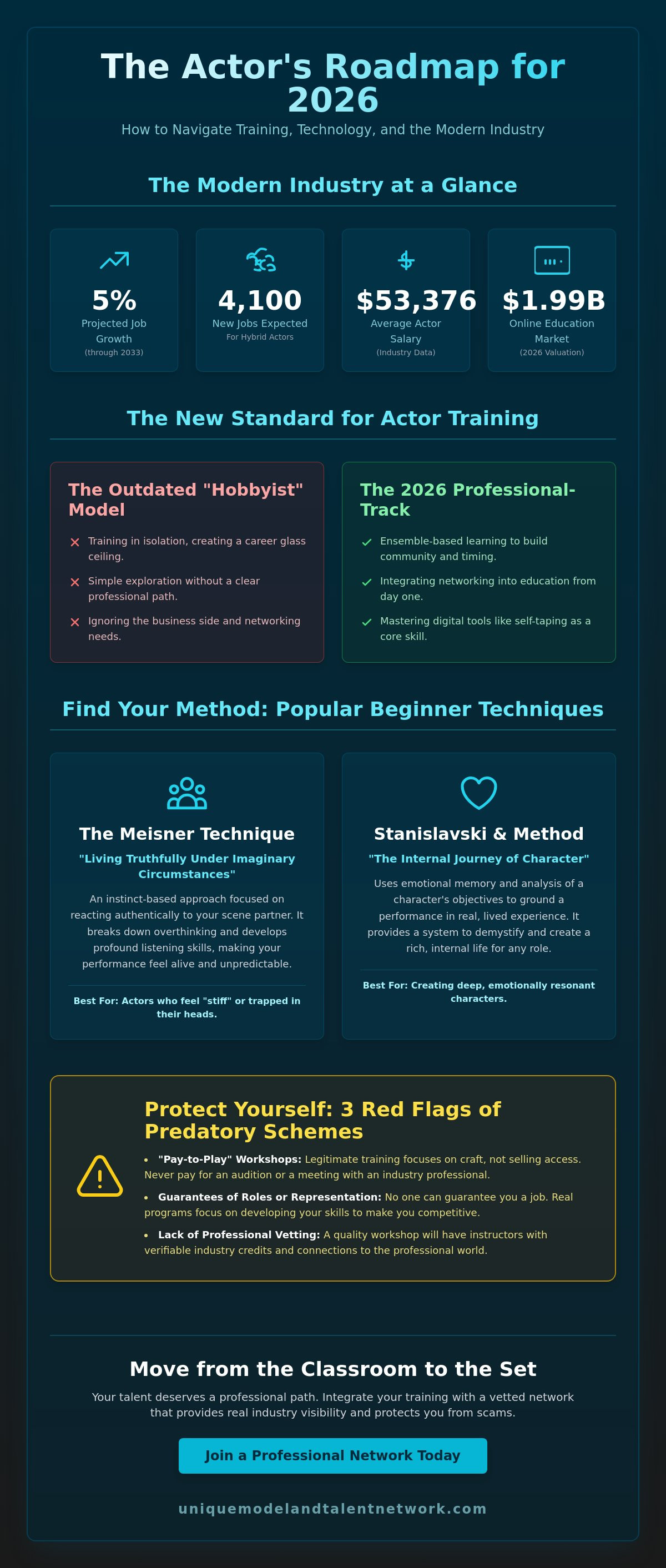
Acting workshops for beginners are designed as structured, safe environments where you can fail without consequence. This psychological safety is vital for fundamental skill acquisition. However, the industry has shifted significantly. While older models focused on "hobbyist" exploration, the 2026 standard emphasizes professional-track development. You don't need a resume to start, but you do need a professional mindset. This means showing up on time, respecting the ensemble, and treating every exercise as a step toward a career where the average salary has risen to $53,376 according to recent industry data. There are over 11,286 actors currently employed in the United States, and the most successful ones started by treating their first class as a business investment rather than a weekend distraction.
Ensemble-based learning is the backbone of any legitimate program. It is not just about your individual performance; it is about developing the social confidence and reactive timing that casting directors demand. When you train alongside others, you learn to listen, which is 90% of the craft. Developing these professional bonds early creates a community of peers who will support your growth as you move toward more advanced training.
The Core Objectives of Your First Class
Your initial sessions focus on breaking down internal inhibitions. You'll work on developing spontaneity, ensuring your reactions feel authentic rather than rehearsed. You will also begin to understand the "vocabulary" of the business. To truly excel, it helps to review a comprehensive overview of acting to familiarize yourself with historical methods and technical terms. You'll learn the basics of script analysis, identifying character motivations, and how to communicate effectively with directors on set. These workshops provide the tools to translate a writer's words into a living, breathing performance that feels grounded and real.
Why 2026 is the Year of the Hybrid Actor
The industry has moved beyond the local stage. With the online acting education market valued at $1.99 billion in 2026, training has become digital-first. Proficiency in self-taping is no longer optional; it is a core requirement for any beginner. While local acting workshops for beginners provide essential physical presence, they must be supplemented with global networking. This is why "vetted" communities are so important. They act as a safety net, protecting you from predatory scams while connecting you to decision-makers in major hubs like Los Angeles, New York, and Atlanta. With employment growth for actors projected at 5% through 2033, the hybrid actor who masters both the craft and the digital workflow will be the one who secures those 4,100 new jobs.
Popular Acting Techniques for Beginners: Which is Right for You?
Choosing a specific technique shouldn't feel like joining a cult. At the start, the individual mentor often matters more than the specific school of thought. You want a guide who respects your unique voice while pushing you toward professional standards. When looking for acting workshops for beginners, it's helpful to understand the two primary paths: internal and external approaches. Internal techniques focus on your inner emotional state to drive performance. External techniques prioritize physical movement and voice to create a character from the outside in.
Theatrical work often requires the broad physical presence of external methods to reach a live audience. Commercial work, however, demands the subtle, relatable spark of internal methods. High-quality legitimate acting workshops will often introduce a blend of these styles. This allows you to build a versatile toolkit that works across different mediums and casting requirements.
The Meisner Technique: Living Truthfully
The Meisner Technique is an instinct-based approach to acting. It's famous for the "repetition exercise," which forces you to stop overthinking and start reacting to your partner. This is the gold standard for anyone who feels "stiff" or trapped in their head during a performance. By focusing entirely on the other person, you develop the listening skills that make a scene feel alive and unpredictable. It's about finding the truth in the moment rather than planning your next line.
Stanislavski and Method Acting: The Internal Journey
Stanislavski’s "System" and the subsequent "Method" demystify the internal journey of a character. These approaches use emotional memory to ground a performance in your own lived experiences. Beginners benefit from this by learning to identify a character’s "super-objective," which provides a clear through-line for their performance. However, be aware that heavy method training can be emotionally exhausting. It's often better to learn the basics of script analysis before diving into the more intense psychological aspects of this style.
On-Camera vs. Stage Workshops
Performing for a lens is a technical skill that differs vastly from stage work. On stage, you project. On camera, you exist. Beginners should seek out workshops that provide on-camera playback. This immediate feedback allows you to see how your expressions translate to the screen without the need for theatrical projection. Once you've captured these moments, you can begin assembling a professional acting portfolio that demonstrates your range to casting directors. If you're ready to put these techniques into practice, participating in Monthly Skill-Building Challenges is an excellent way to refine your craft in a supportive, professional environment.
Why Training in a Vacuum is a Beginner's Biggest Mistake
Many aspiring performers believe that if they simply become "good enough," the industry will eventually find them. This is a dangerous misconception. Training in a vacuum is the fastest way to hit a professional dead end. While local community theater classes offer a great introduction to the stage, they often come with a "Glass Ceiling." These environments are excellent for hobbyists, but they rarely provide the bridge to professional recruitment or talent evaluation. If you want to book roles in 2026, you must adopt a "Savvy Insider" approach. This means choosing acting workshops for beginners that are led by active industry professionals who understand current casting standards and digital self-tape workflows.
Strategic training involves more than just learning lines; it involves learning the business. You need to understand how decisions are made behind the camera to position yourself effectively in front of it. By choosing workshops that balance craft with professional context, you avoid the trap of becoming a perpetual student who never actually auditions. You're not just practicing a hobby; you're developing a career.
The Power of Direct Industry Access
Workshops led by active casting directors are invaluable because they demystify the hiring process. When you work directly with those who make the decisions, you experience a vital psychological shift. You begin to realize that industry experts are not gatekeepers to be feared; they're professionals looking for a solution to their casting needs. This realization builds the confidence you need to walk into a room and deliver a grounded, professional performance. To dive deeper into how to find these connections, consult our acting industry networking platform guide.
Building Your Professional Network from Day One
Networking starts the moment you walk into the room. Your classmates are your future collaborators, not just your competitors. In an industry where projects are often cast through word-of-mouth and professional bonds, these relationships are your most valuable asset. However, avoid the noise of unorganized social media groups. A managed, private community provides a level of security and focused support that open platforms cannot match. Peer feedback within these gated spaces accelerates your growth, allowing you to refine your craft outside of formal hours. By surrounding yourself with serious, disciplined peers, you elevate your own professional standards. This environment fosters the career security and community belonging that every new actor needs to thrive.
How to Choose a Legitimate Acting Workshop in 2026
The rise of digital-first training has democratized access to elite instruction, but it has also made it easier for predatory "pay-to-play" schemes to hide in plain sight. Choosing acting workshops for beginners requires a disciplined evaluation process. You aren't just buying a class; you're investing in your professional development and career security. To ensure your resources are spent wisely, use this 5-point evaluation framework before signing any contract:
- Instructor Credentials: Verify their current standing on IMDB and look for recent credits or successful students.
- Syllabus Specificity: Look for a clear breakdown of skills—such as script analysis or self-tape technicals—rather than vague promises of "stardom."
- Student-to-Teacher Ratio: Ensure the class size allows for individual feedback and "on-your-feet" time.
- Financial Transparency: Legitimate programs provide clear pricing without hidden "registration" or "photo" fees.
- Audit Policy: Respectable studios often allow you to observe a session to gauge the environment and teaching style.
Price points in 2026 vary by location and format. General group classes typically range from $25 to $65 per hour, while monthly studio memberships often fall between $150 and $350. In major hubs like New York, a 10-week Meisner course can cost around $700. If these costs are prohibitive, look for "work-study" opportunities where you can trade administrative or studio labor for tuition. This is a common practice in physical studios that helps build professional bonds with the faculty.
The choice between online and in-person training depends on your immediate goals. In-person workshops provide the physical chemistry and ensemble energy essential for stage work. Conversely, online workshops focus heavily on the digital casting workflow, which is the standard for 2026. Online training offers global access to guest casting directors who you might never meet in a local community theater setting. If you're ready to bridge the gap between training and the professional market, joining Live Industry Workshops is a decisive way to get noticed by real decision-makers.
The Red Flag Checklist: Avoiding Scams
A protective mentor will tell you that no legitimate workshop can "guarantee" an agent, a union voucher, or a specific role. These are the most common lures used by predatory talent searches. Be wary of any program that requires you to pay for "required" headshots from their own photographer as a condition of enrollment. Under the California Freelance Worker Protection Act, your contracts must be in writing and include an itemized list of services. If a workshop feels more like a sales pitch than a training ground, trust your instincts and walk away.
Maximizing Your Investment
Preparation is the difference between a student and a professional. Before your first day, read the assigned materials and research the instructor's background. During class, ask for constructive feedback with a focus on growth rather than validation. Auditing a class before committing to a full term is the best way to ensure the studio's culture matches your professional needs. By treating every session as a high-level recruitment opportunity, you accelerate your growth and build the reputation of a serious, disciplined performer.
Accelerate Your Growth with Unique Model & Talent Network
Finding the right acting workshops for beginners is only the first step toward a sustainable career. While many studios offer standalone classes that end after six weeks, the Unique Model & Talent Network serves as your definitive "Home Base" for long-term development. We bridge the gap between classroom theory and professional reality. By providing a structured environment where you can train, connect, and showcase your progress, we ensure you never have to navigate this industry in isolation. Our members gain exclusive access to Live Industry Workshops led by guest casting directors and professional photographers, offering the kind of visibility that local classes simply cannot match.
We host our community on a private Mighty Networks platform to remove the noise and predatory distractions of general social media. This gated space is designed for serious performers who value professional standards and career security. It's a focused environment where you can engage in Monthly Skill-Building Challenges that push you to move from the mindset of a "student" to that of a working "professional." These challenges are designed to sharpen your technical skills while building the discipline required for high-level recruitment.
A Supportive Mentor in Your Pocket
Our "Protective Mentor" philosophy is at the heart of everything we do. We understand that the entertainment industry can feel chaotic, so we act as a reliable gatekeeper to keep you safe from common pitfalls. Through our Industry Expert Q&A Sessions, you get direct answers to complex career questions, from navigating union eligibility to understanding the latest AI regulations. If you're looking for a deeper dive into digital training, our guide on acting workshops online serves as a core resource for mastering the remote casting landscape.
Beyond the Workshop: Continuous Career Development
A career isn't built on a single performance. It's built on a consistent, high-quality professional brand. We provide ongoing Portfolio & Reel Reviews to ensure your marketing materials stay competitive as you gain experience. You'll also leverage the power of the network to find vetted photographers and coaches, saving you from the "talent search" scams we discussed earlier. This is a rare opportunity to join a community that values your integrity as much as your talent. Don't wait for permission to start your career. Join the Network and book your first workshop today to secure your place in the future of the industry.
Step Into Your Professional Future
Navigating the early stages of a career requires more than just enrolling in acting workshops for beginners. It demands a strategic balance between mastering your craft and building the industry relationships that lead to recruitment. You now have the tools to vet instructors, choose the right technique for your goals, and avoid the predatory scams that often target new talent. Training in a vacuum is a career dead end. The bridge to success is built through active engagement with professionals who understand current casting standards and digital workflows.
The transition from student to working actor happens when you surround yourself with an elite, supportive community. Join the Unique Model & Talent Network to access live workshops and industry experts. Our members benefit from live sessions with guest casting directors, a private moderated community on Mighty Networks, and monthly skill-building challenges designed to grow your resume. We provide the clarity and career security you need to move forward with confidence. Your talent deserves a professional platform. We're here to ensure you find it.
Frequently Asked Questions
Are online acting workshops effective for beginners?
Online acting workshops for beginners are highly effective, especially for mastering the digital casting workflow that is standard in 2026. Since the online acting education market has reached a valuation of $1.99 billion, the technology and teaching methods have evolved to provide high-quality, real-time feedback. These sessions allow you to learn essential self-tape technicals and connect with global industry experts without the logistical hurdles of travel.
How much should a beginner acting workshop cost in 2026?
You should expect to pay between $25 and $65 per hour for group acting classes in 2026. Monthly fees at established acting studios typically range from $150 to $350, though specialized classes in hubs like Los Angeles can reach $495 per month for twice-weekly sessions. Always ensure your workshop provides a written contract as required by the California Freelance Worker Protection Act to maintain financial transparency and professional standards.
Do I need a professional headshot before I start my first acting workshop?
You don't need professional headshots to begin your first round of acting workshops for beginners. Most seasoned coaches recommend waiting until you've developed basic skills and understood your "type" before investing in a professional portfolio. A simple, well-lit photo taken on a modern smartphone is sufficient for your initial classes. This approach saves you from spending money on images that might not reflect your eventual professional brand.
Can acting workshops help me find an agent?
Workshops help you find an agent indirectly by building the skills and professional network necessary for a successful referral. While legitimate workshops never guarantee representation, they often feature guest casting directors or industry pros who can offer guidance on the recruitment process. The bonds you build with your peers and instructors are often the most reliable way to secure an audition or an introduction to a reputable agency.
What is the best acting technique for an absolute beginner?
The Meisner technique is often considered the best starting point because it focuses on instinctive reactions rather than complex psychological theory. It helps you get out of your head and focus on your scene partner, which is vital for building authenticity. Other foundational options include the Uta Hagen technique, which is popular in markets like Atlanta for its practical, grounded approach to character development and scene study.
How long does it take to see progress in an acting workshop?
Most students see a noticeable shift in their confidence and spontaneity within six to ten weeks of consistent training. This timeframe matches the standard length of many beginner intensives in major markets like New York and Chicago. While mastering the craft is a lifelong journey, you'll likely gain a solid grasp of script analysis and basic industry vocabulary after your first full term of study.
Should I take a commercial or theatrical acting workshop first?
Choose a commercial workshop first if your goal is to quickly enter the professional market and book lucrative, short-form roles. Commercial training focuses on relatable, "real person" performances and technical camera skills. If you're more interested in long-form storytelling or film, a theatrical workshop provides the deep emotional foundation and script analysis skills needed for those mediums. Many performers eventually study both to remain competitive.
What happens if I'm too shy for an acting class?
Acting classes are specifically designed to help you find your voice in a safe, controlled environment. You aren't expected to be a polished performer on day one; instead, you'll participate in ensemble exercises that break down inhibitions. Most shy beginners find that focusing on the character's objectives helps them forget their own self-consciousness. Over time, this supportive community environment builds the social confidence required for a professional career.


