

Professional representation is a partnership of mutual profit, not a pay-to-play gatekeeping system. While 67% of creators now use representation to boost their earnings according to Influencer Marketing Hub, the wrong signature can stall your career for years. If you've ever felt like your career is stuck in a holding pattern while your representative ignores your emails, you're likely seeing the first signs of a bad talent agent. It's exhausting to deal with the fear of wasting time or the anxiety of hidden fees, especially when you're ready to take the next big step in your professional development.
We believe you deserve a career built on legitimacy and transparency. This article will teach you how to distinguish between high-level representation and predatory scams so you can protect your future in 2026. We'll provide a clear checklist of industry red flags and the confidence to leave a situation that isn't serving you. You'll also gain an insider perspective on how professional agents actually operate, from standard commission structures to the communication habits of the industry's most successful mentors.
Key Takeaways
- Understand that legitimate agents only profit when you do, operating on a strictly commission-only basis without charging upfront fees for "listing" or "maintenance."
- Identify the primary signs of a bad talent agent, such as demands for mandatory in-house photography services or vague responses regarding your submission history.
- Recognize the "ghosting" threshold and learn how to demand the transparency required to ensure your materials are actually reaching casting directors.
- Master a professional vetting process by verifying SAG-AFTRA or ATA affiliations and researching agency rosters on IMDbPro to confirm their talent is active.
- Discover how to navigate the 2026 industry landscape by building direct relationships with decision-makers through strategic networking and professional workshops.
Understanding the Role of Professional Talent Representation
A talent agent is a licensed professional whose primary function is to procure employment and negotiate contracts for their clients. If you're wondering What is a Talent Agent?, think of them as the bridge between your craft and the commercial marketplace. They don't just find you work; they protect your rights and ensure your compensation matches industry standards. One of the clearest signs of a bad talent agent is a lack of understanding of these boundaries. A pro agent focuses on procurement, whereas a manager handles long term career strategy and a casting director represents the employer's interests. This distinction is vital for your career security.
A legitimate relationship is built on transparency, advocacy, and a shared goal of professional growth. Your agent should be your most vocal advocate in the room, pushing for better rates and safer working conditions. When you sign with an agency, you're entering a business partnership where the expectations should be documented and clear from day one. If the communication feels disorganized or the expectations keep shifting, you aren't dealing with a professional operation.
The Commission Standard: How Pro Agents Get Paid
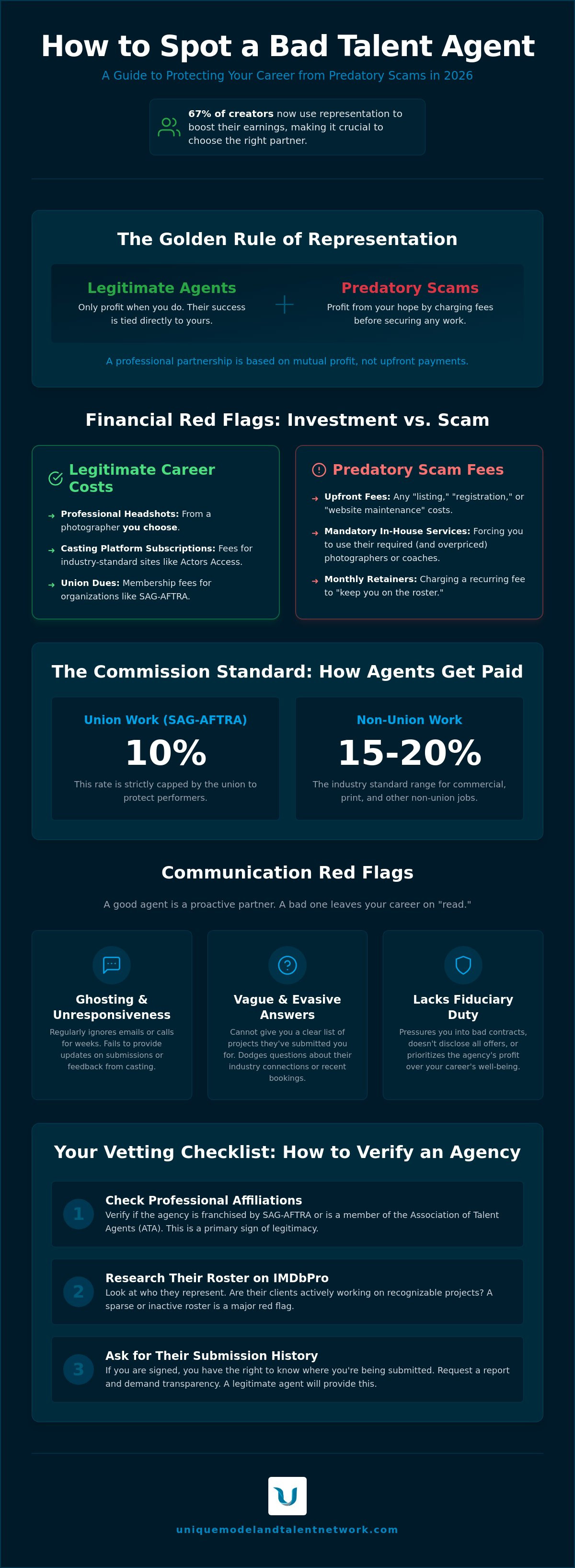
Legitimate agents operate on a performance based model. They only make money when you book a paid job. For union work, SAG-AFTRA regulations strictly cap commissions at 10%. In the non union sector, rates typically range between 15% and 20%. These percentages are calculated from your gross earnings on the specific projects the agent secured for you. The commission model is the only legitimate way an agent earns from talent.
- Union Jobs: 10% commission (Capped by SAG-AFTRA).
- Non-Union Jobs: 15% to 20% commission.
- Red Flag: Any request for a "monthly retainer" or "administrative fee" to stay on the roster.
Fiduciary Duty: Why Your Agent Works for You
In many jurisdictions, agents have a fiduciary duty to their clients. This means they're legally and ethically obligated to prioritize your career interests above their own agency goals. They must disclose all offers and provide honest advice regarding contract terms. You should also know the difference between being a "signed" talent, where you have a formal contract, and a "pocket" talent, where an agent calls you for specific roles without a long term commitment. Engaging in modeling career coaching can help you understand these legal nuances and ensure you're never being exploited by someone who claims to represent you but lacks the proper licensing or ethical standards.
Financial Red Flags: When "Investment" is a Scam
Building a successful career requires financial planning, but knowing where your money goes separates the professionals from the preyed-upon. One of the most glaring signs of a bad talent agent is the demand for capital before they've secured a single audition for you. Predatory agencies often disguise these costs as "website maintenance" or "listing fees." In reality, a legitimate agent's infrastructure is part of their business overhead, not a cost passed down to the talent. If an agency requires you to pay for the privilege of being on their roster, they aren't an agency; they're a subscription service.
Pay-to-play traps are designed to exploit your ambition. They rely on the idea that you must "invest" in yourself to be taken seriously. While you should invest in your craft, that money shouldn't flow into your agent's pocket. Legitimate third-party casting sites charge subscription fees because they provide the platform where casting happens. An agency-owned paywall, however, is a closed loop that rarely leads to external opportunities. Don't let the excitement of a signature blind you to a basic breach of professional standards.
Upfront Fees vs. Legitimate Career Costs
It's vital to distinguish between necessary business expenses and predatory scams. For more detailed protection, the FTC advice on modeling scams warns that no legitimate agency requires payment just to sign you. Use the following lists to evaluate where your money is going:
- Legitimate Costs: Professional headshots from your choice of photographer, subscriptions to major industry-standard casting platforms like Actors Access, and union dues for SAG-AFTRA members.
- Scam Costs: "Signing fees" to join the agency, "processing fees" for your contract, or "mandatory website fees" that only exist on the agency's private domain.
A simple rule of thumb: if the money stays within the agency's ecosystem, it's likely a scam. Legitimate investments are paid to third-party professionals of your choosing. If you're unsure about a specific fee or the quality of your current materials, getting a Portfolio & Reel Review can provide the professional clarity you need to move forward with confidence.
The "In-House" Service Trap
Many bad actors use representation as a front to sell overpriced services. You might be told your current materials aren't up to par and that you must use their "in-house" photographer or take their specific acting classes. This is a classic kickback scheme. A professional agent should provide a list of recommended photographers across various price points, giving you the autonomy to choose. If they refuse to work with your existing acting portfolio despite it being high-quality and current, they're prioritizing their referral fee over your career success.
Communication Red Flags: Signs Your Agent is Ghosting Your Career
Many performers believe the hardest part of their career is over once they secure representation. In reality, the signing is just the starting line. A professional relationship requires active, ongoing engagement. If you've been on a roster for months without a single audition or even a brief check-in, you've reached the "ghosting" threshold. This silence often indicates a lack of submission activity. While the industry has slow seasons, a total absence of communication is one of the most reliable signs of a bad talent agent who has relegated your career to the back burner.
Vague answers are another warning sign. When you ask about your progress, a professional agent provides specifics. They can name the casting directors they've contacted and the projects they've targeted. If your representative responds with empty phrases like "we're pushing you" or "it's just quiet," they're likely masking a lack of effort. You deserve a partner who can quantify their work on your behalf. A lack of transparency is a clear signal that your interests aren't the priority.
The Submission Report: Your Proof of Work
Professionalism and Boundaries
The medium of communication matters as much as the message. An agent who only communicates via Instagram DMs or casual text messages is a liability. These platforms lack the organization and paper trail necessary for high-level business development. Professionalism requires a formal channel like email or scheduled phone calls to ensure nothing gets lost in a social media feed. Also, if an agent is "too busy" to discuss your career strategy at least once a year, they aren't managing your career; they're just collecting a roster. Professional agents treat their talent as business assets, not social acquaintances. They respect your time and provide the structure needed for tangible success.
How to Vet a Talent Agency Before Signing
You are the CEO of your career. Before you grant anyone the right to represent your brand, you must conduct a thorough audit of their business practices. Vetting is not an act of distrust; it is a standard professional procedure used by every high-level performer to ensure their foundation is secure. One of the most common signs of a bad talent agent is a defensive reaction to basic questions about their licensing or track record. A professional agent expects you to do your homework and will welcome the opportunity to prove their legitimacy.
Start your search by verifying professional affiliations. In the United States, look for SAG-AFTRA franchised agents or members of the Association of Talent Agents (ATA). These organizations require agents to adhere to strict ethical codes and financial regulations. You should also consult the Better Business Bureau (BBB) and industry-specific forums to see if other performers have reported issues with contract fulfillment or payment delays. If an agency has a history of legal disputes with its roster, consider that a definitive warning.
Using IMDbPro as a Vetting Tool
Data provides the clarity that marketing materials often obscure. Use an IMDbPro subscription to look up an agency’s client list and analyze their "StarMeter" rankings. This allows you to see if their talent is actually working on professional sets or if the roster is filled with inactive profiles. Pay close attention to niche alignment. If you are a theatrical actor but the agency's recent bookings are exclusively for local commercials, they may not have the casting director relationships necessary to advance your specific goals. An agency with over 500 clients but zero recent bookings is a major red flag; it suggests they are "volume signing" rather than actively managing careers.
The Contract Deep Dive
Never sign a contract on the spot. A legitimate agency will encourage you to have a legal expert or a mentor review the document. Look specifically for "sunset clauses" that allow you to terminate the agreement if the agent fails to secure a specific number of auditions within a set timeframe. You should also be wary of "automatic renewals" and "perpetual commissions" that bind you to the agency long after the relationship has soured. Utilizing acting industry networking platforms can help you connect with peers who have first-hand experience with the agency's contract enforcement.
If you want to ensure your career is built on professional standards rather than guesswork, join our Network Membership to access expert guidance and a community of serious professionals who prioritize career security.
Taking Control: Navigating the Industry Without a Middleman
The industry in 2026 has evolved beyond the traditional gatekeeper model. While a top tier agent is a powerful asset, you no longer have to wait for a signature to begin booking professional work. Many performers fall into the trap of thinking they are invisible without representation, but this belief often leads them to ignore the signs of a bad talent agent just to feel included on a roster. If you are sitting by the phone waiting for a representative who hasn't secured an audition for you in six months, you are giving away your power. You have the tools to build your own momentum and establish direct lines of communication with decision makers.
Building these relationships requires a proactive strategy rather than passive waiting. Casting directors are increasingly accessible through structured networking events and professional development platforms. By focusing on your craft and visibility, you can create a resume that makes elite agencies pursue you. This shift puts you in the driver's seat. It ensures that when you do sign with an agent, it's a partnership of choice rather than a desperate attempt at validation.
Direct Access to Casting Directors
Online platforms have revolutionized how talent meets opportunity. Utilizing acting workshops online allows you to showcase your talent directly to casting directors and producers without a middleman. These sessions provide real time feedback that an agent's submission report simply cannot offer. You learn exactly what decision makers are looking for in 2026, allowing you to refine your brand and reel based on actual market demand. This direct access bypasses the risk of being ghosted by a non productive agent and helps you build a resume that commands respect.
The Power of a Managed Talent Community
Public social media groups are often breeding grounds for the financial scams and predatory fees discussed earlier. A private, moderated environment is significantly safer than public casting websites where anyone can post a breakdown without verification. In a managed community, you benefit from collective intelligence. Peer networking allows you to identify the signs of a bad talent agent before you ever sign a contract. You gain access to vetted opportunities and a support system that prioritizes your career security over quick profits.
Unique Model & Talent Network acts as the essential bridge between being unrepresented and becoming a working professional. We provide the resources you need to stay active, informed, and protected in a chaotic industry. Join The Network today to start building your career with clarity and the professional support you deserve.
Secure Your Professional Future Today
Your career is a high-value business asset that deserves elite protection. By identifying the signs of a bad talent agent early, you've already taken the first step toward reclaiming your professional autonomy. True representation is a partnership of mutual profit, not a barrier to entry. You now possess the knowledge to distinguish between legitimate advocacy and predatory traps, ensuring your foundation remains solid as you scale. You have the right to demand transparency, and you have the power to walk away from any situation that doesn't prioritize your growth.
Don't let your ambition be exploited by disorganized or dishonest actors. If you want to accelerate your progress in a secure environment, it's time to move toward a more disciplined approach. Join The Network: Your Safe Path to Industry Success and gain immediate access to live workshops with real Casting Directors. Our monthly skill-building challenges help you grow your resume, while our private, moderated community of serious professionals keeps you informed and protected. You have the talent; now give yourself the professional structure you need to succeed. Your best work is still ahead of you.
Frequently Asked Questions
Is it normal for a talent agent to ask for money for a website fee?
No, it isn't normal. Legitimate agents cover their own business overhead, including their website, and only earn money through commissions when you book a job. Charging for "listing" or "maintenance" is one of the most common signs of a bad talent agent. Professional agencies view their digital presence as an internal marketing expense, not a cost to be passed down to their talent roster.
How often should I hear from my talent agent?
You should hear from them whenever there is an audition, a booking, or a significant update regarding your submissions. While they won't call daily, a professional relationship requires a response to your emails within 48 to 72 business hours. If you've been on the roster for months without any communication or submission activity, it's a clear signal that your career development is being ignored.
What is a sunset clause in a talent agency contract?
A sunset clause is a provision that allows you to terminate your contract if the agent fails to secure a specific number of auditions within a set period. It's your "out" if the relationship isn't productive. Always ensure this clause is clearly defined before signing to protect your career mobility and avoid being trapped in a non-performing agreement that stalls your professional progress.
Can I have more than one talent agent at the same time?
Yes, you can, provided your contracts are non-exclusive or cover different geographic regions and niches. For example, you might have one agent for commercial work in New York and another for theatrical work in Los Angeles. Always disclose these relationships to your representatives to avoid legal conflicts. This transparency ensures all parties are working toward your success without overlapping interests or commission disputes.
What should I do if I think my talent agent is scamming me?
If you suspect a scam, stop all payments immediately and document every interaction you've had. You should report the agency to the Better Business Bureau, your state's Labor Commissioner, and the Federal Trade Commission. If they claim to be union-affiliated, contact SAG-AFTRA to verify their status. Taking these steps protects your reputation and helps prevent other performers from falling into the same predatory trap.
Do I need an agent to join a professional talent network?
No, you don't need an agent to join a professional network. In fact, many performers use these communities to build their resumes and gain the skills necessary to attract high-level representation. These networks provide the resources and direct access to decision-makers that help you bypass the need for a middleman. It's a proactive way to build your career on a foundation of legitimacy and community.
How do I fire a bad talent agent without ruining my reputation?
You fire an agent by following the termination procedures outlined in your signed contract, usually through a formal written notice sent via email. Keep the communication professional and brief; you don't need to provide a detailed list of grievances. Simply state that you are moving in a different direction for your career development. Maintaining a calm and business-like demeanor protects your standing in the industry.
What is the difference between a talent agent and a talent scout?
A talent agent is a licensed professional who procures work and negotiates contracts for you. A talent scout is someone who finds potential talent and refers them to agencies or casting directors. Scouts do not represent you long-term and shouldn't charge you a fee for their services. If someone asks for payment to "scout" you, they're likely operating outside of professional standards and should be avoided.


