
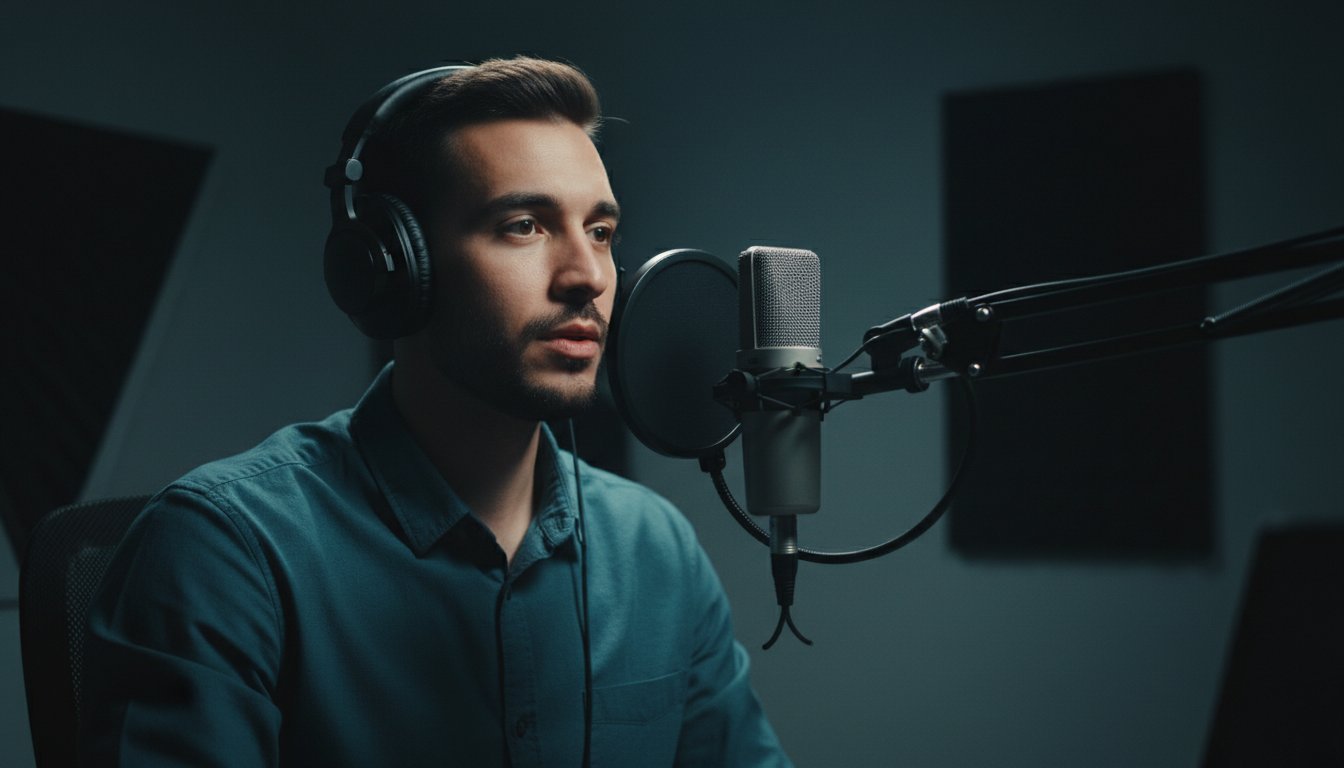
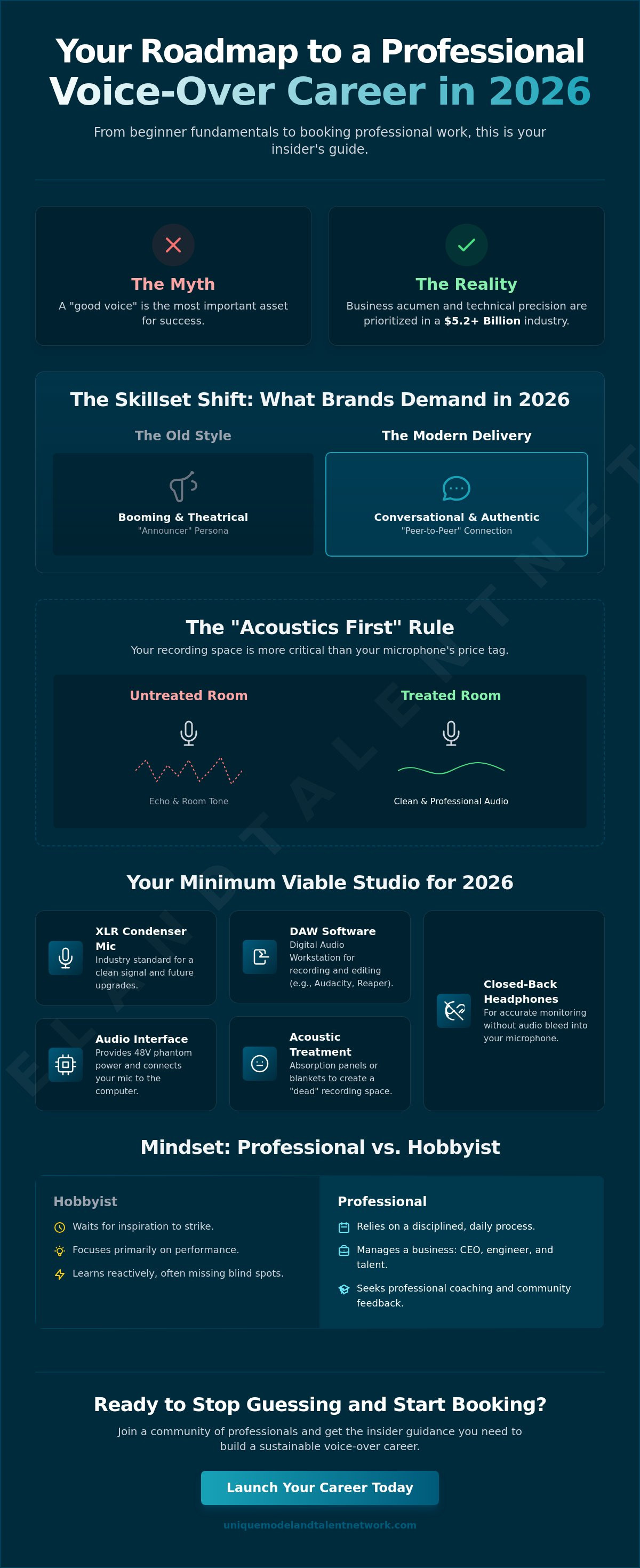
A "good voice" is actually the least important asset in a professional voice actor's toolkit. While most people think a pleasant tone is the key to success, the U.S. voiceover industry generates over $5.2 billion in revenue by prioritizing business acumen and technical precision over raw talent. If you're looking for voice over for beginners, you've likely felt the sting of technical jargon or the fear of predatory scams that target newcomers. It's exhausting to figure this out alone, especially when you're unsure if your home setup meets the high standards of a 2026 production house.
You don't have to guess your way through the noise. This guide provides the exact roadmap to launch your career with the authority of an industry insider. We'll show you how to build a broadcast-ready studio for as little as $150, master the vocal exercises that top pros use to stay competitive, and identify legitimate casting calls that pay fair rates. By the end of this article, you'll have a clear checklist to move from an isolated hobbyist to a respected professional in a growing market.
Key Takeaways
- Master the shift from traditional announcer styles to the modern conversational delivery that brands demand in 2026.
- Learn why acoustic room treatment is more critical to your professional sound than the price tag on your microphone.
- Discover how professional coaching identifies performance blind spots that DIY learning misses, protecting you from recording a premature demo.
- Navigate the 2026 casting landscape by identifying high-value, legitimate platforms while avoiding predatory scams.
- Understand how voice over for beginners transitions into a sustainable career through private networking and community advocacy.
Beyond the Mic: What Voice Over for Beginners Really Entails
Success in this field requires a fundamental mindset shift. You aren't just reading words off a page; you're solving a client's communication problem through performance. Entering the world of voice over for beginners means more than just buying a microphone; it means launching a performance-based business where you are the CEO, the engineer, and the talent. The technical art of Voice-over involves specific techniques that bridge the gap between simple speech and professional storytelling.
The industry has moved away from the booming, theatrical "announcer" persona of previous decades. Modern brands demand a conversational, authentic delivery that sounds like a peer talking to a friend. If you can't drop the artifice and speak naturally, you'll struggle to book work in 2026. This shift applies across the primary industry niches:
- Commercial: Selling products through relatable, everyday characters.
- Animation: Bringing distinct personalities to life with consistent vocal choices.
- Narration: Guiding listeners through documentaries or corporate videos with clarity.
- E-learning: Maintaining engagement over long, instructional scripts.
A professional standards approach separates the successful from the hobbyists. While a hobbyist waits for "inspiration," a professional relies on a disciplined process. This includes meeting strict delivery deadlines, providing clean audio files, and maintaining a consistent vocal quality that clients can rely on for future projects.
The Reality of the Modern VO Market
AI technology has automated some entry-level tasks, but this has created a "quality rebellion" among high-end brands. Clients now seek human actors who can deliver emotional depth and nuance that algorithms cannot replicate. Versatility is your best defense against automation. You must understand "spec" (the specific requirements of a job) and "tone" (the emotional atmosphere of the script). If you can pivot your performance based on a casting director's notes during our Live Industry Workshops, you become an indispensable asset.
Vocal Health and Performance Basics
Your voice is a physical instrument that requires a daily maintenance routine. Professional actors use a consistent warm-up to prevent strain and ensure they can perform for hours without fatigue. You also need to identify your "vocal archetype." This isn't just about your pitch; it's about identifying the natural authority, warmth, or energy your voice naturally conveys. Once you stop "reading" a script and start "interpreting" the character's intent, your booking rate will climb. We focus on these distinctions during our Monthly Skill-Building Challenges to help you find your unique professional lane.
Setting Up for Success: Essential Equipment and Home Studio Basics
The most common mistake in voice over for beginners is prioritizing the microphone over the room. If your recording space has echoes or a high "room tone," even a high-end Neumann won't save your session. Professional audio relies on the Acoustics First rule. You must neutralize your environment before you worry about your signal chain. This doesn't mean building a $10,000 booth. It means understanding how sound waves bounce off hard surfaces and learning how to absorb them effectively to create a dead recording environment.
Choosing your hardware setup is your next hurdle. While USB microphones have improved, the industry standard for 2026 remains the XLR connection. XLR setups provide a cleaner signal and allow you to upgrade individual components without replacing your entire system. You'll also need a Digital Audio Workstation (DAW) to record and edit your work. Options like Reaper, Audacity, or Adobe Audition are excellent starting points. For those wanting to supplement their technical setup with deeper industry context, checking out resources like The Best Books on Voice Acting can help you understand the performance standards required within these technical constraints.
A Minimum Viable Studio for a professional 2026 home setup includes:
- A large-diaphragm condenser microphone
- A dedicated audio interface with 48V phantom power
- Closed-back studio headphones for accurate monitoring
- A stable DAW for recording and basic mastering
- Basic acoustic absorption treatment
Microphones and Interfaces: Making the Right Investment
Don't fall into the trap of overspending on "pro" gear too early. Reliable XLR microphones like the Audio-Technica AT2020 or the Rode NT1 provide exceptional clarity for their price point. An audio interface acts as the bridge between your mic and your computer, converting your analog voice into high-resolution digital data. If you're unsure if your current audio quality meets professional standards, our Portfolio & Reel Reviews can provide the objective feedback you need to avoid costly gear mistakes.
Sound Treatment on a Budget
You must distinguish between soundproofing and acoustic treatment. Soundproofing stops outside noise from entering; acoustic treatment stops your voice from bouncing around inside. You can achieve professional results in a walk-in closet by using heavy moving blankets, pillows, and clothing to dampen reflections. To test your noise floor, record 10 seconds of silence in your space. If the meters stay below -60dB, you're in the professional range. If they're higher, you have more work to do before submitting to major casting calls.
The Skillset Shift: Why Professional Coaching Trumps DIY Learning
Listening to your own recorded voice is a flawed metric for success. Because your brain compensates for your own speech patterns, you're biologically incapable of hearing your own performance blind spots. In the journey of voice over for beginners, a professional coach acts as your external "mental mirror," identifying the subtle mouth clicks, pacing issues, or lack of emotional range that would otherwise trigger an immediate rejection from a casting director. You cannot fix what you cannot hear.
The most dangerous trap for newcomers is the "DIY Demo." Attempting to record your own reel before you've mastered performance techniques is the fastest way to burn bridges with industry gatekeepers. A professional reel is a high-stakes marketing tool, not a home project. To avoid predatory "pay-to-play" coaching scams, vet potential mentors by checking their active industry credits and ensuring their curriculum aligns with current 2026 standards. Integrating specific VO coaching into a broader strategy of acting workshops online ensures you develop the foundational performance skills that transcend simple vocal mechanics.
Performance Coaching vs. Technical Coaching
Professional development is a two-front battle. Performance coaching focuses on script analysis, character development, and finding the "why" behind every line. Technical coaching, conversely, masters the physicalities of mic technique and "acting for the ear." You need both to succeed. Receiving real-time feedback during our Live Industry Workshops accelerates your learning curve by months, allowing you to correct habits in a controlled environment before you step into a high-pressure session.
Preparing for Your First Professional Demo
A winning beginner demo in 2026 is concise, high-energy, and strategically segmented. You don't need one reel; you need a suite of reels tailored to specific niches. A commercial reel should showcase your range of conversational tones, while a gaming reel must demonstrate character consistency and vocal combat stamina. You are truly "ready" to record only when a neutral professional confirms your performance is indistinguishable from current top-tier talent. If you're questioning your readiness, our Portfolio & Reel Reviews provide the objective analysis required to protect your professional reputation.
Booking Your First Gigs: Navigating the 2026 Casting Landscape
You've built the studio and honed the craft. Now comes the transition from student to professional business owner. Booking work in voice over for beginners requires a strategic approach to the digital marketplace. It's not about applying to every job you see; it's about applying to the right jobs with surgical precision. The 2026 landscape is fast-paced, and your ability to navigate it determines your career's longevity.
Your first step is identifying legitimate casting websites that prioritize talent protection over high membership fees. Once you've selected your platforms, your profile becomes your digital storefront. It must be optimized with searchable tags that reflect your vocal archetype, such as "warm narrator" or "energetic millennial," rather than generic descriptions. Casting directors use these filters to find talent in seconds. If your profile isn't optimized, you're invisible.
Audition speed is a critical factor in your success. In the current market, the first 50 submissions often receive the most attention. You must master the art of the "fast audition" by having your recording chain ready at a moment's notice. This doesn't mean rushing the performance. It means having a workflow that allows you to deliver high-quality audio within minutes of a posting. Once you book a job, focus on building a relationship. Professional follow-ups and delivering files ahead of schedule turn one-off gigs into recurring revenue. Eventually, you'll transition toward direct marketing, where you reach out to production houses and creative agencies to bypass third-party platforms entirely.
Avoiding the 'Pay-to-Play' Trap
Distinguishing between reputable sites and predatory platforms is a vital survival skill. Legitimate sites often use an Escrow system, which holds the client's payment in a neutral account until you deliver the files. This ensures you actually get paid for your labor. If a site demands high annual fees but offers no payment protection or client vetting, it's a red flag. Don't ignore local networking either. Small businesses in your own city often prefer working with local talent, providing a less competitive entry point than global platforms.
The Professionalism of Submissions
Your submission is your first "job" for that client. Follow industry-standard naming conventions, such as "Name_Project_Take01.wav," to prove you understand the technical workflow. Your cover letter should be concise and benefit-driven. Instead of saying you're "excited to try," state clearly that you have provided the specific tone requested in the brief. If you don't book the gig, use it as data. Analyze your "listen rate" to see if your demo is even being heard, or if you need to adjust your performance style. To refine your submission strategy with expert guidance, consider joining The Network Membership for ongoing professional support.
Joining the Inner Circle: How Professional Networking Fuels VO Growth
The final stage of your professional roadmap isn't just about booking a single job; it's about sustaining a career through strategic relationships. Voice over is a notoriously isolated profession. Spending hours inside a soundproof booth can lead to creative stagnation and professional burnout if you don't have a reliable support system. For those navigating voice over for beginners, finding a community is the primary antidote to the isolation of solo work. A private network provides the clarity and direction that public forums simply cannot offer.
Many high-value opportunities never reach the public casting platforms discussed in previous sections. Instead, they circulate within trusted circles where professional standards are a verified quantity. By joining a gated environment, you gain access to these unlisted casting opportunities and the peer reviews necessary to keep your performance sharp. The Unique Model & Talent Network acts as the definitive bridge between your initial training and your first major booking. It surrounds you with mentors and peers who focus on tangible success rather than industry gossip.
Direct Access to Industry Experts
Stop relying on social media "experts" who lack current industry credits. Our Industry Expert Q&A Sessions offer direct dialogue with the casting directors and producers who actually hire talent. You can receive objective feedback on your materials through our Portfolio & Reel Reviews, ensuring your digital storefront is ready for elite scrutiny. This vetted, actionable advice is the difference between guessing your way through the market and growing with precision. When you receive insights from working professionals, your learning curve accelerates significantly.
The Power of the Private Community
A gated network removes the noise of external platforms and replaces it with career-centric focus. You can find accountability partners for daily practice or join peer-led groups to workshop scripts before a high-stakes audition. This sense of shared ownership and prestige helps you build a professional brand that commands respect. Within our community, you can participate in Monthly Skill-Building Challenges that push your range and keep your skills relevant to 2026 standards. When you are part of a network that values integrity and efficiency, you stop being a hobbyist and finally become an industry insider.
Take Control of Your Voice-Over Future
Launching a career in the 2026 market requires more than a microphone; it demands a business-first mindset and a commitment to professional standards. You've learned that neutralizing your recording environment is more vital than buying expensive gear, and that a professional ear is necessary to identify the performance blind spots that hinder your growth. The transition from voice over for beginners to a sustainable career happens when you stop guessing and start following a vetted roadmap.
Success in this industry is rarely a solo achievement. It's built through direct access to casting directors, monthly skill-building challenges, and the support of a high-standard community. By moving away from the noise of public social media and into a focused professional network, you protect your career from predatory scams and isolation. Join The Network Membership to accelerate your voice over career today. You have the talent and the roadmap. Now, it's time to step into the inner circle and claim your place in the professional landscape.
Frequently Asked Questions
How do I start voice acting with no experience?
You begin by shifting your mindset from "having a good voice" to running a performance-based business. Start with research into different niches like e-learning or commercial work and identify your natural vocal archetype. You don't need a professional background, but you must invest in performance training through workshops to understand script analysis before you ever approach a casting director.
What equipment do I need for voice over for beginners?
A functional beginner setup in 2026 typically costs between $150 and $300. This essential kit includes a large-diaphragm condenser microphone, an audio interface with phantom power, and closed-back studio headphones. You also need a computer equipped with a Digital Audio Workstation (DAW) like Reaper or Audacity to record and edit your sessions to professional standards.
Do I need a professional demo right away?
No, recording a demo prematurely is a strategic mistake that can damage your reputation with industry gatekeepers. You should only record a professional reel once your performance is indistinguishable from top-tier talent. A "DIY" demo often signals a lack of professional standards, so wait until a neutral coach confirms you're ready for the investment.
How much do beginner voice actors make in 2026?
Non-union beginners typically charge between $50 and $100 per hour or per project for entry-level work. As you gain experience and move toward union-standard contracts, the rates increase significantly. For example, the 2026 day rate for interactive media is $1,134.95 for a 4-hour session. Your total income depends on your ability to market directly to clients.
Is voice acting a stable career for beginners?
Stability in this industry is a product of business diversification and consistent networking rather than luck. With freelance talent making up 78% of the workforce in 2023, you must act as your own marketing department. The global market is projected to reach $7.8 billion by 2028, providing a massive landscape for those who treat voice over for beginners as a serious professional pursuit.
How do I avoid voice over scams and predatory sites?
You avoid scams by prioritizing platforms that use Escrow payment systems to protect your earnings. Be wary of sites that demand high annual fees without vetting their clients or offering payment guarantees. Joining a private, gated community is the most effective way to stay informed about which platforms are legitimate and which are predatory.
Can I do voice over work from home without a booth?
Yes, you can record professional-grade audio in a walk-in closet or a room treated with heavy acoustic absorption. You don't need an expensive booth as long as your noise floor remains below -60dB. Using DIY solutions like moving blankets and pillows can neutralize room reflections effectively enough to meet the standards of most casting directors.
How long does it take to get your first paid VO gig?
The timeline for your first booking depends on the quality of your training and your technical setup. Many professionals spend between 3 and 6 months in the research and skill-building phase before they are ready to audition. Focus on the precision of your submissions rather than the volume to decrease the time it takes to land your first contract.


